
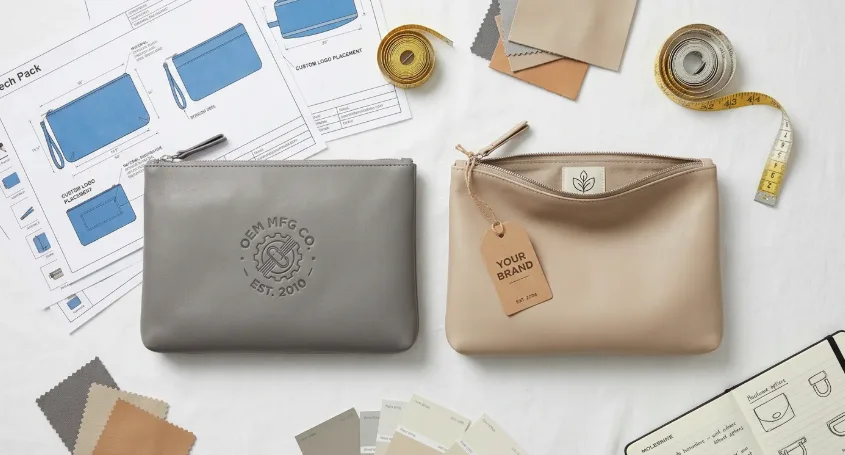
What Are OEM Custom Clutch Bags?
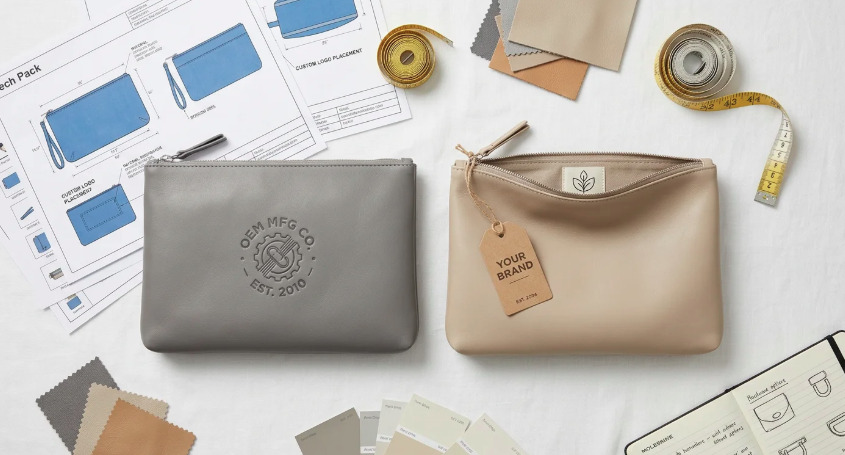
OEM stands for Original Equipment Manufacturer — but in the clutch bag world, it means something more specific: you own the design, and the factory builds it.
With OEM custom clutch bags, your brand supplies the complete design package. The factory’s job is execution — reproducing your specifications at scale, to the letter. Design IP stays with you. The factory cannot sell that same style to anyone else.
This is a different starting point from picking a ready-made style off a factory catalog. The difference is total.
What “Complete Design” Really Means
OEM bag production runs on a tech pack — a full technical document with no room for guesswork. A solid clutch bag tech pack includes:
-
BOM (Bill of Materials): Every component listed with exact specs — fabric weight, zipper brand (YKK or equivalent), hardware finish codes, lining material
-
Measurement table: Precise dimensions with set tolerances (±2 mm on body length/width, ±1 mm on seam spacing). Standard evening clutch dimensions run 20–26 cm long, 10–14 cm high, 3–6 cm deep
-
Construction drawings: Flat pattern layouts, cross-section views, seam allowances (5–10 mm standard), interior pocket placement
-
Stitch specifications: Stitch density (3–4 mm pitch), thread weight (20s/30s), reinforcement points at corners and openings
-
Logo artwork placement: Exact dimensions, edge distances, and finish method (debossing, foil stamping, hardware badge)
A complete tech pack means fewer surprises in production. Gaps in your specs become problems on the production floor.
From Submission to Mass Production
A standard OEM clutch bag workflow follows this path:
-
Brand submits design files, samples, or CAD drawings with full specs
-
Factory produces a first prototype in 5–7 days
-
One to two revision rounds refine fit, structure, and hardware
-
Pre-production (PP) sample locks final BOM and packaging
-
Mass production begins after PP sample sign-off — typical lead time: 30–45 days
MOQ for OEM custom clutch bags starts at 100–500 units in most cases. More complex builds — structured hard-shell frames, hand-inlaid detailing, genuine leather — push that up to 300–500+ units minimum. High-end specialty pieces can reach 1,000 units.
OEM vs. ODM: Where the Line Falls
This is where most buyers get confused.
|
OEM |
ODM |
|
|---|---|---|
|
Design origin |
Brand-owned |
Factory-owned |
|
IP ownership |
Brand |
Factory |
|
Customization depth |
Full structural control |
Logo + colorway only |
|
Exclusivity |
Yes — factory cannot resell your style |
No — same base pattern sold to others |
A practical rule: Changing colors, materials, or adding a logo to an existing factory style — that’s ODM. Specifying dimensions, interior layout, hardware placement, and structural form — that’s OEM.
The contract side matters just as much as the design side. A proper OEM agreement states clearly that design files, patterns, and tooling belong to your brand. The factory cannot reproduce your style for other clients. Any structural improvements the factory suggests during development stay inside your OEM project. They do not get shared with third parties.
What Are Private Label Clutch Bags?
Private label clutch bags flip the design equation. The factory already has the bag. You bring the brand.
A third-party manufacturer produces a clutch from their existing catalog. You pick the base design, add your logo, choose your colorway, and select your lining or hardware finish. The factory then produces it under your brand name. You’re not building a bag from scratch. You’re building a brand around a bag that already exists.
What You Can — and Can’t — Control
Private label has a hard boundary most buyers don’t expect.
Yours to customize:
– Logo placement and branding method (embossing, printed label, hardware badge)
– Exterior color and lining fabric
– Hardware finish (gold, silver, antique brass)
– Zipper pulls, magnetic closures, chain straps
– Packaging and retail tags
Factory-controlled:
– Core silhouette and internal construction
– Base pattern and structural design rights
– The overall shape that made you pick it in the first place
That last point matters. The factory owns the base design. So they can sell the same structure to other buyers too. Your brand identity lives in the finish — not the form.
White Label vs. Private Label: Not the Same Thing
White label clutch bags are generic, unbranded products. Multiple buyers get the same product with little to no changes. Private label goes further — more customization, stronger brand expression. But both start from the factory’s existing design library. Neither starts from your original concept.
OEM vs. Private Label Clutch Bags: Core Differences at a Glance
Six dimensions. That’s all it takes to separate these two models.
Put them side by side. The contrast is clear — not just in terminology, but in how your business runs, what you spend, and what you own at the end.
|
Dimension |
OEM Custom Clutch Bags |
Private Label Clutch Bags |
|---|---|---|
|
Design Origin |
You supply the full tech pack — structure, dimensions, hardware, lining layout. The factory builds to your spec. |
The factory supplies the base style. You pick from their catalog and customize the finish. |
|
IP Ownership |
Design and structure IP belong to your brand. The factory cannot resell your style. |
Base pattern IP stays with the factory. You own your logo and brand elements — nothing more. |
|
Customization Depth |
Full structural control — silhouette, closure type, interior layout, hardware placement, custom tooling. |
Surface-level changes only — color, material grade, hardware finish, logo, packaging. The core shape stays fixed. |
|
Exclusivity |
High. A contract can lock your style to your brand by region or across markets. |
Low to medium. The same base pattern sells to multiple buyers. Regional exclusivity often needs a higher MOQ. |
|
MOQ (per color/style) |
500–1,000 units is standard. Complex or high-end builds: 1,000–5,000+ |
100–300 units is standard. Some factories accept 200–500 for simple logo versions. |
|
Time to Market |
3–6 months (pattern development → sampling → tooling → mass production) |
1–2 months (style selection → logo confirmation → small-batch production) |
|
Upfront Development Cost |
$200–$1,000+ per style for pattern development. Custom hardware tooling: $300–$5,000+ per set. |
$50–$300 for logo plates or printing dies. Often waived at MOQ. |
|
Unit Cost vs. Equal Quality |
15–30% higher than private label. Development costs spread across your order alone. |
10–25% lower. Development costs spread across many buyers over time. |
|
Risk Level |
Higher sunk cost exposure. A market failure means tooling and patterns go to waste. |
Lower financial risk. You can switch styles fast without losing structural development investment. |
|
Best Fit |
Established brands with proven sales channels, clear positioning, and a long-term product line strategy. |
Early-stage brands, new market testing, social commerce sellers running small-batch style validation. |
The short version: OEM means you bring the design, own the IP, and control everything — at higher cost and longer lead times. Private label means you brand what already exists — faster, cheaper, but with less control and no structural exclusivity.
Neither model is better by default. The right choice depends on where your brand stands right now.
Customization Depth: How Different Are They?
The surface looks similar. Both models let you pick colors, add your logo, and choose a hardware finish. That’s where the similarity ends.
The real dividing line isn’t aesthetic — it’s structural. OEM custom clutch bags give you control over geometry, internal structure, hardware tooling, and functional systems. Private label stops at the surface layer. The bag’s core stays the same as the factory built it.
What “Deep Customization” Means in OEM
With OEM bag production, you’re not decorating an existing product. You’re building a new one from the ground up. The customization scope covers:
-
Structural form — bag shape, silhouette dimensions, closure path, load-bearing points
-
Interior layout — partition count, hidden compartments, layered inner frames
-
Hardware tooling — custom zipper pulls, magnetic closures, alloy fasteners built to your spec, not pulled from stock
-
Functional systems — RFID-shielded inner layers built into a dedicated compartment, not just a material swap
-
Packaging development — folded into the same production workflow, not added at the end
A magnetic closure system makes a clear example. Swapping the surface finish on an existing magnet? That’s private label territory. Designing the snap position, pull strength, opening path, and structural attachment point so they all work together? That’s OEM-level development. It needs pattern rework, production coordination, and sample sign-off before a single unit goes into production.
Private Label’s Hard Ceiling
Private label handbag manufacturing covers logo, colorway, partial fabric changes, and hardware finish. The silhouette, interior layout, and structural design stay with the factory. You can’t touch that structure.
The practical test: A change that affects visual identity — private label handles it. A change that touches load distribution, compartment function, closure mechanics, or hardware interfaces — you need OEM.
Three questions to ask any clutch bag supplier before signing:
-
Can you produce independent tooling for custom hardware and structural components?
-
Can you modify the inner lining structure and partition layout — not just swap fabric colors?
-
Do you require a tech pack and sample sign-off before MOQ confirmation?
A supplier who answers yes to all three is operating at true OEM depth. Anything less is closer to white label clutch bag production with a branding layer on top.
IP Ownership & Brand Exclusivity: The Risk Most Buyers Overlook
Most buyers focus on price and lead time. They sort out MOQ, negotiate per-unit cost, confirm the sample — and then sign. What they don’t check is who owns the product they just built their brand around.
This is where the OEM vs. private label distinction stops being theoretical and starts costing real money.
What You Own (And What You Don’t)
Under a standard private label arrangement, the IP split looks like this:
-
Factory owns: The base design, structural pattern, mold, core construction, and any proprietary manufacturing techniques used to produce the bag
-
You own: Your registered trademark, logo, packaging design, and marketing materials — nothing more
So the same factory can take that exact clutch silhouette, swap the label, tweak the colorway, and sell it to ten other buyers tomorrow. There’s nothing stopping them. You can protect your logo. You cannot protect the bag itself.
OEM custom clutch bags work a different way. You provide the design. You control the tooling. A well-structured OEM contract states that all design files, patterns, structural drawings, and molds belong to your brand — not the factory. They build it. You own it.
The Hidden Damage Private Label Does to Premium Brands
The IP gap isn’t just an abstract concern. It follows a clear pattern of damage for brands trying to hold a premium price point.
Price erosion happens fast. Your factory may supply the same base structure to mid-market and budget brands at 30–50% of your retail price. Your target customer will find it. Once they do, holding a 2–3x price premium on what looks like the same product becomes close to impossible.
Distributors cut orders or demand discounts. A distribution partner spots the same clutch bag on a low-cost channel. Their response usually comes down to two options: reduce their purchase commitment or push for a 20–40% margin concession. Either way, your unit economics take a direct hit.
The factory’s own brand benefits from your work. This one is less visible but does real damage over time. Factories running private label programs often use the same molds and supply chains to build their own direct-to-consumer brands on e-commerce platforms. Your product testing, content production, and market education end up validating their competing SKU — which then launches at cost price. In most cases, that competing product shows up within 6–12 months of your market entry.
What’s Missing From Most Private Label Contracts
The contract gap is where the real risk lives. A standard private label clutch bag agreement covers:
-
Product specifications, pricing, delivery schedule, and quality standards
-
Permission to use your trademark on the packaging
What it almost never includes:
-
Any clause defining who owns the structural design IP (default: the factory)
-
Any restriction on the factory selling the same base style to other buyers
-
Any prohibition on using the mold for other clients’ products
Brands that customize packaging and pick a unique colorway often believe they have an exclusive product. What they have is exclusive branding on a non-exclusive structure. The core asset — the bag itself — stays open to any buyer who asks the factory.
OEM Contracts That Protect You
Going the OEM route means your contract needs to cover three separate layers:
1. NNN Agreement (Non-Disclosure / Non-Use / Non-Circumvention)
Use this before sharing any design files with a factory. Key provisions:
-
Confidentiality scope covers all protected information: CAD drawings, BOM, mold structures, cost breakdowns, sampling results — with a protection period of 5–10 years minimum, or tied to the product lifecycle
-
Non-use clause stops the factory from applying your design, tooling, or technical data to produce the same or similar products for any other client
-
Non-circumvention clause blocks the factory from going to your distributors, retail partners, or platform stores with competing products — and prohibits them from registering any trademark, design patent, or utility model based on your IP
-
Penalty structure tied to order volume: violation damages of 20–50% of annual purchase value per incident, with the right to seek an immediate injunction and production halt
2. Tooling & Mold Ownership Clause
Every mold, fixture, and custom hardware die your brand paid for — even partially — should belong to you by contract. Key terms:
-
Molds belong to the brand; the factory holds a limited production license for your orders only
-
Factory must return molds within 7–30 days of a written request — no exceptions
-
Any use of your molds for third-party production is a material breach
-
At contract end: the factory provides photo and video documentation of mold destruction, or transfers physical custody to your designated warehouse
3. Exclusive Manufacturing Agreement
Exclusivity needs a precise definition. Broad language creates loopholes.
-
Define the exclusive product scope by SKU list, technical drawing numbers, and design references — not by generic category description
-
Specify the channels and markets covered (e.g., North America, EU, Amazon marketplace)
-
Tie exclusivity to a minimum annual purchase commitment — standard terms run 2–5 years, with renewal conditions linked to volume targets
-
Require the factory to notify you in writing if any third party approaches them about producing the same or similar product
The Pre-Signing IP Checklist
Before signing any clutch bag supplier agreement — OEM or private label — confirm the following:
|
IP Area |
What to Confirm |
|---|---|
|
Background IP |
Factory’s pre-existing designs and tooling — define the scope, make sure they’re licensed (not transferred) for your product only |
|
Foreground IP |
Any new designs, improvements, or structural changes created during the project — assign these to your brand, or get an exclusive license |
|
Mold ownership |
Who paid for it, who holds title, and who controls its use after the contract ends |
|
Same-style restrictions |
Explicit clause stopping the factory from selling the same structural design to other buyers |
|
Factory’s own brand clause |
Prohibition on the factory launching competing products based on your design, mold, or development work |
One question cuts through most of the ambiguity: “If I end this relationship tomorrow, can you sell this exact bag to someone else?” A factory under a proper OEM IP framework should answer no — and show you the contract clause that makes it so.
Cost & MOQ Breakdown: What’s the Real Investment?
Numbers tell the story faster than theory. Here’s the core formula for both models:
Total Investment = Upfront One-Time Costs + Unit Price × Order Quantity + Logistics/Misc
The difference between OEM and private label isn’t just which number is bigger — it’s where the money goes.
OEM Custom Clutch Bags: Where Your Budget Goes
OEM front-end costs split into three buckets before a single unit ships:
Pattern & structural development: Budget $1,100–$4,200 per style for mid-range clutch bag development. This covers structure verification, die-cut drawings, and white sample testing. Full brand identity plus structural design from an established design firm runs $7,000–$21,000+. That range suits established brands scaling a product line — not first-time launches.
Tooling & mold fees: A custom metal logo badge plus one structural die set runs $700–$4,200, depending on complexity. Add custom hardware — zipper pulls, alloy closures, proprietary fasteners — and total tooling can climb to $7,000–$14,000+ for a full hardware suite.
Sampling: Standard clutch bag prototypes cost $30–$60 per sample. High-difficulty genuine leather builds push that to $70–$210 per piece. Factories credit sample costs against your production order in most cases.
The MOQ math that changes everything:
One fixed development cost produces very different effective unit prices at different order volumes:
|
Order Quantity |
Fixed Cost Example |
Base Unit Cost |
Effective Unit Cost |
|---|---|---|---|
|
100 units |
$2,800 |
$8.40 |
$36.40 |
|
1,000 units |
$2,800 |
$8.40 |
$11.20 |
|
5,000 units |
$2,800 |
$8.40 |
$8.96 |
At low volumes, fixed development costs eat into your per-unit economics. At scale, you get close to true material-plus-labor cost. OEM makes financial sense once your sales channel is proven — not before.
Private Label Clutch Bags: Lower Entry, Different Trade-Off
Private label cuts the development line completely. No structural design fees. No tooling investment. Your upfront costs shrink to:
-
Logo plate / printing die: $40–$210 depending on application method
-
Per-unit branding add-on: embossed or foil-stamped logo at $0.15–$0.70/unit; metal badge attachment at $0.70–$2.80/unit
-
Samples: 1–3 units at catalog price; many suppliers waive this cost at MOQ
Typical private label MOQ and pricing:
-
PU clutch bags, small-batch private label: $8–$20/unit at MOQs of 50–200 pieces
-
Genuine leather, private label: $25–$80/unit
Compare that to OEM at volume: the same PU clutch can reach $5–$12/unit at 1,000+ pieces. The trade-off is real. Private label gives you a lower barrier to entry, but the factory controls the baseline price — not you. Plus, you get no structural IP to protect your product.
The honest summary: Private label means near-zero development risk. You pay a higher unit cost for that safety. OEM means more money on the table upfront. In return, unit economics improve with scale — and you get a product your competitors can’t copy off the same factory floor.
Time to Market: Launch Speed vs. Brand Depth Trade-off
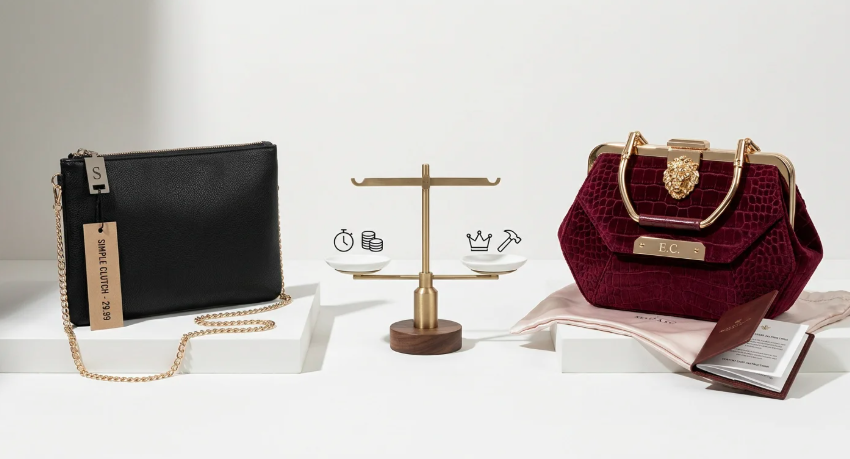
Speed and brand depth pull in opposite directions. The model you choose forces a trade-off between the two.
Private label gets you to market in 4–8 weeks. Pick a base clutch style from the supplier’s catalog. Confirm your logo and colorway. Run production, then ship. That’s it. OEM custom clutch bag production takes 3–6 months at minimum. Complex builds with custom hardware tooling can stretch to 5–7 months before a single unit moves.
Why the Gap Matters for Seasonal Launches
For wedding-season evening bags or holiday gift clutches, this timing difference is real and costly. It decides whether you catch the peak or miss it.
Planning for a November holiday launch?
-
Private label path: Start in September. Style confirmed by week 2, production done by week 6, stock arrives by week 8. You make the season.
-
OEM path: Design development needs to begin in March or April — six months out. Miss that window, and your inventory arrives after the holiday rush.
Wedding season follows the same logic. Private label started in January lands product by April, just before peak. OEM requires design kick-off the previous summer.
The Trade-off in Plain Terms
|
Situation |
Right Model |
|---|---|
|
Launch window ≤ 8 weeks |
Private label |
|
Testing a new style or market |
Private label |
|
Building a signature, long-term SKU |
OEM |
|
Planning 6–12 months ahead |
OEM |
Private label wins on speed. OEM wins on ownership. Neither wins on both.
Which Model Fits Your Business? A Practical Decision Guide
Your business stage, budget, and market target determine the right model. Personal preference doesn’t. Neither does what your competitor is doing.
Use this matrix to find your fit:
|
Business Stage |
Market Target |
Budget |
Best-Fit Model |
|---|---|---|---|
|
Startup |
Fast fashion / mid-market |
Low–mid |
Private label |
|
Startup |
Premium / luxury |
Mid–high |
OEM (with a clear hero concept; otherwise start with private label) |
|
Growth |
Fast fashion |
Mid |
Private label → selective OEM on proven SKUs |
|
Growth |
Mid-market |
Mid–high |
Hybrid — private label for breadth, OEM for margin expansion |
|
Growth / Mature |
Premium / luxury |
High |
OEM |
|
Mature |
Any |
High |
OEM core line + private label for assortment depth |
5 Signals You’re Ready for OEM
-
You need a feature, material, or construction standard that no catalog product can deliver
-
One hero SKU will anchor your brand identity and drive repeat purchase
-
You’re positioning at premium or luxury price points and need design exclusivity
-
Your value rests on proprietary fit, IP, or a technical edge competitors can’t copy
-
Demand is already proven — you can justify tooling costs and longer lead times
5 Signals Private Label Is the Right Move Now
-
You’re entering a new category or market and need fast demand validation
-
Your model is dropshipping or low-inventory — upfront risk needs to stay minimal
-
You’re chasing seasonal trends and need quick-turn SKUs
-
Capital is tight. A shorter time-to-launch matters more than having an exclusive product
-
You want a wide assortment to spot winners before committing to custom development
The Practical Path From Private Label to OEM
Most successful clutch bag brands don’t start with OEM. They earn their way into it.
-
Launch private label first — test 10–30 SKUs to identify real demand patterns
-
Track what wins — look at sell-through rate, repeat order rate, return rate, and contribution margin
-
Pick 1–3 top performers as OEM candidates. Do this after they show stable, repeatable demand
-
Upgrade your best SKU into OEM — lock in the fit, materials, packaging, and brand-specific details
-
Keep private label as a testing layer — OEM becomes your core margin and brand-building line
You get both sides with this approach. Private label gives you speed and discovery. OEM covers the products worth defending long-term.
The One-Line Decision Rule
Speed and validation? Private label. Differentiation and defensible margins? OEM. Both? Build a hybrid portfolio and move SKUs up as they prove themselves.
How to Evaluate a Custom Clutch Bag Manufacturer: OEM & Private Label Supplier Checklist
Finding a supplier is easy. Finding one who can deliver — on quality, timelines, and IP protection — is where most buyers get burned. Use this checklist before you sign anything.
For OEM Manufacturers
Design & Development Capability
– In-house structural pattern makers: ≥2 on staff is standard for a mid-size bag factory
– New style output: ≥100 styles/year signals genuine development capability. Under 30 styles/year means they’re executing other people’s ideas, not creating their own
– Request 3–5 complete tech pack samples from previous clutch bag projects. These should include flat patterns, BOM, and construction drawings
Sampling Standards
– First prototype turnaround: 5–10 days for PU/fabric clutches. Allow 10–20 days for structured leather or metal-frame builds
– Revision rounds to production-ready: ≤3 rounds at a capable factory. More than 5 rounds is a red flag
– Stitch density on finished exterior seams: 8–10 stitches per inch is the mid-to-premium standard
– Hardware pull strength at handle/wrist strap attachment points: ≥15–20 kg without thread failure
IP Protection Mechanisms
– Get a bilingual NDA plus an order-specific design ownership clause. It should cover both drawings and physical samples
– Design files should sit on encrypted servers with access-level controls. Open USB transfers are not acceptable
– Check for dedicated lockable storage for unreleased or exclusive styles. No-photography policies in the showroom are a good sign
Quality & Compliance
– ISO 9001:2015 certification — verify the issue date and certifying body
– BSCI, Sedex, or SA8000 for brands selling into Europe or North America
– LWG certification if genuine leather clutches are part of your order
– A three-stage inspection process should be in place: IQC (incoming materials) → IPQC (in-process checks) → FQC (100% visual + AQL functional sampling)
– Defect rate target: ≤5% per month. On-time delivery rate: ≥95%
– Zipper/magnetic closure cycle test: ≥3,000–5,000 open-close cycles without functional failure
For Private Label Suppliers
Catalog Depth
– Clutch and evening bag SKU count: 50–150 styles is typical for smaller suppliers. ≥300 styles points to a serious catalog-driven operation
– New additions per quarter: ≥20–30 SKUs, including color and material combinations. This shows real, ongoing product development
MOQ Flexibility
– Standard PU clutches: 100–300 units per style per color
– Special hardware finishes or heat transfer prints: 300–500 units minimum
– Trial order option: prioritize suppliers who allow 30–50 units at a premium or sample-fee offset. This lets you validate quality before committing to a full run
– Mixed-color runs: one style, 300 total units split across 3–5 colorways at 60–100 units each
Branding & Customization Range
– Logo application methods: look for at least 3 options — debossing, foil stamping, metal badge, embroidery, or screen print
– Packaging: ask for custom hangtags, inner labels, gift boxes, and barcode stickers quoted as one complete package
– Color matching: confirm they use Pantone-referenced dye matching for leather or fabric
– Compliance labeling: check whether they can add fiber content, country of origin, and care symbols for EU/US market requirements
5 Questions to Ask Any Supplier Before Committing
These questions work for both OEM and private label sourcing:
-
What’s your clutch bag production capacity per month, and what was your on-time delivery rate over the past 12 months?
Target answers: 10,000–30,000 units/month capacity; ≥95% on-time rate -
Which markets and price segments have you produced similar clutches for — and what were the return or complaint rates?
Look for: EU/US export experience, brand positioning match, and return rates ≤2–3% -
Can you share your quality KPIs — defect rate, rework rate, repeat order ratio — and provide the last 3 months of data?
Healthy benchmarks: defect rate ≤5%, repeat order ratio ≥25% -
Walk me through your standard timeline from design confirmation to first sample to mass production. What files do you need from us at each stage?
Expect: first sample in 5–10 days, bulk production in 25–45 days depending on complexity -
How does your contract handle IP ownership, third-party inspection, and penalties for late delivery or quality failures?
Non-negotiables: NDA, design ownership clause, third-party inspection rights (SGS/BV), staged payment terms (30% deposit / 40% mid-production / 30% at shipment)