
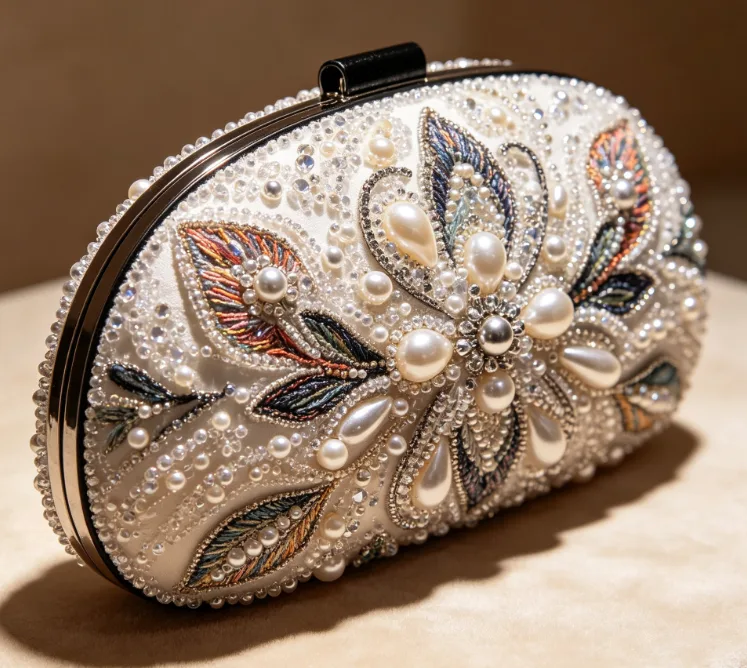
Why Clutch Construction Type Is a Brand Decision, Not Just a Style Choice
The structure of a clutch is a signal system — and your customers are already reading it.
A rigid metal frame signals ceremony, exclusivity, and visual drama. A soft clutch signals ease, tactility, and everyday relevance. Neither is better than the other. But picking the wrong one for your brand archetype has real consequences.
B2B buyers often misjudge this decision. They treat construction as a finishing detail. It’s not. Structure sets your viable price range, your minimum order quantities, and how your product holds up in the real moments your customers use it.
Go with rigid metal-frame construction, and you lock into an MSRP range that starts around US$150–500 for mid-luxury positioning. The tooling costs make that unavoidable. Go with soft construction, and you can open at US$40–150 with less upfront financial risk.
That’s not just a cost difference. It’s a completely different product strategy.
The real risk isn’t picking the “wrong” style — it’s choosing a structure that clashes with your brand’s core use-case. Then you absorb the MOQ, tooling, and inventory costs that follow.
Structure sits at the point where brand strategy and supply chain meet. Get that right first. Everything else builds from there.
What Is a Metal Frame Clutch Bag? Structure, Silhouette & Signature Appeal
The metal frame clutch has one defining characteristic: it holds its shape whether you’re carrying it or not.
At the core of every rigid frame evening bag is a metal structure — a frame that runs along the top edge or the entire perimeter of the bag. This isn’t just decorative hardware. It’s the skeleton. It controls the silhouette, holds the closure mechanism, and gives the bag an architectural presence that soft construction can’t replicate.
The Anatomy of a Metal Frame
A standard frame has three functional components:
-
Main bars — two metal strips forming the front and back of the bag opening, sized to match the finished bag width (15–25 cm for evening clutches)
-
Side hinges — mechanical joints that let the bag open 70–110°, keeping the silhouette clean even at full open
-
Closure hardware — kiss-lock balls, snap clasps, or push-locks centered at the top, projecting 10–20 mm above the frame bar
That closure detail matters more than most buyers realize. It sits at eye level in every flat-lay, editorial shot, and tabletop moment. It’s the first thing a customer notices — and in minaudière bag design, it works like jewelry.
The frame itself is a 3–6 mm metal profile, attached to the fabric body through one of three methods:
-
Glue-in: Clean exterior finish, no visible stitching — needs overnight curing for full bond strength
-
Sew-in: Topstitched through perforations in the frame — stitch lines become part of the design
-
Screw-in: Fabric sits between frame and facing plate — allows adjustment and frame replacement
What Creates the Silhouette
The structured handbag design of a metal frame clutch depends on layered reinforcement, not just the frame alone. Manufacturers build this structure by combining:
-
Fusible interfacing + fleece layers on the outer fabric
-
Boxed corners sewn 19–25 mm from the corner point to create a flat base
-
Consistent 6–9 mm seam allowances for a symmetric shape
The result: a bag that holds a clean rectangular, trapezoidal, or box silhouette even when empty. Box clutch and minaudière bag formats land at 16–20 cm wide, 8–12 cm tall, and 3–6 cm deep. Compact by design — and that’s exactly the point.
The Visual Language of Metal Frame Hardware
Hardware-forward aesthetics are what give the metal frame clutch its luxury signal. Designers pick frame finishes — electroplated gold, polished silver, brushed gunmetal, or black nickel — to coordinate with evening jewelry, not standard handbag hardware. Some high-end frames go further, with crystal-encrusted edges using 2–4 mm rhinestones spaced along the perimeter. The structural element becomes an ornamental one.
Body coverings follow the same elevated standard: silk dupioni, satin, velvet, brocade, or full acrylic bead panels. Capacity stays minimal — phone, lipstick, cards. The luxury clutch bag design philosophy is straightforward: high visual impact, small physical footprint.
For brands building an evening or occasion-wear line, that trade-off is the whole point.
What Is a Soft Clutch Bag? Construction Variations & Brand Versatility
The soft clutch doesn’t hold its shape — and that’s the whole point.
A flexible clutch purse has no internal skeleton, unlike metal frame constructions. Shape comes from the shell material itself, a light fusible interfacing bonded to the lining, and basic seam reinforcement. Empty, it lies flat. Filled, it breathes and conforms. That pliability is a design feature, not a flaw.
Three Construction Types — and What Each Signals
Envelope clutch bag — A fold-over flap with a magnetic snap or hidden clasp. The flap panel has no hardware breaking up the surface. That makes it ideal for embossed logos, bold prints, or clean leather statements. This format is closely tied to evening bag construction at accessible price points.
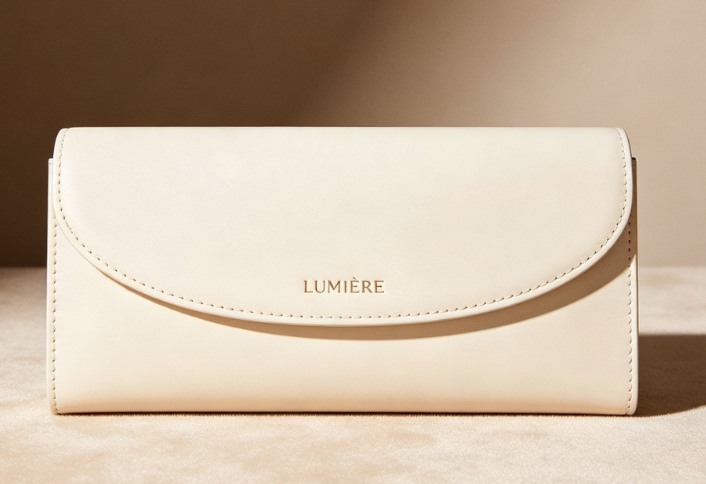
Pouch clutch — A top-zip soft body with a gusset depth of 3–5 cm. It collapses empty and expands with use. Clean, modern, and the easiest format to scale across multiple colorways from a single base pattern.
Fold-over clutch — A rectangular pouch folded in half. No frame holds the crease in place, so the fold line shifts with the contents. That movement signals softness and ease at a glance. This format works well for casual-to-evening crossover positioning.
Why Soft Construction Wins on Brand Flexibility
Soft construction has one major advantage for clutch bag manufacturing at scale: a single base pattern can produce multiple SKUs. You just swap the shell fabric and surface treatment. No new tooling. No retooling costs.
That makes it the go-to choice for:
-
Fast-fashion labels running seasonal color and print rotations
-
Artist collaboration drops using digital prints on canvas or jersey bodies
-
Gift and promotional brands needing logo-forward panels with low MOQ entry points
Surface area plays a big role here. Without a rigid frame cutting across the front panel, branding can cover 30–70% of the face through embossing (0.2–0.5 mm depth on leather/PU), embroidery, or screen print — with zero impact on structure. For logo-driven brands, that’s a real design edge over the metal frame format.
Material Range and Hardware Logic
Clutch bag material comparison for soft formats focuses on flexibility and surface compatibility:
|
Material |
Key Benefit |
Best Surface Treatment |
|---|---|---|
|
Full-grain / PU leather (1.0–1.4 mm) |
Fold-friendly, durable |
Emboss, deboss |
|
Suede / velvet |
Soft handfeel, muted edges |
Embroidery, heat-transfer |
|
Canvas / cotton |
Easy to cut and print |
Screen print, digital print |
|
Satin / jute |
Sheen or sustainability signal |
Minimal print or plain |
Hardware stays minimal by design — one zipper or one to two magnetic snaps, at most. No hinges, no kiss-locks, no corner protectors. The visual focus lands on material and surface design. That fits well with both clean minimal aesthetics and print-heavy branded clutch bag OEM programs.
Head-to-Head Comparison: Metal Frame Clutch vs Soft Clutch Across 8 Key Dimensions
Eight dimensions. Two construction types. One decision that shapes your entire product line.
The table below gives you the fast scan. The breakdowns that follow give you the reasoning behind each call.
|
Dimension |
Metal Frame Clutch |
Soft Clutch |
|---|---|---|
|
Structure |
Rigid geometric silhouette, holds shape when empty |
Flexible, conforms to contents |
|
Visual Style |
Structured, jewellery-forward, editorial-ready |
Soft lines, print/surface-driven |
|
Closure Mechanism |
Kiss-lock, snap clasp via metal hinge |
Zipper, magnetic snap, fold-over flap |
|
Best Occasion |
Evening, wedding, red-carpet, cocktail |
Daily, brunch, date night, travel |
|
Practical Capacity |
Minimal — phone, cards, lipstick |
15–30% more usable space at same exterior size |
|
Brand Perception |
Hero SKU, icon piece, luxury signal |
Volume SKU, seasonal driver, accessible entry |
|
Craft Complexity |
High — frame fitting, glue cure, QC alignment |
Moderate — standard sewing + hardware install |
|
Factory Cost Premium |
+20–40% vs comparable soft clutch |
Lower base cost, faster tooling turnaround |
How Each Dimension Plays Out in Practice
Structure. A rigid frame evening bag keeps a clean rectangular or trapezoidal silhouette through every season. Common frame widths run 18–30 cm. Gusset depth lands at 4–8 cm. A flexible clutch purse sits flat when empty and expands with use. Width falls in the 24–32 cm range, with 2–4 cm compressed depth. Building a signature icon piece? Rigid wins. Running quarterly SKU rotations? Flexible wins on speed.
Visual Style. Soft clutches give you 30–70% of the front surface for embossing, embroidery, or print. No structural compromise. Metal frame clutches pull visual attention straight to the frame — the finish, the kiss-lock hardware, the closure detail. That hardware sits at eye level in every flat-lay. It does the work of jewelry.
Closure Mechanism. The metal hinge system needs precise frame fitting. Fabric edges go into open metal channels, get glued, and clamp for 2–3 hours per side. Any misalignment at this stage hurts the open/close feel and cuts shelf life. Soft clutch closures — zippers, magnetic snaps — carry much lower QC risk. They also hold up better for high-frequency, everyday use.
Occasion Fit. Rigid frame evening bags lead in wedding, gala, and Middle Eastern and Asian bridal markets. Ceremonial accessories in these categories command premium placement. Soft clutches stretch across a wider range — from everyday commutes to semi-formal eveningwear. That broader use-case footprint drives year-round sell-through.
Practical Capacity. A rigid frame evening bag with a 22 cm frame width and 6 cm gusset holds a phone, small wallet, lipstick, and keys. That’s it. That’s by design. The soft clutch has no metal perimeter boxing in the interior. You get 15–30% more capacity at the same external measurement. Your product copy says “fits everything you need”? Soft construction backs that up. Rigid frame does not.
Brand Perception. Metal frame clutches sit in the hero SKU tier — campaign photography, KOL styling, brand archive pieces. Soft clutches work as volume SKUs: lower margin per unit, but faster turn and broader customer reach. Most mature clutch lines need both. The real question is which one leads.
Craft Complexity. Frame-fitting adds a full production step. The pattern must match the metal perimeter exactly. Factory workers mark hinge stop points to keep fabric and frame from conflicting. Seam allowances get trimmed after sewing to cut bulk before gluing. Per-unit labour time runs 15–30% higher than a comparable soft clutch. That added complexity is the right trade-off for a premium line — but it’s a real cost. Plan for it.
Cost Range. Metal frame hardware — frame profile, hinges, kiss-lock closure — adds real materials cost before a single stitch goes in. Add the extra assembly labour and stricter QC requirements, and factory ex-works pricing lands 20–40% above a soft clutch of the same size and material quality. Soft construction flips that equation. Lower base costs and simpler tooling make it the go-to choice for branded clutch bag OEM programs with tight MOQ thresholds or frequent colourway updates.
Bottom line: No single construction type wins across the board. Metal frame clutches justify their cost premium through brand positioning and visual authority. Soft clutches earn their place through scalability and commercial flexibility. The right answer comes down to where your brand sits — and where you’re trying to take it.
Craft & Manufacturing Differences: What Brands Need to Know Before Ordering
The cost gap between metal frame and soft clutch construction is real — and it shows up fast once you look at how each one gets made.
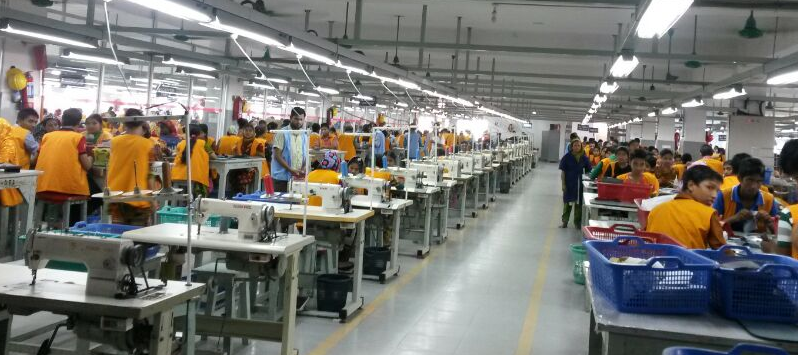
Metal frame clutch production runs through a multi-stage supply chain. Most soft-goods factories aren’t set up for it. The frame alone often needs custom tooling. Mold development runs USD 500–2,000 per style, depending on structure and alloy choice (zinc vs. brass). That cost hits before you cut a single piece of fabric.
Clutch bag manufacturing with a metal frame also demands tighter precision than soft construction. Pattern pieces must align with the metal perimeter to within ±0.5–1.0 mm. Leather grain direction plays a direct role here:
-
Crossgrain stretches
-
Straight grain holds firm
-
Bias cut falls somewhere between
Each grain behaves differently against a rigid frame. Get it wrong, and the bag won’t close right — or it loosens with use.
The two main fixing methods — crimping and screw fastening — both need dedicated tooling and hands-on engineering oversight. Crimping yield rates at mid-tier factories can fall below 90%. High-end operations hold 95–98% yield, but reaching that standard requires jig design capabilities most general sewing factories don’t keep in-house.
Soft clutch production runs on a different level entirely. Standard OEM factories — gift manufacturers, sportswear bag factories, general leather goods workshops — can handle soft construction without specialist support. Cut-and-sew tolerances sit at a workable ±2 mm. Closure hardware is straightforward:
-
A #5 nylon zipper costs USD 0.05–0.15 per piece
-
12–18 mm magnetic snaps are available off-the-shelf from any major hardware supplier
The supply chain differences are direct:
|
Metal Frame |
Soft Clutch |
|
|---|---|---|
|
First Sample Lead Time |
3–5 weeks (with new tooling) |
7–14 days |
|
Bulk Production Lead Time |
45–60 days |
30–45 days |
|
Typical MOQ |
500–1,000 pcs/style |
100–500 pcs/style |
|
Factory Pool |
Specialist frame bag factories only |
Broad — most OEM bag factories qualify |
Before ordering a rigid frame evening bag, ask your factory three specific questions:
-
Do they have in-house hardware development capability?
-
What is their crimping yield rate on metal frame bags?
-
Has their pattern team completed structural verification for metal-and-leather assembly?
These aren’t optional. The answers separate a clean first sample from four rounds of expensive revisions.
For branded clutch bag OEM programs on soft construction, your leverage point sits in the sourcing setup. Use factory stock materials and standard hardware to bring MOQ down to 100–300 pcs per style. Submit a complete tech pack with BOM upfront, and you can compress your sampling cycle to as few as 5–7 days.
Brand Positioning Matrix: Which Clutch Style Fits Which Brand DNA?
Brand DNA isn’t a tagline. It’s a set of structural commitments that shapes every product decision you make — including your clutch construction type.
The table below maps three primary brand archetypes to their natural clutch style fit. Use it as a reference point before you brief your factory.
|
Brand Archetype |
Primary Clutch Style |
SKU Ratio |
Typical Retail Range |
|---|---|---|---|
|
Luxury / Eveningwear |
Metal frame box clutch / minaudière |
60–80% hard frame |
US$800–3,000+ |
|
High-Street / Contemporary |
Soft clutch as base + 1–2 frame styles |
70–90% soft, 10–30% frame |
US$80–350 |
|
Fast Fashion |
All soft clutch, print and color rotation |
≥90% soft |
US$19.99–49.99 |
|
Corporate Gift / Events |
Depends on budget tier and distribution scale |
Varies |
US$6–150 (B2B cost) |
Luxury & Eveningwear Brands: Hard Frame as Hero
For brands in this tier, the metal frame box clutch isn’t one option among many. It’s the category anchor. Labels like Judith Leiber and Jimmy Choo evening lines carry 60–80% hard-frame styles across formal occasion assortments. Soft clutches sit in a secondary role — not core SKUs.
The construction specs back that up. A signature minaudière runs 15–20 cm wide and 8–12 cm tall. Frame thickness sits at 2–3 mm, with up to 800–2,500 crystal pieces per bag. Full embellishment brings total weight to 400–800 g. These aren’t accessories. They’re collectible objects. Average retail price lands at US$800–3,000, and Judith Leiber pieces can reach US$1,200–5,000.
The brand signal is clear: heirloom, red-carpet, rarity. Logo placement stays minimal — a logo plate no wider than 2 cm. The frame hardware and embellishment carry all the identity work.
High-Street & Contemporary Labels: Soft as Base, Frame as Capsule
Brands like Sandro, Maje, and Reiss build their clutch assortments on a split model. Soft clutches carry the volume — 70–90% of SKUs. Then 1–3 metal frame or acrylic box styles per season serve as campaign focal points or occasion capsules.
This ratio works for a practical reason. Soft construction handles trend rotation with far less friction. Envelope clutches in nappa or faux leather (1.0–1.4 mm thickness, width 26–30 cm) keep production flexible. Retail pricing stays accessible at US$80–250. Frame styles step up to US$150–350 and signal elevated positioning — without shifting the whole brand upmarket.
For product development, the sequence matters:
– Plan your frame styles first
– Shoot them for campaign imagery
– Then build out your soft clutch range to fill commercial volume
Fast Fashion: Construction Is Never the Differentiator
At this level, structural complexity works against you. Zara, H&M, and similar labels keep ≥90% of clutch SKUs in soft construction — pouch formats, wristlets, and simple envelope styles. Most are cut to ≤5 main pattern pieces to keep production tight.
The differentiator isn’t how the bag is built. It’s what’s on the surface. Color and print refresh cycles run every 4–6 weeks, with 2–4 new colorways per drop. Core neutral tones (black, nude, metallic) hold 30–40% of the range. Seasonal prints and trend colors fill the remaining 60–70%.
MOQ for private-label soft clutches in this segment runs 1,000–3,000 pcs per color through Asian OEM factories. Lead times sit at 45–75 days from sample approval. Hard frame styles almost never show up in these ranges. On the rare occasion they do, you’ll see 1–2 SKUs per region per season at US$35.99–69.99 — used as visual anchors, not volume drivers.
Corporate Gifts & Events: Match Construction to Distribution Scale
This segment runs on different logic. The decision isn’t about brand DNA in the traditional sense. It comes down to order size, perceived value, and retention intent.
Metal frame box clutch for premium gifting (50–300 pcs): High-value events — VIP dinners, anniversary milestones, limited brand collaborations — call for hard-frame construction. B2B unit cost runs US$70–150, with a perceived retail value of US$200–400. Custom laser-engraved logos (0.2–0.3 mm depth) on the frame side or kiss-lock closure lock in the “commemorative object” feel. Most specialist frame factories accept MOQs as low as 50 pcs, with sampling cycles of 10–20 days.
Soft clutch for large-scale branded gifting (500–10,000+ pcs): Conferences, staff gifts, and loyalty programs prioritize reach over rarity. Soft PU or fabric clutches with silk-screen or heat-transfer logos (≥40 cm² print area) bring B2B cost down to US$6–18 per unit. That’s a completely different financial model. Minimum orders start at 300–500 pcs. You can also split colors across a single logo version and merge them to hit ≥1,000 pcs for better unit pricing.
The short version: go rigid frame for gifts people will keep. Go soft construction for volume coverage — it’s the only path that makes the numbers work.
Cost, MOQ & Margin Reality Check for B2B Buyers
Brand enthusiasm is great. But the numbers are where supply chain reality hits — and most first-time clutch buyers don’t see it coming.
Metal frame and soft clutch constructions don’t just look different. They carry different cost structures, MOQ thresholds, and margin profiles. Know those differences early. It saves you from locking into tooling commitments your sales projections can’t support.
Factory Cost Breakdown: What You’re Paying For
Soft clutch FOB unit pricing lands in the $5–$150 range, driven by material grade, construction complexity, and order volume. The cost structure breaks down as:
-
Materials: 30–40%
-
Labour: 20–30%
-
Hardware: 10–15%
-
Overhead, testing, profit: remainder
Labour is straightforward to estimate once you know factory rates. At 25 minutes per bag and a $4/hour wage, your labour cost comes to $1.67 per unit. No tooling required. No structural alignment headaches. One base pattern can produce 3–5 SKUs across different fabrics and colourways — ideal for test-and-learn buying.
Metal frame clutch costs follow a different logic. The frame mould alone costs $800–$3,000 per style for standard zinc or aluminium alloy tooling. Complex or oversized structures push past $5,000. That’s before you produce a single bag. It’s a fixed cost you need to recover across your entire run.
At 1,000 pcs, a $2,000 mould adds $2.00 per unit to your ex-factory cost. At 3,000 pcs, that drops to $0.67 per unit. MOQ isn’t just a factory preference — it’s what makes your unit economics work.
Factor in electroplating ($0.20–$1.20/pc depending on layers and corrosion requirements), decorative crystals ($0.30–$3.00/pc for standard glass; $5–$10/pc for Swarovski), and a 30–40 minute assembly cycle per bag. Here’s how FOB ranges stack up:
|
Metal Frame Tier |
FOB Range |
|---|---|
|
Entry (standard frame + basic plating + non-brand crystals) |
$8–$15 |
|
Mid-high (complex frame + multi-layer plating + more embellishment) |
$15–$40 |
|
Luxury (brand crystals + heavy embellishment + fine plating) |
$40–$120 |
Margin Reality: The Numbers Behind the Decision
Both construction types can deliver healthy margins. The paths to get there look different.
Soft clutch margin model:
– Manufacturing cost: $3 materials + $2 labour + $1 overhead = $6
– FOB price (with 20% buffer): ~$7.20
– B2B wholesale at 2.3× multiplier: ~$16.56
– Gross margin: ~56.5%
Metal frame margin model:
– Manufacturing cost: $8 materials + $3 labour + $2 overhead = $13
– FOB price (with 20% buffer): ~$15.60
– B2B wholesale at 2.5× multiplier (premium positioning): ~$39.00
– Gross margin: ~60%
The margin percentages are close. But the capital at risk is not. Metal frame requires a larger upfront tooling investment plus a higher MOQ commitment — all before you see any return. That’s a fair trade-off for a premium line with strong sell-through confidence. It’s an expensive mistake on a product that hasn’t been validated yet.
MOQ Strategy by Construction Type
Metal frame: Consolidate your SKUs. Higher MOQ per style is unavoidable once tooling is in play. Treat frame styles as hero pieces — 1–3 per season — rather than volume drivers. This keeps mould costs manageable and protects your margin structure.
Soft clutch: MOQ flexibility is the real advantage here. Standard OEM programs open at 100–500 pcs per style. Stock materials and hardware bring entry points down even further. So soft construction is the right choice for A/B testing new colourways, seasonal prints, or logo-forward variations — without taking on heavy inventory risk.
Practical rule: Your sales forecast for a single clutch style sits under 500 units? Metal frame tooling will squeeze your margins to the point where premium positioning becomes hard to justify. Start with soft construction. Validate demand first. Then put money into frame tooling once the numbers back it up.
Materials & Design Recommendations by Clutch Type
Material choice is where clutch bag design earns its price point — or loses it.
The shell fabric, lining, and surface treatment you specify aren’t finishing decisions. They’re structural ones. The wrong material on a metal frame clutch creates fit problems at the frame channel. The wrong surface treatment on a soft clutch wastes your largest branding real estate.
Metal Frame Clutch: What the Structure Demands
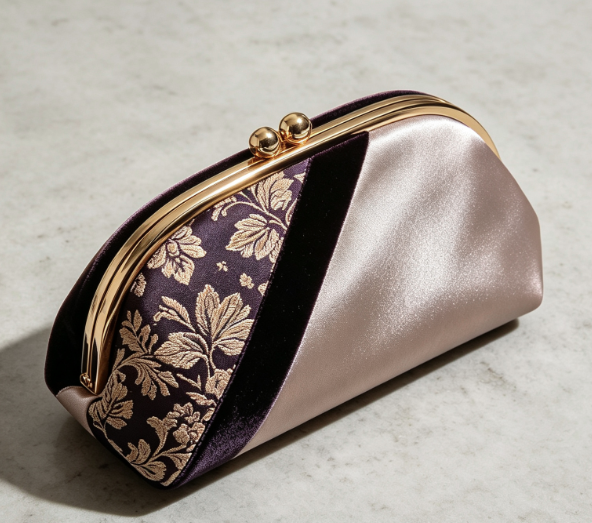
A rigid frame evening bag works best with low-stretch fabrics that fold cleanly. The frame channel needs consistent fabric thickness — 1.0–1.5 mm combined (outer fabric + interfacing) — to glue or crimp without gaps or buckling.
Recommended outer materials:
– Silk satin / dupioni — sits flat against the frame edge, takes embellishment well
– Velvet — adds texture contrast against polished hardware; requires directional cutting
– Brocade / jacquard — self-patterned; cuts down the need for surface decoration
– Metallic fabric — pairs well with gold or silver frame finishes
Skip stretch fabrics. Even mild elasticity causes misalignment at the hinge points and cuts frame lifespan short.
Lining: Use habotai silk or satin-weave polyester at 18–22 g/m². Heavier linings add bulk at the seam allowance. That bulk creates visible ridges once the frame closes.
Surface design logic: On a metal frame clutch, the hardware carries the visual identity. Keep embellishment close to the frame edge — crystal trim, embroidered borders, beaded panels. Full-face prints fight the frame rather than working with it.
Soft Clutch: Material Range and Surface Opportunity
Flexible clutch purse construction opens up a much wider material range. You also get the full front panel as a design canvas.
Recommended shell materials by brand tier:
|
Material |
Thickness |
Best For |
|---|---|---|
|
Full-grain / PU leather |
1.0–1.4 mm |
Clean minimal aesthetics, emboss or deboss branding |
|
Suede / microsuede |
0.8–1.2 mm |
Soft-touch premium feel, embroidery-friendly |
|
Canvas / coated cotton |
Medium weight |
Print-forward designs, sustainable positioning |
|
Satin / jacquard |
Varies |
Occasion crossover, seasonal colorways |
For envelope clutch bag formats, leather and PU at 1.0–1.4 mm hold the fold line without internal reinforcement. For pouch formats, softer materials like suede or satin work well — just pair them with a light fusible interfacing to stop sagging.
Surface treatment by brand objective:
– Logo-forward OEM programs → embossing at 0.2–0.5 mm depth on leather or PU; covers up to 70% of the face panel without structural compromise
– Fashion-forward seasonal drops → screen print or digital print on canvas; low setup cost, fast colorway rotation
– Premium gifting → heat-transfer on satin or embroidery on velvet; higher perceived value at modest MOQ
Lining recommendation: Use 190T polyester taffeta for volume programs. For any SKU retailing above US$80, upgrade to a satin-weave lining. Customers feel the difference the moment they open it.
The Decision Shortcut
Your brand centers on occasion, ceremony, or collected luxury? Build around materials that support the metal frame’s structural demands: low-stretch fabrics, consistent thickness, surfaces that take embellishment well.
Your brand runs on flexibility, print identity, or seasonal volume? Soft construction gives you the material freedom and surface area to make that work. Match your material grade to your retail tier, and the margin math follows.
Decision Checklist: 5 Questions to Choose the Right Clutch Style for Your Brand
Five questions. Ten minutes. One clear direction for your product line.
Run through this checklist before briefing any factory on clutch bag manufacturing. Each answer narrows your structural choice. It also protects you from expensive tooling commitments that don’t fit your actual brand needs.
Q1. What is your brand’s positioning tier?
-
Luxury / contemporary (target retail ≥ USD 200, margin goal 60–75%): Prioritize 1–2 metal frame styles as hero SKUs. Soft clutches play a supporting role.
-
High-street / accessible (retail USD 40–150, margin goal 55–65%): Lead with soft construction. Add one rigid frame evening bag per season as a visual anchor — not a volume driver.
-
Corporate gifting / events (B2B unit cost USD 15–60): Default to soft construction. Save metal frame for premium-tier clients where “commemorative value” is part of the brief.
Q2. What is your primary sales occasion?
-
Evening / wedding → choose metal frame for ceremony presence and visual drama. Pick a flexible clutch purse for lightweight feel and soft texture.
-
Daily use → start with soft construction. Full stop.
-
Corporate gifting → budget-driven = soft. Premium and memorable = minaudière bag or hard-shell format with custom engraving.
Q3. What retail price range are you targeting — including discount headroom?
Your core price sits above USD 200? Build at least one structured handbag design in metal frame as your price anchor. Planning regular promotions at ≥ 40% off? Soft construction is the safer bet. Metal frame hardware costs turn deep discounting into a margin problem fast.
Q4. What is your expected MOQ per colorway?
-
Under 200 pcs/color → soft clutch is your only real option. Most specialist factories set metal frame MOQs at 500–800 pcs once custom hardware comes into play.
-
500+ pcs on core neutrals (black, gold, silver) → metal frame becomes viable. Cap hardware finishes at 1–2 colors to keep procurement costs in check.
-
Mixed strategy (1 main color + 2 secondary colors, total ≤ 1,000 pcs/style) → run the hero color in metal frame at a premium price point. Use a soft version of the same silhouette for the secondary colors.
Q5. Is this an icon SKU or a volume filler?
In mature luxury clutch bag design portfolios, icon pieces take up just 10–20% of SKUs. Yet they drive 40–60% of brand visibility. Volume fillers cover 50–70% of SKUs and account for most actual units sold.
-
Icon / hero SKU → invest in metal frame. Plan 2–3 campaign shoots per season. Use this style across window displays, homepage, and social covers.
-
Volume / replenishment SKU → go soft construction. Build the base pattern to stretch across ≥ 3 materials and ≥ 3 colorways with no retooling needed.
Your answers, mapped to a decision:
|
If your answers lean toward… |
Go with… |
|---|---|
|
Luxury tier + evening occasion + retail ≥ USD 200 + MOQ ≥ 500 + icon role |
Metal frame as primary style |
|
Accessible tier + daily use + retail USD 40–150 + MOQ < 300 + volume role |
Soft clutch as primary style |
|
Mixed positioning |
Soft clutch base + 1 metal frame capsule per season |
No single construction type works for every brand. After five honest answers, though, the right choice for your brand becomes clear.
Custom Clutch Bag Development: Metal Frame & Soft Clutch OEM/ODM Solutions
Both construction types are available through OEM/ODM programs. The development path for each is simpler than most buyers expect.
For metal frame clutch bag wholesale orders, custom frame molds start at US$150–500 based on complexity. Per-unit hardware costs run US$0.30–1.50 at 500–2,000 pcs scale. Complete metal frame clutch bags ex-factory range from US$3–10 for standard PU-plus-frame builds. Leather bodies with custom plating and logo hardware go up to US$15–40. MOQ for a complete style sits at 300–500 pcs per color, or 600–1,000 pcs per style total.
Custom soft clutch bag OEM programs open at lower thresholds. Standard hardware builds start at 200–300 pcs per color. Many factories allow mixed-color orders — for example, 500 pcs total split across 5 colorways. Ex-factory pricing runs US$2–6 for PU or satin builds, up to US$8–15 for premium leather or embellished finishes.
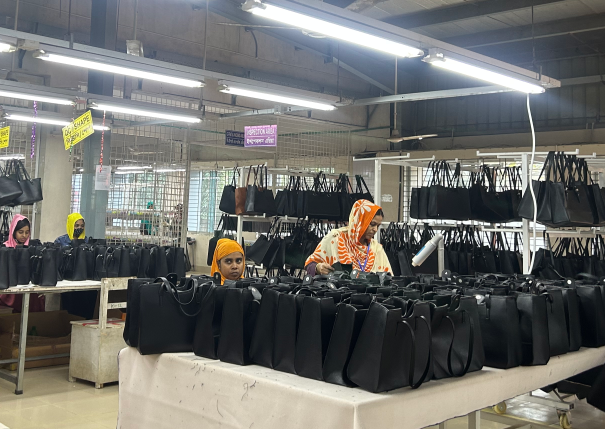
From Brief to Bulk: The Development Timeline
Both types follow the same seven-stage development flow:
-
Design brief — submit your sketch, target price, size, and material references
-
2D/3D technical drawing — the supplier converts your brief to CAD with frame dimensions, seam positions, and logo placement (2–5 days)
-
Hardware sourcing & tooling — frame mold production (7–15 days); plating color chips (3–7 days)
-
First sample — (7–20 days) based on custom hardware complexity; you get 1–2 free revision rounds included
-
Pre-production sample — frame fit, logo alignment, and opening/closing cycle test (100–300 cycles) all get checked and confirmed
-
Mass production — (30–45 days) after PP sample approval for 500–3,000 pcs
-
Final inspection & shipment — AQL 2.5/4.0 standard; critical defects get zero tolerance
Ready to Start Your Clutch Line?
No full tech pack needed to get a quote. A JPEG sketch, a target retail price, and an estimated quantity gives you indicative pricing within 2–3 working days.
Building a rigid frame evening bag as a hero SKU? Scaling a custom soft clutch bag OEM program across multiple colorways? Send your brief and we’ll take it from there.