
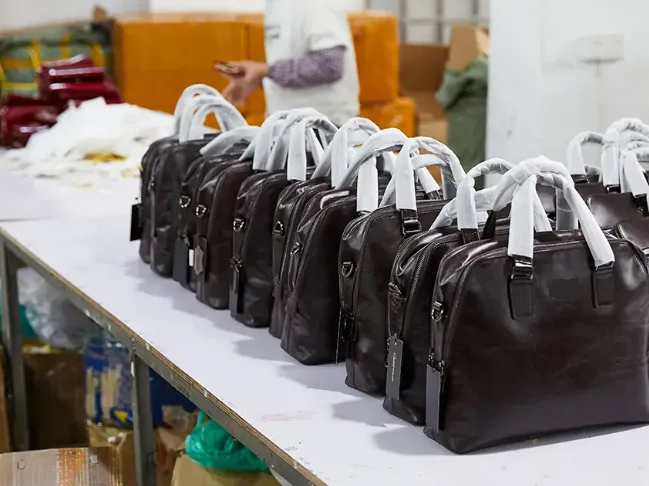
Leather can make or break an OEM bag brand. Most brands don’t see how their sourcing decisions shape margins, product quality, and customer perception — all before a single bag ships.
Smart leather sourcing isn’t just a procurement task. It’s a competitive edge most brands overlook.
Scaling production? Entering new markets? Protecting margins from volatile raw material costs? Your decisions about where, how, and from whom you source leather affect every part of your business.
This guide covers the full sourcing journey. You’ll go from defining leather specs, to vetting global suppliers, managing costs, and building a sourcing model that grows with your brand.
What Type of Leather Does Your OEM Bag Brand Need?
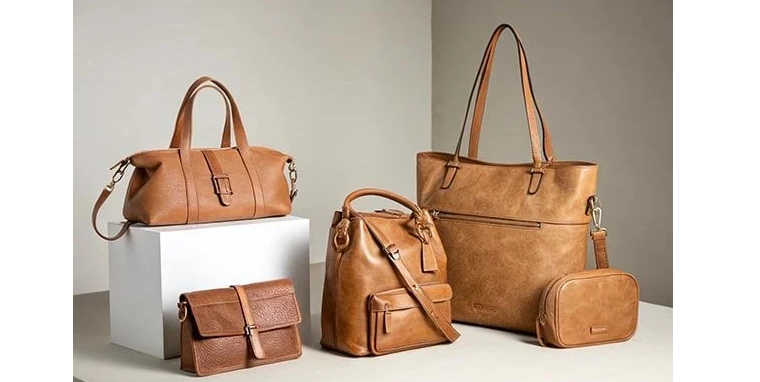
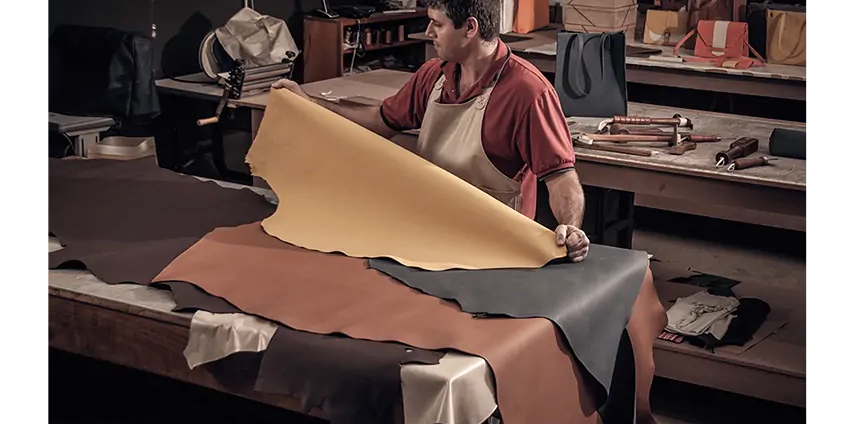
Leather grade shapes more than how a bag feels. It sets your price ceiling, your customer’s expectations, and your OEM bag factory‘s ability to deliver consistent quality at volume.
The right leather for your brand isn’t the best leather on the market. It’s the leather that fits your bag type, retail price tier, and production volume — all at once.
Match Leather Grade to Bag Type First
Each bag construction needs different leather properties. Here’s how they line up:
| Bag Type | Recommended Leather | Thickness |
|---|---|---|
| Tote | Full-grain or rigid top-grain cowhide | 1.8–2.2 mm |
| Shoulder / Handbag | Soft top-grain cowhide | 1.6–2.0 mm |
| Backpack | Full-grain or suede | 2.0–2.4 mm |
| Crossbody | Lightweight top-grain | 1.4–1.8 mm |
| Briefcase | Vegetable-tanned full-grain | 2.0–2.6 mm |
| Small goods / linings | Split or corrected-grain | 1.0–1.4 mm |
Then Align Leather Grade to Your Price Tier
Your retail price band sets a minimum leather standard. Here’s what each tier requires:
- Luxury (≥$300–500) — Full-grain or premium calfskin on all visible surfaces. Tensile strength must reach ≥ 20 N/mm². Brands like Gucci and Louis Vuitton source Italian cowhide, calfskin, and exotic leathers at this level.
- Premium / Affordable Luxury ($150–400) — Top-grain cowhide covers exterior faces. Split or corrected-grain works fine for linings and internal parts.
- Mid-market ($60–150) — Corrected-grain or genuine leather handles exterior panels well. Use split leather for internal reinforcements.
- Mass / Entry (<$60) — Bonded or synthetic leather fits this range. Durability is limited, so focus on cost and appearance rather than long-term wear.
Putting the wrong grade on the wrong price point causes real problems. Use bonded leather on a $200 bag, and visible quality failures show up within months. Repeat purchase rates drop fast. The match between grade and price tier isn’t optional — it’s what keeps your brand credible.
How to Build a Leather Sourcing Policy Before You Contact Any Supplier
Most sourcing problems don’t start with a bad supplier. They start with a brand that never defined what “good” meant before the conversation began.
A leather sourcing policy locks in your standards before any supplier gets the chance to define them for you.
Step 1: Assign a Leather Grade to Every Product Tier
Create a simple internal code system tied to your product lines:
- L1 (Flagship): Full-grain only. LWG Gold certification required. Hides must be deforestation-free with traceability back to the farm. Tear strength ≥ 20 N/mm. Color deviation ΔE ≤ 1.5 between batches.
- L2 (Core): Top-grain or selected corrected-grain. LWG Silver or Gold accepted. Traceability must go back to the slaughterhouse at minimum.
- L3 (Entry): Recycled leather (≥ 20–50% recycled content per GRS) or vegan alternatives (PU, bio-based PU) are allowed. Must pass abrasion ≥ 40,000 cycles and tear strength ≥ 10 N/mm.
Document substitution rules for each tier. Your flagship SKU hits a hide shortage? Your policy decides what’s acceptable — not your supplier’s suggestion.
Step 2: Set Sustainability Rules Before Supplier Outreach
Don’t hand ethics decisions to your supplier. Set them yourself:
- Tanning method: Chrome-tanned leather must test below 3 mg/kg Cr(VI) (REACH limit). Set a clear target: ≥ 30% metal-free tanning volume by 2030.
- Deforestation commitment: Use the 31 Dec 2020 cut-off date. This aligns with the Textile Exchange Deforestation-Free Call to Action. Get signed supplier declarations on file.
- Wastewater: Every tannery must run certified effluent treatment. Zero direct discharge to natural water bodies — no exceptions.
Step 3: Pre-Define Compliance by Market
Your policy needs to match where you sell:
- EU: REACH Annex XVII compliance is mandatory. Azo dyes are prohibited. EUDR traceability rules also apply, using the same 2020 cut-off date.
- US: Include a California Prop 65 clause. Heavy metals — lead, Cr(VI), cadmium — must stay below < 90–100 ppm.
- All markets: Build a brand RSL as a required annex — formaldehyde ≤ 75–150 mg/kg, chlorinated phenols ≤ 0.5 ppm, PFAS banned across the board.
Get these three steps documented first. Then build your supplier questionnaire around them. Every yes/no question should trace back to a rule already sitting in your policy.
Where and How to Find Qualified Leather and OEM Bag Suppliers
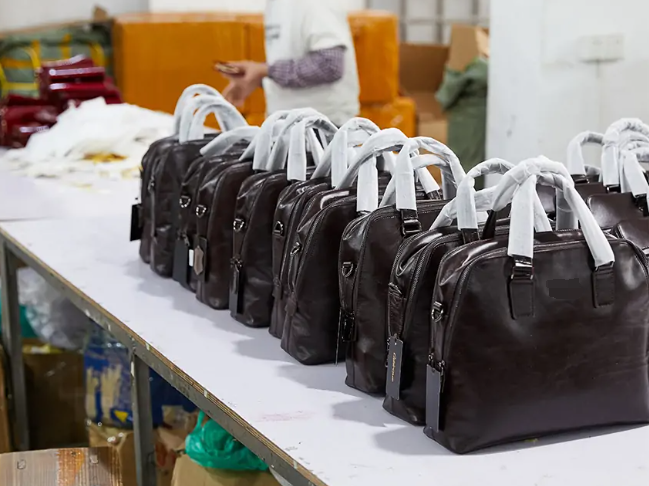
Finding the right supplier is a filtering problem, not a search problem. The market has no shortage of factories willing to take your order. The real challenge is knowing which channels surface qualified options — and how to cut through the noise fast.
Trade Fairs: The Fastest Way to Verify Supplier Claims in Person
No directory replaces a face-to-face conversation at a factory booth. Three fairs matter most for leather OEM bag sourcing:
- Lineapelle (Milan) — Focused on tanneries and leather components. This is the right place to verify LWG certification, REACH compliance, and chrome-free tanning claims. You talk to the people who process the hides.
- APLF Leather & Materials+ (Hong Kong / Dubai) — A strong mix of Asian tanneries and OEM bag factories from China, India, Pakistan, and Italy. Many OEM factories here already have established tannery relationships. That cuts down your supply chain complexity.
- Canton Fair (Guangzhou) — The most volume-oriented option. The luggage and bags section covers hundreds of OEM/ODM factories. Expect genuine leather MOQs around 150–500 pcs/style and PU at 100–300 pcs/style as a baseline.
LinkedIn and Instagram: Underused but Effective
LinkedIn is good for finding mid-size factories that don’t advertise much on B2B platforms.
Use search strings like “handbag manufacturer OEM,” “leather bag factory,” “bag manufacturer Guangzhou/Kolkata.” Filter by companies with 11–200 employees — that’s the standard size range for serious mid-tier OEM factories. Target contacts with titles like Export Manager or Sales Manager – Leather Goods. Aim to identify 15–30 factories per target country, then cross-check their websites and portfolio images.
Instagram is less obvious but useful for visual screening. Search hashtags like #bagmanufacturer, #leathergoodsfactory, #handbagfactorychina. Focus on accounts posting factory floor content — cutting lines, stitching stations, QC checks, client project details. Shortlist 5–15 accounts whose posts show the construction techniques you need, then move to email outreach.
In-Country Sourcing Agents: When Direct Outreach Doesn’t Work
Small order volumes (under 100 pcs/style), niche craftsmanship needs, or no ability to attend fairs or conduct in-person audits — a sourcing agent fills that gap well.
Agents charge 5–10% of order value and handle factory discovery, sampling, QC, and consolidation. Key hubs with established agent networks:
- Guangzhou / Shenzhen — China OEM scale
- Kolkata / Chennai — India
- Ho Chi Minh City — Vietnam
- Istanbul — Turkey
- Florence — Italy
How to Score and Shortlist Suppliers
Once you have a candidate list, use a structured scorecard to compare them. Here’s a 100-point framework with the indicators that matter most:
| Criterion | Weight | What to Measure |
|---|---|---|
| Sample quality & development capability | 25 pts | Stitching consistency, edge paint, color match, structural integrity; ≤ 2 sample rounds to approval; dimensions within ±2 mm of tech pack |
| Production capacity | 20 pts | Monthly output 5,000–50,000 pcs depending on your volume; MOQ ≤ 150–300 pcs/style for leather |
| Communication speed & PM | 15 pts | Full replies within 24 hours; clear quotation with unit price, tooling, sample fee, payment terms, lead time in one document |
| Certifications & compliance | 15 pts | ISO 9001 + BSCI/Sedex for factory; LWG or equivalent for tannery supply |
| English proficiency & technical clarity | 10 pts | Sales contact can explain construction details clearly — materials, thread spec, edge paint coats — without confusion |
| Relevant segment experience | 10 pts | Portfolio of comparable bag types; client references in a similar price tier |
Scoring guidance:
– Sample quality: 22–25 pts for clean results within 2 rounds; drop to 0–10 pts for repeated misalignment or poor finishing
– Communication: 13–15 pts for consistent, detailed replies with proactive updates; 0–6 pts for frequent gaps or misunderstandings
– Certifications: 15 pts for full documentation; 0–5 pts for vague or unverifiable answers
Run every shortlisted supplier through this scorecard before requesting samples. It takes the guesswork out of a process that too many brands treat as gut instinct alone.
Designing Your OEM Leather Bag Sourcing Model: Specs, Control, and Approval Process
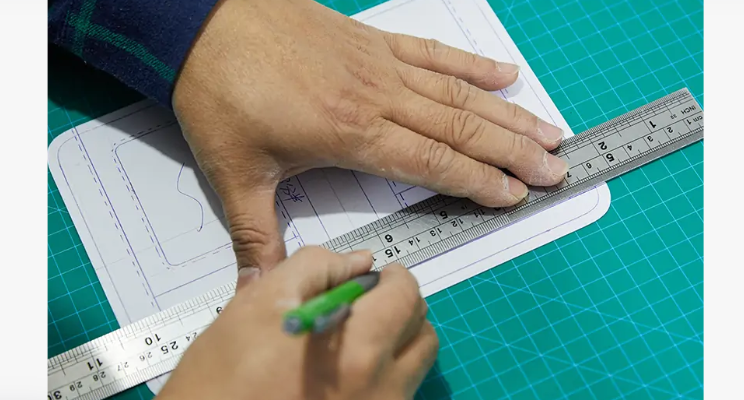
Quick test: Can you name your leather article code, thickness tolerance, finish type, and approved color reference right now? If not, your program isn’t OEM-controlled. The factory is still making those calls for you.
That gap matters. In a true OEM model, the brand owns every leather decision. Article code, thickness, finish, color standard, test criteria, approved substitutes — all of it. The factory executes to your spec. In an ODM setup, the factory controls material selection. Brand input stops at approving the final sample. You get less leverage, less consistency, and less protection when something goes wrong in bulk.
What Goes Into a Leather Spec Sheet
Every OEM leather program needs a locked spec sheet before sampling starts. The core fields:
- Tannery / article code — one unique reference tied to one approved material
- Leather type — full grain, top grain, corrected grain, suede, nubuck, or coated; pick one and lock it
- Thickness target and tolerance — set your nominal thickness with ±0.2 mm control tolerance
- Finish type — aniline, pigmented, waxed, embossed, etc.; note gloss or matte target
- Color standard — approved Pantone or lab-dip ID, plus a defined acceptance range for bulk
- Physical performance criteria — tensile, tear, flex, abrasion, color fastness; name the actual test methods, not vague “must pass testing” language
- Approved substitutes — pre-approved alternates with defined conditions and clear sign-off authority; no open-ended swaps
- Revision number, approval date, sign-off names
Each field exists for a reason. Missing one leaves a decision in the factory’s hands, not yours.
The Approval Workflow That Keeps Bulk on Spec
Color and material approval follows a fixed sequence — no shortcuts:
- Tannery submits lab-dip or strike-off for brand review
- Brand approves or rejects against the reference standard
- Factory builds the pre-production sample using approved leather and construction details
- Brand signs off bulk leather panels against the approved shade, finish, and hand feel — before cutting starts
- Goods inspection checks finished bags against approved materials and batch records before shipment
Bulk release happens after the panel matches the pre-production sample across all three variables: color, surface finish, and hand feel. All three. “Close enough” is not an approval standard. Skipping any step in this sequence breaks the chain of control.
Key Control Benchmarks
| Control Point | Benchmark |
|---|---|
| Thickness variance | ±0.2 mm across panels and lots |
| Color approval | Defined range around master lab-dip |
| Batch traceability | Article code + tannery lot + inspection batch recorded per shipment |
| Quality claim rate | ≤ 1–2% of shipped volume |
Batch traceability makes problem-solving fast. A rejected lot comes in — you isolate it right away. That speed depends on whether the records exist. No records means no traceability, and no traceability means the problem spreads before you can stop it.
Your Pre-Bulk Approval Package
Before any bulk ships, require these six documents:
- Signed spec sheet
- Approved lab-dip or color standard
- Approved pre-production sample
- Third-party test report references
- Approved substitute list
- Bulk leather panel inspection checklist
Any of these missing? Bulk doesn’t move. That’s the control structure that separates a well-run OEM leather sourcing program from one the factory floor is still managing for you.
Conclusion
Leather sourcing isn’t a procurement checkbox. It’s one of the most important decisions your OEM bag brand will make. It touches everything — margin integrity, customer trust, and long-term supplier relationships.
Winning brands aren’t the ones spending the most. They’re the ones who built a sourcing policy before panic-buying. They vetted suppliers with discipline, not urgency. They treated sustainability as a differentiator worth charging for — not a burden.
Your leather sourcing strategies for OEM bag brands don’t need to be perfect on day one. They need to be systematic. Start with your material spec sheet. Lock down one qualified supplier relationship. Run your first sample audit. Each step builds on the last.
The sourcing infrastructure you build today becomes a competitive advantage your rivals struggle to copy tomorrow.
Ready to move forward? Go back to your current supplier list. Check it against the vetting criteria in this guide. Then identify the first gap worth fixing this quarter.