Bad material selection is why that travel bag fell apart after six months. Zippers that jam, seams that split, and coatings that peel and crack rarely happen randomly. They happen because the fabric, coating, or hardware wasn’t built for the job it was asked to do. Whether you’re comparing nylon vs polyester travel bag options for your next purchase or evaluating ballistic nylon luggage specs as a sourcing manager, understanding why certain materials outlast others changes how you buy. The rest of this article breaks down the real science behind fabric durability, denier ratings, coating types, and construction quality so you can spot a bag built to last from one destined for the donation pile within a year.
Material Properties That Determine Travel Bag Lifespan
Abrasion resistance, tear resistance, water resistance, and load-bearing capacity at stress points. These four properties decide whether a bag lasts years or fails within months.
Abrasion resistance is measured in cycles, and it’s the first thing to check.
|
Cycle Rating |
Suitable For |
|---|---|
|
6,000–12,000 |
Light home use |
|
12,000–20,000+ |
General side-panel wear |
|
20,000–40,000+ |
High-friction zones (bottom, corners) |
|
40,000+ |
Commercial-grade, ballistic nylon and high-denier fabrics |
Bottoms and corners fail first in real-world use—dragged across airport floors, rubbed against overhead bins, scraped on stair edges. The coating wears thin, fibers get exposed, and a fraying-to-hole-to-leak chain begins.
Tear resistance decides whether a small nick becomes a structural blowout. High-density nylon, ballistic nylon, and CORDURA-style fabrics outperform standard polyester here, especially under uneven load at zipper ends and strap attachment points.
Waterproofing prevents moisture-driven aging, not just leaks. PU coatings, TPU laminates, and taped seams keep water out of fibers and stitching. Once moisture penetrates, it accelerates fabric fatigue, adhesive breakdown, and hardware corrosion.
Reference lifespans: nylon averages 5–15 years, polyester 3–7 years, leather can last decades with care. Hard-shell materials rank aluminum (8–12 years) > PP (10–12 years) > PC (5–8 years).
Load stress concentrates at three points: handles, seams, and zipper tracks. Each fatigues faster under repeated heavy lifting without reinforced stitching or metal zippers like YKK.
Travel Bag Material Comparison: Durability & Lifespan Breakdown
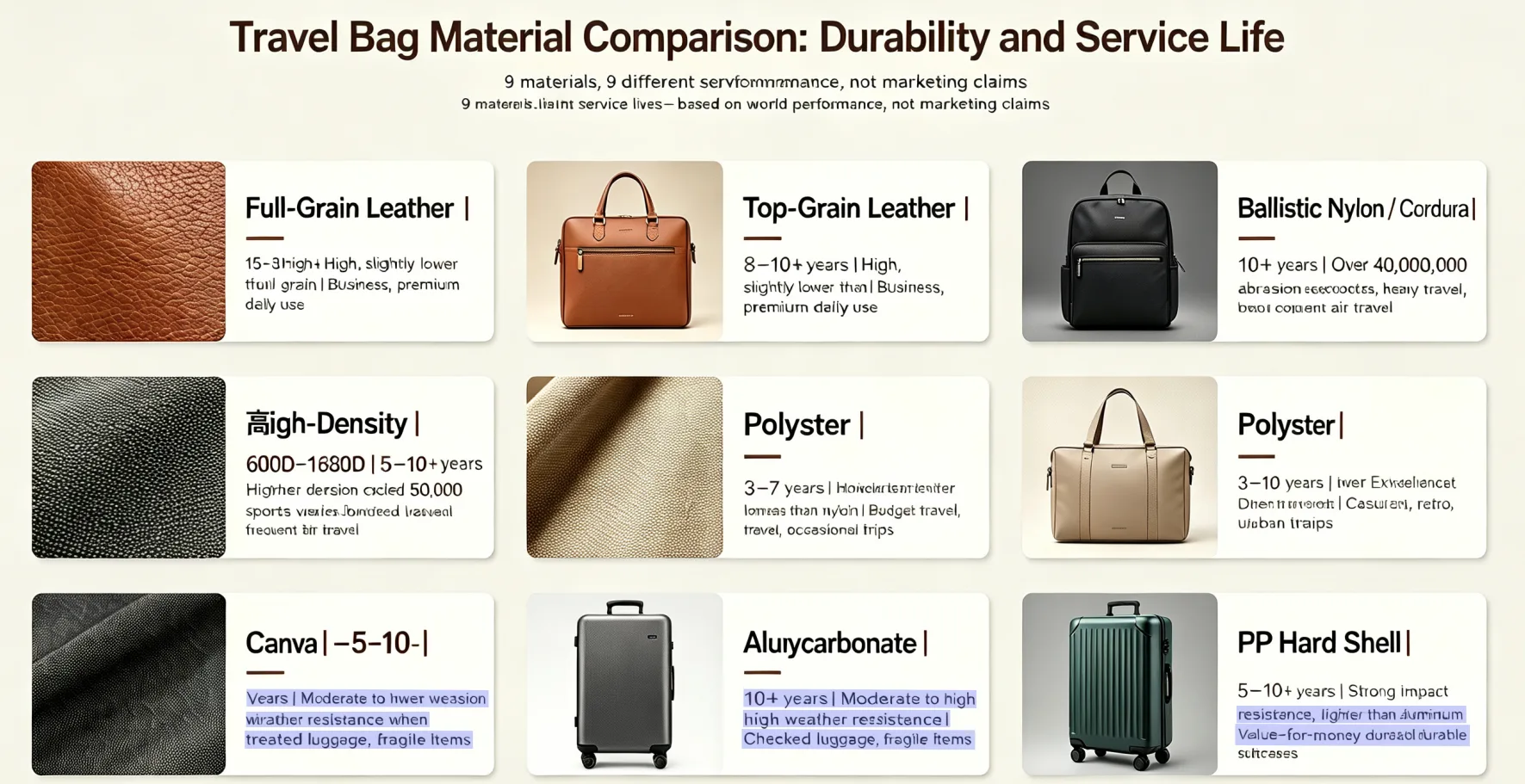
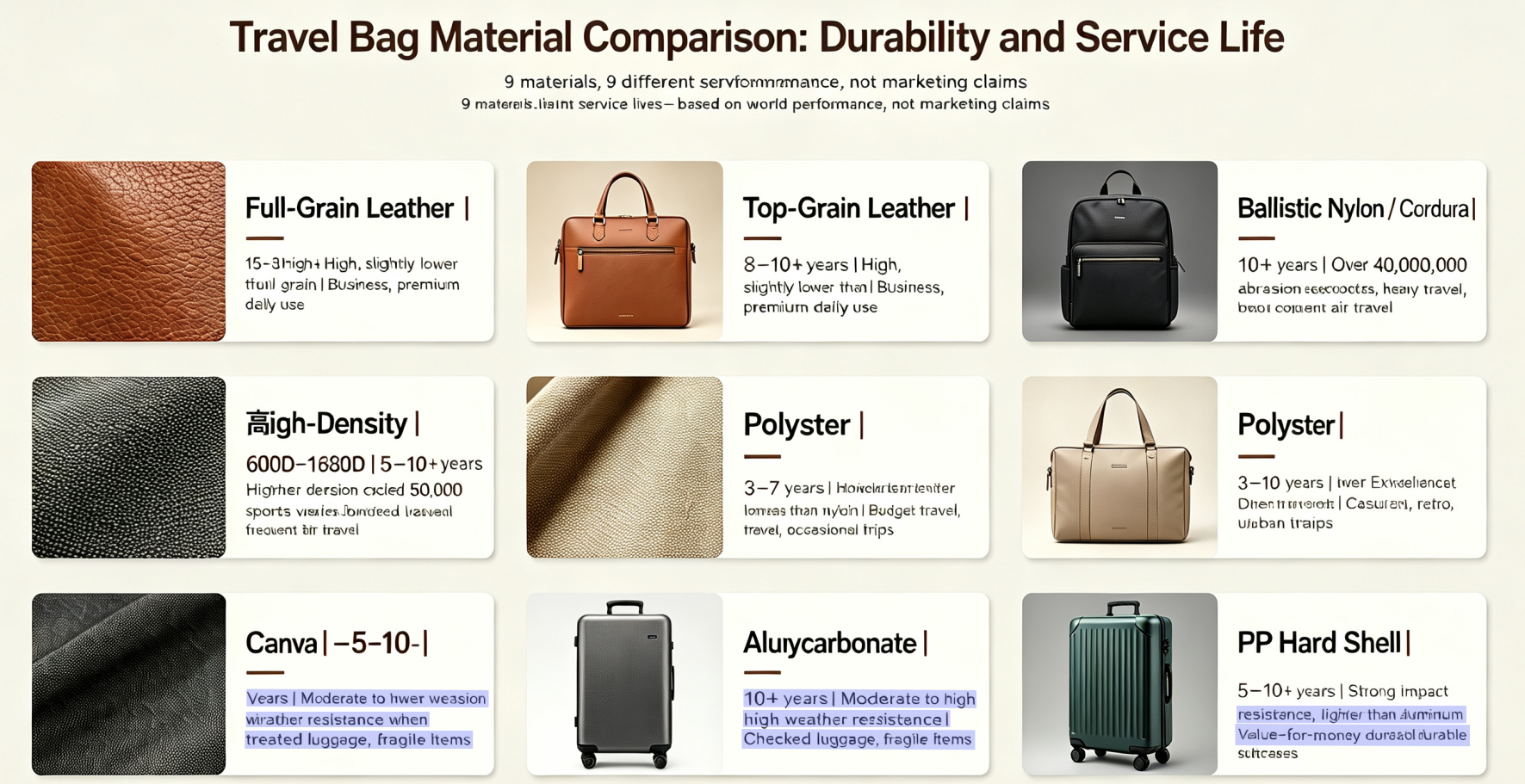
Nine materials, nine different lifespans. That’s what you get when you line up leather, nylon, polyester, canvas, and hard-shell polymers side by side. Here’s how they stack up in real-world use, not marketing claims.
|
Material |
Typical Lifespan |
Durability/Abrasion |
Best Use Case |
|---|---|---|---|
|
Full-grain leather |
15–30+ years |
Very high; strongest long-term aging |
Business, luxury, daily premium bags |
|
Top-grain leather |
8–10+ years |
High, slightly less than full-grain |
Business, premium everyday use |
|
Ballistic nylon/Cordura |
10+ years |
Exceeds 40,000+ abrasion cycles |
Outdoor, heavy-duty travel, frequent flyers |
|
High-density nylon (600D–1680D) |
5–10+ years |
High-denier versions exceed 50,000 cycles |
Daily travel, commuting, backpacks |
|
Polyester |
3–7 years |
Moderate; lower abrasion resistance than nylon |
Budget travel, occasional trips |
|
Canvas |
5–10 years |
Moderate to high, weather-resistant if treated |
Casual, vintage, city carry |
|
Polycarbonate hard shell |
10+ years |
Excellent impact resistance |
Checked luggage, fragile contents |
|
Aluminum hard shell |
10+ years |
Highest impact protection, dent-prone |
Business, premium checked luggage |
|
PP hard shell |
5–10+ years |
Strong impact resistance, lighter than aluminum |
Value-focused durable luggage |
Quick matching guide:
-
Maximum lifespan: Full-grain leather, ballistic nylon/Cordura
-
Frequent checked baggage: Polycarbonate or aluminum hard shells
-
Durability-to-weight balance: High-density nylon (600D–1680D)
-
Budget-conscious: Polyester—accept the 3–7 year tradeoff
-
Rough, outdoor use: Cordura, ballistic nylon, treated canvas
-
Business/premium look: Full-grain or top-grain leather
One data point worth remembering: a 1000D nylon fabric can push past 50,000 abrasion cycles in controlled testing, while comparable polyester typically plateaus around 30,000–40,000. That gap explains why nylon vs polyester travel bag debates almost always favor nylon for anyone flying more than a few times a year.
Beyond raw material, construction quality tips the scale further. Look for double- or triple-stitching at stress points, bar-tacking on handles and straps, YKK or equivalent metal zippers, and coated or laminated fabric where water resistance matters. Material sets the ceiling—construction decides whether you actually reach it.
Nylon vs Polyester: Which Travel Bag Material Lasts Longer
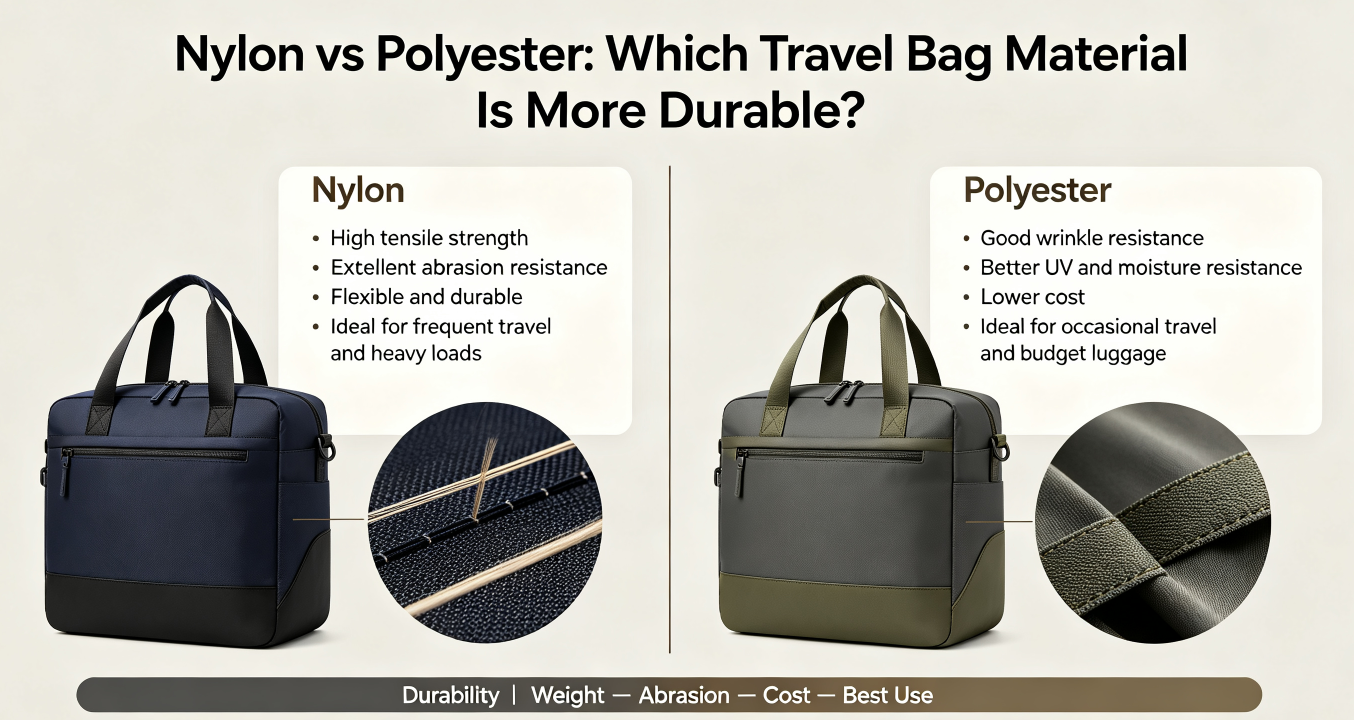
Put nylon and polyester side by side under a rotary abrasion test, and the winner becomes obvious fast. Nylon typically outperforms polyester in abrasion resistance by around 20% under identical conditions. In drum tests, nylon fabric shows only slight fuzzing after 5,000 rotation cycles, while polyester already displays visible wear damage by 3,500 cycles.
Push the comparison into higher-frequency use, and the gap widens further. At equal fabric thickness, nylon holds up until roughly 8,000 cycles before pilling starts. Polyester begins fiber breakage after just 5,000 cycles. Tear resistance follows the same pattern: nylon’s elongation at break runs 30%-40%, compared to polyester’s 15%-25%. Match the specs exactly, and nylon’s tear strength still comes out about 15% higher.
But nylon isn’t the better choice everywhere.
Where Polyester Actually Wins
Polyester’s moisture absorption sits around 0.4%, keeping it dimensionally stable in humid climates. Nylon absorbs up to 8% moisture, which can drop its strength by roughly 10% temporarily—though it recovers once dry.
UV resistance flips the script too. After extended sun exposure, polyester retains 10%-15% more strength than nylon. Leave a nylon bag outdoors for six months and its abrasion resistance can fall by 40%. Polyester loses only about 15% under the same conditions.
The Practical Buying Rule
-
Weekly flyers, frequent checked baggage, rough handling → high denier fabric luggage, specifically high-denier nylon
-
Occasional trips, budget-conscious, sun exposure a concern → polyester performs fine
-
Premium travel bag → high-denier nylon plus reinforced bottom panels and bag-grade double stitching—construction matters as much as the fabric name on the tag
For anyone weighing nylon vs polyester travel bag options strictly on wear-and-tear performance, nylon wins on the metrics that decide how long a travel bag survives: abrasion resistance, tear strength, and rebound after repeated stress.
PU Coating vs PVC Coating: Impact on Bag Longevity
What damages a coated fabric more than abrasion is repeated folding in the cold. PU coating stays soft and pliable; PVC coating stiffens and eventually cracks as plasticizers migrate out over time.
|
Metric |
PU Coating |
PVC Coating |
|---|---|---|
|
Flexibility |
Soft, drapable, stays supple |
Stiffer, tarp-like, worsens in cold |
|
Crack resistance |
Better long-term flex retention |
Hardens and cracks as plasticizers migrate |
|
Waterproofing (hydrostatic head) |
1,500–2,500 mm |
2,500–3,000 mm |
|
Weight add-on |
80–150 gsm |
200–400 gsm |
|
Flex durability |
200,000+ flex cycles |
~100,000 flex cycles |
|
Abrasion resistance |
20,000–30,000 rubs |
≥50,000 rubs |
PU is best for daily-use travel bags—folded, compressed, carried through varying temperatures. PVC is best for static, heavy-duty applications that require maximum waterproofing, even if that means extra weight and stiffness risk.
Sourcing checklist:
-
Request coating thickness of 0.35mm+ for static, durability-first use
-
Demand cold-flex testing if shipping to winter climates
-
Inspect fold zones (seams, corners) for whitening or micro-cracks
-
Verify adhesion quality; poor bonding causes peeling and delamination
For B2B buyers specifying PU coated fabric bags or PVC-coated luggage lines, matching coating chemistry to the end-use climate matters more than choosing the “stronger” spec on paper.
Technical Factors Beyond Fabric Type (Denier, Weave, Stitching, Hardware)
The fabric name on the label tells you half the story. Denier, weave density, stitching, and hardware quality decide the rest.
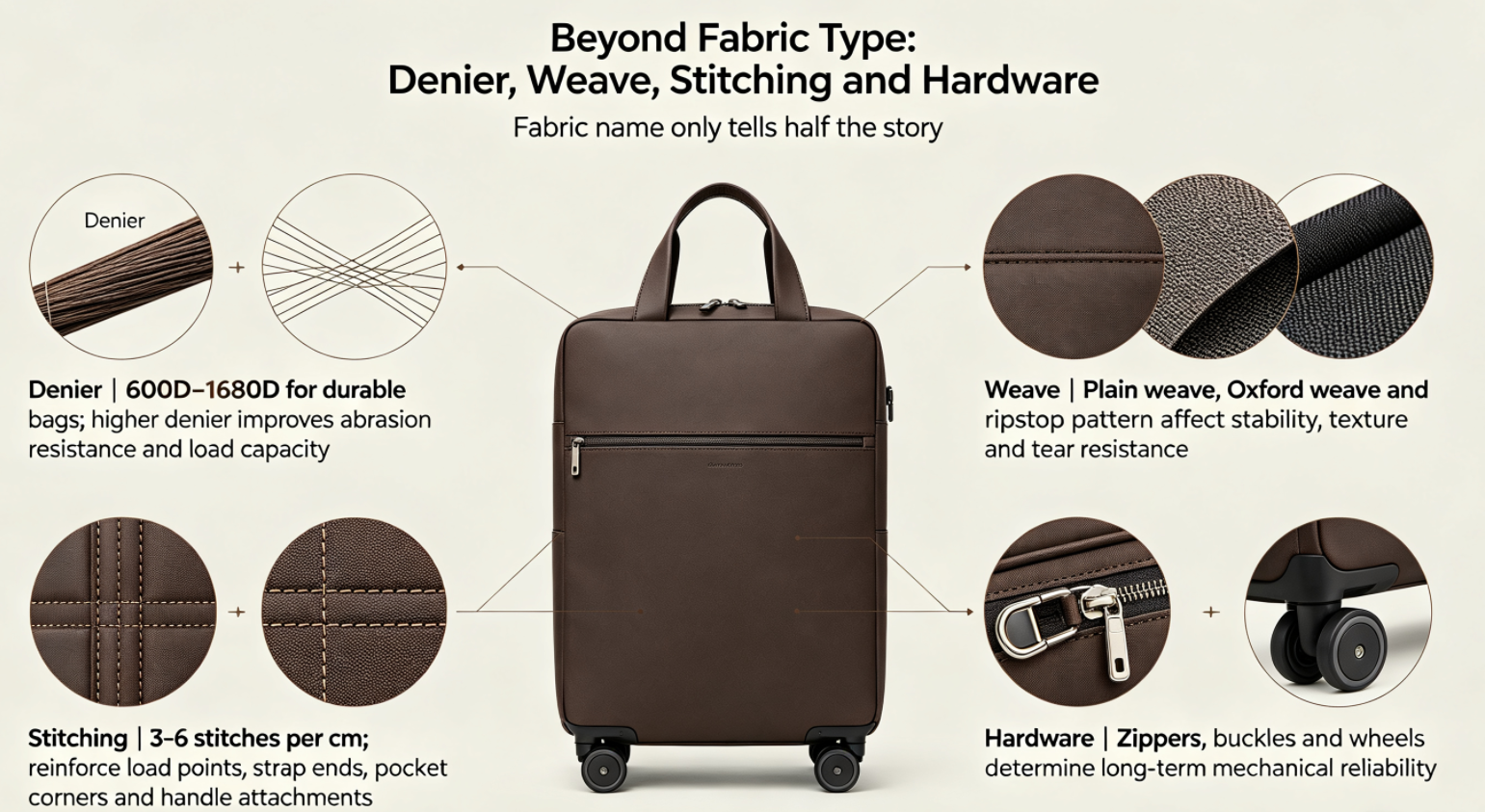
Denier measures yarn thickness—1D equals 1 gram per 9,000 meters of fiber. For bags built to last, 600D–1680D is the practical range. At the high end, 1680D is what you get when abrasion resistance and load-bearing outweigh saving a few grams.
Weave structure matters as much as denier. Plain weave gives stable, predictable seams. Oxford weave adds texture and toughness. Ripstop fabric bags use a reinforced grid pattern designed to stop small tears from turning into blowouts. Higher EPI/PPI (ends and picks per inch) also correlates with stronger seams.
Stitching is where a bag usually fails first. Stitch density around 3–6 stitches per cm, depending on fabric weight, gives the best seam strength in testing. Look for three specific reinforcements:
-
Box stitches at load-bearing points
-
Bar-tacks on strap ends and pocket corners
-
Double or triple stitching on handles, corners, and shoulder straps
These are where tensile shock and cyclic fatigue hit mile after mile.
Hardware fails before fabric more often than people expect. Zippers, wheel assemblies, and buckles take repeated mechanical cycling that fabric never faces. YKK is still the benchmark for zipper reliability, but the real procurement question comes down to cycle testing, pull strength, and corrosion resistance.
Before mass production, request open/close cycling tests on zippers, load tests on buckles, and rolling-impact tests on wheels. Fabric sets the ceiling. Construction and hardware decide whether the bag reaches it.
How to Choose the Best Travel Bag Material for Your Use Case
Specs on a data sheet only matter once you match them to how the bag actually gets used. A weekend commuter and a road-warrior consultant need completely different material profiles, even if both call their purchase a “travel bag.”
Match material to travel frequency:
-
Business travel, frequent flights: Ballistic nylon or high-density nylon softsides; PC or aluminum hard shells for a protective, professional look
-
Outdoor/heavy checked baggage: Cordura, ripstop fabric bags, or coated technical fabric; PC hard shells for impact resistance under rough handling
-
Budget/occasional short trips: Polyester or canvas softsides; ABS hard shells keep upfront cost low
-
Maximum protection priority: Aluminum ranks highest for impact resistance, though it adds weight versus PC
PP hard shells split the difference—lighter than aluminum, still strong on long-haul impact resistance, often positioned as the pick for extended trips.
Procurement Checklist: Structure Before Surface
Before evaluating finish or color, inspect the parts that actually fail:
-
Reinforcement at handle bases, wheel housings, and side seams
-
Zipper quality—smooth pull, thick teeth, dual sliders where possible
-
Denier rating on softside fabric; higher denier correlates directly with abrasion resistance
-
Impact recovery and scratch resistance on hard shells, not surface texture
Budget allocation should track usage frequency: invest in PC, aluminum, or high-denier nylon for frequent travel; ABS or standard polyester covers occasional use without overspending.
Practical Buying Rules for Sourcing Durable Travel Bag Materials (B2B Focus)
“Durable” and “thick fabric” mean nothing on a spec sheet. Manufacturers read numbers, not adjectives. Write “1680D nylon with 1500mm PU coating” instead of “durable fabric,” and “10mm high-density EVA” instead of “good foam.” That precision separates a professional buyer from a guessing one.
Build Your Spec Sheet Around These Fields
-
Fabric weight: 500D–630D nylon ripstop for lightweight carry-ons; 600D+ as the durability floor for heavy-use bags.
-
Coating type: PU or TPU, stated with a target hydrostatic rating. TPU-coated nylon or polyester for rain-exposed markets.
-
Seam construction: reinforced stitching called out by location: handles, straps, corners, wheel mounts.
-
Zipper class: YKK or equivalent heavy-duty zippers, named in the brief.
-
Hardware material: specified, not left open to interpretation.
Demand Proof Before You Pay a Deposit
Request third-party test reports from SGS, Intertek, or TÜV confirming tear strength and colorfastness. For luggage, ask for QB/T 2155-2018 or equivalent certificates. For hard shells, require minimum 1.2mm wall thickness post-vacuum forming. If you’re using PC+ABS blends, demand tensile strength ≥65MPa under ISO 527-2.
Pull samples before mass production. Cycle zippers, pull on stress points checking for separation, and measure against your approved tolerance. Proof beats promises every time.
Maintenance Tips to Extend Your Travel Bag’s Lifespan
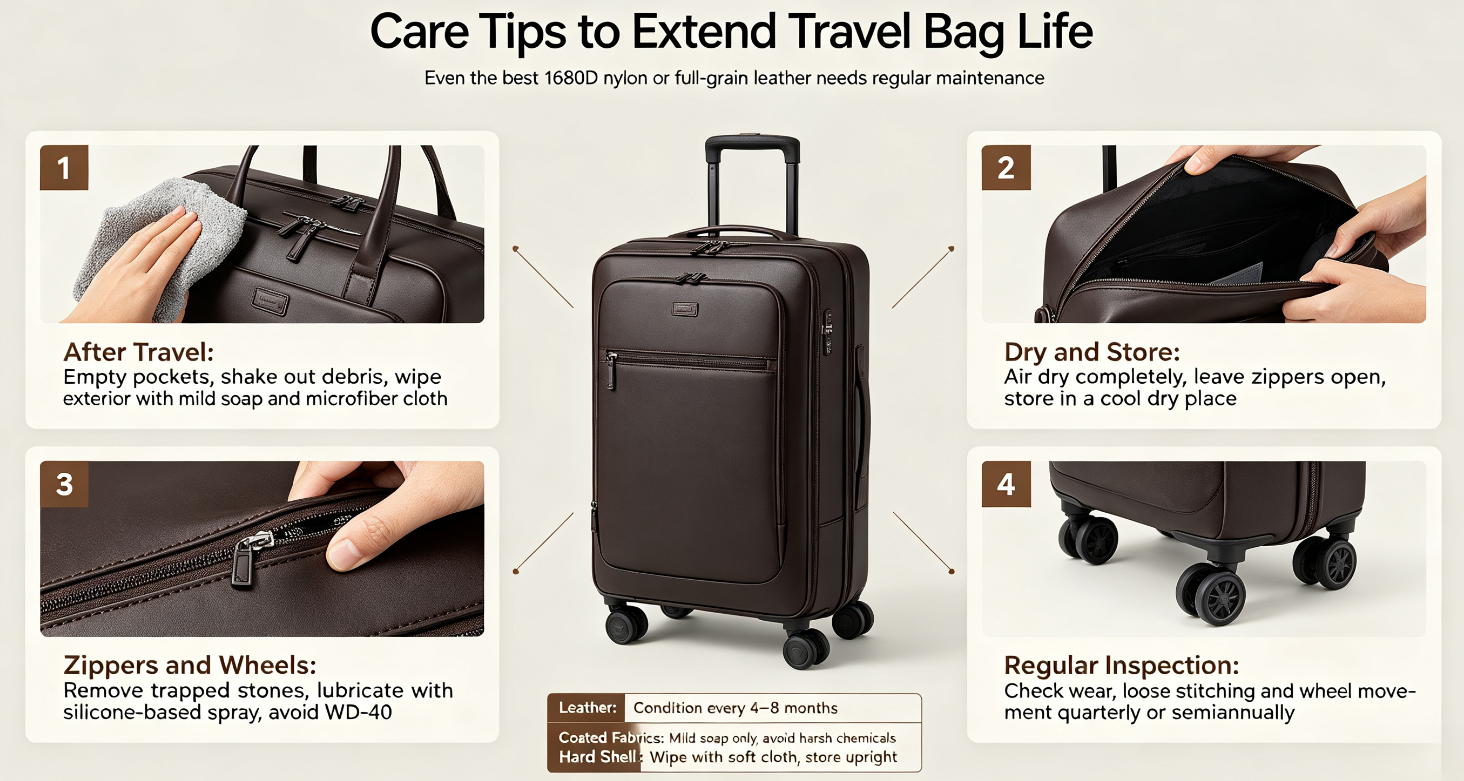
Even the best 1680D nylon or full-grain leather won’t survive years of neglect. After every trip, empty every pocket, shake out debris, and wipe the exterior with a damp microfiber cloth and mild soap. Clean handles, wheels, zippers, and seams—grit here causes sticking and premature wear.
Drying and storage matter more than most buyers think. Air-dry fully before repacking, leave pockets unzipped, and store in a cool, dry spot—never garages, basements, or direct sunlight. Humidity and UV cause fading, cracking, and mold.
Zipper and wheel care: clear lodged stones from tracks and housings, then lubricate with silicone-based spray—skip WD-40, which breaks down coatings over time.
Material-specific routines:
-
Leather: condition every 4–8 months
-
Coated fabric: mild soap only, avoid harsh chemicals and prolonged sun
-
Hard-shell: wipe with soft cloth, store upright
Inspect after every trip for fraying, loose stitching, or wobbly wheels. Frequent flyers should deep-clean quarterly; occasional travelers, biannually.