
What Separates a Luxury Evening Clutch Bag from Ordinary Alternatives
The price gap tells the first part of the story. Luxury evening clutches from Chanel, Judith Leiber, and Bottega Veneta run between $1,500 and $6,000. A mass-market satin evening bag costs $30 to $200. That gap isn’t just a branding premium. Every single component is different — and the numbers prove it.
Here’s where the real gap is:
Materials built to last beyond a single season. Luxury satin uses silk at ≥19–22 momme weight. Cheaper alternatives use ~12–14 momme polyester. That pills within 20–30 wears. Premium lambskin costs $20–$60 per square meter. The PU leather in ordinary clutches? As low as $2–$4 per square meter — and it starts showing wear within a year.
Hardware that doesn’t tarnish by spring. Luxury clasps and frames use solid brass or stainless steel with gold plating ≥0.5 microns. Budget clutches use zinc alloy with thin electroplating under 0.1 microns. That’s prone to discoloration within 6–12 months.
Embellishments applied by hand, not machine. A crystal-covered Judith Leiber minaudière uses 2,000–5,000 hand-applied Austrian crystals. Each piece takes 1–3 hours of artisan work. Machine-set rhinestones on ordinary bags start falling off after just 50–100 openings.
Interior finish most buyers never inspect. Luxury linings use fabric at 120–150 g/m², with seam strength ≥8–10 N/mm. Ordinary alternatives use ~80–100 g/m² polyester with seam strength as low as 4–6 N/mm. You won’t see the difference at first. But you’ll feel it over time.
The difference isn’t perception. It’s hard specification — written in materials, weights, and measurements.
Premium Materials That Define a Luxury Evening Clutch Purse
Material is where luxury begins — and where budget alternatives fall short. Fast.
The exterior surface of a clutch sets its price tier, its aging behavior, and the sensory impression it leaves the moment someone picks it up. Luxury evening clutches pull from two main material categories: exceptional leathers and statement non-leather surfaces. Each plays by different rules.
Exotic Leathers: The Highest Tier
At the very top sits crocodile and alligator leather — rated “Excellent” in durability and priced at the $$$$$ tier. A small envelope clutch alone needs 0.3–0.6 m² of skin. Branded exotic-skin clutches start at $1,000–$2,000+. That price reflects scarcity, strict regulatory handling, and the skill required to match scales across every panel.
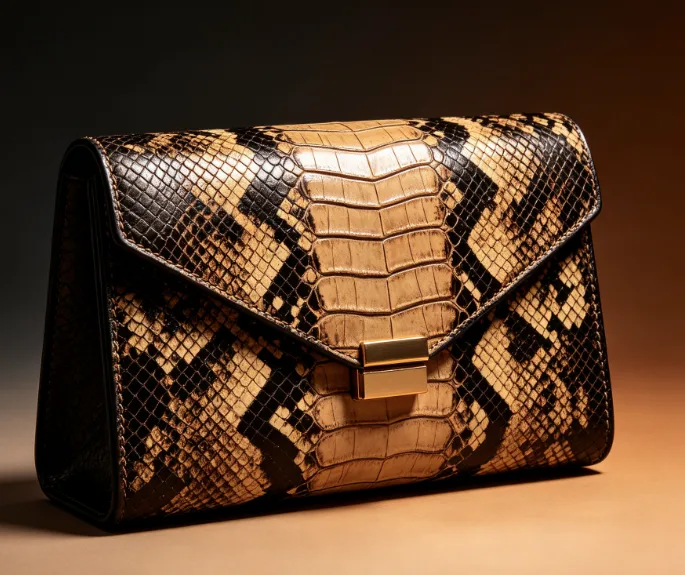
Python leather sits one tier below ($$$$, “Very Good” durability). Its appeal is tactile — lightweight with a bold scale pattern. Quality comes down to alignment. Scales should run straight across the flap and body with no breaks or gaps.
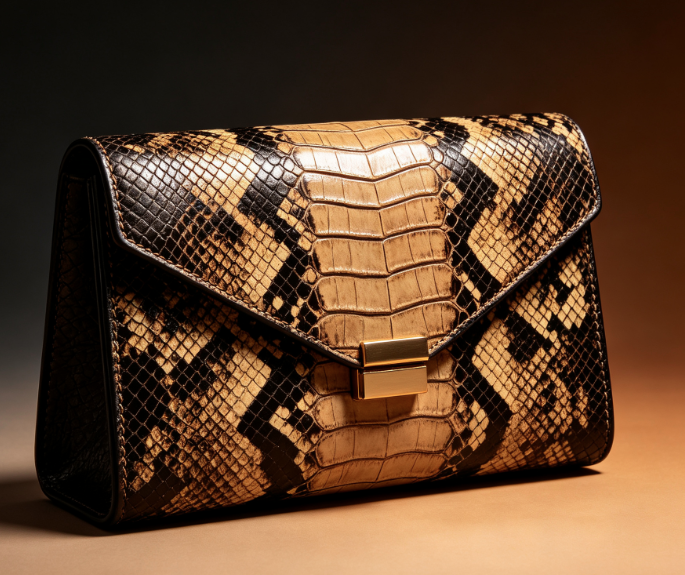
Ostrich leather matches crocodile’s durability rating but has a very different feel. You get a signature quill-dot pattern and an unusually soft hand feel. That combination makes it a go-to choice for high-end evening pieces.
High-Grade Conventional Leathers
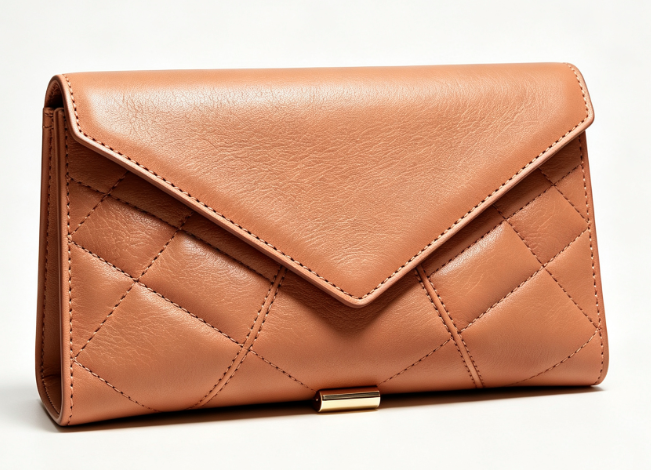
Lambskin (0.8–1.2 mm thickness, $$$ tier) delivers the softness luxury buyers want — though it gives up some durability in return. Italian calf leather is the benchmark material in Saint Laurent envelope clutches and top Italian luxury pieces. Quilted, it layers at 2.5–3.5 mm, giving the clutch structure without making it stiff. Patent leather hits its high-gloss formal finish at a surface gloss above 85 GU — consistent, measurable, and built to hold that mirror shine through repeated use.
Statement Non-Leather Surfaces
Some luxury clutches skip leather altogether. The Paco Rabanne 1969 Nano is built from rows of 3–4 cm metal discs linked by metal rings. It weighs 300–600 g and works as wearable jewelry as much as a bag. Bottega Veneta’s Intrecciato woven leather uses strips 7–12 mm wide in a double-layer weave. You get both flexibility and visual depth from that construction. By Far’s Amber bags show how finish variation — buttery suede, holographic calf, croc-embossed leather — can become a luxury differentiator on its own. Embossed options sit 1–2 price tiers below real exotic skin, but still carry a premium feel.
Material choice drives evening clutch pricing more than anything else. Standard calf or lambskin with quality hardware lands in the $200–$600 range. Step up to exotic skins with premium hardware, and the price floor moves to $800–$2,000+. The reasons are concrete — you can see them, feel them, and measure them.
Craftsmanship Details That Signal Genuine Luxury Bag Quality
Most buyers check the outside surface and move on. That’s where luxury brands pull ahead of the competition — in the details you only spot once you slow down and take a closer look.
Evening bag craftsmanship is something you can measure. No guessing needed. A few simple tests tell you everything.
Stitch Quality: The First Number to Check
Count the stitches. Luxury evening bags target 7–10 stitches per inch (SPI) on main seams. Saddle-stitched or reinforced lockstitch construction hits 8–10 SPI on stress areas. Anything below 4–6 SPI on a handle base or corner is a clear sign of non-luxury workmanship.
Also check consistency, not just density. Every stitch should be the same length, straight, and spaced evenly. Skipped holes, puckering, or loose thread ends — on the exterior or lining — point to rushed production. Reinforced backstitching should appear at all high-stress points: strap anchors, handle bases, and corners.
Hardware: The Magnet Test and the Tap Test
Two quick tests show hardware quality right away. Hold a magnet to a hidden area. A strong magnetic pull means iron alloy or cheap zinc — not solid brass. Solid brass and premium metals show little or no reaction. Then tap the hardware. Genuine brass gives a dense, soft click. Cheap alloy produces a thin, tinny ring.
Check plating under strong light. Look for a consistent tone with no cloudy patches or micro-bubbling. Engravings should be crisp, centered, and cut to an even depth — never shallow or fuzzy. Zippers must glide with zero catching and stay closed once the bag is folded shut.
Leather Behavior and Edge Finishing
Press your thumb into a hidden leather panel. Full-grain and top-grain leather springs back within 1–2 seconds. A slow return, a lasting dent, or a papery sound during a pinch-release test signals heavy coating or low fiber density. A chemical smell is another red flag. Quality leather has a clean, warm scent.
Edge finishing reveals how much care went into production. Run a fingernail along every exposed edge. Luxury bags feature multi-layer hand-painted or burnished edges — smooth, rounded, glossy, and consistent in paint thickness from one end to the other. Rough, gritty, or chalky edges mean corners were cut. Corner paint should be crack-free with no color mismatch.
Structure and Interior
Set the bag on a flat surface. It should sit straight without any twist. Handles align. Panels sit balanced. Quilted patterns line up at every seam and flap edge.
Open it all the way. The lining should feel soft, dense, or silky — not thin or scratchy. Interior seams should match the exterior stitch quality: even, clean, and free of glue residue. Pockets should feel anchored and solid. Check for date codes and serial stamps too. Clean alignment and correct font are the baseline for any authentic luxury piece.
Hardware Excellence: The Overlooked Marker of a Designer Clutch Bag
Most people inspect the fabric, run a finger along the seams, and call it done. The hardware gets a glance at best. That’s a mistake — because clutch bag hardware details are where manufacturers either commit to quality or cut corners without you noticing.
The metal tells the story. Luxury designer clutches use solid brass or 304 stainless steel on every load-bearing component: frames, clasps, and chain attachment rings. Zinc alloy shows up in budget hardware because it’s cheap. But it’s also brittle and prone to cracking under stress. It’s lighter too — in a way that feels flimsy the second you pick it up.
Plating thickness is the number most buyers never think to ask about. On a high-end evening clutch, 18k gold plating should reach 2–3 µm on high-touch parts like clasps and chain rings. Below 2 µm, the base metal starts showing through within months of regular use. A complete luxury plating stack adds a nickel undercoat of at least 0.5 µm before the decorative layer. That foundation stops the top finish from peeling too soon.
Three Quick Tests Worth Running
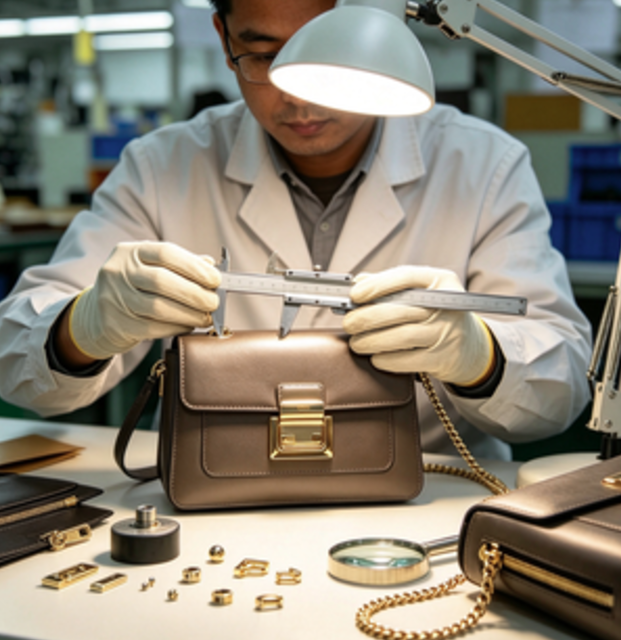
You don’t need lab equipment to evaluate hardware quality:
-
The magnet test — Press a magnet to a hidden hardware surface. A strong pull means iron alloy or zinc. Solid brass has almost no reaction.
-
The drag-and-snap test — Close the clasp and pull outward with force. Luxury closures engage with a crisp, resistant snap. A soft or grinding response signals poor tolerance or thin plating.
-
The directional light check — Hold the hardware under strong light. Look for micro-pits, cloudy patches, or uneven color. Visible gouges after short use point to plating under 0.5 µm — well below luxury standard.
Why Precision Tolerances Matter
Frame alignment tolerance on a quality evening clutch should stay within ≤ 0.3 mm variance. Go past that threshold and you get visible gaps at the corners, crooked frames, and stitch stress that speeds up wear. Clasp mechanisms should handle 2,000+ open/close cycles with no functional failure or plating breakdown at the contact points.
The price signal here is a solid indicator. At $800–$1,000, you start seeing genuine brass hardware with strong plating and tested closures as a standard. Below $500, zinc alloy and thin electroplating are the norm. Above $2,000, you’re paying for hand-polished edges and custom-milled frames — hardware that gets treated like jewelry on its own terms.
Silhouette, Structure & Design: How a Luxury Evening Bag Makes a Statement
Shape communicates first. The silhouette tells the room what kind of piece you’re holding — before the fabric registers, before the hardware catches the light.
Four shapes dominate luxury evening wear: the envelope clutch, the minaudière or box clutch, the structured frame bag, and the compact mini bag. Each sends a different signal. The envelope clutch reads as polished and minimal. The minaudière is built to dazzle — rigid, hard-cased, made for galas and red-carpet moments. A structured frame bag brings architectural presence without the bulk. A compact mini makes a shape-led statement without looking oversized.
What Makes a Silhouette Read as Luxury
The key word is structure. Sharp edges, trapezoidal profiles, and rigid sides signal intention. Soft, slouchy forms don’t deliver that. Luxury bags also stay small by design — minaudières and clutches keep a tight scale. Statement value comes from geometry, finish, and detail. Capacity is not the point.
Surface treatment pushes everything further. Metallic finishes, embellished fabrics, and tactile materials make a defined shape hit harder. Stick to one dominant visual cue — metallic surface, sculptural hardware, or strong texture. Stack all three at once and the effect falls apart.
Design Language Combinations That Work
Different occasions call for different approaches:
-
Minimal-luxury: black leather envelope + sharp edges + polished hardware — the most consistent year-round performer
-
Glamour-luxury: metallic minaudière + rigid shell + decorative closure — strongest pick for galas and events
-
Artisan-luxury: embroidered or textured clutch + compact geometry + tonal finish
-
Modern-luxury: structured frame bag + clean geometry + gold or silver hardware
Practical Structure Benchmarks
Functional details matter even in fashion-first pieces. Closure quality counts — magnetic snaps, turn-lock clasps, or zippers keep a small bag secure without breaking the design line. Weight needs to stay low. A heavy clutch causes hand fatigue and kills the easy, effortless carry that makes an evening bag work. The bag includes a strap? Check the handle drop and length for real wearability, not just how it looks in photos.
Size, Capacity & Functional Elegance: What to Look for in a Luxury Clutch Bag
A bulging clutch loses its luxury the second you close it. Doesn’t matter what’s inside or how much you paid for it.
Size is a functional decision, not just an aesthetic one. The right dimensions let you carry what you need, close the bag with a clean snap, and hold it without strain for hours. Get the proportions wrong and nothing else about the piece matters.
The Three Size Bands
|
Size |
Dimensions (W × H) |
Best For |
Fits |
|---|---|---|---|
|
Small |
~18 × 14 cm |
Black tie, weddings |
Phone + cards + 1 lipstick |
|
Medium |
20–25 cm wide |
Dinners, events |
Phone + slim wallet + keys + 1–2 cosmetics |
|
Large |
~28 × 22 cm |
Statement looks, taller frames |
More room, but risks losing clutch delicacy |
Depth is the number most buyers miss. Most people focus on width and height — but gusset depth is what separates a functional clutch from a decorative one. A minimum 3.5–4 cm gusset lets a well-built 18–22 cm clutch hold a smartphone, card case, keys, and lipstick with no visible bulging. Flat-profile clutches without that depth look refined on a shelf. Load them up and they fail fast.
The 80% Rule and Why It Matters
Your clutch can hold more. Fill it to 80–85% of capacity anyway. This is a real industry threshold, not a styling suggestion. An overfilled clutch strains at the corners, stresses the closure, and makes the problem visible to everyone in the room.
Test it this way: close the loaded clutch and set it flat on a surface. It should lie flat without rocking. If it rocks or tilts, it’s either overfilled or undersized for your needs.
Proportion Against Your Frame
-
Petite frames: keep width at or under 22 cm — anything wider starts to overwhelm your silhouette
-
Taller frames: widths up to 28 cm work well, as long as depth stays controlled and structure stays clean
-
Universal rule: the clutch tucked under your arm should not extend past your forearm. Past that point, it reads as a small bag — not an elegant clutch
One Functional Check Before You Buy
Slide your phone in straight — not at an angle. Rotating it sideways to close the bag means the capacity is there on paper but breaks down in real use. The internal opening needs to be at least 0.5–1 cm wider than your phone’s length. For large phones around 16 cm, target an internal opening of 17–18 cm+ — measured inside the frame, not across the exterior.
Luxury lives in the details. For a clutch, the most honest detail is simple: does it close with a clean, flat finish after you’ve packed it for a real evening out?
How to Match a Luxury Evening Clutch Bag to Your Occasion and Outfit
A wrong clutch at the wrong event doesn’t just look off — it silently pulls apart everything else you’re wearing. Matching a luxury evening clutch bag to your occasion and outfit comes down to a few clear, repeatable rules.
Match Formality First
Your occasion level sets the starting point:
-
White-tie / state dinners: Go with hard-case minaudières in precious metal or gemstone-accented designs. Stick to black, silver, gold, or deep jewel tones. Visible logos or large patterns should cover no more than 5–10% of the bag’s surface.
-
Black-tie (galas, formal weddings): Classic envelope or box clutches in black, gold, silver, emerald, sapphire, or ruby work well here. Keep embellishment — beading, crystals, embroidery — to borders or the clasp. Aim for 20–30% surface coverage at most.
-
Cocktail / semi-formal: You get more freedom here. Unique shapes, bolder colors, and artistic textures all work. Keep the scale small to medium.
-
Business dinners / office evening events: Sleek leather or satin in neutral tones — black, navy, taupe. Keep hardware minimal. Match the clutch’s formality to your shoes, not just your outfit.
-
Casual evening (date night, dinner): Soft clutches or compact pouches are a solid choice. A metallic or patterned option can carry the whole look — just keep the rest of your outfit simple.
Color, Finish, and the Outfit Balance Rule
One principle drives most clutch styling decisions: balance the visual weight between your outfit and your bag.
-
Statement outfit → quiet clutch. Bold color, heavy embellishment, or a strong pattern on your dress? Pick a smooth, solid, minimal clutch in a neutral tone.
-
Simple outfit → statement clutch. A solid, neutral gown is the perfect backdrop for a metallic evening purse, a beaded clutch bag, or a crystal-covered minaudière.
Not sure about color matching? Use the bookend rule — match your bag to your shoes, not your outfit. A black pump paired with a black clutch creates visual anchors that hold the whole look together, no matter the dress color.
For metallics: gold and champagne suit warm-toned outfits (reds, ivories, browns). Silver and platinum pair with cool tones (blues, greens, black). Both metallic finishes push perceived formality up about one level — so a cocktail look can read as black-tie territory.
Material Alignment by Occasion
|
Occasion |
Recommended Materials |
|---|---|
|
White-tie / very formal |
Satin, silk, high-gloss patent, metal minaudière |
|
Black-tie |
Satin, velvet, metallic leather, beaded or crystal overlays |
|
Cocktail |
Embossed leather, snakeskin-effect, acrylic, printed fabrics |
|
Corporate evening |
Smooth leather, polished hardware, clean lines |
Stick to one texture focal point per look. A dress that’s heavily textured or sequined? Limit clutch sparkle to the clasp or trim — nothing more.
A Practical 3-Step Matching Checklist
-
Classify your occasion — white-tie, black-tie, cocktail, business, or casual evening. This alone narrows down your clutch category.
-
Identify your outfit’s focal point — a bold dress earns a quiet bag; a minimal dress earns a statement piece.
-
Confirm scale — for petite frames or delicate gowns, stay under 18 cm width. For taller frames or structured gowns, 20–22 cm is the practical upper limit.
Building a small collection that covers most formal events? Three pieces handle 80–90% of occasions: a black envelope clutch in smooth leather or satin, a metallic minaudière in silver or champagne gold, and one structured frame clutch in a deep jewel tone or neutral metal. Add a crystal or beaded accent clutch for evenings where the gown stays minimal and the bag does the work.
Custom-Made vs Designer: Understanding the Pinnacle of Luxury Evening Clutch Bags
Two paths lead to the top of luxury evening clutch bags — and they solve different problems.
Designer clutches from houses like Chanel, Judith Leiber, and Saint Laurent offer proven craftsmanship, instant availability, and resale value you can bank on. Custom-made ateliers offer something else: a piece built around your exact specifications, your wardrobe, your event. Neither is the better choice for everyone. The difference tells you exactly where your money goes.
What You’re Paying For
The price gap between tiers is real — and the reasons are concrete.
Designer evening clutches break into two clear bands:
– Mainstream luxury (Saint Laurent, Furla, Coach): $300–$800. The Saint Laurent Uptown Pouch at ~$800 is a well-known benchmark. It comes in smooth or embossed leather, a clean envelope silhouette, and strong cost-per-wear for versatile styling.
– High-end luxury (Chanel, Dior, Judith Leiber): $800–$2,500+. Judith Leiber crystal minaudières run $2,000–$6,000+. Many styles retain 50–100% of retail value at resale. Limited editions sometimes exceed the original price.
Custom-made evening clutches run on different economics:
– Standard custom (full-grain leather, custom hardware, hand-finishing): $1,000–$3,000
– Ultra-luxury custom (exotic skins, precious-metal frames, gemstone embellishment): $5,000–$15,000+
Here’s the key structural difference. In a mass-produced designer clutch, brand markup takes up the largest share of cost. Labor represents around 10–15% of the price. In a custom piece, labor and design time account for 40–60% — that includes pattern development, prototype construction, hand stitching, and custom hardware sourcing. You’re paying for hours, not logos.
Lead Time: The Hidden Cost of Going Custom
Designer pieces are available right away or within 2–8 weeks for pre-orders and limited editions.
Custom-made follows a different timeline:
– Design consultation and sketch approval: 1–3 weeks
– Pattern making, material sourcing, prototype, and final construction: 4–12 weeks
– Total: 6–16 weeks from first consultation to finished clutch
Got an event in three weeks? Custom is not an option. Commissioning a piece for a wedding six months out? The timeline works in your favor. You end up with something no one else will ever carry.
Where Custom-Made Is Worth the Investment
Custom-made makes sense in specific, concrete scenarios:
-
You need precise color matching to couture or bridal garments — Pantone-matched silk or custom-dyed leather that no retail line stocks
-
You need non-standard dimensions — an ultra-slim profile for a minimal look, or extra depth to fit a specific device
-
You want unique iconography — a family crest, custom monogram clasp, or initials cast in metal
-
You need material combinations unavailable at retail — full-grain leather body paired with hand-embroidered silk front and a solid silver frame
Where Designer Is the Smarter Choice
Designer wins on efficiency in these situations:
-
You want proven resale value — Chanel and Judith Leiber pieces hold 40–80% of retail within 3–5 years; rare minaudières sometimes exceed original price
-
You need the clutch within 1–2 weeks
-
You prefer iconic, recognizable silhouettes with standardized interior layouts that fit your essentials without guesswork
Mid-tier contemporary designer clutches resell at 20–50% of retail. Trend sensitivity and production volume work against them. Factor that in before treating any purchase as an investment.
The Cost-Per-Wear Reality Check
Raw price is the wrong number to focus on. Cost per wear tells the honest story:
|
Piece |
Price |
Wears |
Cost Per Wear |
|---|---|---|---|
|
Designer clutch |
$800 |
10 |
$80 |
|
Couture designer |
$2,500 |
25 |
$100 |
|
Custom atelier |
$3,000 |
30 |
$100 |
The numbers converge — but only if you use the piece. Plan to wear a high-end designer clutch at least 5 times to justify the spend. For custom-made, 10+ wears is the honest minimum. A custom clutch worn twice and stored is an expensive mistake. One that travels with you across a decade of formal occasions becomes a personal luxury asset.
Resale value for custom-made pieces depends almost entirely on the maker’s name recognition. Unknown ateliers recover under 30–40% of original price on secondary markets. The real value lives in the object itself — in the fit, the finish, and the fact that it was made for you.