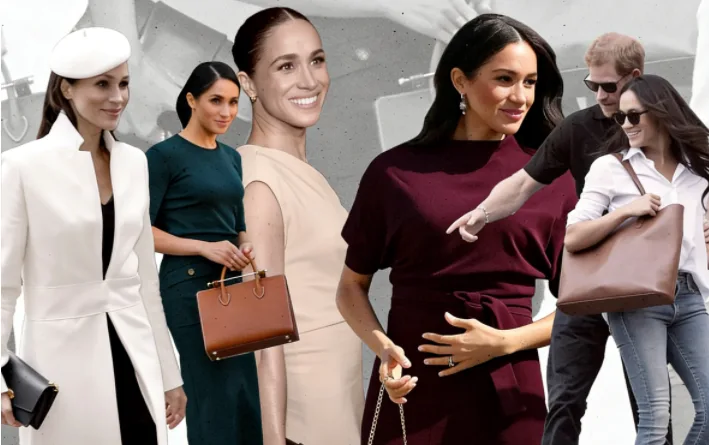
Every time Meghan Markle steps out with a sleek black bag, something remarkable happens. Waitlists form. Search volumes spike. Manufacturers scramble to copy what made that silhouette so irresistible.
But most of them miss the point. It was never about the bag itself. It was about the decision-making behind it.
What bag manufacturers can learn from Meghan Markle’s classic black bags runs far deeper than looks. Think positioning, material strategy, price structure, and low-key branding that turns one-time buyers into lifelong customers. Eight clear lessons are hiding in plain sight — and the smartest bag manufacturers are already using them to shape their next product lines.
The “Markle Effect” Is Real — And the Data Proves It
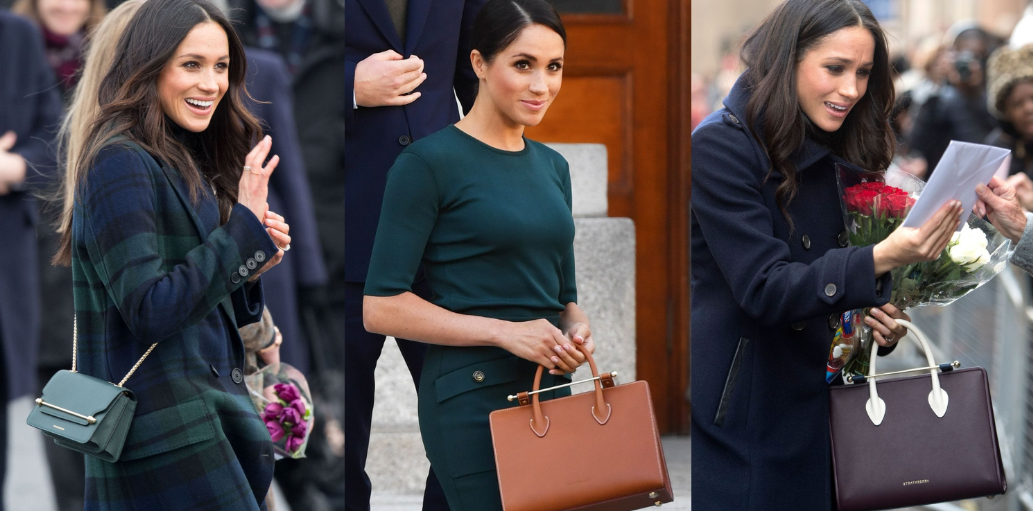
Fashion economists have a name for it. The “Markle Effect” describes her proven ability to shift consumer behavior by being seen with a product. It is not hype. It has academic roots.
Thorstein Veblen mapped this dynamic back in 1899. In The Theory of the Leisure Class, he argued that wealthy, high-profile individuals push purchasing behavior through conspicuous consumption. Meghan Markle is a clear, modern example of that theory in action—especially in how her choices influence demand for products like those developed by a black bag manufacturer targeting premium markets.
Her influence stands apart from standard celebrity endorsements because of one thing: measurability. Strathberry waitlists surged after her royal debut. Oroton’s crossbody sold out after a public appearance. The cause-and-effect was direct and visible. These were not vague brand lifts. They were sharp, traceable spikes—signals that any black bag manufacturer can study to better align product development with real-time market demand.
For bag manufacturers, that distinction matters. General celebrity placement creates noise. Markle’s carry choices create something different — demand with intent. These are buyers who research, compare, and convert.
That is the market signal worth building around.
Lesson 1: Black Is Not a Color — It’s a Custom Bag Strategy
Black accounts for 44% of the best-performing fashion logos in the world. That stat alone tells you something. Meghan Markle’s bag choices make it concrete.
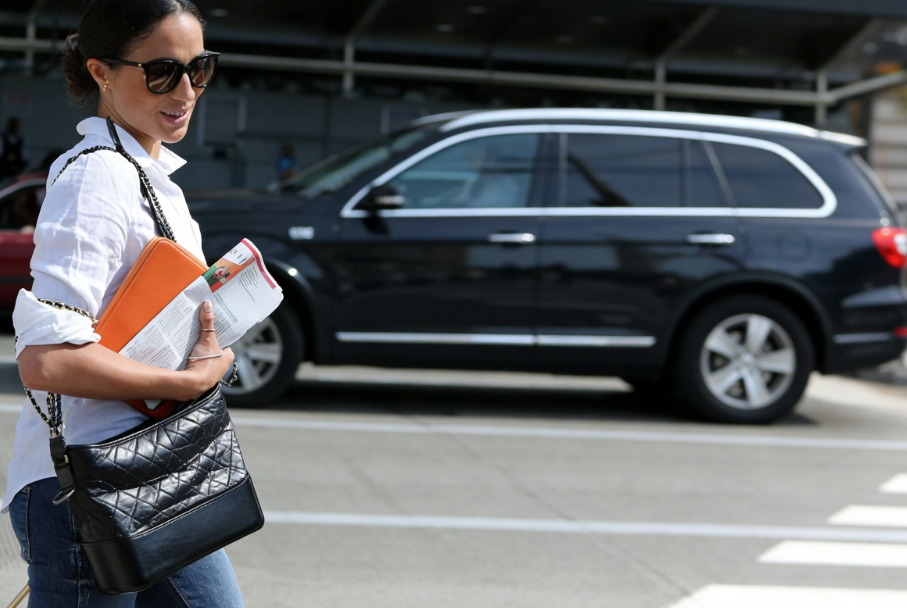
She doesn’t reach for black because it’s safe. She reaches for it because it works — across seasons, across occasions, across every camera angle. Her Mulberry grain leather, Cuyana smooth leather, and Strathberry mini all share one anchor: black. Different brands, different price points, same instinct.
The data behind the decision is hard to argue with:
-
85% of consumers make purchasing decisions based on color alone
-
Black achieves 20–30% faster sell-through compared to colored alternatives
-
Cross-seasonal neutrals like black drive 70%+ repeat purchase rates
-
Black appears in 85% of high-end product lines built for steady, long-term sales
For manufacturers, those numbers have a clear impact on inventory health. A black-anchored core line cuts SKU complexity by 40–50%. That means one strong black per silhouette. No chasing a color rotation that goes stale within a season.
Finish selection matters too. Classic grain leather signals durability. Smooth leather reads as sleek and modern. Nubuck carries a matte, handcrafted softness. Each finish sends a different message. Yet all three fit well within the same black range.
The practical benchmark: anchor 60% of leather black bag production in black grain or smooth. It’s not a creative limitation. It’s a commercial foundation — the kind Meghan’s bag choices reinforce every time she steps outside.
Lesson 2: Signature Hardware Outperforms Logo Branding
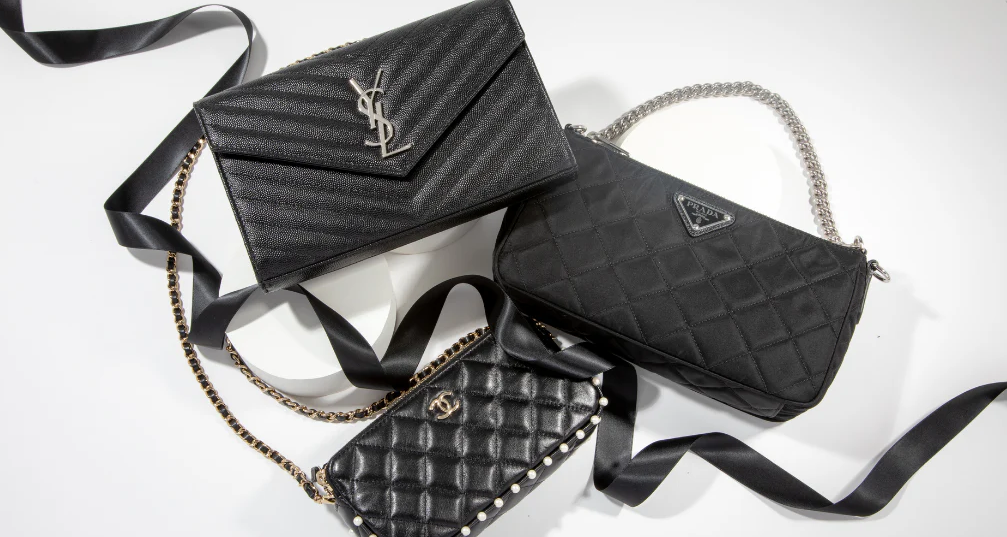
Hardware is the most honest part of a luxury bag. You can’t fake the weight of solid brass. You can’t copy the crisp mechanical click of a precision turn-lock with a cheaper zinc casting. Buyers — even those who can’t explain why — feel the difference right away.
That sensory experience is what Meghan Markle’s bag choices keep proving. The Strathberry bar closure. The Mulberry Postman’s lock. Neither puts a logo front and center. Both are recognizable at a glance. The principle is simple: signature hardware builds recognition through form, not typography.
Dior’s Cannage quilting works the same way. It’s a structural pattern that acts as a brand code — no letters, no logo printed anywhere on the surface. Recognition comes from design. Not marketing spend.
The manufacturing economics behind this matter:
-
Generic zinc alloy fittings: $0.08–$0.09/piece — commodity hardware with zero differentiation
-
Mid-tier customized OEM hardware: $0.37–$1.48/piece — shape or logo modification
-
Custom mold investment: one-time R&D cost, spread across every bag production run
Most manufacturers miss the point on that last one. A proprietary closure mold is a capital barrier competitors can’t cross without serious investment. Every unit sold reinforces the signature — no extra marketing needed. Logo branding demands constant spend just to stay visible. Signature hardware bakes recognition into the object itself. That stays.
Material substrate is where the signal lives:
|
Material |
Density Feel |
Brand Signal |
|---|---|---|
|
Solid Brass |
Heavy, warm touch |
Premium / Heirloom |
|
Stainless Steel 304/316 |
Cold, heaviest |
Technical luxury |
|
Zinc Alloy (Zamak) |
~18% lighter than brass |
Mid-market |
There’s a quick field test worth knowing. Tap the hardware sample on a hard surface. A hollow sound means zinc — no matter how good the plating looks. Buyers run this test without thinking, every time they pick up a bag.
Plating thickness sets the durability floor. The minimum viable spec is 2–3 microns. Drop below that, and daily skin contact plus friction tears up the finish fast. That destroys brand equity at the exact moment someone is using the product.
For smaller manufacturers, three practical entry points exist:
-
Custom closure mold — commission one hero closure in solid brass. A single turn-lock or bar closure, built with precision, becomes a brand asset that grows stronger over time.
-
Structural stitching pattern — Dior’s Cannage approach uses leather dies, not metal casting. Lower tooling cost, same recognition effect.
-
Proprietary finish stack — start with standard brass hardware, then add a custom plating specification on top. You protect it through finish secrecy, and the capital requirement stays well below a full mold.
Small-batch custom hardware is already happening. New York leather artisans source hand-cast solid brass fittings from an English foundry in small runs. The foundry relationship is the access point — not the production volume. Scale is not a requirement.
What bag manufacturers can take from Meghan Markle’s hardware choices comes down to one shift: stop treating closures as functional necessities and start treating them as brand infrastructure.
Lesson 3: Size Selection Is a Market Positioning Decision
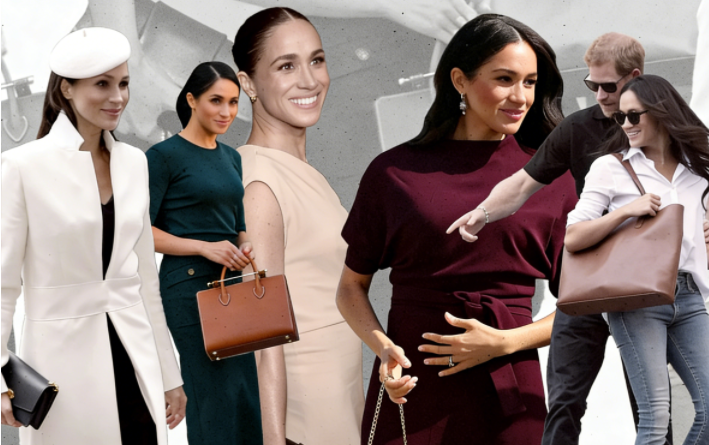
The Gucci super mini holds a phone and a card. The Strathberry large Midi Tote fits a laptop and a change of shoes. Neither size is accidental.
Meghan Markle’s bag choices span both ends of that spectrum — and that’s no mistake. Every size she carries has a clear functional identity. That clarity is what drives purchase intent. Buyers don’t just buy a bag. They buy a bag that solves a specific problem in their day.
Most manufacturers treat size as a scaling exercise: take the hero silhouette, shrink it, enlarge it, call it a range. That misses the point. Size is a positioning decision before it’s a bag production decision.
Think of it this way:
-
Compact sizes (mini, micro) — target the buyer who wants style with minimal commitment. Lower entry price. High gifting volume.
-
Mid sizes (day bag, structured tote) — the daily-use core. Broadest market reach. Highest repeat purchase potential.
-
Large sizes (travel tote, work carryall) — premium pricing backed by utility. Appeals to professional buyers with specific functional needs.
Each bracket speaks to a different customer. Pushing one size to serve all three won’t broaden your reach. It blurs your positioning and cuts conversion across every segment.
The practical rule: define the job before you define the dimensions. What occasion does this bag own? What does the buyer already carry in it? Start with those answers. The measurements come after.
Lesson 4: Ethical Bag Manufacturing Is Now a Commercial Differentiator
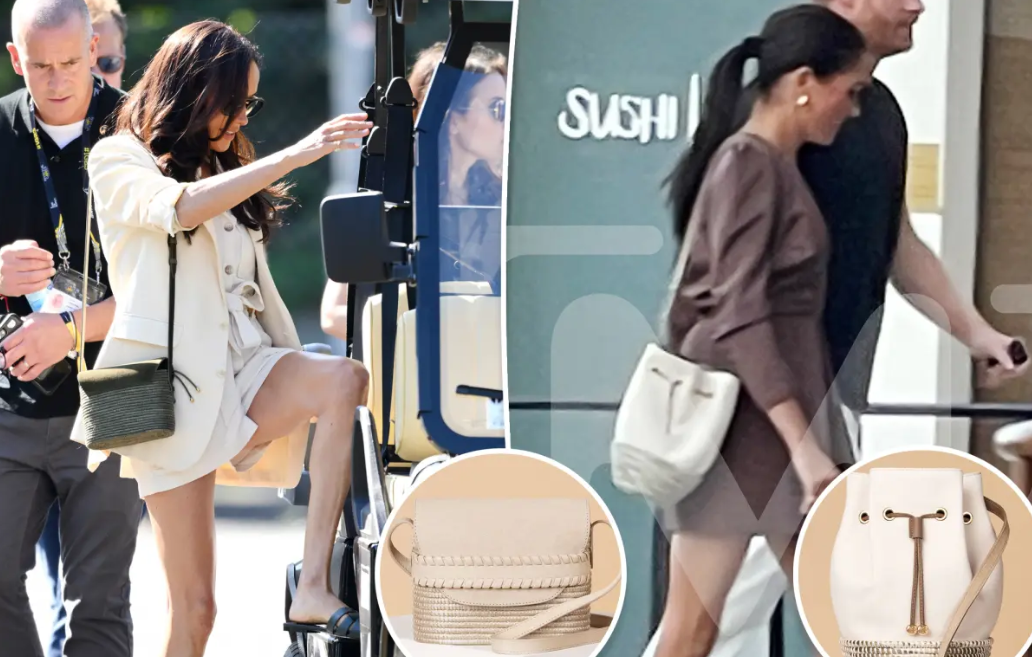
Meghan Markle doesn’t just carry bags. She carries brands — and the values those brands represent show up directly in sales data.
Her audience watches more than silhouette. 82% of shoppers say a brand’s values should match their own. For bag manufacturers, that number carries real commercial weight. Buyers filter by ethics before they filter by price.
This is not a soft trend. It’s a purchasing mechanism.
The data points worth building around:
-
63% of consumers trust brands that prove transparent sourcing — not just claim it
-
86% of beauty shoppers want to know where ingredients come from. Bag buyers now expect the same answers about leather origin, hardware sourcing, and factory conditions
-
75% of businesses treat circularity as important today — that figure is projected to reach 95% within three years
Adidas and Allbirds turned ethical manufacturing into market positioning. Adidas made 11 million pairs of shoes from recycled plastics in a single year. They turned that number into a commercial story, not a footnote.
So what’s the practical shift for bag manufacturers? Quantify the ethics, then communicate them. Vague sustainability claims build nothing. Specific data does. Share your on-time performance rates, material traceability records, and recycled content percentages. That kind of detail builds trust with buyers, investors, and retail partners all at once.
EU CSRD reporting rules are pushing global supply chains toward full disclosure. Manufacturers who build that infrastructure now get access to markets that require it. Those who wait lose the partnership window.
Ethical bag manufacturing is no longer a cost center. It’s a sourcing credential — and credentials close deals.
Lesson 5: The £500–£900 Price Band Is the Sweet Spot Manufacturers Are Underserving
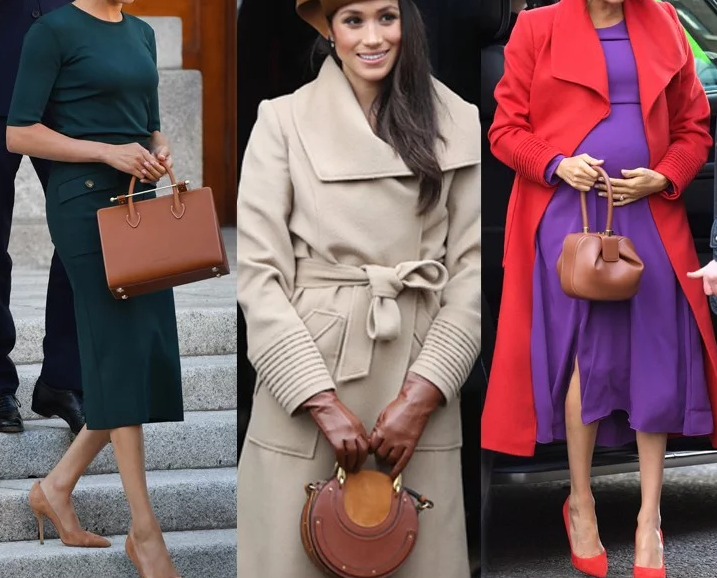
Mid-market handbag prices jumped 33% in Europe and 38% in the US in FW25. That’s the biggest increase across all fashion categories, based on Lectra’s Retviews data. That number isn’t just impressive. It’s a market signal most manufacturers are walking past.
Meghan Markle shops in this price corridor. Strathberry at ~£495. Mulberry at ~£695. Cuyana at ~$398. These brands sit on purpose between high street (£50–£150) and true luxury (£2,000+). The price point signals quality without needing conglomerate heritage. Buyers here are ambitious, but they still weigh value. Mass-market spending can drop — this band holds anyway.
The competitive landscape explains the opportunity:
-
Ultra-luxury (£2,000+): Locked up by LVMH, Kering, and Richemont. You can’t break in without runway presence and established distribution
-
Fast fashion (£50–£150): Saturated and margin-compressed, with zero loyalty premium
-
£500–£900: Few players, growing fast, and absorbing price increases that mass-market buyers simply won’t accept
What Entering This Band Takes
The barrier isn’t production capability. It’s brand infrastructure. Brands winning here — Strathberry, Polène, Danse Lente — are brand-led companies that control manufacturing. Not the other way around.
The non-negotiables at £500+:
-
Genuine leather — PU destroys consumer trust at this price point
-
Visible brass or gold-tone hardware — plated zinc reads as lower tier straight away
-
Structured silhouettes with internal architecture
-
Traceable origin — Italian leather, British-made, or a clear supply chain
-
DTC or curated wholesale — mass retail distribution breaks price integrity
DTC gross margins at this tier run 60–75%. That’s why brands like Cuyana push hard into direct channels. Traditional wholesale cuts that down to 30–50%.
One more tailwind worth knowing: US tariffs of 15–50% make UK and European manufacturing a real commercial advantage for brands selling into the American market. “Made in Britain” commands a premium — and avoids the tariff problem entirely.
The white space is real. Most manufacturers are built for volume at low prices. Accessible luxury needs the opposite: fewer SKUs, higher investment per style, and a brand story strong enough for the product to carry.
Turning Observation Into Product Roadmap: A Bag Manufacturer’s Action Checklist
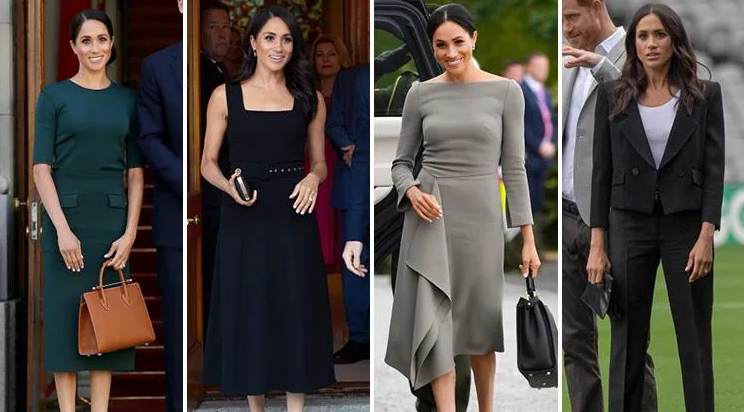
Eight lessons. One question remains: where do you start?
The answer is sequencing. Not every insight from Meghan Markle’s black bag choices carries the same urgency — or the same cost to act on. Smart manufacturers don’t chase everything at once. They build a roadmap with three clear time horizons:
|
Horizon |
Timeline |
Focus |
|---|---|---|
|
Now |
0–6 months |
Hardware spec upgrades, black colorway anchoring, strap geometry fixes |
|
Next |
6–12 months |
Mid-market price repositioning, interior architecture improvements |
|
Later |
12–24 months |
Ethical sourcing credentials, DTC channel build, customization infrastructure |
Quick wins belong in the first sprint. Closure material upgrades and strap modularity changes are high-impact, low-dependency moves. Start there. These are the changes you can ship fast without waiting on big budget approvals or supply chain overhauls.
Structural shifts are a different story. Brand positioning, supply chain transparency, and £500+ market entry all need 12 to 24 months of steady investment. Don’t compress them into a short cycle. They won’t survive it.
One task runs across all three horizons: monitor the celebrity signal. Here’s what that looks like in practice:
-
Track sell-through spikes after high-profile appearances
-
Use social listening to spot demand patterns early — before competitors catch on
-
Feed that data back into your next round of prioritization
That intelligence sharpens every decision you make across the roadmap.
The checklist is simple. The discipline to follow it isn’t.
Conclusion
Meghan Markle doesn’t just carry bags — she proves entire product strategies work. The signals are right in front of you: a clean black palette that works across every season, hardware that builds identity better than any logo, and a price point that millions of buyers are searching for and not finding.
What bag manufacturers can learn from her classic black bags isn’t about copying a celebrity. It’s about reading the market signals she’s already cracked open. Versatility, ethical sourcing, and quiet confidence are not passing trends. They’re the new baseline.
The manufacturers who win the next decade won’t chase hype. They’ll be the ones who built what serious buyers want before the peak hits.
Your next move: Audit your current black bag line against the 8 lessons above. Can’t check at least five boxes? You’re leaving serious margin on the table.