

Flip a leather bag over and you might spot a small Oeko-Tex label — but what does it guarantee? Not all Oeko-Tex certifications are the same. The one that applies to leather bags has a very specific set of requirements. These go far deeper than a general “non-toxic” stamp.
Testing screens for 1,000+ harmful substances. Every zipper, lining, and dye gets evaluated — not just the leather itself. So the standard covers far more than most buyers (and even some brands) expect.
Here’s what the standard covers, what it doesn’t, and how to tell whether a certification claim is legitimate.
What Oeko-Tex Ensures In Leather Bags
For leather bags, the right certification is OEKO-TEX® LEATHER STANDARD — not STANDARD 100, which covers textiles.
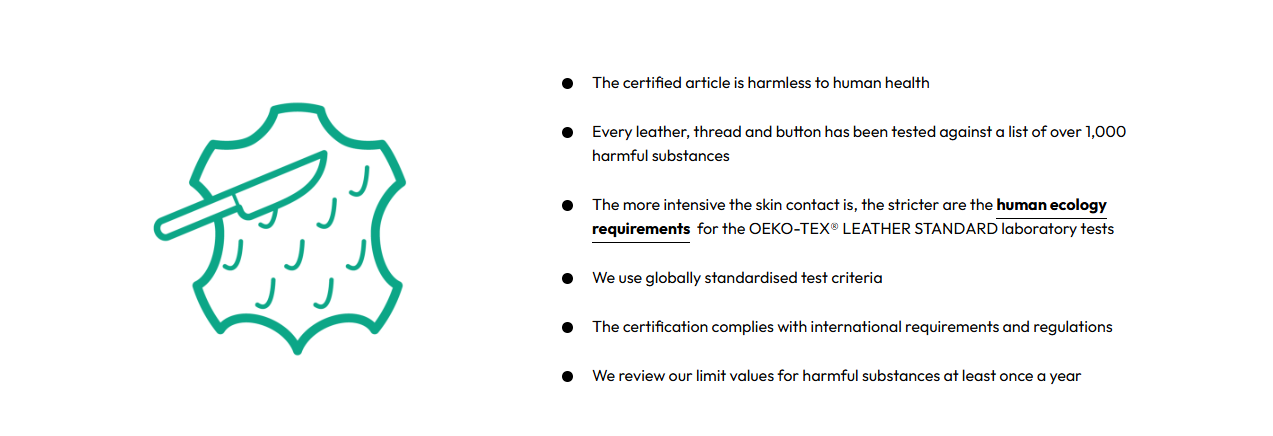
The core guarantee is simple: the certified bag is declared harmless to human health under the standard’s testing criteria. But the testing covers more than most people expect.
Every component gets tested, not just the outer leather:
-
Leather panels
-
Sewing thread
-
Buttons and hardware
-
Any other accessory parts in the bag
There’s also a skin-contact rule built into the standard. Parts that touch skin more directly face stricter lab requirements.
One more detail: certification lasts one year, then needs renewal. Always ask for a current LEATHER STANDARD certificate that covers the specific bag model — not just the leather supplier’s materials.
What the Oeko-Tex Leather Standard Is (And Why It’s Different From Other Oeko-Tex Labels)

The OEKO-TEX® LEATHER STANDARD is its own standalone certification — built for leather from the ground up, not borrowed from textile rules.
That difference is bigger than it sounds. Most people know STANDARD 100 as a textile safety label. It covers products from raw yarn to finished fabric. The LEATHER STANDARD runs as a separate system, built around the chemistry and production process of leather itself.
It’s not a copy of textile requirements applied to hides. OEKO-TEX states that the Leather Standard combines leather-specific controls with a broader harmful-substance framework. The testing criteria reflect how leather is made and used — not how fabric is.
The standard covers a wide range of leather products:
-
Ready-made leather articles (finished bags, wallets, accessories)
-
Semi-finished materials — including wet blue (chrome-tanned) and wet white (vegetable-tanned) hides
-
Bonded leather
One edge case worth knowing: a textile product with leather accents does not qualify for LEATHER STANDARD certification. It falls under STANDARD 100 — unless leather makes up the majority of the product.
The standard also fits inside OEKO-TEX’s broader modular system. That system tracks input, process, and output across supply chains. In April 2025, OEKO-TEX introduced stricter transparency requirements for leather supply chains. That move signals that oversight in this category is getting tighter — not staying flat.
Chemical Safety: The 1,000+ Harmful Substances It Screens For
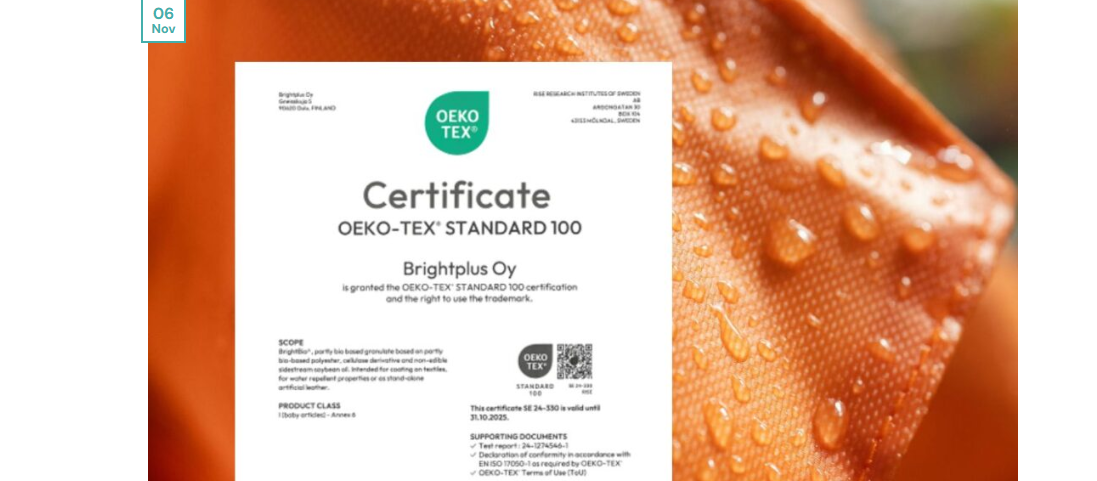
The number 1,000 actually understates it. Chemical safety screening — the kind behind certifications like the OEKO-TEX® LEATHER STANDARD — cross-checks against 1,000 to 5,000+ distinct hazardous substances. It pulls from multiple regulatory lists at once. That scale reflects a hard reality: over 80,000 chemicals are registered for commercial use in the U.S. alone. List-based screening of the worst offenders is the most practical front-line tool available.
What Lists Feed Into the Screening
No single regulation covers everything. Screening draws from a stack of overlapping frameworks:
-
EU REACH SVHC list — 240+ substances of very high concern, including carcinogens, reproductive toxicants, and endocrine disruptors
-
California Proposition 65 — 900+ chemicals known to cause cancer or reproductive harm
-
Stockholm Convention POPs — 30+ persistent organic pollutants (PFOS, PFOA, certain flame retardants)
-
NTP Report on Carcinogens — ~256 known or expected human carcinogens
-
IARC Group 1 carcinogens — ~125 confirmed substances and mixtures
-
US EPA TSCA high-priority chemicals — 20 substances now under active risk evaluation, including formaldehyde and methylene chloride
Each list targets different hazard profiles. Together, they form the 1,000+ substance pool.
What Gets Flagged — and at What Levels
The hazard categories are real and specific. For leather bags, the substances most common in the supply chain include:
-
Heavy metals: Lead, cadmium, chromium(VI), mercury — flagged at ≥0.1% concentration, with cadmium thresholds as low as 0.01%
-
Phthalate plasticizers (DEHP, DBP, BBP): Reproductive toxicants; limits ≤0.1% per individual compound
-
PFAS: PFOS and PFOA flagged under both REACH SVHC and Stockholm POPs — persistent, bioaccumulative, and linked to immune and developmental harm
-
Formaldehyde: A respiratory irritant and TSCA high-priority substance. It shows up often in leather finishing.
-
Azo dyes releasing carcinogenic amines: A direct concern in leather dyeing processes
-
Organohalogen flame retardants: 30 specific chemicals under CPSC evaluation, many classified as PBT substances
The concentration thresholds matter. Carcinogens in mixtures get flagged at ≥0.1% (w/w). Certain reproductive toxicants and potent endocrine disruptors trigger scrutiny at 0.01–0.05% — far below what any consumer could detect or smell.
Why This Matters for Leather Bags
Leather production is chemical-heavy. Tanning, dyeing, finishing, and softening all introduce substances that standard “non-toxic” claims don’t address. A bag can smell fine, feel smooth, and still carry residual chromium(VI) compounds or PFAS from water-resistant coatings.
Screening doesn’t depend on brand self-reporting. The process collects CAS numbers for every input chemical, runs automated cross-checks against all applicable lists, then checks whether concentrations exceed regulatory thresholds. Anything that flags triggers substitution, restricted use, or additional documentation requirements.
That process — applied across every component of a certified bag — is what the 1,000+ substance claim represents.
Every Component of the Bag Is Tested — Not Just the Leather
The leather panel is the easiest part to inspect. It’s also the last place a bag tends to fail.
Real-world QC testing covers a core set of components: leather + seams + zippers + straps and handles + load-bearing structure + carton protection. The Oeko-Tex Leather Standard follows the same logic. Chemical screening applies to every one of those parts — not just the outer hide.
Here’s what that looks like in practice.
What Gets Tested Beyond the Leather
Zippers go through a twisting test in three positions — open, middle, and closed. Testers apply lateral force and hold it for 10 seconds in each direction. This checks both the zipper mechanism and the seams anchoring it to the bag.
Straps and handles go through an abuse and fatigue test. Testers apply stronger-than-normal force to find weak construction points before a customer does. Load tests for backpacks run between 2–20 kg depending on the model, followed by 20 lifts and a 4-hour hang.
Seams get pulled with normal force or a tension gauge — separate from any evaluation of the leather itself.
Color fastness testing involves rubbing with a dry cloth 10 times, then a wet cloth 10 times. This shows whether the dye transfers.
Carton humidity has its own benchmark: below 12%. This reduces mold risk during shipping, especially in rainy-season transit.
Inspectors also wear the bag and operate the zippers themselves. This confirms real-use function — not just visual appearance.
Why This Detail Matters
Identifying real leather doesn’t validate the whole bag. Smell, water absorption, grain variation — these tell you genuine from faux leather. But they say nothing about zipper strength, seam integrity, or what chemicals sit in the hardware dye.
A bag can pass a surface check and still fail at the strap on the third use. Component-level testing is what closes that gap.
What It Means for Brands Selling Oeko-Tex Certified Leather Bags
Stocking an OEKO-TEX LEATHER STANDARD–certified bag is a real business decision. There’s operational weight behind it — not just a marketing upgrade.
The certification covers every component in that bag — leather panels, threads, buttons, zippers, coatings. Each one goes through lab testing against more than 1,000 harmful substances. Lab results must confirm the bag is harmless to human health in its produced state. That scope goes well beyond what most regulatory frameworks require. OEKO-TEX limits run 2–10x stricter than EU REACH and US legal thresholds on the same substances.
What Brands Can and Cannot Claim
Certified brands can make these claims with confidence:
-
“Tested for over 1,000 harmful substances beyond legal minimums”
-
“Third-party verified as harmless to human health”
-
“Safer for sensitive users and prolonged skin contact” — the standard applies tighter limits to straps and handles with high skin contact
What the label does not support: durability claims, colorfastness guarantees, or anything related to physical performance. It’s a human-ecology certification — nothing else.
Operational Realities
Certification is product-specific and model-by-model. Each bag SKU must appear on the certified article register. Certificates expire every 12 months. Annual re-testing of representative samples is required to keep them current.
That renewal cycle has real practical implications:
-
Supply chain chemistry must stay stable batch-to-batch
-
Any material change — new dye, different hardware, updated finish — triggers a lab review before certified production can continue
-
Supplier documentation (tanning chemicals, dye recipes, metal fitting composition) must stay maintained and accessible at all times
Why It Matters in B2B and Retail
For brands selling into larger retail channels, OEKO-TEX LEATHER STANDARD gives you a direct path to retailer RSL (Restricted Substances List) compliance. Most major retailers set their RSL thresholds at OEKO-TEX-level limits. Show up to a buyer meeting with a current certificate. Add a matrix showing how your tested values map to their RSL. That combination removes a major sourcing friction point right away.
It also cuts your regulatory exposure. Leather goods rank among the most flagged product categories at customs for excessive chemical content. A current LEATHER STANDARD certificate covers all components. It gives you documented proof that the risk has been tested and addressed — not just assumed away.
Conclusion
Oeko-Tex certification on a custom leather bag isn’t a marketing badge. It’s a verified promise. Independent labs run 1,000+ chemical screens and test every single component — from the stitching to the zipper pull.
What Oeko-Tex ensures in leather bags comes down to three clear points:
-
Harmful substances are screened out
-
No single part skips testing
-
A third party with no financial interest verifies every claim
What it doesn’t cover — animal welfare, sustainability, or ethical labor — is just as important to understand. Certification has a defined scope. Smart buyers respect that boundary rather than read into it.
So here’s your next step: before your next leather bag purchase, pull up the Oeko-Tex database and check the certification number yourself. It takes 30 seconds. What you find — or don’t find — will tell you a lot.
Smart purchasing starts with knowing what a label truly covers — nothing more, nothing less.