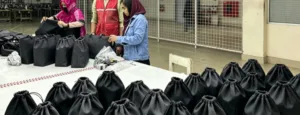
Sourcing custom shoe bags sounds simple — until you compare quotes from factories in China, Vietnam, India, and Bangladesh. The prices, MOQs, and lead times tell four completely different stories. One supplier offers rock-bottom pricing but demands a 10,000-unit minimum. Another charges double for premium craftsmanship. A third ships fast but won’t use eco-friendly materials. Without a framework, picking the right country turns into an expensive guess.
China: Custom Shoe Bag Manufacturing Hub
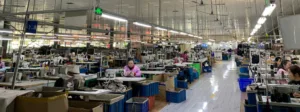
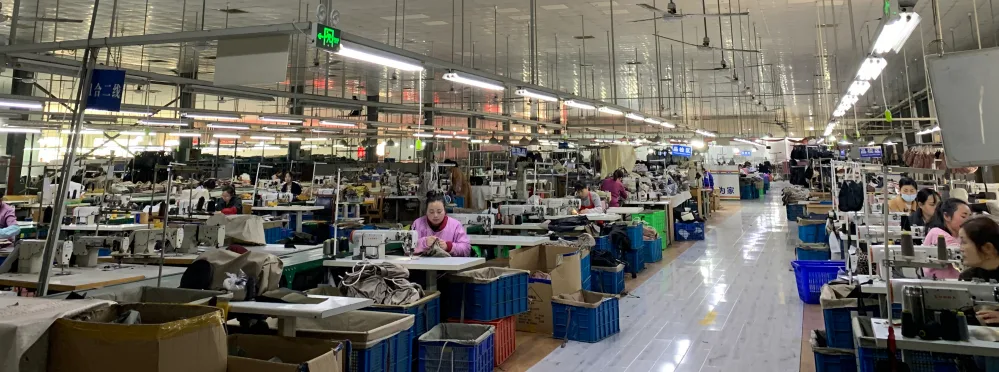
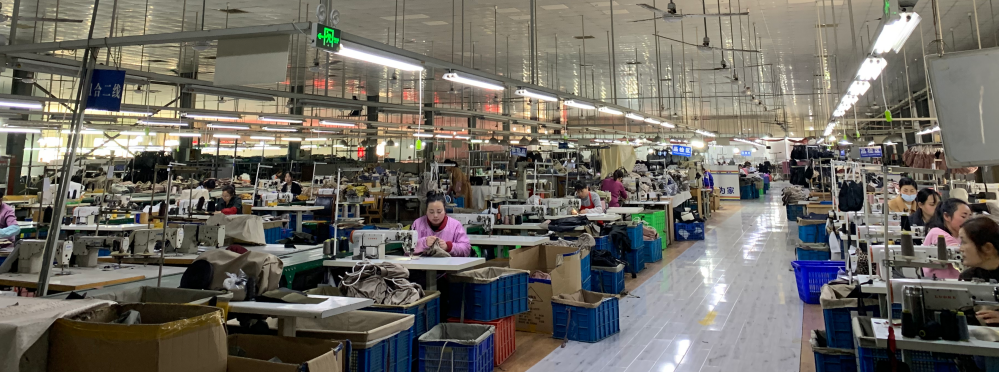
No single city runs China’s shoe bag production. It’s a network of specialized clusters, each with its own strengths. Made-in-China alone lists over 2,000 custom shoe bag manufacturers and suppliers, with 6,000+ products under this category — and other factory directories put the number of verified shoe bag factories closer to 4,000+. This scale is exactly why so many brands treat any shoe bag factory China search as their starting point.
Where Production Happens
Three provinces dominate:
-
Fujian (Xiamen, Quanzhou, Jinjiang, Fuzhou) — footwear and sports/travel bag specialists. Jinjiang’s textile and footwear cluster made China’s 2024 top 100 industrial clusters list.
-
Guangdong (Guangzhou, Dongguan, Foshan, Shenzhen) — large-scale bag/leather OEM supply, known for export-ready capability.
-
Zhejiang (Pinghu, Yiwu, Hangzhou, Wenzhou) — mid-market bags built for export volume using synthetic materials.
Material options are broad: nylon, polyester, cotton/canvas, jute, non-woven fabric, and PVC/waterproof fabric for premium or travel-grade lines. Most factories position themselves as OEM/ODM partners serving footwear brands, retailers, and promotional buyers.
Cost, MOQ, and Lead Time
China sits in the low-to-mid cost range. Pricing swings based on material, printing method, closure style, and lining — non-woven drawstring bags are cheapest, padded or multi-compartment designs cost more. Typical MOQs run 500–5,000+ pieces, and standard lead times fall between 4–8 weeks, covering sampling through packing.
Screening Checklist
Before placing a PO:
-
Request material swatches, stitching specs, and printing proof
-
Get sample lead time, bulk lead time, and QC checkpoints in writing
-
Confirm the factory specializes in shoe bags — not just “bags” generically
-
Verify OEM/ODM support, including custom logo and packaging
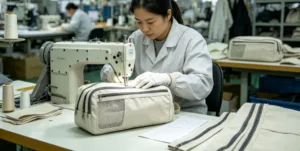
The biggest risk is incomplete spec sheets causing communication gaps, plus quality slips on seam strength, print accuracy, and drawstring durability. Vet for shoe bag-specific experience, and China remains hard to beat for large-volume, multi-SKU sourcing.
Vietnam: High-Quality & Technical Shoe Bag Sourcing
Post-trade-war order shifts pushed a wave of low-to-mid technical manufacturing into Vietnam, and shoe bags rode that wave. A Vietnam shoe bag manufacturer today is better suited to mid-to-high-end brands than to bargain-hunters chasing rock-bottom pricing. Canvas, leather, outdoor, and functional shoe bags — anything needing tighter construction — fit this market well.
MOQ, Lead Time, and Cost Position
-
MOQ: Footwear runs 500–2,000 pairs; bag categories run 300–2,000 pieces per style/color. Larger OEM lines scale to 5,000–10,000+ for established brand orders. Boutique workshops may accept 100–300 pieces, though these usually require local sourcing agents to access.
-
Lead time: Sampling takes 15–30 days; first production runs typically span 45–90 days. Finished bag/luggage categories run 2–8 weeks, with complex styles or first orders trending toward the upper end. Add 30 days upfront for fabric, hardware, and zipper sourcing on component-heavy designs.
-
Cost: Industry consensus places Vietnam in the low-to-mid cost bracket — it’s not the cheapest option, but offers more stable quality and craftsmanship for that price.
Why It Works for Technical Products
Vietnamese factories handle functional shoe bags, outdoor bags, leather shoe bags, and hardware-heavy designs well. These need tighter tech-pack review, BOM coordination, and QC processes. Brands that prioritize fabric quality, stitching precision, and structural detail benefit most.
The Sourcing Challenge
Factory density trails China. Fewer public-facing suppliers exist, and many specialized workshops don’t market internationally. Cold outreach success rates run lower than in mature Chinese clusters — expect to lean on sourcing agents, QC teams, or existing supplier networks. Material supply chains are also more fragmented. Zippers and specialty hardware often get outsourced, which makes first orders vulnerable to raw material delays.
Screening Standards
-
Filter for 500–1,000 pieces/style/color MOQ as a baseline; smaller 100–300 piece runs need agent access
-
Prioritize factories hitting 15–30 day sampling, 45–60 day production; anything past 90 days signals raw material or scheduling gaps
-
Confirm experience with outdoor bags, technical backpacks, sports/travel storage, or leather goods — not just basic promotional bags
-
Require tech pack review, BOM, material swatches, QC protocols, and packaging specs before committing
India: Natural Materials & Artisanal Shoe Bag Manufacturing
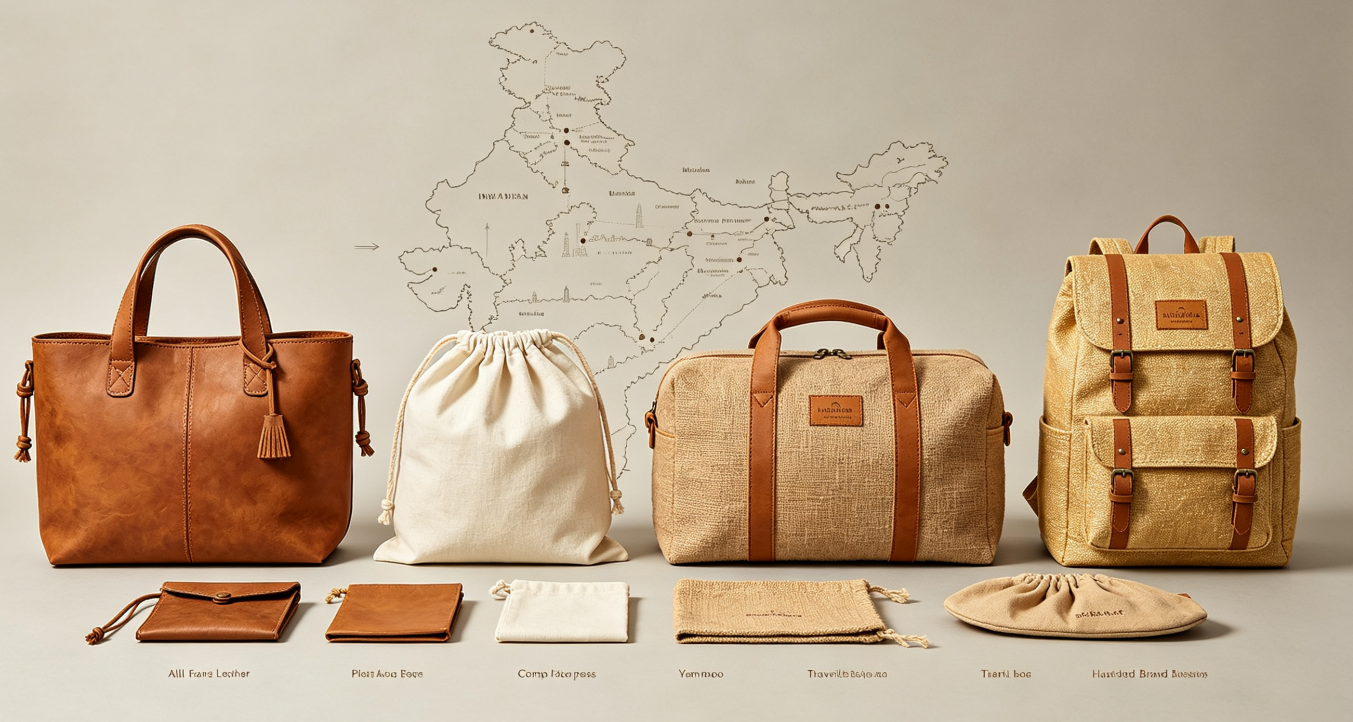
Jute, cotton, canvas, and leather define India’s competitive edge. An India shoe bag supplier built its reputation on natural-fiber craftsmanship long before “sustainable packaging” became a buzzword. One exporter has operated since 1995, and a jute/cotton/canvas specialist launched in 1998. That mix of artisanal detail and natural-material sourcing is what you get here.
Best-Fit Products and Regions
India excels at leather shoe bags, cotton/canvas dust bags, jute travel pouches, and handcrafted branded shoe sleeves. Private-label leather makers also produce totes, duffles, and backpacks using full-grain and vegetable-tanned leathers. For leather goods, manufacturing clusters around Chennai, Kanpur, Agra, Delhi NCR, and Kolkata. Jaipur, Gurgaon, and Delhi handle shoe-bag and packaging work.
MOQ, Lead Time, and Cost
-
MOQ: Standard programs run 500–2,000 pieces. Some leather suppliers accept 50–100 pieces for small launches, with custom patterns starting around 300 pieces.
-
Lead time: 5–7 weeks is realistic. Leather-bag references cite 45–60 days after sample approval, and faster private-label runs quote 4–6 weeks.
-
Sampling: 10–15 working days for standard samples, or 25 days for complex embroidery or hardware.
-
Cost positioning: low-to-mid cost, mid-to-high quality. This is strongest for leather goods and natural-fiber bags.
Sourcing Strategy for Small Brands
Start small: test 1–3 SKUs at 50–500 pieces, then scale to 500+ once demand proves out. Suppliers like Maryadha (MOQs from 50 units, 4–6 week samples) and Asia Sourcing India (500-piece MOQ, 60-day standard lead time, 300 pieces for custom patterns) fit this phased approach.
Risks to Watch
Supplier capability varies. Some are export-ready and responsive, while others are weak on documentation or on-time delivery. Factor in logistics: air freight adds 5–10 days, sea freight adds 25–40 days, depending on customs efficiency.
Bangladesh: Low-Cost Bulk Shoe Bag Production
Rock-bottom pricing defines Bangladesh’s position in the global shoe bag market, but that price comes with trade-offs buyers need to plan around. This country works best for budget-sensitive promotional buyers who need the lowest unit cost and can tolerate longer, less flexible production cycles.
Why Bangladesh Is So Cheap
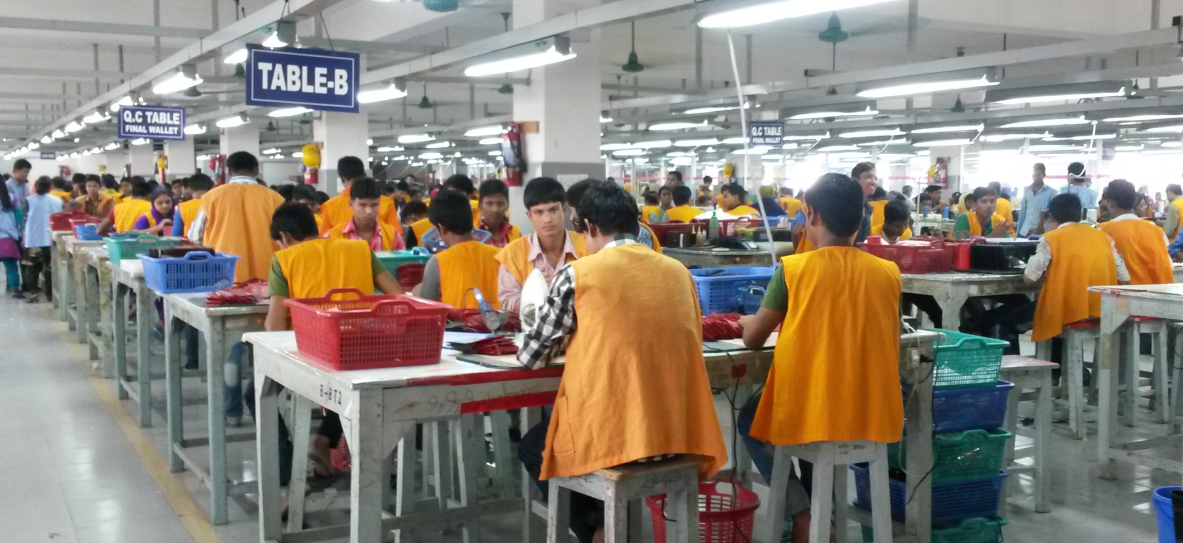
Labor costs anchor the advantage. Skilled garment workers earn $120–180/month, while sewing machine operators run $80–120/month. Combine that with an established textile ecosystem built around cotton, polyester, and blended fabrics, and you get factory-direct pricing that’s hard to match elsewhere for simple textile shoe bags.
MOQ and Lead Time Reality
Flexible manufacturers accept 500–1,000 pieces, but the real cost advantage kicks in at 1,000+ pieces. For the lowest per-unit price, expect 3,000–5,000 pieces. Standard bulk production runs 60–120 days from PO to shipment, though some factories quote 40–45 days or 6–8 weeks for bag-specific orders. Add 20–26 days for sea freight to Europe. The best target is 1,000–5,000 pieces at 6–8 weeks production, plus 2–4 weeks freight buffer.
Compliance and Quality Checks
Request certificate copies for BSCI, SMETA, WRAP, ISO 9001, OEKO-TEX, or GOTS, with expiration dates verified against issuing databases. Not every factory carries strong audit coverage. Confirm the supplier already produces drawstring shoe bags or textile pouches. Many are apparel-focused and treat bags as a side product, which shows up in inconsistent stitching and finishing quality across batches.
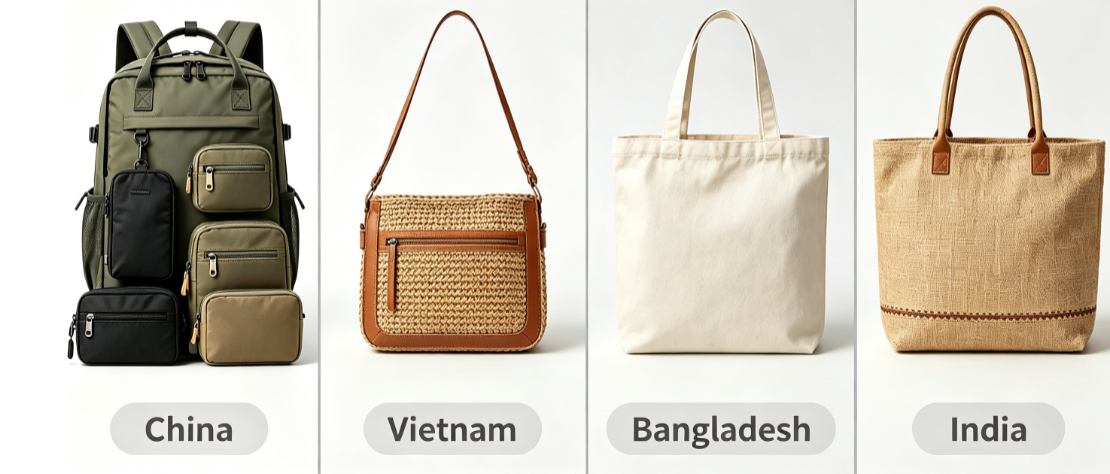
Country Comparison: Cost, Quality, MOQ & Lead Time
Four countries. Four different sourcing personalities. Line up the numbers, and the right call starts showing.
|
Country |
Cost |
Quality/Strengths |
MOQ |
Lead Time |
Best Fit |
|---|---|---|---|---|---|
|
China |
Mid-to-high |
Full category range, complex construction, deepest supply chain |
300–2,000+ pieces |
30–45 days; complex styles 60–75 days |
Fast-turn orders, complex designs, reorders, flexible customization |
|
Vietnam |
Mid |
Woven bags, technical/functional styles, outerwear-grade craftsmanship |
500–1,500 pieces; premium factories 1,000–5,000+ |
45–60 days; complex orders 75–100 days |
Quality-first buyers, stable bulk orders, technical materials |
|
Bangladesh |
Low |
Basic styles, knit fabrics, high-volume production |
1,000–3,000+ pieces |
90–120 days; 30–60 days with in-stock fabric |
Low-budget, high-volume, simple designs |
|
India |
Low-to-mid |
Cotton, natural fibers, embroidery/artisanal work |
50–1,500 pieces |
60–90 days; complex/custom 75–120 days |
Natural materials, specialty craftsmanship, small-to-mid batches |
Matching Budget to Country
Each country solves a different sourcing priority — pick based on what you’re optimizing for:
-
Lowest budget → Bangladesh. Garment worker wages average around $113/month in some benchmarks. MOQs run 300–500 pieces on the low end, scaling to 1,000–3,000+. Per-unit cost gets pushed hardest here.
-
Quality consistency → Vietnam. Better for buyers who need stitching reliability and technical fabric handling. Typical MOQ sits at 500–1,500 pieces, with 45–60 day lead times.
-
Flexibility and speed → China. The deepest supply chain means small test orders, fast reorders, and complex structures are all manageable. MOQs as low as 300–1,000+ pieces, first-run lead times of 30–45 days.
-
Natural materials and craft → India. Best suited for cotton, embroidery, and artisanal textures. MOQs can drop to 50–100 pieces, though complex custom work extends lead time.
How Lead Time Should Shape Your Sourcing Decision
Seasonal timing changes the calculus. For peak-season launches, seasonal changeovers, or holiday deadlines, China and Vietnam’s 30–60 day windows are far more manageable than Bangladesh or India, where complex orders can stretch to 75–120 days.
Brands sensitive to time-to-market should set a hard threshold: no more than 8–12 weeks from design freeze to warehouse arrival. China and Vietnam hit that mark. Bangladesh can qualify only for simple designs using fabric already in stock.
For reorders and quick-turn replenishment, China’s shallow MOQ floor and deep supplier network lead the pack. Vietnam suits planned, forecasted orders better. Bangladesh is built for large, pre-scheduled bulk runs.
Lowest cost points to Bangladesh. Consistent quality points to Vietnam. Speed and flexibility point to China. Natural materials with craftsmanship point to India. If lead time is the constraint, keep your shortlist to countries hitting 60 days or under — China and Vietnam. If you’re running large basic-style orders and can absorb a longer cycle, Bangladesh’s per-unit pricing is tough to beat.
Sustainable Sourcing Options
Verified sustainable sourcing means checking suppliers have the documentation to back up their claims. A supplier offering rPET, organic cotton, or jute should provide certificates, not just marketing copy.
Material Options and Specs
-
RPET: made from recycled PET bottles, printable in full color or Pantone matches. A common benchmark is 120 gsm rPET nonwoven at roughly $2.45/m², with substrates ranging 80–160 gsm.
-
Organic cotton: pairs with GOTS certification. Uncoated cotton runs 180–280 gsm, organic canvas around 320 gsm.
-
Jute: a durable, low-impact natural fiber. Digital textile printing benchmarks show 220–380 gsm compatibility.
-
Biodegradable nonwoven: demand compostability test reports and chain-of-custody paperwork. A “biodegradable” label alone isn’t enough.
-
Water-based inks: reduce VOCs and printing waste; some suppliers also recycle ink responsibly at end-of-life.
Certifications That Matter
-
GRS verifies recycled content plus chain-of-custody compliance, best for rPET products.
-
OEKO-TEX Standard 100 confirms restricted-substance safety, critical for skin-contact items.
-
GOTS applies specifically to organic fiber claims.
Portugal, Turkey, and Vietnam rank as dense GRS/OEKO-TEX sourcing hubs. Egypt offers zero-tariff shipping advantages into Turkey and Europe.
The Tradeoff
Verified sustainable sourcing typically costs more, extends lead time for recycled feedstock, and narrows your supplier pool. Use a Good/Better/Best framework, and always request recycled content %, GSM specs, and test reports before committing.
How to Choose the Right Custom Shoe Bag Supplier: Selection Checklist
A supplier scorecard beats gut instinct every time. Before you sign a purchase order, put every shoe bag OEM manufacturer through the same checklist. The numbers will separate serious factories from ones just chasing volume.
Core Evaluation Criteria
-
MOQ structure: Find out if the MOQ applies per SKU, per color, or per fabric — not just a blanket “total order” number. Ask whether initial orders and reorders have different minimums, and whether you can combine mixed colors and styles to hit the threshold.
-
Sample turnaround: Standard timelines run 3–7 days, 5–7 days, or 7–15 working days depending on complexity. Push for a revisable sample and get confirmation on Pantone matching, print placement, and hardware details before bulk production starts.
-
Bulk lead time: Ask the factory to break total lead time into six stages: sampling, material sourcing, production, QC, packing, and shipping. A supplier that holds 15–25 days after sample approval has strong scheduling discipline.
-
Material and print coverage: Confirm GSM, thickness, and waterproof specs across nylon, polyester, mesh, and satin. Screen printing, heat transfer, embroidery, and foil stamping should each come with position diagrams and color proofs.
-
QC protocols: Look for staged inspection — incoming material, first-piece, in-process, and final. Ask about AQL sampling and batch traceability.
-
Trade terms: Get quotes split into EXW, FOB, and landed cost. This keeps comparisons across shoe bag manufacturers accurate.
Weight Priorities by Buyer Type
Startups should prioritize MOQ flexibility, fast sampling, and payment terms. Chain retailers should put more weight on QC consistency, export documentation, and reorder capacity.