
What Makes a Clutch Bag Material “The Best”?
“Best” is relative — and in clutch bag sourcing, it depends on context.
Full-grain leather earns rave reviews for corporate gifting programs. But it’s overkill for a promotional giveaway. A silk evening clutch photographs well at a gala. Put it through daily commuter use, and it falls apart fast. Material quality only makes sense against a specific purpose.
Four variables define the right material for any project:
-
Occasion — formal event, everyday carry, or promotional use?
-
Brand positioning — luxury, premium, mass-market, or budget?
-
Durability target — occasional use versus daily carry versus travel?
-
Budget ceiling — full-grain leather with brass hardware runs $40–80+ per bag in COGS; a canvas build with zinc hardware sits closer to $8–15
That cost gap shows why material choice goes beyond aesthetics. It determines which retail tier is viable for your business model.
Each use case pulls in a different direction:
-
A wedding clutch puts appearance first. Abrasion resistance is secondary.
-
A daily-use bag ranks stitching and closure security above all else.
-
A promo clutch lives or dies by scalable unit cost.
Same product category. Very different answers.
Leather & Synthetic Leather: From Luxury Clutch Bags to Budget-Friendly Alternatives
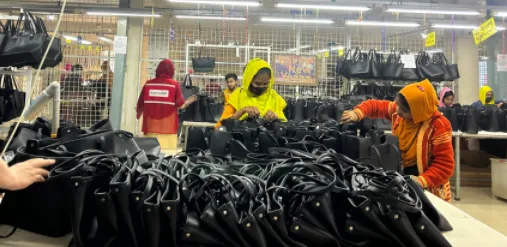
Leather is the most important material decision in clutch bag sourcing. It’s not always the right choice — but the quality gap between grades is much wider than most buyers expect.
Genuine Leather: Three Grades, Three Different Products
Full-grain, top-grain, and suede aren’t just quality tiers. Each one produces a different bag with different strengths.
Full-grain leather keeps the complete outer fiber structure intact. ISO 3376 tensile strength testing puts it at the top of all leather grades — it beats every other type in flex and tear resistance. Bags made from full-grain leather last 10–20+ years with basic care. For brand positioning, there’s another key advantage: full-grain builds a real patina over time. High-contact areas darken and develop a natural sheen. That aging story — the “heritage and craftsmanship” angle — is something luxury clutch buyers will pay a premium for.
Top-grain leather goes through sanding and surface correction. You lose some of the raw strength you get from full-grain, but you gain consistent color and texture across large production runs. For a branded flagship clutch line at mid-to-premium retail prices, that consistency is worth more than patina depth.
Suede comes from the split layer. It has looser fibers, lower tear resistance, and builds no real patina. It soaks up moisture fast and doesn’t hold up for daily use. Where it does work: seasonal fashion clutches and evening bags where soft texture and rich color matter more than long life.
PU vs. Microfiber: Don’t Treat Them as the Same Category
Standard PU leather fits the $20–60 retail price band. It takes bold finishes well — high-gloss, metallic, printed — which makes it a solid pick for trend-driven seasonal clutch series. The core problem is structural. PU coatings break down over time, and humid climates speed that up. Surface peeling within 3–5 years is a real, documented complaint. It damages brand reputation on products meant to last.
Microfiber leather runs 20–50% more than standard PU, but it sits in a different performance class. Its non-woven fiber base holds up against breakdown far better. Typical service life reaches 5–8+ years in high-use conditions. Buyers positioning a “vegan leather clutch” at the $60–150 retail tier need microfiber to support that price point. Standard PU won’t get you there.
Customization Trade-offs by Material
Your material choice also controls which logo techniques are on the table:
|
Material |
Emboss/Deboss |
Foil Stamping |
|---|---|---|
|
Full-grain leather |
Deep, long-lasting; patina builds on the logo over time |
Precise edges; temperature-sensitive |
|
Top-grain leather |
Consistent across production; ideal for large runs |
Most uniform foil adhesion of all leather types |
|
Standard PU |
Shallow emboss only; deep pressure risks coating cracks |
Adhesion varies; long-term durability is lower |
|
Microfiber |
Cleaner result than PU; recovers shape well |
More stable than PU; output closer to genuine leather |
For bulk custom orders where logo permanence matters — corporate gifting, branded retail collections — pick your material and customization technique at the same time. Deciding them apart leads to problems later.
Fabric Clutch Bag Materials: Satin, Velvet, Canvas & More for Every Occasion
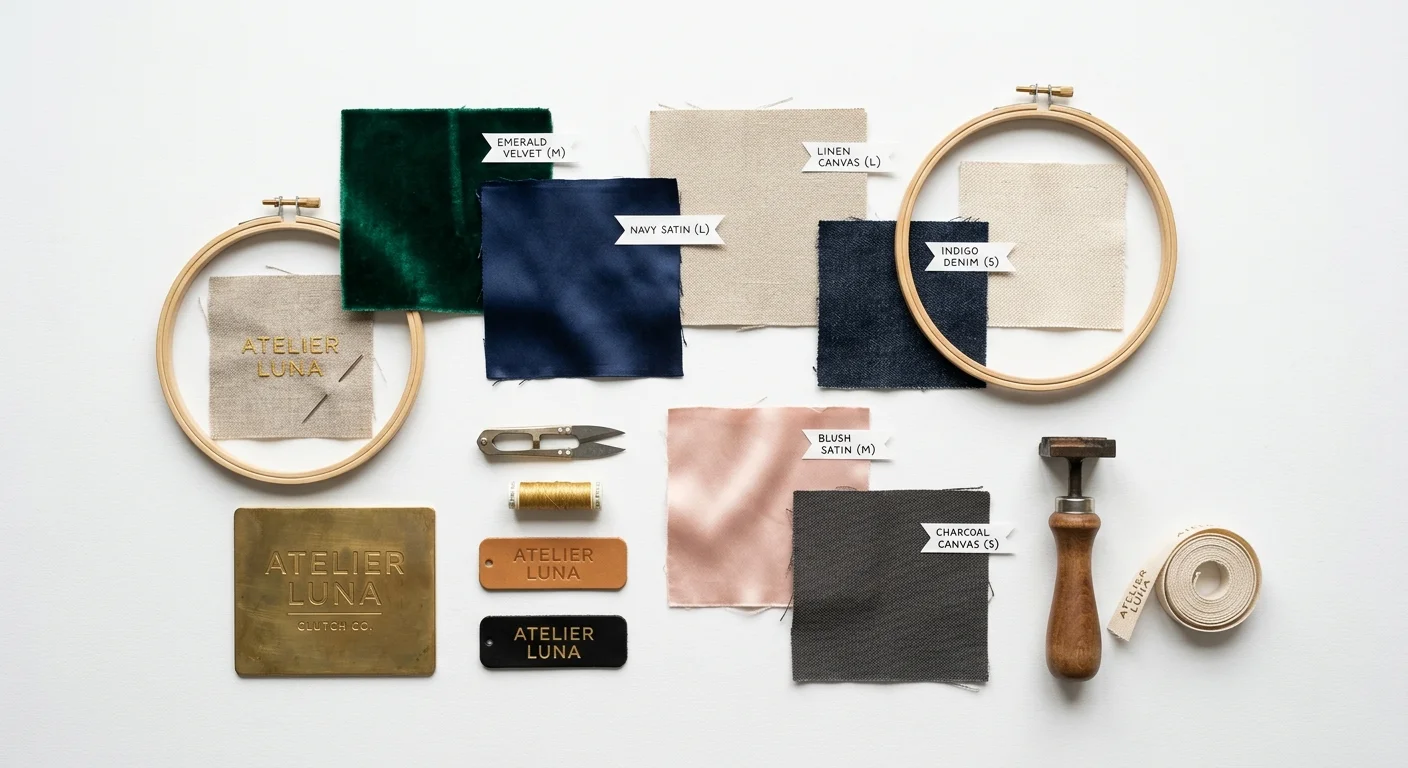
Fabric materials don’t compete with leather. They serve different occasions, buyer segments, and price points.
Matching the right fabric to the right scenario cuts sourcing time. It also helps you avoid expensive sampling errors.
Satin and Velvet: Formal and Bridal Applications
Satin gives you a high-gloss surface that photographs well and drapes cleanly. That’s why it dominates wedding and formal collections. The trade-off: it’s one of the most damage-prone finishes out there. Direct sunlight dulls the sheen. Heat causes wrinkling. Improper cleaning ruins the surface for good. For end-buyer guidance, the rules are simple — blot, air-dry flat, keep away from heat.
Velvet sits above satin for pure luxury feel. Its plush pile creates tactile depth and richer color saturation that satin can’t match. For evening bags and premium bridal clutches, velvet holds a more lasting “luxe” look. Care requirements are stricter though. Always brush in the nap direction. Never rub or soak. Store in a breathable dust bag — not plastic. Plastic traps moisture and causes mildew.
Quick comparison:
|
Material |
Best For |
Key Risk |
Logo Method |
|---|---|---|---|
|
Satin |
Weddings, galas, formal events |
Sunlight damage, wrinkling |
Foil stamping, embroidery |
|
Velvet |
Evening bags, premium bridal |
Pile crushing from moisture |
Embroidery, woven labels |
Canvas, Denim, and Functional Fabrics: Everyday and Brand-Driven Programs
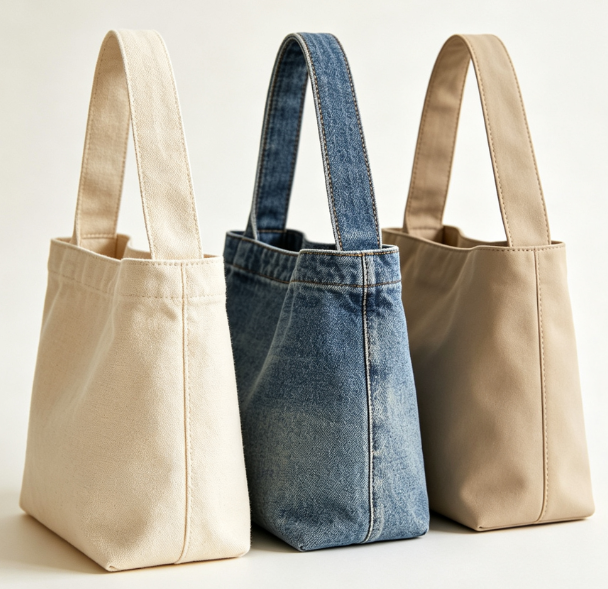
Canvas and denim are the top choices for print-heavy, logo-driven clutch lines. Both handle screen printing and digital printing with consistent results — something velvet and satin can’t deliver at scale. For seasonal graphics, limited-edition drops, or branded retail collections with repeat print placement, canvas and denim cut decoration risk by a wide margin.
For travel and utility clutches, 600D polyester and nylon lead the spec sheet. Polyester is stiffer, more abrasion-resistant, and easier to source in volume. Nylon runs lighter and softer, but it costs more. FOB benchmarks for unbranded functional clutches sit at $1.50–4.00/unit for polyester builds and $2.00–5.50/unit for nylon — before coating, lining, or logo work pushes the quote higher.
Beaded and embellished fabrics sit at the opposite end of the cost curve. They deliver maximum visual impact for bridal and red-carpet SKUs. The catch: high bead density drives up assembly time fast. Save this material class for small-batch, high-margin runs where the retail price covers the labor cost.
Occasion-to-material quick reference:
– Wedding/formal → satin (sheen) or velvet (texture depth)
– Daily/street style → canvas or denim (printability, logo customization)
– Travel/functional → 600D polyester or nylon (durability, spec control)
– Bridal/red carpet → beaded fabric (visual impact, accepting higher QC cost)
Eco-Friendly Materials for Sustainable Custom Clutch Bags
Sustainability is no longer a niche selling point. For brands in Europe and North America, it’s becoming a baseline procurement requirement.
For B2B buyers sourcing custom clutch bags, this shift has real consequences. ESG reporting obligations, supplier scorecards, and retail buyer mandates are pushing eco-material decisions into the design phase — earlier than ever. You need to know which materials hold up under scrutiny and which ones don’t.
rPET: The Corporate Gifting Standard for Verified Sustainability
Recycled PET (rPET) is now the most scalable eco-material for bulk clutch programs. The global rPET market is projected to reach $17.62 billion by 2035. That growth is driven by brand-side ESG commitments to cut virgin plastic use across packaging and accessories.
The carbon reduction case is concrete. Each rPET clutch bag uses 2–3 recycled PET bottles. Compared to virgin polyester, the carbon footprint drops by 50–70%. GRS-certified builds using ≥50% recycled content show 45% lower carbon output and 1.8 tonnes of crude oil saved per tonne of material produced — figures you can put straight into corporate gifting proposals and ESG procurement documents.
GRS certification is what makes these claims credible to buyers. Without it, genuine rPET content still can’t count toward a brand’s recycled materials KPI. Here are the key content thresholds:
|
rPET Content |
What You Can Claim |
|---|---|
|
< 20% |
Cannot use “recycled” labeling |
|
20–49% |
Recycled content claimable at raw material level only |
|
≥ 50% |
GRS logo and “recycled content X%” on finished product |
|
100% |
Highest tier — suitable for premium eco gifting lines |
Certification through SGS or Bureau Veritas takes 3–6 months. It covers material traceability from bottle source through fiber, fabric, and finished bag. Suppliers with a GRS scope certificate plus transaction certificates have a clear edge in competitive B2B tenders.
Natural and Alternative Eco Materials: Match the Brand Story First
Four natural materials are showing up more in sustainable clutch programs. Each has a distinct look and real production limits.
Cork gives natural water resistance and a distinctive organic texture. It’s a strong fit for vegan leather clutch positioning at the premium end. That said, cork panels work best on bags ≤25 cm in their longest dimension. Larger surfaces flex more and develop micro-cracks over time. Material cost runs 2–3× more than standard canvas. So cork is most viable for small-batch, high-margin programs.
Jute delivers a raw, handcrafted environmental image. It suits food, coffee, or agricultural brand gifting well. The coarse fiber structure limits fine logo detail. It also needs a waterproof inner lining — polyester or PVC-coated fabric — to handle its high moisture absorption.
Organic cotton gives a soft, clean feel. It’s ideal for lifestyle and wellness brand clutches. To carry an “organic” label in most Western markets, the material needs GOTS certification. Without it, you can only market it as plain cotton. Cost sits 20–40% above conventional cotton, which tightens the price band for bulk orders.
Felt — especially rPET felt — works well for tech-accessory clutches. Its self-supporting structure at 2.5 mm+ thickness makes it a natural fit for electronics brands. One tradeoff: felt surfaces attract dust and lint. Go with dark colorways or add anti-static treatment to manage this.
Washable kraft paper fills a niche but growing segment — creative brands, bookstores, and event giveaways where the paper look is part of the concept. It handles fine print well. Durability is limited though. Design for a ≤3 wash cycle lifespan and keep load capacity under 0.5 kg for single-layer construction.
Sourcing Implication
Eco-material selection affects more than brand messaging. Here’s what to factor in before sampling begins:
-
rPET with GRS certification adds 3–6 months to initial supplier qualification
-
Cork and organic cotton carry material cost premiums that need higher MOQ or retail pricing to absorb
-
Certification timelines and cost buffers must go into project planning from the start — not after samples are approved
Get these details locked in early. They shape your budget, timeline, and what sustainability claims you can actually make.
Material Selection by Use Case: A Practical Decision Guide for Custom Clutch Bags
Scene drives material — not the other way around. Lock in your use case before you request samples or finalize fabric specs. Define where this bag is going and who’s carrying it. Four scenarios cover most custom clutch bag programs. Each one points to a different material stack.
Wedding & Formal Events
Appearance takes priority here. Satin (80–150 g/m²) delivers the high sheen bridal and gala clutches demand. It pairs well with beading and embroidery. The price point also works for MOQs of 200–500 pcs. For maximum visual impact — crystal, sequin, or bead patterns — go with embellished fabric over a poly satin or taffeta base. Run sizes get tighter (100–300 pcs) and unit cost goes up because of the extra assembly labor involved. Budget-conscious formal programs often use high-gloss or metallic PU leather (0.8–1.2 mm) instead. You get the leather look without the leather price.
Hardware match: Brass kiss-lock frames and decorative metal clasps in gold or rose gold. These choices shape how luxurious the bag feels at point of purchase.
Business & Corporate Gifting
Longevity and brand perception matter most here. Microfiber leather (1.0–1.2 mm) is the practical sweet spot. It offers better wear resistance than standard PU, clean emboss results, MOQs from 100–300 pcs, and lead times of 30–45 days including color matching. For VIP-tier programs, top-grain or full-grain genuine leather (1.2–1.6 mm) supports luxury positioning. Keep in mind that COGS climbs to USD 40–80+ per bag with brass hardware. Eco-focused gifting programs can go with a cork or organic canvas composite (300–400 g/m²) paired with a simple metal logo plate.
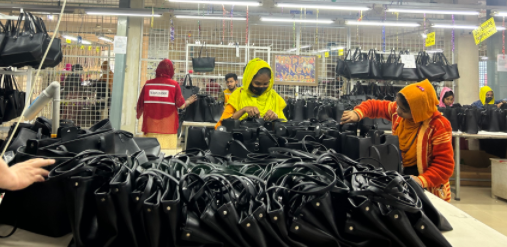
Hardware match: Solid brass zippers and logo plates for genuine leather builds. Zinc alloy is the standard mid-tier pick for microfiber or canvas.
Daily Casual Use
Durability and print versatility lead here. Canvas (10–14 oz / 340–475 g/m²) with a polyester lining and zinc hardware puts COGS at USD 8–15 per bag. That’s the benchmark for everyday clutches. Quality PU leather (0.8–1.0 mm) expands your color and texture options. Plan for a service life of 1–3 years before hydrolysis becomes an issue. Nylon (210D–420D) handles water resistance and cuts weight — a solid fit for sporty or functional wristlet formats.
Hardware match: Coil nylon zippers (#3/#5) with zinc alloy pullers. Brass adds cost with no real benefit for this segment.
Promotional & High-Volume Giveaways
Unit cost and MOQ define everything. Lightweight cotton (6–8 oz / 200–270 g/m²) is the standard pick for screen-printed promo pouches. MOQs run 500–2,000 pcs with 20–30 day lead times. Clear or tinted PVC (0.5–0.8 mm) works for trend-driven campaigns where price is the main filter. Non-woven PP (70–100 g/m²) brings the floor cost down even further for flat envelope-style clutches in very large runs. Trade-off: quality perception is the lowest of all options.
Hardware match: Basic nylon zippers or single metal snaps. One closure point, standard nickel plating — nothing more.
Quick reference by scene:
|
Use Case |
Primary Material |
MOQ Range |
Typical COGS |
|---|---|---|---|
|
Wedding / Formal |
Satin, beaded fabric, metallic PU |
100–500 pcs |
USD 15–40+ |
|
Corporate Gifting |
Microfiber or genuine leather |
50–300 pcs |
USD 20–80+ |
|
Daily Casual |
Canvas, PU leather, nylon |
300–800 pcs |
USD 8–15 |
|
Promo / Wholesale |
Lightweight cotton, PVC, non-woven |
500–5,000 pcs |
USD 2–8 |
How Clutch Bag Material Affects Customization Options (Logo, Print & Finish)
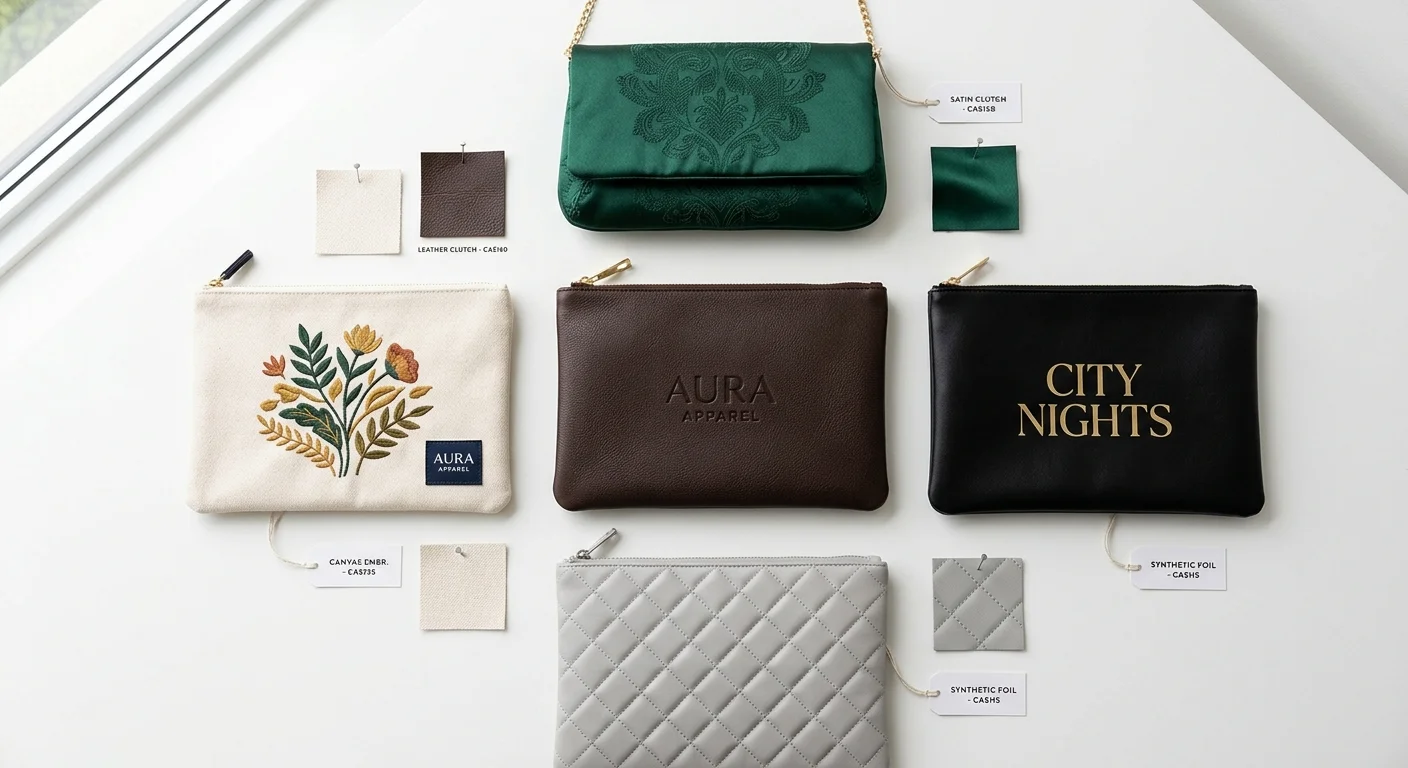
Material choice and decoration technique are really the same decision — just made at different stages. Get them out of sync, and you’re paying for sampling errors that were easy to prevent.
One rule covers most cases: smoother, flatter surfaces work best with screen printing, foil stamping, and heat transfer. Thicker, textured, or structured surfaces suit embroidery and emboss/deboss. Synthetic fabrics with polyester or nylon content also open the door to sublimation printing. That’s the framework. Everything else is just detail.
How each technique maps to material:
|
Technique |
Best-Fit Materials |
Avoid |
Logo Detail Impact |
|---|---|---|---|
|
Screen printing |
Smooth nylon, polyester, flat cotton canvas |
Rough textures, curved surfaces, thin TPU |
Solid colors, bold shapes — fine lines under ~1 pt risk losing clarity |
|
Embroidery |
Heavy canvas, denim, 600D/900D polyester |
Ultra-thin fabrics, TPU, waterproof layers |
3D depth and durability — but letterforms under ~3–5 mm get “eaten” by stitching |
|
Emboss / Deboss |
Leather, PU, structured faux leather |
Soft or elastic fabrics, thin cloth |
Best for tonal, understated logos — mold depth and material rebound need close control |
|
Foil stamping |
Leather, PU, coated flat surfaces |
Rough canvas, napped or raised textures |
High contrast on small areas — edge sharpness depends on surface flatness |
Logo placement matters as much as technique. Always put the logo on the flattest, seam-free panel you have. On any textured or uneven surface — no matter the technique — edge definition takes a hit.
Lining material signals quality tier too:
-
Satin lining — sheen and smoothness that reinforces a gift or premium feel
-
Polyester lining — practical, wear-resistant, cost-efficient for volume production
-
Suede lining — soft, tactile luxury feel; higher cost, best suited to top-tier SKUs
A simple decision sequence for brand buyers:
-
Start with surface type. Your surface narrows down which techniques actually work.
-
Check logo complexity. Fine lines and gradients suit screen printing or sublimation on synthetics better than emboss or embroidery.
-
Match to product tier. Premium gifting points toward leather emboss, foil stamp, and suede lining. Promotional runs work better with screen print on canvas and a polyester interior.
Cost vs. Quality: Choosing the Right Material for Your Budget and MOQ
Material price and total procurement cost are two different numbers. Confusing them is one of the most common sourcing mistakes in custom clutch bag programs.
FOB pricing covers 55–70% of your true landed cost — nothing more. The remaining cost comes from sampling, raw material fluctuations, quality losses, compliance, logistics, and delay risk. A “low unit price” material can turn into the more expensive option once you add all those variables up.
Three Cost Tiers — and What Each One Costs You
Premium tier (genuine leather, heavy embellishment, specialty coatings): The price premium goes beyond the material itself. Higher-end materials push up sampling rounds, fabric sourcing lead times, and batch consistency risk. Genuine leather and decorated fabrics vary between production runs. Color shifts, texture inconsistencies, and rework costs are real line items — not edge cases.
Mid-range tier (PU/synthetic leather, standard polyester/nylon, satin lining): This is the practical sweet spot for most custom clutch programs. You get predictable FOB, manageable MOQs, and stable batch consistency.
Budget tier (basic PU, plain polyester, no lining or simplified lining, print instead of embroidery): Lowest unit cost, but perceived quality drops fast. Reserve this tier for high-volume promotional runs where price-per-unit is the one metric that drives the decision.
The Smartest Low-MOQ Material Combination
For first-time orders or small-batch launches, a PU outer shell + satin lining gives you the best cost-to-quality ratio. The PU exterior keeps unit cost down and delivers consistent color. The satin interior raises the unboxing experience and tactile quality — without pushing FOB up much.
A few other practical rules:
-
Budget toward contact surfaces. Put your spend on outer shell fabric and hardware. Keep interior pockets, binding, and non-visible panels simple.
-
Replace full-coverage embellishment with localized decoration. A logo-area embroidery or foil stamp costs a fraction of all-over beading — and it reads just as premium at point of sale.
-
Lock primary materials before choosing decoration techniques. Finalizing embroidery or foil stamping before you confirm the shell fabric is a reliable path to budget overruns.
The Right Comparison Framework
Don’t compare fabric unit prices in isolation. The number that matters is:
Sampling cost + MOQ allocation + FOB + freight/insurance + rework risk
That total tells you whether a material fits your budget — and protects your margins.
Quick Reference: Best Materials for Custom Clutch Bags by Priority
Four priorities drive every clutch bag material decision: durability, cost, brand image, and sustainability. Here’s where each material ranks.
|
Priority |
Top Pick |
Runner-Up |
Budget Option |
|---|---|---|---|
|
Most Durable |
Full-grain leather (1.2–1.8 mm) |
High-grade PU ≥0.8 mm |
600D polyester + PVC backing |
|
Most Cost-Effective |
600D polyester + PVC (FOB <$5) |
Standard PU 0.6–0.8 mm (FOB $5–10) |
Cotton canvas / blended fabric |
|
Best for Luxury Image |
Full-grain / top-grain leather |
Microfiber leather or premium PU |
Silk, satin, or beaded fabric |
|
Most Eco-Friendly |
LWG-certified genuine leather |
Recycled polyester / nylon + water-based coating |
Cactus or apple leather (small batch) |
The bottom line: no single material wins on all four priorities. Each one involves a trade-off.
-
Full-grain leather lasts 10–15+ years. But it pushes COGS to $40–80+.
-
A 600D polyester build keeps FOB under $5. That said, it reads as budget-tier to buyers at a glance.
So, match the material to your actual program goal first. Then source from there.