
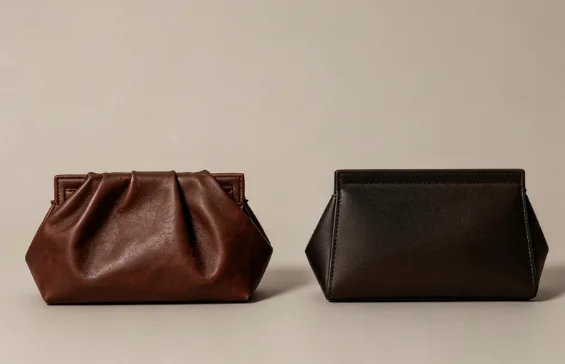
What Defines a High-Quality Clutch Bag
The stakes are higher than most buyers realize. Poor stitching, flimsy hardware, and capacity mismatches are the top drivers of returns in small leather goods. Industry benchmarks show that fixing these three issues alone can cut defect-related returns by 20–40%.
That’s the business case for understanding quality before you order.
Quality in a custom clutch bag comes down to measurable, verifiable standards — not vague impressions. You can see it in how materials hold under stress. You can test it by running hardware through 200 open-and-close cycles. You can measure it by checking whether the internal dimensions fit a modern smartphone.
Getting these details right opens up real pricing power. Consider what full-grain leather, 8–10 stitches per inch, solid metal hardware, and a silk or satin lining can do for your margins. These upgrades can support 2–3× higher retail pricing compared to a PU clutch of the same size built to lower specs.
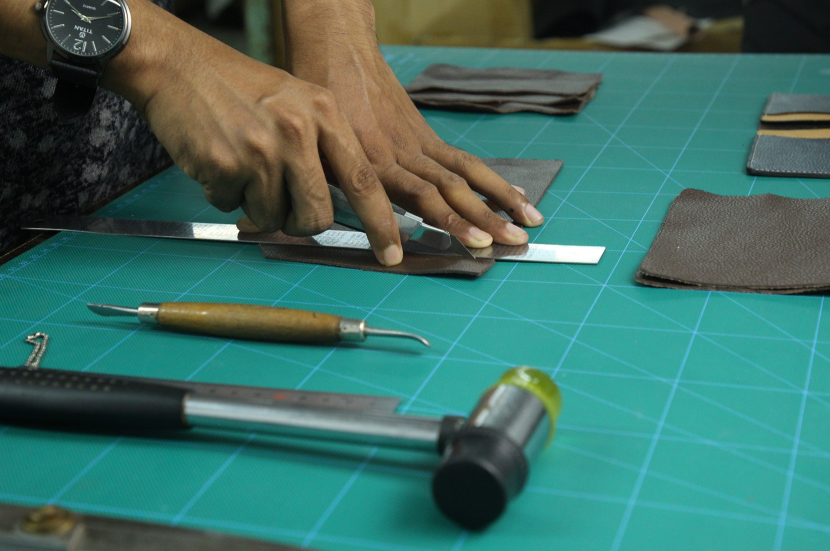
For branded clutch bag production, quality consistency does one more critical thing: it builds the tactile “luxury feel” that keeps customers coming back. Plus, it protects your brand positioning at premium price points.
The sections below break down what to look for — and how to verify it.
Material Quality: The Foundation of Every Premium Custom Clutch Bag
Material choice is where quality is won or lost — before a single stitch is made.
The outer shell sets the standard for everything else. For premium positioning, the benchmark is clear: full-grain or top-grain leather. These grades offer superior tear resistance, natural bend recovery, and a surface that builds character over time. Bonded leather and low-grade PU don’t belong here — they crack at stress points, peel at corners, and drag down your brand’s tactile story fast.
Genuine vs. Vegan Leather: What the Numbers Say
Checking a genuine leather clutch bag? Look for natural pore texture, soft elasticity, and no chemical smell. For a vegan leather clutch bag built to premium specs, high-density PU is the benchmark. Always request abrasion test results focused on corners and closure edges — that’s where low-grade PU breaks down first.
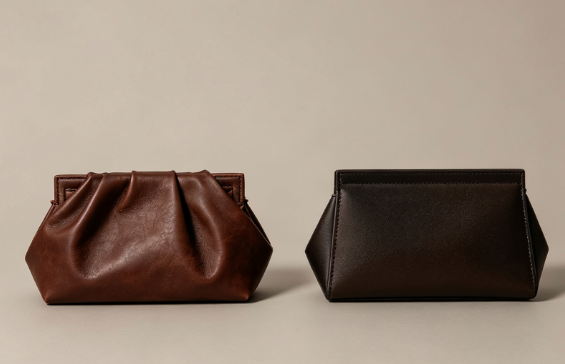
A well-spec’d clutch — regardless of material — should carry 1.5 kg without seam strain, hardware distortion, or visible deformation. That’s a simple load test you can run on any sample.
Lining Fabric: The Interior Tells the Truth
Clutch bag lining fabric is one of the first places suppliers cut corners. Premium linings use cotton twill, silk, or quality polyester/suede — dense, opaque, and resistant to snagging. Run a tug test on any sample. Fabric that tears with light force or feels thin won’t hold up through regular use.
Avoid thin, low-denier polyester. You’ll feel the difference the moment you touch it. Plus, it signals cost-cutting across the rest of the build.
Eco Materials: A Growing Premium Segment
Sustainable options — cork, recycled polyester, organic cotton — are seeing a 14% year-over-year increase in wholesale procurement inquiries. This isn’t a niche trend. It reflects a broader shift where material certifications actively support premium brand positioning. For branded clutch bag production, eco-certifications on coatings and fabrics are now a buyer requirement. They’re no longer a bonus feature.
Stitching & Structural Integrity: How to Spot Craftsmanship That Lasts
Stitching is the skeleton of a clutch bag. Get it wrong, and even premium leather becomes a liability.
The standard for clutch bag stitching quality in structured small leather goods is 8–10 stitches per inch (SPI). This range keeps seam strength and fabric integrity in balance. Too dense, and you get puckering and seam displacement. Too loose, and stress points split open under load — that’s where failure starts.
Where to Look First
Not every seam carries equal risk. On a clutch bag, focus on these areas:
-
Closure edges and zipper attachment points — these take the most tension during regular use
-
Side seams and corner joins — panel stress builds up here
-
Strap or wrist loop attachment zones — these need bartack reinforcement where applicable
At each spot, check for even stitch spacing, no skipped stitches, and flat seam lines that stay smooth under light hand pressure. Visible puckering, wandering stitch lines, or loose thread tails are red flags. These aren’t cosmetic issues — they signal structural weakness.
The Quick Buyer Check
You don’t need a lab to catch weak construction. Run this check on any sample:
-
Count stitch density over a 2.5 cm stretch at a stress seam
-
Pull test by hand — apply firm, steady pressure across the closure edge and side joins
-
Check reinforcement points — bartacks should sit at every spot where load concentrates
-
Request seam strength data — solid suppliers give specific Newton values and point to ASTM D1683/D1683M for woven components
|
Durable Sign |
Weak Sign |
|---|---|
|
Even spacing matched to material weight |
Irregular or wandering stitch lines |
|
Bartacks at all load points |
No reinforcement at stress zones |
|
Seam stays flat under tension |
Seam opens or ripples when pulled |
|
Lab report with defined N values |
Vague “strong stitching” claims |
For branded clutch bag production, seam strength data isn’t optional — it’s your quality baseline. A well-built clutch should hold 150 N or more at critical seams before any failure shows. A supplier who can’t back that up with numbers? That tells you everything you need to know.
Hardware & Closures: The Details That Determine Daily Reliability
Hardware fails without warning — until it ruins everything. A zipper jams at a formal dinner. A clasp pops open mid-event. A magnetic closure loses its grip after three months. These aren’t rare cases. They’re predictable results of poorly specified components.
Clutch bag hardware quality comes down to three checkable factors: plating durability, closure strength, and attachment method.
What to Test Before You Approve a Sample
-
Cycle-life rating — good closures should handle 50,000+ open-and-close cycles with no stiffness, misalignment, or surface wear. Ask the supplier for that number upfront.
-
Corrosion resistance — hardware should pass 96 hours of neutral salt-spray testing with no rust or plating peel. This is critical for plated brass and zinc alloy components used in custom evening clutch designs — both materials are prone to surface breakdown under humidity.
-
Plating adhesion — thin electroplating chips at edges and pivot points first. Ask for plating thickness specs. Finish color tells you nothing about durability.
-
Attachment strength — riveted and bar-tacked hardware points hold up far better than glued or poorly sewn alternatives under real use. Check the attachment method on every sample.
The Buyer Verification Checklist
|
Spec to Confirm |
Minimum Benchmark |
|---|---|
|
Cycle-life rating |
50,000+ cycles |
|
Salt-spray corrosion test |
96 hours, no peel or rust |
|
Plating thickness documentation |
Supplier-provided spec sheet |
|
Closure attachment method |
Riveted or reinforced |
For branded clutch bag production, hardware specs belong in your tech pack — don’t leave them to the factory’s judgment. A supplier who can’t show cycle-life data or corrosion test results is telling you where they cut costs. That’s the part of your bag that will fail first.
Interior Construction & Lining: The Quality You Feel, Not Just See
Most buyers never open a clutch bag sample to check the inside as closely as the outside. That’s where suppliers cut costs first.
Clutch bag lining fabric does more than look clean. It shapes how the bag feels in your hand, how items sit inside, and how long the interior lasts under regular use. Premium builds use cotton twill, silk, or high-density suede-finish polyester. These materials are dense, opaque, and snag-resistant. Thin, low-denier polyester is the cheap shortcut. You’ll spot it fast — it feels papery, catches on lipstick caps, and often pulls away from the shell within months.
What to Check on Every Sample
-
Lining adhesion — press hard along the interior edges. Bubbling or lifting means the bonding is weak
-
Seam alignment — interior stitching should lie flat with no loose thread ends or puckering at corners
-
Opacity and weight — hold the bag up to light. A good lining blocks light out
One practical test: drag a fingernail across the interior base seam. Tight, clean stitching holds in place. Poor bonding pulls apart fast — often in seconds.
For custom evening clutch production, interior finish quality shapes how customers judge the product’s value. A crooked lining or rough interior seam signals to buyers that the brand takes shortcuts — no matter how polished the outside looks.
Request a pre-production sample with interior photography before full runs start. Lock in your lining specs — fabric weight, finish grade, and attachment method — in your tech pack. Don’t leave these details to factory defaults.
Surface Treatment & Durability Testing: Standards That Separate Good from Great
Surface finish on a clutch bag is not decorative. It’s a durability system — and the numbers either hold up or they don’t.
For hardware and coated surfaces, abrasion resistance is the first test that matters. A premium finish on metal closures and frame elements should hold up after repeated friction contact. Think about how a clasp edge wears against your wrist, or how a frame corner scrapes a tabletop. Low-grade plating fails here fast.
The Tests That Reveal the Truth
Three testing dimensions separate a durable finish from one that looks good in a sample and falls apart in six months:
-
Corrosion resistance — hardware and coated metal must pass a salt-spray exposure window with no plating peel, blistering, or base metal exposure. This matters for custom evening clutch pieces where plated brass or zinc alloy components face moisture on a daily basis.
-
Abrasion and wear — finish surfaces must show no visible breakdown after sustained friction cycles. Ask suppliers for documented wear test results, not just visual claims.
-
Adhesion integrity — coating or plating that lifts at edges or pivot points signals thin application. A quality finish holds at every stress point, not just flat panels.
What to Request From Your Supplier
Don’t accept “premium finish” as a specification. Ask for:
|
Test Dimension |
What to Request |
|---|---|
|
Corrosion resistance |
Salt-spray test results with hours logged |
|
Surface abrasion |
Documented wear cycles with observable outcome |
|
Coating adhesion |
Evidence of no lifting at edges after stress exposure |
For branded clutch bag production, these finish specs belong in your tech pack. A supplier who quotes specific test results runs a controlled process. That’s the clearest signal of consistent quality across a full production run.
Design, Proportion & Functional Versatility: Where Aesthetics Meets Utility
A clutch bag that photographs well but jams shut at the clasp — or fits nothing useful inside — is a design failure. It’s just dressed up as a product.
Proportion and function aren’t separate decisions. They’re the same decision made at different stages.
For a custom evening clutch, the external dimensions set the visual statement. But the internal capacity decides whether the bag gets used at all. The balance point matters. A body ratio close to 2:3 or 3:5 looks right to the eye. It also keeps the bag compact enough to carry at arm’s length without feeling awkward.
Functional Fit Comes First
The interior needs to hold a modern smartphone, folded cards, and a lip product. It should do this without the bag looking oversized. That’s a functional constraint. It shapes proportion — it’s not a styling choice.
Hardware placement follows the same logic:
-
The closure position should sit where your hand reaches first
-
The wrist loop attachment should feel natural to grab
-
Interior pocket openings need to land where the hand goes — not where they look symmetrical on a flat sketch
The rule is straightforward: build the functional core first. Then refine the proportions around it. A great silhouette on a bag that fails its basic job is a return waiting to happen.
OEM/ODM Customization Capability: What to Expect from a Reliable Clutch Bag Manufacturer
Knowing what quality looks like is half the equation. The other half is knowing whether your manufacturer can deliver it — at your volume, on your timeline, every time.
Here’s what separates a capable OEM/ODM clutch bag partner from one that burns your budget on bad samples and missed deadlines.
MOQ and Lead Time: The Baseline Numbers
For standard PU or fabric clutch bags, expect a minimum order of 100–300 pieces per color/style. Complex builds — custom metal frames, specialty hardware, unique linings — need 500–1,000+ pieces per style to make production viable.
Lead times follow a clear structure:
-
Development sample: 5–7 days (with a clear tech pack and standard materials)
-
General custom sample: 7–14 days from confirmed brief
-
Bulk production: 30–45 days after PP sample approval and materials booking
Sample costs at reliable factories are fixed and clear: US$50 for PU clutch samples, US$80–120 for genuine leather. Custom metal molds — logo plates, clasps, frames — carry an extra mold fee. Any factory worth working with quotes mold costs and amortization terms upfront, before you commit.
OEM vs. ODM: Which Path Fits Your Project
OEM means your original design, pattern, and spec. Expect more sampling rounds, custom hardware development, and higher upfront mold costs. It’s the right path for an exclusive silhouette or branded clutch bag production with proprietary hardware.
ODM uses the factory’s existing base patterns. You apply your branding, colorways, and material choices on top. Sampling moves faster, MOQs drop, and development costs shrink — the frames, trims, and patterns are already built. It’s a strong fit for market-testing a custom evening clutch line or launching fast collections.
The Development Flow (Step by Step)
A reliable factory runs a structured process — not a loose back-and-forth. Here’s what each stage looks like:
-
Brief definition — bag type, target dimensions (20–25 cm width, 10–15 cm height, 3–6 cm depth), outer material, hardware type, logo placement rules, target FOB cost, and MOQ tiers
-
Tech pack build — full BOM (fabric spec, lining GSM, zipper type, frame material, chain gauge), finished measurement table with tolerances (±0.5 cm body, ±0.3 cm hardware placements), and artwork placement in mm
-
Prototype sampling — verify fit, capacity (fits iPhone Pro Max, cards, lip product), and material route; target 1–2 iterations max, documented in a golden sample sheet
-
PP sample sign-off — final BOM locked, all color codes confirmed, packaging spec finalized (polybag size, carton ratio: 20–40 pcs/carton)
-
Production with QC gates — minimum 3 checkpoints: cutting, in-line assembly, and pre-pack inspection; AQL 2.5 (major) / 4.0 (minor) as the default standard
-
Final inspection and shipment — the lot passes the agreed AQL before release; shipped under clear Incoterms (FOB/CIF/DDP) with the correct HS code
The Manufacturer Evaluation Checklist
Ask these questions before committing to any supplier:
-
Can they handle MOQ 100–300 pcs for standard clutches and quote higher MOQs with clear pricing for complex hardware builds?
-
Do they work from a full tech pack — BOM, measurement table, tolerance map, artwork — and help you refine it if yours is incomplete?
-
Will they commit to sample lead time ≤14 days and bulk lead time of 30–45 days with a written timeline?
-
Do they quote sample fees and mold costs upfront, with partial deduction against bulk orders?
-
Can they confirm AQL 2.5/4.0 and at least 3 QC gates, backed by photo or video records during production?
-
Are they audited — ISO, BSCI, or Sedex — and able to meet compliance requirements like REACH or nickel-free hardware?
-
Will they lock a golden sample into the contract as the binding quality standard?
A supplier who checks all these boxes isn’t just a vendor. They’re a production partner. That difference decides whether your branded clutch bag production run ships on time, on spec, and on budget.
Practical Quality Checklist: How to Evaluate a Custom Clutch Bag Before Bulk Order
Every quality standard in this guide is worthless without checking it against the actual bulk production run. This checklist gives you a clear, step-by-step process to do just that.
Seven Dimensions to Check on Every Sample
Check each unit against your signed spec sheet across these seven areas before approving any bulk order:
-
Dimensions — Measure H × W × D against the agreed tolerances (±0.5 cm body). Load the bag with the actual intended contents — phone, cards, lip product — and test the fit.
-
Material match — Check that the fabric type, surface finish, and hand feel match the approved sample. Hold it under strong light and look for discoloration, pilling, or uneven dyeing.
-
Stitching quality — Focus on high-stress zones first: zipper ends, bottom corners, side seams, and strap attachment points. Check for even spacing, no skipped stitches, and no loose thread ends.
-
Hardware function — Cycle zippers, clasps, and magnetic closures by hand. They should move smoothly with no sticking or misalignment.
-
Logo and branding — Compare placement, color accuracy, and adhesion against your approved artwork. Off-center or peeling logos are automatic rejects.
-
Symmetry and finish — Check left/right panel alignment, edge finishing, and lining seam position. Visible asymmetry points to broader production inconsistency.
-
Packaging — Check that polybag thickness, hangtag placement, barcode accuracy, and folding method all match the packing spec.
The Five-Step Pre-Shipment Inspection Procedure
-
Place the production sample next to the signed spec sheet and golden sample. Compare them side by side.
-
Inspect every critical seam and stress point first — then move on to general appearance.
-
Run a real-use test: load the bag with expected contents and cycle the closure 20+ times.
-
Photo-document every defect right away. Classify each one as critical (functional failure), major (usability impact), or minor (cosmetic issue).
-
Get a written correction plan before approving shipment. Never move forward on a verbal agreement.
Inspection Standards and Reject Triggers
For branded clutch bag production, use AQL 2.5 as your final inspection benchmark. Set sample sizes using ISO 2859-1 based on lot size. Use a 4-point system for fabric defect classification. This keeps grading consistent across all inspections.
Reject the batch straight away if any of these appear:
-
Seam opening or stitching gaps at stress points
-
Zipper failure or weak hardware attachment
-
Dimensions outside the agreed tolerance
-
Logo misplacement or branding errors
-
Fabric damage, staining, or uneven dye
What to Lock in Writing Before You Release the Order
Don’t go off memory or sample photos alone. Confirm these specs in writing before bulk production starts:
|
Spec Element |
What to Document |
|---|---|
|
Size and tolerance |
Exact H × W × D with ±mm allowance |
|
Material and color |
Fabric type, finish grade, Pantone/color code |
|
Logo file and placement |
Final artwork version, position in mm |
|
Hardware specification |
Component type, plating grade, cycle-life rating |
|
Packaging specification |
Polybag size, hangtag, barcode, folding method |
|
Inspection standard |
AQL level, defect classification, sample size |
|
Golden sample sign-off |
Version number, date, signed by both buyer and supplier |
One rule applies to every custom evening clutch or bulk run: never approve from a digital mock-up alone. A physical sample — or physical proof on the confirmed production material — is the one valid baseline for bulk sign-off.
FAQ: Common Questions About High-Quality Custom Clutch Bags
Buyers ask the same questions over and over — and the answers are never as simple as you’d hope. Here are the ones that come up most.
Q: What’s a realistic MOQ for custom clutch bags?
Most standard OEM factories start at 100–300 pieces per style/color. High-end or specialty manufacturers may accept 50 pieces for established brands. Custom hardware — logo plates, shaped clasps — is a different story. These carry a separate MOQ of 300–500 pieces per hardware design.
Q: How long does production take?
Plan for 4–8 weeks from final sample approval to bulk completion. Heavily embellished or exotic-leather pieces can push up to 12 weeks. For seasonal or hand-embellished styles, add another 3–4 weeks to your sampling timeline. Build that buffer in early.
Q: What durability specs should I require?
Set these as hard requirements in your spec sheet:
-
Closures and frames: ≥3,000 open-close cycles with no deformation
-
D-rings and chain attachment points: stitched and riveted — never glued
-
PU corners and edges: abrasion test results must clear before bulk approval
-
Load test: fill with 0.5–1.0 kg, hang by strap for 24 hours, then check for seam stress or deformation
Q: What are realistic ex-factory prices?
|
Type |
Typical Price Range |
|---|---|
|
Premium leather OEM (50–300 pcs) |
$15–$60 per unit |
|
Luxury / exotic leather |
$200–$2,000+ retail |
|
Custom clear PVC (event/promo) |
$3–$10 per unit (bulk) |
Three things drive your cost the most: material grade, hardware complexity, and order quantity. Get clear on all three before you negotiate.
Q: What compliance documents should I request?
Ask for these upfront — don’t wait until bulk production:
-
Exotic leather: CITES certificates and full supply-chain traceability records
-
Vegan/eco materials: lab test reports that back up any sustainability claims
-
Hardware: nickel-free and tarnish-resistant plating specs, plus plating thickness documentation
-
Closures: written cycle-test results showing ≥3,000 cycles minimum
Q: What functional specs should be defined before sampling?
Lock these down in your tech pack before a single sample is made:
-
Internal width ≥19–20 cm — enough to fit a modern large-screen smartphone
-
Capacity for phone + 4–8 cards + lipstick + keys
-
Detachable chain length: 110–120 cm for crossbody use, 40–60 cm for hand carry
-
Empty bag weight target: ≤400–600 g for comfortable everyday use