
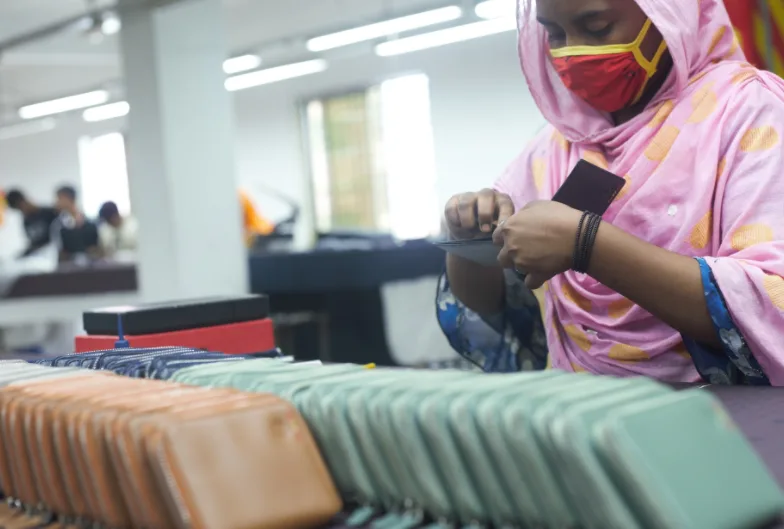
Some briefcases that appear high-end in product photos may wear out quickly, including peeling surface material, stiff zippers or loose stitching. Many buyers struggle to distinguish genuine leather briefcases from quality imitations, which may lead to unexpected costs and client dissatisfaction later on.
This guide covers the leather grades that actually matter, the hardware details manufacturers hope you’ll overlook, and the construction standards that determine whether your bag survives daily use or falls apart by year two. Whether you’re buying one bag or sourcing thousands, you’ll know what to inspect and what to avoid.
Full-Grain Leather vs Genuine Leather:How to understand the leather grades used for briefcases
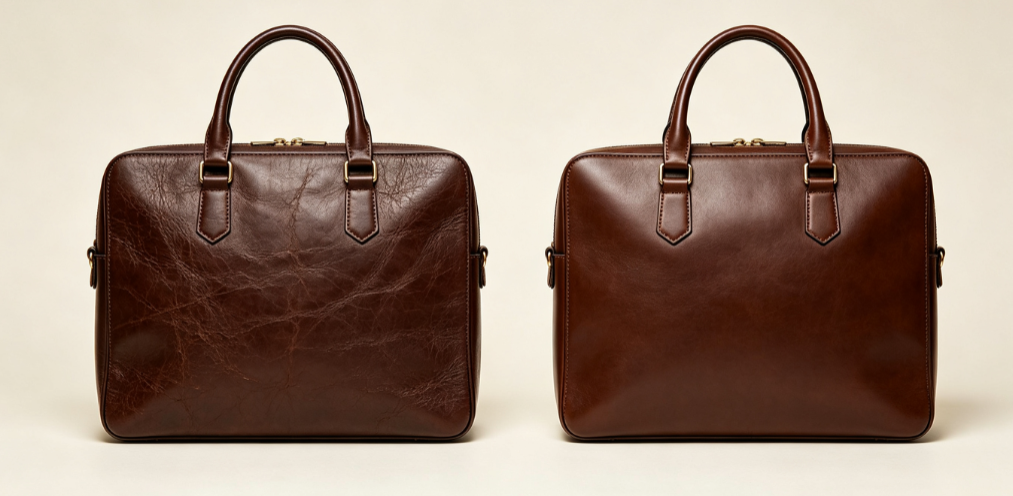
Not all leather comes from the same layer of hide. That distinction determines whether your briefcase lasts a decade or falls apart in three years.
The Three-Tier Hierarchy
Every cowhide splits into layers, and the layer your briefcase leather comes from determines its grade. Full-grain is taken from the outermost 1-2mm of the hide, with natural pores, scars, and texture left untouched—no sanding or polishing. This is the densest fiber structure available. Top-grain is also from the upper layer but lightly buffed (0.1-0.3mm removed) to smooth out imperfections. It’s slightly less dense than full-grain, but still solid. Genuine leather is the industry’s lowest grade. It comes from split layers or rejected upper-grain sections, then embossed and coated to fake a premium texture.
Lifespan and Price Reality Check
The differences show up fast in daily use. Full-grain lasts 10-20+ years with proper care and costs $250-700, with Italian vegetable-tanned versions reaching $800+. Top-grain lasts 5-10 years before the coating wears through, typically $150-350. Genuine lasts 2-5 years, often closer to 2-3 years under daily commuting loads, and usually costs $50-150. Anything under $80 labeled ‘genuine leather’ is almost certainly split leather with heavy coating.
Cost-per-year math favors full-grain. A $400 full-grain bag used for 12 years runs about $33/year, same as a $200 top-grain bag lasting 6 years. Genuine leather looks cheaper upfront but degrades faster, hurting professional appearance sooner.
Hardware Quality Inspection: Hidden Details of Zippers, Clasps, and Metal Feet
When a briefcase fails, the hardware usually goes first. A zipper that jams mid-meeting or a lock that won’t stay closed hurts your professional image more than a scuffed corner ever will. But most buyers pick hardware by how shiny it is. That’s exactly what low-cost manufacturers count on.
Zipper Quality: Brand Names vs Generic Pulls
Branded zippers like YKK are rated for 5,000–10,000+ open-close cycles before they fail. That’s the industry benchmark for mid-to-high-end bags. Generic zippers start showing problems within 100–200 cycles: the slider wobbles, fabric edges fray, and teeth stop meshing cleanly.
Try this yourself. Pull the slider back and forth at least 50–100 times. It should glide without catching or biting the fabric. Then check self-locking strength: hold the pull tab down and pull both sides of the zipper apart at an angle greater than 60°. A quality zipper won’t slide open under moderate force. If it slips easily, your documents can spill out the moment you set the bag down.
Distinguishing Brass/Stainless Steel From Zinc Alloy
Cheap zinc alloy hardware that looks like brass or stainless steel is a common trick in briefcase manufacturing. Three quick tests catch it:
-
Magnet test: Brass and stainless steel barely attract a magnet. A strong magnetic pull means zinc alloy or plated steel underneath.
-
Weight test: Brass density is 8.4–8.7 g/cm³; zinc alloy is lighter at 6.6–7.2 g/cm³. Hold two same-sized buckles side by side. The one that feels hollow is almost always zinc alloy.
-
Corrosion test: Stainless steel resists red rust for 48–96+ hours in salt-spray testing. Zinc alloy develops dark spots and pitting at high-friction points like lock edges, D-ring interiors, and zipper pull holes within weeks of daily contact with sweat or humidity.
Tilt the bag under bright light and inspect the edges of buckle tongues, D-rings, and metal foot bases. Uneven plating, bubbling, or inconsistent color all point to cheap alloy underneath a thin coating.
Metal Feet: The Detail Everyone Skips
Metal feet lift the bag base 3–5 mm off the ground, keeping the leather off floors and desks. Without them, corner leather wears through within a few months of regular use. You’ll see exposed raw fiber, loosened stitches, and sometimes moisture seeping in. Bags with intact metal feet show only minor plating wear on the feet themselves the base leather stays undamaged. Press each foot firmly; any wobble means the foot will fail long before the leather does.
Stitching Quality Standards: Professional Assessment Methods for SPI and Stress Point Reinforcement
Stitching is where craftsmanship either shows itself or gives itself away. SPI—Stitches Per Inch—measures how tightly a seam is sewn, and it’s one of the fastest ways to judge briefcase stitching quality without touching a spec sheet.
Reading the SPI Range
-
8–10 SPI: The durability-first zone. Common on briefcases built for daily commuting where strength matters more than looks.
-
12 SPI: Denser, more refined. Typical of high-end handmade leather goods where appearance carries equal weight to structure.
Higher SPI means shorter stitch length. A general reference point: SPI-4 in engineering stitch standards equals four stitches per inch, useful for understanding how the density scale works even outside leather goods.
Where Reinforcement Matters
Handle roots, corners, and strap connection points take the most repeated stress—pulling, twisting, constant friction. These spots need double or triple stitching, backstitching, thickened folded edges, or reinforcement patches. The rule of thumb: the more concentrated the stress, the more reinforcement layers should stack up, even if SPI drops slightly in that zone. Manufacturers who prioritize structure over appearance often anchor these connection points in more stable sections of the bag rather than areas exposed to constant movement.
Spotting Poor Stitching With Your Eyes
-
Skipped or broken stitches — gaps between stitch holes signal an unstable machine feed.
-
Loose thread ends — exposed, unsecured tails at start/stop points mean sloppy finishing.
-
Rework marks — overlapping stitch holes, whitened thread lines, or double-punctured leather usually mean a seam was redone.
-
Uneven stitch spacing — SPI that jumps up and down on the same seam is a clear sign of inconsistent quality control.
-
Puckering or bulging at stress points — indicates weak tension or insufficient reinforcement, often failing first at handles and corners.
Thread Type Matters
-
Waxed thread: Higher surface friction, better for hand-stitched lock stitches and decorative exposed seams. Weaker in long-term humidity resistance.
-
Nylon thread: High strength and flexibility—ideal for handles, strap connections, and lining seams under repeated tension. Weaker UV resistance over time.
-
Polyester thread: Better moisture and weathering resistance than nylon, with stable dimensions for daily commuter use. Looks more industrial than waxed thread.
A Practical Inspection Order
When checking samples or finished units, confirm SPI stays consistent across the main seam, verify reinforcement at handles/corners/straps, inspect thread ends and stitch holes for rework signs, then check whether thread type matches its job—nylon or polyester at stress points, waxed thread reserved for visible decorative stitching.
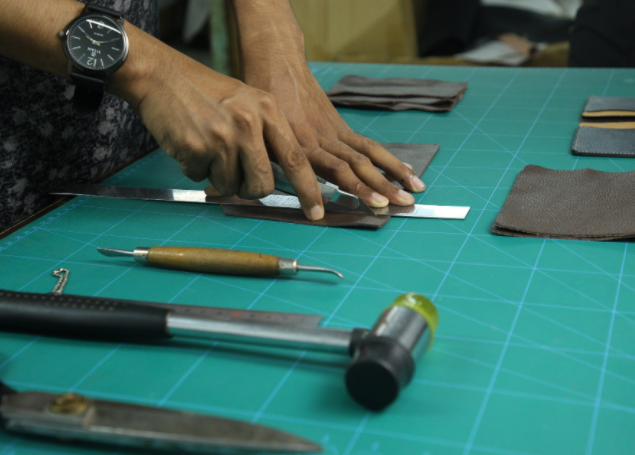
Lining Material and Structural Support: Determining Whether the Bag Retains Its Shape and Stays Upright
Set an empty briefcase on a table. If the sides collapse inward or the top sags, the lining and internal support failed before you ever loaded it.
Lining Material Standards
Cotton canvas lining needs 8–12 oz/yd² (270–400 g/m²) weight. Drop below 220 g/m² and support disappears fast. Structured briefcases pair heavy canvas around 350 g/m² with a non-woven backing (80–120 g/m²) and a PP sheet (0.8–1.2 mm) to hold shape when the bag is empty. Suede-style lining runs 0.5–1.0 mm for real side-wall support. Under 0.4 mm you get a soft touch with no backbone. Microfiber lining at ≥0.3–0.4 g/cm³ density stays stable even at 0.4–0.6 mm thickness. That’s common in lightweight professional laptop bags, and it should survive 10,000+ flex cycles at the flap fold without cracking.
Structural Support Combinations
Premium briefcases layer PP board (0.8–1.5 mm) or HDPE (1.0–2.0 mm) between the leather and lining. 120 g/m² interfacing is typical. A solid business briefcase might use 1.4–1.6 mm full grain leather, 120 g/m² stiff interfacing, and a 1.2 mm PP base board. Lightweight laptop bags swap in EVA foam (3–5 mm, 30 kg/m³) alongside HDPE panels, cutting weight 10–20% without losing shape.
Quick Test
Stand the empty bag upright for one hour. No inward bowing, no top collapse. That’s the benchmark separating durable briefcase construction from bags that look sturdy only on a shelf.
Internal Layout and Functional Design: Tailored for Laptop and Document Storage Needs
A 15.6-inch laptop needs at least 380mm of interior width to slide in without friction. Get that number wrong, and every insertion risks scratching the screen or straining the zipper. This is where a professional laptop bag either earns its price tag or exposes cheap engineering.
Laptop Compartment Sizing
Match the padded compartment to the machine, not the marketing label. A 13.3-inch laptop (roughly 304×212×15–18mm, think ThinkPad X13 or MacBook 13) needs a compartment near 320×230×25mm, leaving 8–15mm of side and top buffer and 7–10mm of protective padding. Step up to 14-inch models (323–325×218–225×17–20mm) and the compartment should grow to 340×250×30mm. For 15.6-inch machines—both traditional bezels (358–380×240–258mm) and slim-bezel builds (355–365×235–245mm)—look for 380–400×260–280mm compartments. If a bag claims “fits 13–15.6 universal,” the main sleeve should measure at least 400×280mm, with adjustable foam blocks or Velcro straps to stop smaller laptops from sliding around. Zipper-to-base height should exceed the laptop’s depth by 25–30mm, and side padding should stack 8–10mm EVA or PE foam under a 2–3mm outer layer for real drop protection.
Document and Organizer Panels
A4 file pockets (210×297mm) need at least 230×320mm of clearance with a 10mm top margin to prevent creasing. Quality briefcases include one file layer next to the laptop compartment and one on the outer wall for quick access. Charger compartments matter more than most buyers realize—roughly 60–70% of business users complain that loose power cables scratch documents or tangle with files. A dedicated slot sized 90–100mm wide, 90–120mm tall, and 40–50mm deep with elastic netting solves this cleanly. Card slots sized 90–92×60–65mm, holding 2–3 cards each, paired with a transit-card quick-access window, shave 2–3 seconds off every retrieval. Small, but it adds up daily.
Trolley Sleeve and Quick-Access Pockets
Over 70% of mid-to-high-end business bags (roughly $45–120 range) now include a trolley sleeve, and reviews consistently rate these bags 0.2–0.5 stars higher for travel use. An effective sleeve needs 220mm+ width and 80–120mm height, positioned 120–180mm from the base to keep the bag stable on rolling luggage. Outside, a well-placed phone pocket (90–100×170–180mm) and flat ticket pocket (210mm+ wide) cut retrieval time from 5–8 seconds down to 2–3 seconds—meaningful when you are clearing security or boarding gates multiple times a day.
Carrying Comfort: Ergonomic design standards for the handle and straps.
Thirty minutes into your commute, a narrow handle starts cutting into your palm. That’s a design failure that pressure-mapping data can predict before the bag ever ships.
Handle Width and Pressure Distribution
Skin can tolerate continuous contact pressure up to 30–40 kPa before pain sets in. Grip a bag for 30+ minutes, and that ceiling drops to 40–50 kPa. This is where handle width matters. For daily commuter briefcases carrying 3–8 kg, the contact width should hit 25–30 mm minimum. Anything narrower concentrates load into a thin line across your palm instead of spreading it flat. Testing with pressure-sensor films (BPMS systems, offering 1 cm² resolution per point) shows widening a handle from 15–20 mm to 25–30 mm cuts peak pressure by 20–30% and shrinks high-pressure contact area by 30–40%. Rounded edges matter too—a curvature radius under 3–5 mm creates a sharp pressure line instead of a broad, comfortable contact surface.
Strap Width and Sliding Resistance
Shoulder straps carrying 8–12 kg laptop loads need at least 60–70 mm of effective width. Every additional 10 mm reduces average shoulder pressure by 10–15%. Anti-slip shoulder pads should cover 100–120 mm with a friction coefficient of μ≥0.4–0.6, cutting strap slippage by more than 50% during a 60-minute walk test compared to unpadded, narrow straps.
Brand Trust and After-Sales Support: Key Decision Factors for B2B Buyers
Ninety percent of B2B decision-makers say reliability—doing what you promised—is the single most important factor in building trust. That’s why sourcing managers look past product photos before signing a contract. They want proof.
Transparency Signals That Build Technical Trust
Traceable supply chains work the same way in leather goods as they do in food exports. Buyers who can scan a batch and see origin, tannery, and inspection data trust a supplier faster and negotiate less. For a genuine leather briefcase manufacturer, that means publishing:
-
Leather origin: country/region, tannery name, environmental certifications
-
Batch-level inspection reports: report number, validity period, LWG/REACH/ISO certificates
-
Factory documentation: workshop size, equipment list, AQL inspection ratio (typically AQL 2.5–4.0, at least 5–10% sampling per batch)
Buyers now ask for factory footage and QC records, not just sample photos. Verified data cuts the fear of “paper specs that don’t match reality”—a common worry when sourcing overseas.
Warranty Length as a Trust Signal
Warranty terms tell you how confident a manufacturer is in their own construction standards.
-
1-year warranty: baseline compliance, minimal confidence
-
2-year warranty: above industry average, suggests better-than-standard quality
-
Lifetime leather warranty: high-confidence commitment, usually paired with 2–3 year hardware/stitching coverage
A lifetime warranty only works if return rates support it. Manufacturers who can quote actual numbers—annual defect rate under 1%, average repair turnaround, percentage of issues resolved within 24–48 hours—turn a vague promise into something buyers can compare across suppliers.
QC Documentation Buyers Actually Request
Structured inspection data beats marketing copy every time. A credible batch inspection checklist should include:
-
Incoming leather inspection (thickness tolerance ±0.1mm, color difference ΔE standard, hardware salt-spray test hours)
-
In-process checks (stitch density, reinforcement length) logged every 2 hours
-
Final QC against AQL standards, with defect classification (minor/major/reject)
Factory video showing cutting, stitching, finishing, final QC, and packing reads as harder to fake than static claims. Client testimonial videos that show concrete results—defect rate dropped from 3% to 0.5%, lead time cut from 45 to 28 days—boost perceived authenticity by roughly 33% compared to text-only case studies.
Return and Trial Policies Reduce First-Order Risk
A first-order trial arrangement—small batch sample run with full refund if quality standards aren’t met—turns a large sourcing risk into a small, reversible one. That matters most for buyers evaluating a new business bag craftsmanship partner for the first time, since it gives them something concrete to report upward when recommending a supplier internally.
Quick Checklist for High-Quality Briefcases (For Consumers and Buyers)
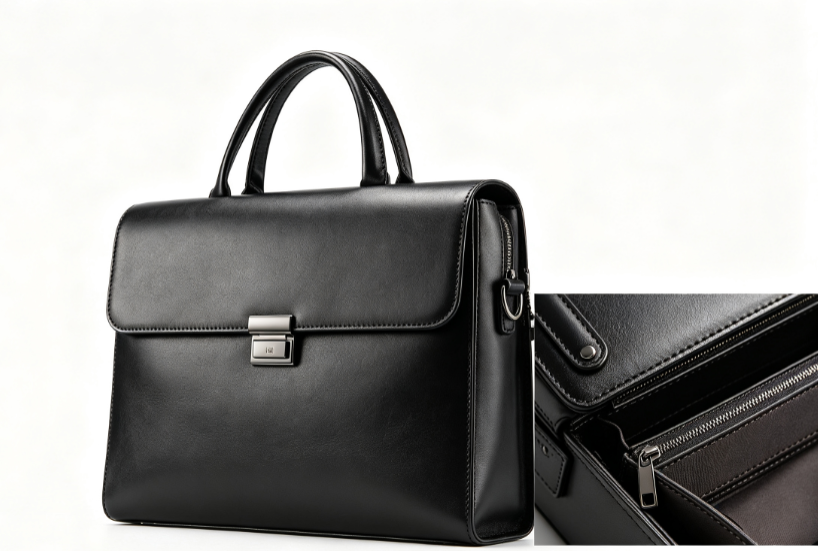
Skip the long reads. Run this checklist before you buy a single bag or approve a batch.
60-Second Consumer Check
– Bend the leather 5–10 times. No cracking, no dead folds.
– Cycle the zipper 10 times. Should run smooth with no snagging.
– Tug the reinforced seams at handles and straps. They shouldn’t give.
– Sniff inside. A sharp chemical smell means reject.
– Load it with 5–8 kg and carry for 5–10 minutes. No sagging or rattling hardware.
B2B Batch Spot-Check
– Match the PP sample against the production run for leather batch, hardware brand, and stitch density.
– Pull 20 units and apply AQL 2.5/4.0 sampling.
– Request salt-spray and colorfastness reports before shipment.
Walk away if: the zipper skips on first cycle, hardware has rust spots, lining shows visible fraying, or the odor stays after airing out.
Guide to Leather Care and Long-Term Maintenance
Even the best full-grain leather fails without maintenance. Skip conditioning for a year and edges dry out, grain turns dull, and stitching accumulates hardened residue, no matter what genuine leather briefcase you bought.
Conditioning Schedule
How often you condition depends on use. Daily use in a humid climate means every two to three months. Standard use needs it every three to six months. Deep conditioning with leather oil is fine once or twice a year.
Application Amount
Less is more. A coin-sized amount (roughly a one-yuan coin) covers most briefcases. Wallets need only a pea-sized drop. Apply with a soft cloth in small circles. Never pour oil directly onto leather. Let it absorb for several hours or overnight, then buff excess off with a dry cloth.
Product Selection
Choose beeswax-and-neutral-oil-based conditioners. Avoid silicone, petroleum distillates, or heavy dyes—they mask surface problems and block leather’s natural breathability.
Storage Standards
Keep humidity near 60%, away from direct sunlight, heating vents, and bathrooms. Use dust bags (never plastic), stuff with plain newspaper to maintain shape, and add silica packets during rainy seasons.