
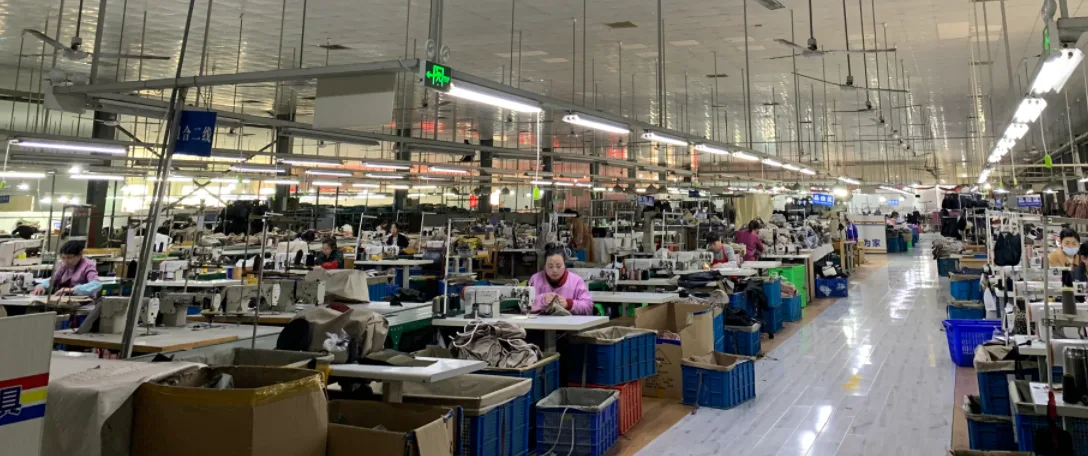
A single wrong material call on a bulk travel bag order can create costly problems—warehouses full of returns, buyers complaining about seams leaking after the first rainy commute, or margins eaten alive by an over-spec’d fabric nobody asked for. For brand owners, trade buyers, and product developers working with weather-resistant materials for travel bag manufacturing, the real challenge is understanding which construction actually performs at your price point and use case. Is 600D polyester with a PU coating enough, or does your product line demand TPU lamination and taped seams? What’s the real difference between a DWR finish and a PVC coated fabric when bags sit in cargo holds or get rained on at a bus stop? This guide breaks down the fabrics, coatings, and testing benchmarks that separate durable, sellable luggage from returns waiting to happen—plus what to ask suppliers before you commit to a bulk order.
Water-Resistant vs. Waterproof: What Buyers Need to Know
Suppliers throw around “waterproof” and “water-resistant” like they’re interchangeable. They’re not, and confusing the two on a purchase order leads straight to buyer complaints. Water-resistant is a surface treatment—a DWR (Durable Water Repellent) finish or tightly woven fabric that makes water bead up and roll off. Waterproof needs a membrane: TPU, PVC, or laminated coating that blocks water completely.
Hydrostatic head ratings give you a number instead of a marketing word:
-
0–1,500mm: Water-resistant, fine for light drizzle
-
1,500–5,000mm: Moderate rain protection
-
5,000–20,000mm: True waterproof performance, suited for heavy rain or outdoor use
-
20,000mm+: Extreme waterproof, marketed for high-pressure exposure
Even a waterproof fabric fails if the seams, zippers, or stitch holes aren’t sealed. Water finds pinholes and pressure points regardless of coating quality.
Buyer Verification Checklist
Before confirming any bulk order, ask suppliers directly:
-
What’s the exact hydrostatic head test value in mm?
-
Is this a TPU/PVC/PU laminated membrane, or just a DWR surface treatment?
-
Are seams fully taped and sealed?
-
Are zippers rated waterproof?
-
Does the DWR require periodic reproofing after washing?
For rainy commutes or light splashes, DWR water-resistant fabric is often enough. For camping gear, cycling bags, or products facing sustained rain exposure, insist on 5,000mm+ hydrostatic head with sealed seams—fabric alone doesn’t make a finished bag waterproof.
Core Fabric Options for Travel Bag Manufacturing: 500D Nylon, 1000D Cordura & Polyester Oxford
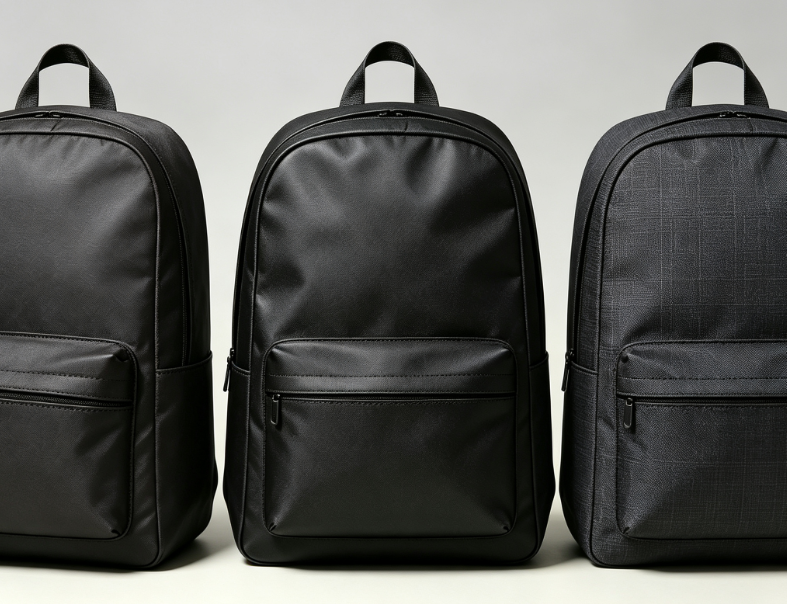
Denier numbers get thrown around in every supplier quote, but most buyers never see what they translate to on the factory floor. The three fabrics dominating travel bag production—500D nylon, 1000D Cordura, and polyester Oxford—each hit a different point on the weight-versus-durability curve, and picking the wrong one shows up fast in field returns.
500D Nylon / 500D Cordura weighs in around 230 g/m² (7–8 oz/yd²). That gives you a lighter, softer hand feel than heavier alternatives. Abrasion resistance varies by test method and coating. Some sources report 80,000+ Martindale cycles, others place it closer to 25,000–30,000. Either way, it’s the go-to for lightweight backpacks, carry-on luggage, EDC bags, and pouches where every gram matters.
1000D Cordura is the heavyweight option, running 310–330 g/m² (9–11 oz/yd²)—roughly a 25–45% jump over 500D by weight. One source cites figures as high as 12.5 oz/yd² vs 7.2 oz/yd², a 73% increase. Abrasion numbers climb accordingly: 50,000 to 150,000+ Martindale cycles depending on coating and test conditions. It’s stiffer, more rigid, and built for tactical backpacks, military-grade gear, and heavy-duty travel bags that need to survive years of cargo handling.
Polyester Oxford sits at the budget end. A typical 600D Oxford runs 200–220 g/m² with around 25,600 Martindale cycles—noticeably below Cordura. It’s also more prone to wear at fold lines, and PU coating adhesion tends to be weaker over time. Water resistance is usually PU-coated, landing in the 600–1,500mm range. Oxford makes sense for gym bags, casual luggage, and mass-market travel bags where cost per unit drives the decision.
RFQ Benchmark: What to Ask For
|
Fabric |
Weight |
Martindale Cycles |
Best Use |
|---|---|---|---|
|
500D Cordura |
~230 g/m² |
25,000–80,000+ |
Lightweight travel/EDC |
|
1000D Cordura |
310–330 g/m² |
50,000–150,000+ |
Heavy-duty, tactical |
|
600D Oxford |
200–220 g/m² |
~25,600 |
Budget, gym/casual bags |
For context: nylon 6,6 offers roughly 3.5× the abrasion resistance and 20% higher tensile strength than polyester at equal denier. Cordura specifically runs about 4× more abrasion-resistant than standard nylon. When reviewing samples, always request the supplier’s exact Martindale result and denier verification. Published ranges vary too widely to trust marketing claims alone.
Waterproof Coating & Lamination Technologies: PU, TPU, PVC and TPE Compared
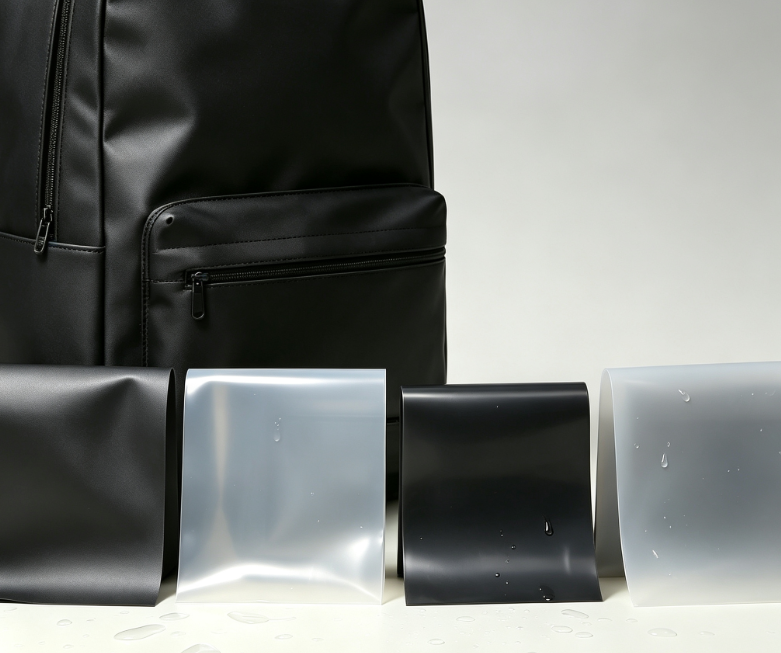
Fabric choice only tells half the story. The coating or laminate on that base textile decides whether your travel bag survives a downpour or just looks waterproof on paper. Four technologies dominate production today: PU coating, TPU lamination, PVC coating, and TPE film. Each runs on a different production logic and lands at a different point on the cost-performance curve.
PU coated polyester is the budget starting point. A liquid polymer goes on the fabric’s back side, then dries and cures. Waterproof ratings run 3,000–10,000mm, depending on coating thickness and how many layers you apply. It stays soft and flexible, so it’s the default for bags, rain shell linings, and light covers where cost matters more than extreme durability.
TPU laminated fabric works differently. A TPU film gets heat-laminated onto the textile instead of coated on. This gives you better seam weldability and more stable waterproofing, with ratings that commonly hit 5,000–10,000mm+. TPU also holds up better in cold weather and resists abrasion more effectively than PVC, which makes it the go-to for dry bags, premium outdoor gear, and technical shells.
PVC coated fabric delivers the strongest hard-barrier performance, with ratings reaching 10,000–30,000mm. Production fuses a PVC plastisol compound into a dense, sealed layer. It’s heavier, stiffer, and completely non-breathable. It’s also the cheapest material in this comparison, which is why tarpaulin for luggage and heavy-duty industrial bags still uses it.
TPE sits closer to TPU in behavior—soft hand feel, elasticity, low-temperature flexibility. But comparative fabric data is thinner than for the other three.
Quick Selection Logic
-
PU — lightweight, low-cost, good for general bags and linings
-
TPU — best for stretch, seam welding, cold resistance, premium feel
-
PVC — maximum barrier at lowest material cost, but heavy and stiff
-
TPE — soft, elastic alternative to TPU for comfort-focused products
Match seam tape to the coating type—PU, TPU, or PVC tape. Mismatched sealing is a common cause of leak failures even on correctly-rated fabric.
How to Choose the Right Weather-Resistant Material by Product Positioning
Material selection isn’t about finding the “most waterproof” fabric on the market. You’re balancing waterproof performance, budget, appearance, production complexity, and how long the bag needs to last. Start with your product line’s positioning, then work backward to the fabric system, coating, and testing benchmarks. That order matters. Reverse it and you’ll end up over-spec’d or under-protected.
Match Material to Product Tier
Budget travel bags — PU coated polyester. Focus on coating uniformity and adhesion rather than full waterproofing. This works for commuter and short-trip bags where basic splash resistance is enough.
Premium waterproof bags — TPU laminated fabric with fully sealed seams. The weak points aren’t just the fabric. They’re the zippers, bag openings, and stitch holes. Check elongation rate, bond strength, and cold-weather flexibility.
Heavy-duty outdoor bags — PVC tarpaulin or 1000D Cordura with heavy coating. These are built for abrasion, UV exposure, and mechanical damage under repeated heavy loads.
Style-driven bags — waxed canvas or coated canvas. Appearance and hand feel matter more than maximum protection. Light rain resistance is sufficient.
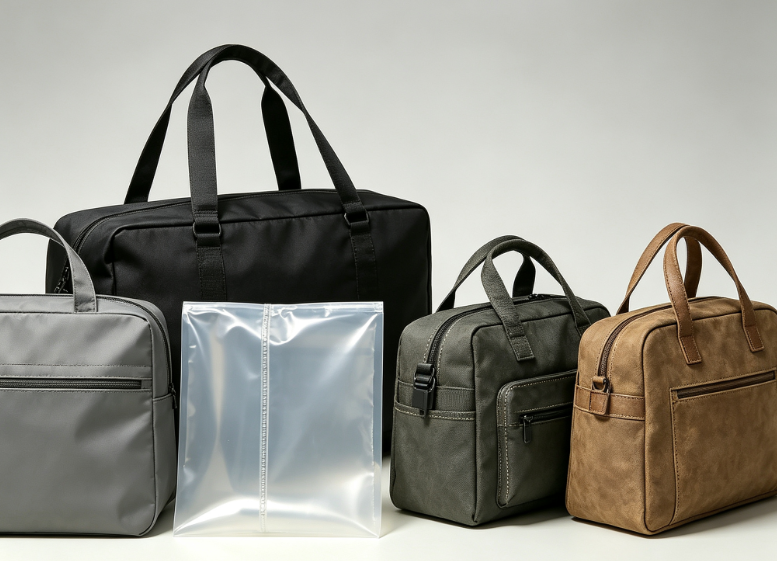
Purchasing Checklist Before Sampling
-
What’s the product positioning — budget, premium, outdoor, or style?
-
What’s the target protection level — splash, rain, sustained storm, or mechanical stress?
-
Where’s the likely failure point — fabric body, seams, zippers, or base?
-
Does the fabric system match — PU, TPU, PVC, or waxed canvas?
-
Are these tested — spray test, seam leak test, fold-cycle test, cold test, abrasion test?
For sourcing conversations, keep it direct: “This line is a budget travel bag — go with PU coated polyester, prioritize cost and basic splash resistance.” Or: “This is a premium outdoor line — TPU lamination with sealed seams is non-negotiable, and we need confirmed zipper waterproofing.”
Durability & Performance Testing: What Data to Request from Suppliers
A “pass/fail” stamp on a test report tells you almost nothing. Real procurement decisions need five data sets: abrasion testing, tensile strength, tear strength, hydrostatic head, and colorfastness. Each one should come with the test standard, sample size (n), mean, min/max, standard deviation, test conditions, and report date. Anything less is a marketing summary.
The Five Non-Negotiable Test Categories
Abrasion resistance – Martindale or Taber method, cycle count, plus appearance change, weight loss, and pilling grade after cycling. Generic TDS numbers don’t count if they aren’t tied to your actual bag structure.
Tensile & tear strength – MD/CD (warp/weft) values, breaking force, tear force, and conditioning environment. Always request the minimum, not just the average. Batch variation hides weak spots that averages smooth over.
Hydrostatic head – units in mmH₂O or kPa, and whether the figure is for raw fabric, coated fabric, or finished sewn seams. “Waterproof” claims without matching numbers mean nothing.
Colorfastness – separate ratings for rubbing, light exposure, and perspiration or washing, each referenced against a grey scale grade.
Fields to Demand on Every Report
Method standard number, instrument model, calibration date, test environment, n, mean, standard deviation, min/max, raw data files, sample batch source, MD/CD direction, and measurement uncertainty. These fields expose suppliers who hand-pick their best sample for testing.
GSM and Coating Specs Aren’t the Full Story
Higher GSM usually means more tear resistance and abrasion reserve. But bad yarn structure or weak coating adhesion can erase that advantage fast. Always evaluate GSM alongside yarn count, weave density, and fabric structure. Never as a standalone number. On coatings, ask for material type, thickness, coating weight, layer count, adhesion data, and matching hydrostatic and abrasion results. Thin coatings fail on waterproofing first. Thick-but-poorly-bonded coatings crack, peel, or whiten at fold lines.
Red Flags That Signal Overstated Durability
-
Marketing language with no method, standard, or numeric value
-
“Passed testing” claims with no conditions, batch, or sample size disclosed
-
Single-metric reports (only abrasion, or only hydrostatic head) with no combined performance picture
-
Generic textile TDS submitted for what should be finished luggage fabric data
-
Reports older than 12–24 months, likely reflecting outdated processes or batches
Acceptance Checklist for Every Sampling Round
-
Structure: GSM, yarn count, weave, density, coating type and thickness
-
Durability: abrasion, tensile, tear, hydrostatic head, colorfastness
-
Consistency: min/max/standard deviation across batches, sample location (roll head, middle, tail), batch traceability
-
Authenticity: third-party lab reports, raw CSV or XLSX data, microscope photos – not polished summary sheets
Require raw data, not conclusions. Suppliers who resist sharing CSV files or original photos are usually hiding the batch that didn’t pass.
Compliance & Sustainability: OEKO-TEX, GRS and Eco-Friendly Waterproof Fabric Options
Certification paperwork gets treated as an afterthought until an EU buyer’s compliance team rejects a shipment. OEKO-TEX STANDARD 100 is the product-safety certificate that actually matters for waterproof fabrics — it covers raw materials, coatings, membranes, thread, zippers, and finishing chemicals, not just the base textile. Testing screens for heavy metals, carcinogenic dyestuffs, pesticides, and formaldehyde. The certificate is valid for one year and requires annual renewal, so a label alone proves nothing. Always verify the certificate number, product class, and transaction certificate.
For recycled claims, GRS (Global Recycled Standard) is the baseline. If a supplier markets “eco-friendly waterproof fabric” without chain-of-custody proof tracing recycled polyester (rPET) or recycled nylon back to the finished roll, that claim is a performance finish — not a sustainability claim.
EU-Bound Fabrics Need REACH Too
A fabric can pass hydrostatic head testing and still fail buyer compliance if PU coating or DWR finish carries REACH risk. Request OEKO-TEX + GRS + REACH declaration per lot, plus composition breakdown, MSDS sheets, and batch-level traceability tied to shipment invoices.
Manufacturing Best Practices: Seam Sealing, Reinforcement & Stress-Point Construction
The face fabric almost never fails first. The stitch line does. Every needle hole punched through waterproof nylon fabric or TPU laminated fabric creates a potential leak path, which is why seam sealing—not fabric selection—decides whether a finished bag actually performs.
Coverage standards matter more than product choice. Seam tape should extend at least 5mm on each side of the seam; liquid sealant beads run closer to 6mm (¼ inch) on either side of the stitch line. Apply in 1–2 ft sections to avoid premature curing, and always clean with isopropyl alcohol first—residue kills adhesion. Full cure takes 24–48 hours.
Stress Points That Fail First
-
Top carry handle ends
-
Bottom corners and base panels
-
Zipper thresholds and garage ends
-
Strap anchors and D-ring tabs
-
Main compartment mouth where zippers interrupt the seam
Reinforce these with bar-tacking, box-X stitching, and patch layers at bottom corners—keep sealant continuous through the attachment base. At corners, blend intersecting beads into one unbroken seal instead of stopping at each joint.
Zippers need dedicated attention. Standard coil zippers leak under load. Choose interlocking, laminated-tape zippers, and seal both sides when they sit under stress or rain exposure.
Case Study: How Sunteambag Applies Weather-Resistant Materials in Custom Travel Bag Production
Wuhan-based OEM-ODM factory Sunteambag runs its SealTech™ line as a working example of the theory above. The factory stitches seams and heat-bonds them, which removes needle-hole leak paths entirely. Sunteambag claims the result is 300% better waterproof performance, 70% stronger seams, and a 5-year+ waterproof lifespan. Traditional stitched bags start leaking within a year.
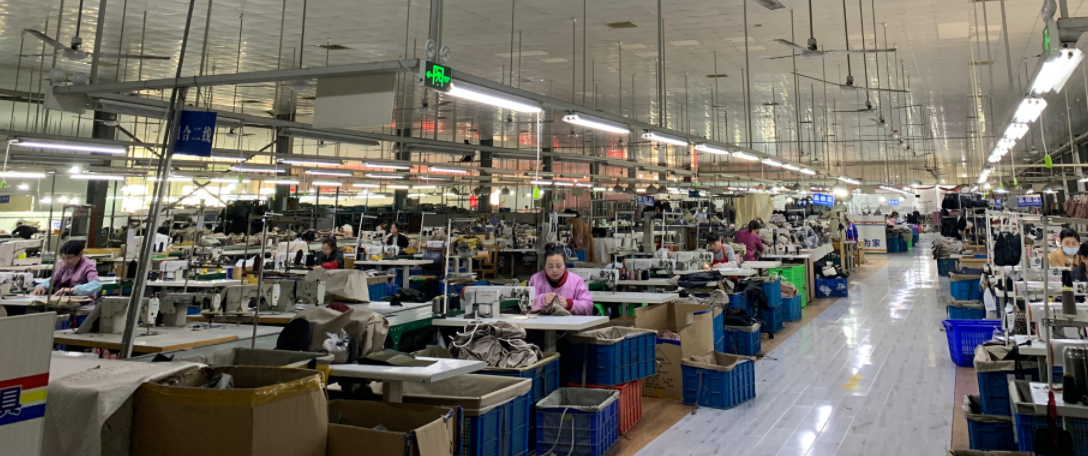
Material Choices by Product Goal
For waterproof travel bags, they use TPU-laminated polyester or PU-coated polyester, sometimes paired with ultrasonic welding so no thread crosses the fabric. Select waterproof models get 3L (3-layer) fabrication for added barrier performance. The 530 g/m² PVC-coated cotton has double-welded seams and is rated above 20,000mm water column. Where abrasion resistance matters more than full waterproofing, 1000D Cordura with PU coating hits 1,500mm+ with DWR added.
QA Backing the Claims
Production testing includes eight checkpoints: rain simulation, immersion, hydrostatic pressure, seam inspection, zipper submersion, open/close cycling, weight-difference water-ingress checks, and paper-towel witness tests. Benchmarks are 10 L/min spray for 10 minutes and 1m immersion under 5kg load for 30 minutes, with fabric held to 10,000mmH₂O+.
A compact travel collection targeting millennial buyers reportedly saw 142% higher engagement than apparel content on the same platforms. Getting the material right doesn’t just prevent returns—it drives interest.
Sourcing Checklist: Key Questions to Ask Before Placing a Bulk Order
Placing a bulk order without a written checklist is how buyers end up with mismatched fabric lots, blown MOQs, or a factory that turns out to be a trading company with no production floor. Before committing budget, get answers in writing.
Supplier & Material Verification
-
Who’s actually making this? Confirm manufacturer vs. trader vs. agent, plus legal name, business license, and factory address.
-
What’s the exact fabric spec? Base fabric, coating/lamination type, waterproof rating target, seam construction, zipper type, abrasion resistance, and colorfastness. Get all of that in writing, not verbal promises.
-
Can I get pre-production samples matching this spec before bulk approval?
Commercial Terms to Lock Down
-
MOQ by color, style, or fabric. Custom mill runs often start at a few hundred yards and cost more per unit than stock programs.
-
Tiered pricing at 500 / 1,000 / 5,000 pcs, with sampling, dyeing, and testing costs itemized separately.
-
Landed cost drivers: dyeing, finishing, certification, freight, and duties can shift total cost significantly.
-
Sample lead time vs. bulk lead time, and what causes delays during peak season.
-
Incoterms (EXW, FOB, CIF, DDP) and payment milestones.
-
QC system: incoming checks, in-line inspection, AQL-based final inspection, and defect/rework policy.
-
Repeat-order continuity — can they hold the same lot, coating, and shade for reorders?