Sourcing teams aren’t picking travel bag materials on price and durability alone anymore. Buyers are asking pointed questions about recycled content, water resistance ratings, and where fabrics actually come from. If you last made a material decision more than eighteen months ago, it’s probably already behind the curve.
The shift is real and measurable. Recycled polyester fabric bags have moved from niche eco-lines into mainstream production runs. Ballistic nylon is being reformulated for lighter weight without losing abrasion resistance. Vegan leather luggage is finally shedding its “cheap alternative” reputation among premium brands. And EU compliance requirements are quietly rewriting what “acceptable sourcing” even means.
Sustainable Materials Are Now the Baseline Standard
Procurement teams now write recycled content requirements into hard specifications. Many material standards require at least 25% post-consumer recycled content, with that product category needing to cover 75% of a project’s weight or cost before it even qualifies. It’s a contract term.
Textile Exchange’s new Materials Matter Standard pushes this further. It folds recycled and virgin raw material production into one unified framework, covering everything from raw material generation to recycling facilities and initial processing — what the standard calls Tier 4. Suppliers now need chain of custody documentation and monthly tracking of chemicals, water, waste, and energy use. Recyclers need paperwork. Waste pickers need records. The days of “we use recycled fabric, trust us” are over.
The timeline matters for anyone planning sourcing strategy:
-
June 2024: Materials Matter Standard pilot publicly released
-
Q1 2026: Standard becomes effective for voluntary certification
-
December 31, 2026: Certification becomes voluntarily active
-
December 31, 2027: Legacy standards (GRS, RCS, RWS, RDS, RMS, RAS) get fully replaced — mandatory switch
Buyers checking recycled polyester fabric bags and RPET fabric luggage now screen for four specific numbers: recycled content percentage (≥25% minimum), category coverage (75% by weight/cost), contaminant disclosure thresholds (1,000 ppm baseline, tightening to 100 ppm for certified suppliers), and third-party verification status.
For travel bags specifically, rPET adoption follows a predictable pattern. Linings get replaced first — lightweight, printable, easy to swap without touching structural performance. Shell fabric and body panels come next, usually paired with coatings or laminates. Webbing, straps, and trim follow last, since these components carry certification documentation most easily without major cost jumps.
Brands still treating recycled materials as a premium upsell are going to find themselves locked out of RFPs that now list traceability and content verification as non-negotiable line items.
Lightweight Performance Fabrics: Ripstop Nylon, rPET Polyester & Waterproof Nylon Lead the Shift
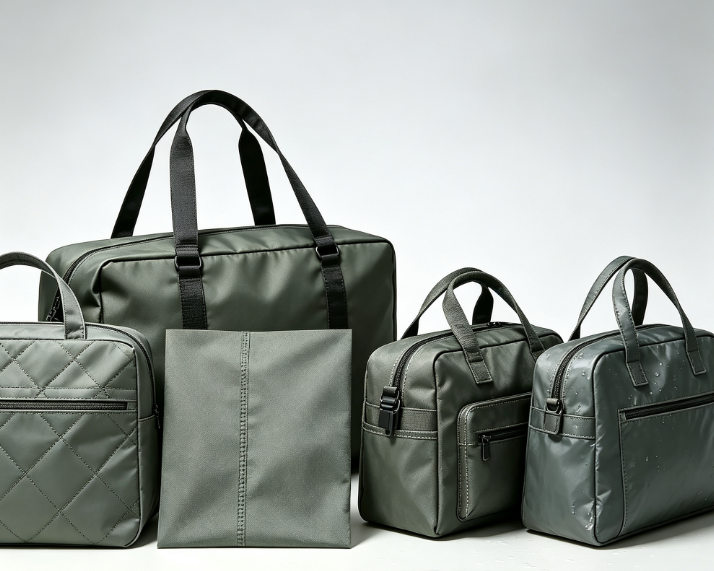
Fiber type isn’t the deciding factor anymore. Construction and coating are. Ripstop nylon, rPET polyester, and waterproof nylon all show up in lightweight luggage material specs, but a fabric’s real performance comes from how it’s woven and finished — not what it’s made of.
Ripstop nylon is a reinforcement weave, not a waterproofing method. On its own, it’s not automatically water-resistant. Common lightweight constructions run 40D and 210D, with 210D nylon weighing roughly 4.85 oz/sq yd. Water resistance only kicks in once DWR, PU, or silicone coatings get applied.
rPET ripstop keeps that same lightweight strength and tear resistance while swapping in recycled feedstock — no performance trade-off, just a different sourcing story that satisfies sustainability line items.
Water Column Ratings Buyers Should Request
Denier alone won’t tell you if a fabric handles rain. Ask for mm water column instead:
– 200D polyester with DWR: marketed as 100% water resistant
– 210T nylon ripstop with PU coating: rated at 2000mm water column
– Standard ripstop nylon/poly blends: often land around 1500mm, with 5 cfm air permeability
Matching Fabric to Use Case
Commuter bags need quick-dry, rain-ready fabric. PU-coated or DWR-treated ripstop in the 1500–2000mm range, paired with sealed seams, does that job.
Long-haul travel bags need abrasion resistance and shape retention over repeated handling. Higher denier ripstop (210D+), stronger yarns, and laminated builds hold up better than lighter commuter-grade fabric.
Nylon wins on flex and abrasion. Polyester wins on moisture resistance and drying speed. Neither wins on waterproofing without the right coating.
Fabric Traceability Is Becoming a Procurement Requirement, Especially for EU-Facing Products
A verbal promise from a supplier no longer counts as proof. EU-facing procurement requires verifiable traceability now, not optional disclosure. That changes what buyers need before they sign a PO.
The EU’s Digital Product Passport (DPP) under ESPR sets the pace. ESPR took effect in 2024. Textile-specific rules are expected in 2026, with a mandatory compliance window around 2027–2028. Priority categories go first, then coverage expands. One interpretation linked to the EU JRC notes a minimum 18-month transition period once the delegated act activates. Industry breakdowns estimate the data requirement at roughly 35 mandatory data points, sometimes framed as 49 fields across four categories: product identification, producer identification, product information, and compliance documentation.
What Buyers Now Ask For
-
Lot-level batch IDs, not just style numbers
-
Composition and origin proof for every fabric, lining, webbing, and filler
-
Factory names, addresses, and timestamps for spinning, weaving, dyeing, coating, and cutting
-
Chemical declarations covering coatings and waterproof treatments
-
Certificate numbers and scope for OCS, GRS, or Bluesign
Each certification covers different ground. GRS verifies recycled content and chain of custody — the right fit for recycled polyester fabric bags and RPET fabric luggage. OCS confirms organic fiber content. Bluesign focuses on chemical management in dyeing and finishing.
Vague sustainability claims no longer work without machine-readable, verifiable data tied to a unique product ID. No batch traceability, no REACH documentation, no certificate numbers — that supplier risks getting cut from EU-facing approved vendor lists entirely.
Durability as a Sustainability Metric: Why “Longest-Lasting” Beats “Most Eco-Labeled”
A bag that survives ten years of travel beats a “green” bag that falls apart in two. Durability studies model the tradeoff between repairing or extending a product’s life versus replacing it, and the math consistently favors longevity. The core mechanism is that durability spreads the original production footprint across more years of use. Researchers define this ratio as lifespan utility divided by initial environmental burden. Longer service life, lower footprint per use, regardless of what the label says.
Industry KPIs now track this. They include product lifespan extension, durability score, repairability index, take-back rate, material recovery rate, and carbon reduction tied to durability gains. One newer indicator, the Specific Durability Performance (SDP) score, merges mechanical, thermal, and chemical durability with environmental performance into a single 0.0–1.0 value. This gives design teams a way to compare materials before committing to production.
What to Ask Suppliers Instead of “Is It Eco-Friendly?”
Skip the label questions. Ask for hard data instead.
-
Abrasion resistance and tear strength ratings
-
Coating delamination resistance after repeated flex cycles
-
Stitch seam strength and failure rate under load
-
UV resistance and wash/clean cycle tolerance
-
Repair patch compatibility
For nylon vs polyester travel bags, recycled nylon only earns sustainability credit if it’s paired with real repairability and warranty backing. Biodegradable bag materials deserve the same scrutiny. A lower-impact feedstock means nothing if it fails after six months. Track carbon per trip, not carbon per label.
Material Comparison: Nylon vs Polyester vs PU/PVC vs Recycled Materials for Travel Bags
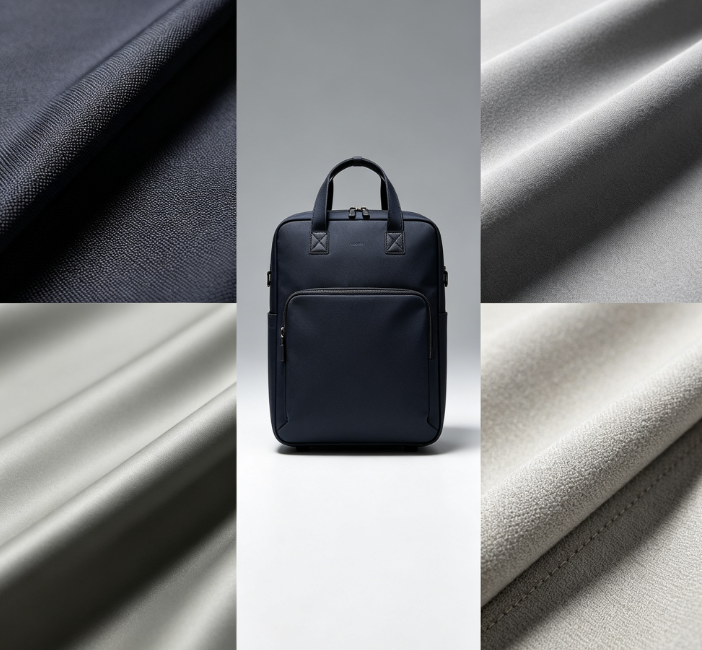
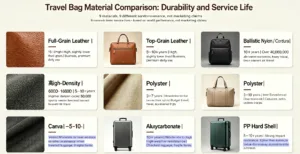
Four material families dominate travel bag sourcing, and each one wins on different metrics. No single fabric checks every box — strength, cost, and environmental profile pull in different directions.
|
Material |
Strength/Weight/Abrasion |
Typical Cost |
Environmental Profile |
Best Use Case |
|---|---|---|---|---|
|
Nylon |
30–50% stronger than polyester at equal denier; poor UV resistance |
Mid-high; 60–80% pricier than polyester |
Petrochemical-based; recycled nylon exists but costs more to produce than rPET |
Premium luggage, carry-ons, high-frequency travel bags |
|
Polyester |
Slightly weaker than nylon; better UV stability and color retention |
Low-mid |
rPET matches virgin polyester performance nearly identically |
Budget bags, promotional items, printed designs |
|
PU/PVC coatings |
Waterproofing comes from the coating, not the fiber; PU is lighter, PVC is heavier and stiffer |
PU is baseline cost; PVC is often the cheapest waterproof option |
PVC has the weakest profile — chlorine content, plasticizer concerns, compliance pressure |
PU for daily rain protection; PVC/TPU for heavy industrial waterproofing |
|
Recycled materials (rPET/recycled nylon) |
rPET performs on par with standard polyester; recycled nylon matches virgin nylon |
rPET runs 10–20% higher than standard polyester |
Most mature recycling stream; GRS certification is the standard ask |
ESG-focused lines, EU/North American channels, lightweight accessories |
Hard Numbers Buyers Should Reference
-
300D polyester: FOB fabric pricing around $0.70–1.00/m, standard for promotional and budget retail bags
-
PU coating: water column rating of 1,000–3,000mm, suited for commuter and light-rain travel bags
-
PVC coating: water column can reach 15,000mm+, but adds weight and stiffness
-
TPU: used more often now as a PVC substitute, priced 40–60% higher than PVC but with better flexibility and a cleaner sustainability story
Why PU and PVC Are Losing Ground
Standard PU degrades faster under repeated folding. Industry data points to roughly 1,000 fold cycles before performance drops, which gives it a 2–3 year durability window in many cases. PVC faces separate pressure: retailers are increasingly sensitive to odor, plasticizers, and compliance scrutiny, and high-end channels are shifting to TPU or recycled nylon instead.
The Practical Sourcing Rule
-
High-abrasion, business-grade bags → nylon or ballistic nylon
-
Budget, print-heavy products → polyester/rPET
-
Waterproofing on a budget → PU-coated polyester or nylon
-
Verified sustainability claims → rPET or recycled nylon with GRS documentation on file
Eco-Luxury Materials Rising: Vegan Leather, Bio-Based Fabrics & Plant-Derived Alternatives

Stella McCartney’s Falabella bag in Mylo™ mushroom leather has been on shelves since 2018. That’s how long “eco-luxury” has quietly moved past marketing talk.
Vegan leather luggage now splits into two practical tiers. Polymer-blended plant leathers (PU/PVC-backed) are cheaper and scale easily. VEGEA® grape leather runs up to 45% PU, which shows how “plant-based” often means “plant-hybrid.” Low-plastic bio-materials like mycelium and agri-waste composites sit at the premium end but aren’t yet ready for mass luggage runs.
Who’s Already Using What
-
Gucci built its own alternative, Demetra
-
Hermès tested a Birkin rework using mushroom leather substitute
-
Alexander McQueen, Ralph Lauren, Richemont work with MIRUM® — petrochemical-free, made from agri-waste and natural rubber
-
Hugo Boss launched pineapple leather shoes
-
H&M used cactus leather in eco collections
What’s Ready for Structured Bags Now
Cactus leather is soft, water-resistant, low-water-use, and pesticide-free. It’s already appearing in handbags and accessories. Pineapple leather (from leaf cellulose) works for bags, wallets, belts. Corn leather, built from corn polyols, holds shape well enough for structured luggage. Apple leather stays smooth but usually blends with PU.
For biodegradable bag materials, ask suppliers about binder chemistry and coating thickness before trusting the label. Hybrid leathers can still carry heavy plastic content. Mycelium remains showcase-grade, not shelf-grade, for now.
Smart-Function Materials: USB Charging, GPS & UVC Liners Inside Lightweight Shells
Electronics are moving inside the shell now, not just bolted onto it. Power circuits, GNSS chips, and UVC modules are getting built into the structural layer itself. Power and control chips sit sandwiched between shell layers. Antennas run flat via flexible printed circuits. UVC diodes tuck into interior liner cavities. The shell stays lightweight; the function layer hides underneath it.
What’s Already Working
USB-C + battery integration: Single-chip power management (like ST’s STBCFG01) handles lithium charging, battery monitoring, and 5V USB OTG output in one component. No bulky separate modules.
Combined USB-C + UVC systems: Patent designs already pair a USB-C port, UV LED, microcontroller, and battery on shared power circuitry. Charging ports and sanitizing functions run off one power management system.
GNSS tracking modules: Quectel’s smart modules support GNSS, Wi-Fi, Bluetooth, and eSIM as swappable peripherals. Location tracking is a modular add-on, not a fixed build.
Reference specs: A comparable portable UV device runs a 3.7V battery, 1.11W input power, and weighs 0.43 kg. Proof this integration works at a bag-friendly weight.
Manufacturing Requirements This Creates
Shells for smart function need PC/ABS or thin-wall glass-fiber reinforced plastic to stay light while housing electronics. USB ports need sealed gaskets or O-rings. UVC diodes must face inward, never toward users. Battery zones need heat dissipation clearance away from UV sources. And every electronic bay should be modular: swap-in USB boards, GNSS chips, and battery packs separately, not soldered as one disposable unit.
How Brands Should Select Materials by Product Tier: Entry-Level to Premium Sourcing Strategy
Not every product line needs the same material spec. Matching material tier to product tier saves procurement teams from overpaying on entry-level runs or underdelivering on premium ones. The framework splits into three material tiers, mapped against supplier capability: Tier 1 (finished goods manufacturing), Tier 2 (fabric and finishing), Tier 3 (yarn and recycled feedstock), and Tier 4 (raw material origin).
Material Combinations by Tier
-
Entry-level: rPET polyester or recycled canvas, standard polyester lining, basic PU/TPU coating, standard zippers and hardware. Priority checks: fabric price stability, weight consistency, colorfastness, basic abrasion resistance.
-
Mid-tier: Recycled nylon, DWR (or equivalent) water-repellent finishing, higher-abrasion lining, reinforced stitching, branded webbing and hardware. Priority checks: abrasion resistance, tear strength, DWR durability, batch-to-batch consistency.
-
Premium: Traceable recycled nylon, bio-based hardware (buckles, zipper pulls, webbing components), high-spec finishing, tighter color and hand-feel control. Priority checks: chain-of-custody transparency, material certification, batch tracking, appearance consistency.
Six Decision Points for Tier Selection
-
Cost ceiling — rPET and recycled canvas for entry-level; recycled nylon and DWR for mid-tier; traceable materials and bio-based hardware for premium.
-
Durability target — abrasion, tear, and water resistance become hard specs at mid-tier and above.
-
Traceability requirement — premium lines need Tier 2/3/4 documentation, down to fiber and raw material origin.
-
Supplier capability — CMT-only factories cover Tier 1; recycled nylon, DWR, and traceable materials require suppliers managing Tier 2 or Tier 3.
-
Certification and compliance — premium sourcing should treat certification files as a sampling gate, not a nice-to-have.
-
Sampling speed — entry-level suppliers turn samples faster; premium chains need multiple fabric and hardware confirmation rounds.
Eight Questions to Ask Every OEM Travel Bag Supplier
Before signing a PO, ask:
-
Are you an OEM travel bag supplier, or CMT/cut-and-sew only?
-
Can you provide spec sheets for rPET, recycled nylon, and recycled canvas?
-
Can you apply DWR finishing and provide test results?
-
Is your recycled nylon traceable to fiber batch level?
-
Can you supply bio-based hardware components?
-
What’s your MOQ per material type?
-
Can you provide certification, test reports, and batch tracking documentation?
-
What’s your typical timeline from sampling to first order?
Sourcing rule of thumb: entry-level decisions start with cost and lead time, mid-tier starts with performance metrics, premium starts with traceability and certification. The material choice comes after, not before.
Supplier Evaluation Checklist – What to Verify Before Ordering
One supplier claim isn’t a verified fact. Sourcing teams need proof before purchase orders go out — not after a shipment shows up short.
Verify Business Legitimacy First
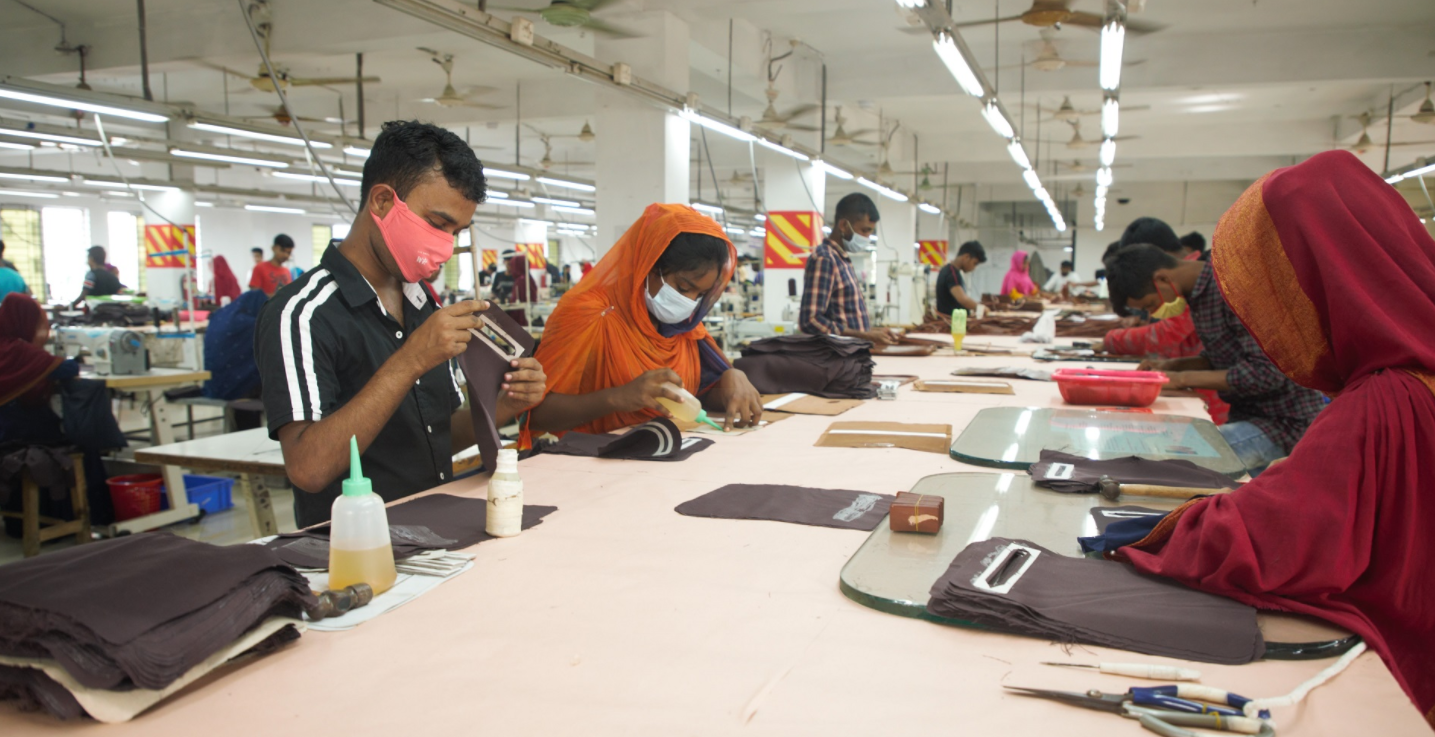
Check the business license, registered address, and actual factory location. A virtual office isn’t a factory. Confirm whether you’re dealing with a manufacturer, trading company, or middleman. Then request equipment lists, production line photos or video, and reference clients that match the claimed capacity.
Test Reports Beat Marketing Language
“Eco-friendly” on a label means nothing without a third-party test report tied to certificate numbers, issuing bodies, and product scope. Require samples in finished condition — coated, washed, pressed — not raw fabric only.
Commercial Terms to Lock Down
-
MOQ, sampling fees, and tiered pricing
-
Payment terms: 30% deposit, 70% before shipment is standard; 100% prepayment is a red flag
-
Tier 2/3 traceability, subcontractor disclosure, CAPA process
Minimum pre-order checklist includes business credentials, product samples, third-party test data, certification scope, commercial terms, and supply chain transparency. Skip any of these, and the risk shifts onto your production line.
Case Study: How Leading Manufacturers Are Applying These Material Trends in Production
Talk is cheap. Closed-loop material recovery shows which manufacturers are serious and which are just running marketing copy. Five industrial case studies from a recent critical materials roundtable prove the model works at scale: H.C. Starck Tungsten recovers tungsten carbide scrap, SungEel Hitech reclaims battery cathode materials, Hitachi Group recovers rare earths from hard drives, Rolls-Royce runs a closed-loop rhenium cycle, and Umicore recovers precious metals. Different industries, same principle — recovered material goes back into production, not into a landfill.
That principle applies to travel bag manufacturing. Recycled nylon and traceable rPET fabric follow the same closed-loop logic, swapped from metal to yarn and fiber.
Energy Sourcing Now Factors Into Material Decisions
Scania’s production facilities run on nearly 100% fossil-free electricity, paired with efficiency upgrades that cut energy waste. Manufacturers across sectors are screening suppliers for low or zero carbon energy use, not just material composition. That standard applies to travel bag fabric mills, too. A supplier’s energy profile is becoming part of the sourcing scorecard, not an afterthought.
Lightweighting and Recycled Feedstock Follow a Similar Trajectory
Automotive materials research shows demand moving from cast iron and steel toward high-strength steel, aluminum, and non-metallic composites, driven by weight reduction goals. One documented PET recycling facility processes 112.4 tons of PET bottles per year through additive manufacturing, turning recovered plastic into new production feedstock. That pilot-to-production model — recover, reprocess, reintegrate — is the pathway rPET and recycled nylon travel bag suppliers need to demonstrate before they earn a spot on an approved vendor list.