
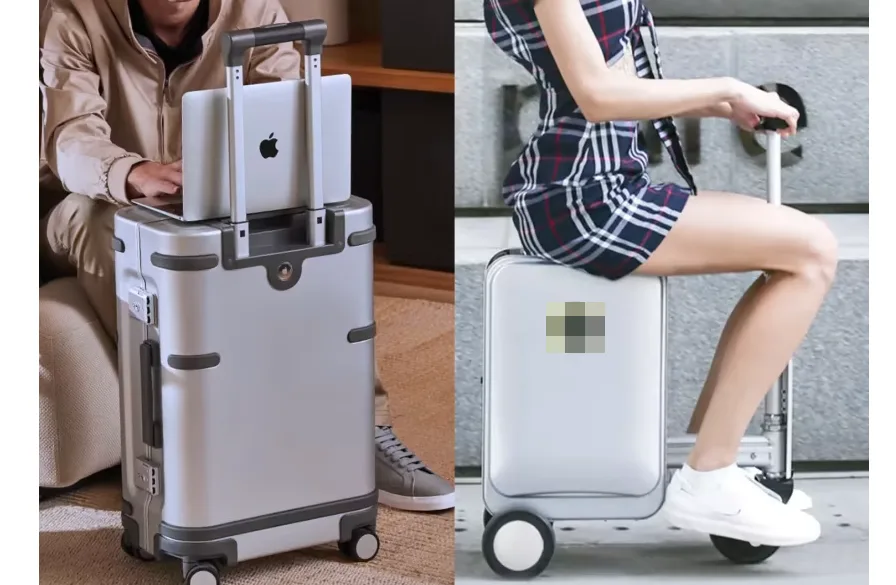
Finding the right smart riding luggage suppliers takes real research. The options pile up fast, and many look the same on the surface. You have to dig deeper to spot the difference.
Are you a retailer looking for a dependable OEM partner? A brand scout checking out white-label options? Or a buyer who wants to know which companies stand behind their products with real engineering? The supplier you pick shapes everything — product quality, lead times, after-sale support, and your bottom line.
The six companies covered here cover a wide range. Some are consumer-facing innovators. Others are serious B2B manufacturers. Each one brings a clear strength worth knowing before you place your first purchase order.
What Is Smart Riding Luggage
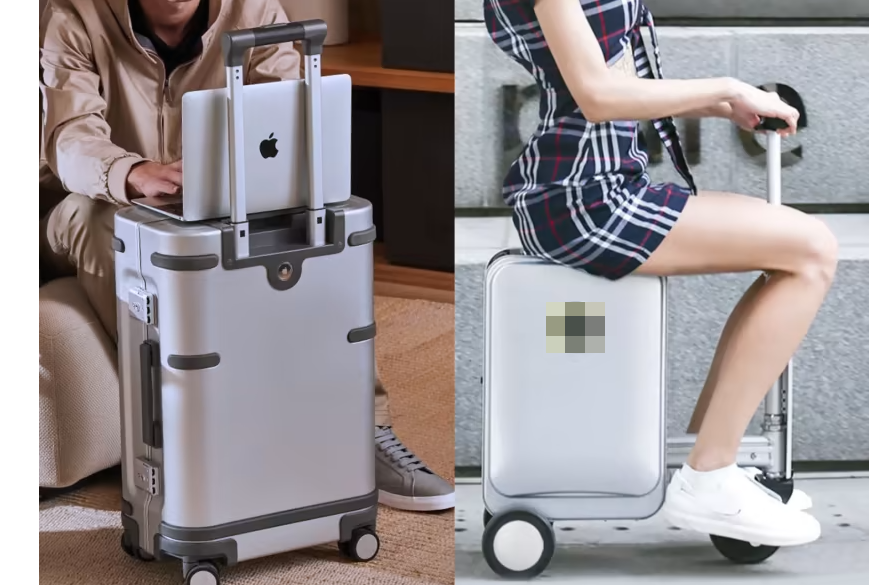
Smart riding luggage is not a glorified suitcase with a USB port. You’re looking at a motorized, rideable device — a full electric drivetrain built into a frame you can actually board. It also carries your clothes.
That difference is real. Take the Airwheel SE3S. It converts from a rolling suitcase to a working scooter at the press of a button. Top speed hits 13 km/h, with both forward and reverse control. The AOTOS L2 supports riders up to 242 lbs (110 kg) and gives you a 6.2-mile range on a single charge. Those are not luggage specs. Those are micro-mobility specs.
Regular smart luggage — USB charging ports, Bluetooth tracking, app-controlled locks — shares none of that engineering. No motor. No throttle. No load-bearing riding frame. The structural gap is huge. A standard carry-on is built for 7–10 kg of clothing. A ride-on frame is rated for 95–110 kg of human weight, in motion.
| Feature | Smart Riding Luggage | Regular Smart Luggage |
|---|---|---|
| Motor | Yes (hub/in-wheel) | No |
| Rider payload | 95–110 kg | N/A |
| Speed | 6–13 km/h | N/A |
| Battery type | High-discharge lithium (73–160 Wh) | Low-draw power bank |
| Controls | App + physical throttle/brake | App lock/location only |
Why the Supplier Is the Real Variable
Most buyers underestimate the risk here.
Ride-on luggage runs on high-discharge lithium batteries — in the 73–160 Wh range. Airlines cap carry-on batteries at ≤100 Wh. The Airwheel SE3S hits that target on purpose. Its 73 Wh removable battery slides out for security checks and doubles as a power bank. That design choice did not happen by accident. It came from a compliance decision made before production started.
Weaker suppliers skip that work entirely. They hide the Wh rating. They use uncertified cells with no UN38.3 testing. They ship batteries with zero MSDS documentation. The result: gate rejection, confiscation, or worse — thermal runaway risk inside the cabin.
Frame strength carries the same level of risk. A suitcase frame that also acts as a scooter chassis takes serious dynamic stress — acceleration, braking, cornering at speed. No verified static and dynamic load testing at 125–150% of rated payload means that frame is a liability you cannot measure.
The supplier you pick is not just a manufacturing call. It is a safety call. A compliance call. A long-term service call. That context shapes everything that follows in this list.
1. Airwheel — Best Overall Smart Riding Suitcase Brand
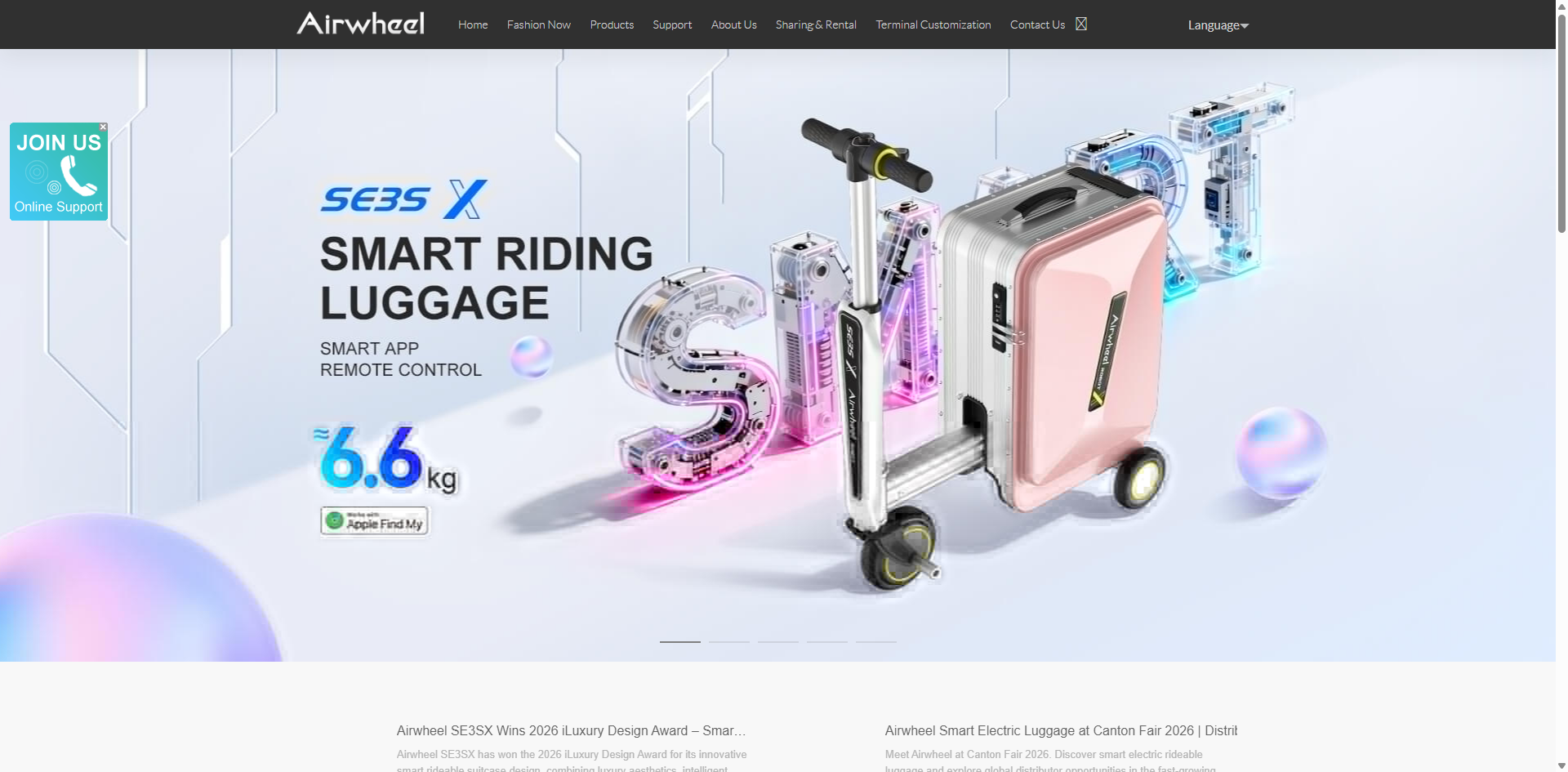
Airwheel did not stumble into this category. The brand built it — and the SE3S and SE3SL are the clearest proof.
Most smart riding luggage suppliers hit the same wall: how do you fit a rideable scooter into a carry-on without breaking airline rules? Airwheel solved this with a 73.26 Wh removable lithium battery. That sits well under IATA’s 100 Wh carry-on limit. It slides out for security checks in seconds. It also doubles as a USB-C power bank. This is not a bonus feature. It is a compliance decision built into the product from day one.
Key specs at a glance:
- Speed: up to 13 km/h (approx. 8 mph)
- Range: 8–10 km per full charge
- Max payload: 95 kg
- Capacity: 20L
- Battery: 73.26 Wh, removable, airline-approved
- Smart features: USB-C charging, app control, TSA-approved lock, anti-loss tracking, remote-control function
Who This Brand Serves
Frequent flyers walking long terminal distances benefit the most. You get 8–10 km of range, which covers most major hubs with distance to spare. Business travelers get carry-on sizing, a TSA lock, and app connectivity — all built for short, repeated trips.
Smart riding luggage suppliers and retail buyers will notice Airwheel’s distribution reach. The SE3S line shows up at Walmart, Best Buy, and specialty mobility retailers. That kind of retail presence is something most factory-direct competitors cannot match.
Put it all together — compliance engineering, strong smart features, and a broad retail footprint — and it is clear why Airwheel holds the top spot in this category.
2. Sunteam — The Custom Manufacturer of Motorized Carry-On Luggage
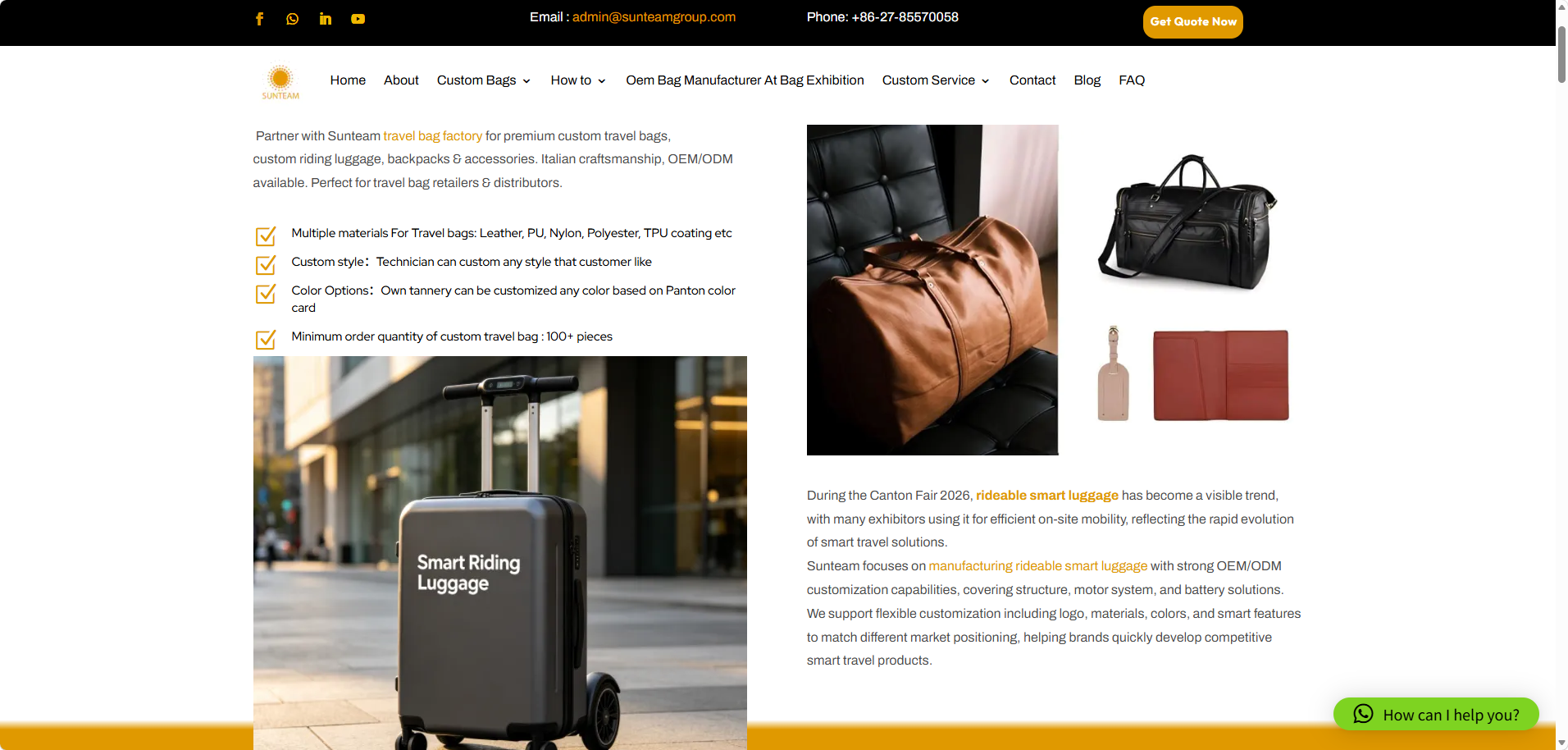
Sunteam did not simply follow the trend — it brings smart rideable luggage into scalable production. As an experienced OEM & ODM manufacturer, Sunteam focuses on delivering motorized, smart, and connected carry-on solutions tailored for global brands. As a custom rideable luggage manufacturer, the specs can be fully customized to match different market needs.
The core idea is simple: ride it through the terminal, tow it at the gate. With speed configurations reaching up to 8 mph — about 3× a normal walking pace — a 15-minute terminal walk can be reduced to under 6 minutes in open spaces, depending on setup. This makes it an ideal solution for brands developing OEM smart electric luggage for modern travelers.
What’s Under the Shell
Sunteam’s rideable luggage solutions can integrate up to a 200W belt-driven torque motor. Structural options include sealed-bearing steering columns, reinforced CNC components, and dual wheel braking systems for enhanced stability. Quick-release foot pegs can be added for riding mode and folded away for towing. Load capacity can reach up to 260 lb (118 kg), with a travel range of up to 6 miles per charge depending on battery configuration. Full recharge time averages around 2 hours.
The battery system supports UL-certified lithium options and can function as a multi-device power bank. Dual USB ports, LED touch dashboards, and interface modules are all customizable based on brand requirements.
On the smart side, Sunteam supports optional integration of GPRS/GSM tracking systems, which remain effective even in environments where standard GPS signals are limited. The system can be connected to iOS/Android apps, enabling proximity alerts and real-time tracking when the luggage moves beyond a defined range.
3. Hangzhou Aliotop Intelligent Technology Co., Ltd.
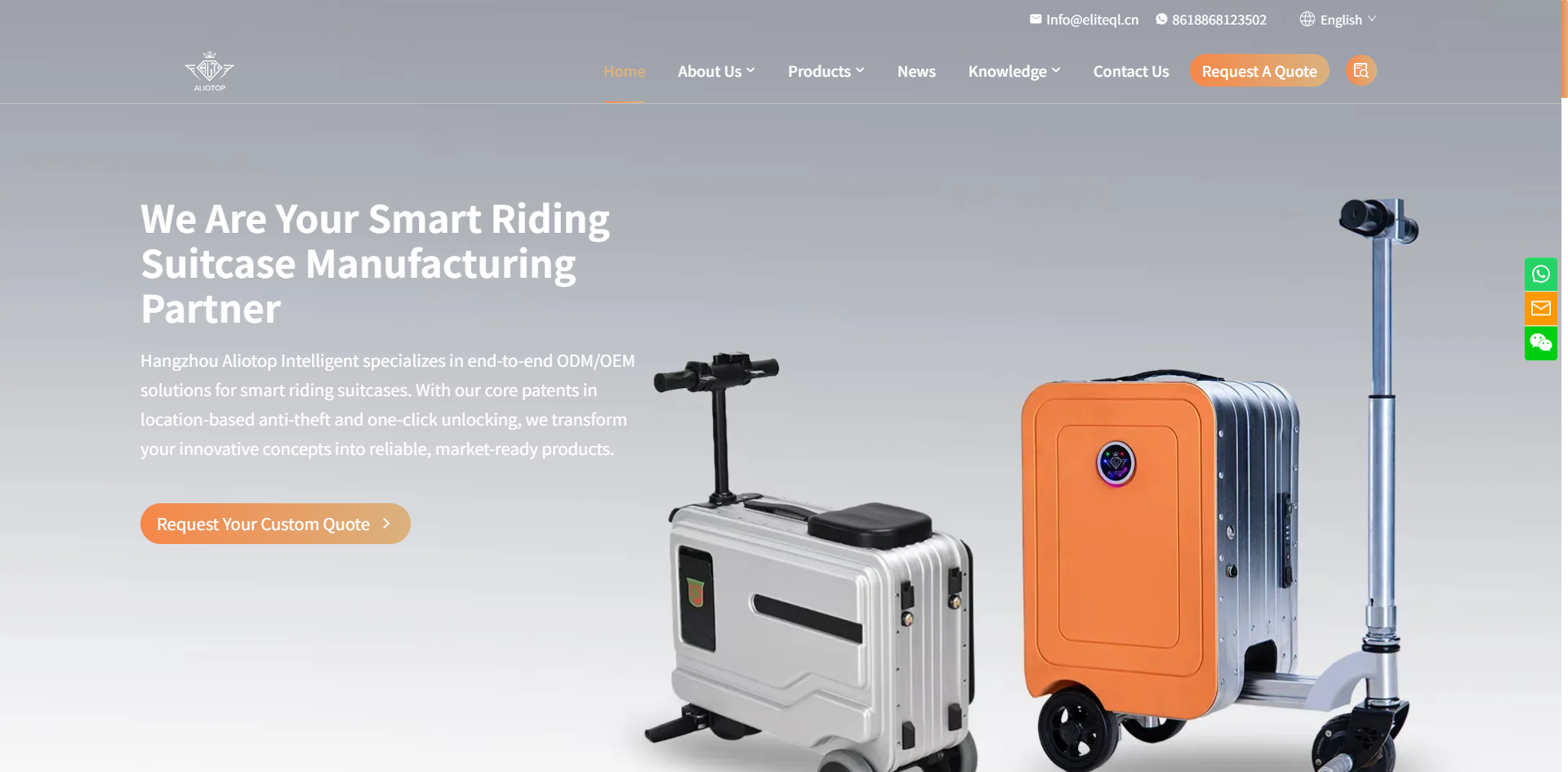
Hangzhou Aliotop sits at a different point in the supply chain compared to Airwheel or Modobag. This is not a consumer brand. It is a manufacturer. The company focuses on OEM/ODM production for smart electric riding suitcases, running its own factory with solid production capacity.
Importers, distributors, and brand startups planning to launch a private-label rideable suitcase — this is the kind of partner that fits that goal.
What the Product Platform Looks Like
Aliotop’s public listings center on a 20-inch format. The specs stay consistent across multiple listings:
- Max load: 110 kg
- Top speed: 13–15 km/h (both variants are listed)
- Motor: 200 W
- Battery: 93.6 Wh / 97 Wh (note: a small title-to-spec mismatch appears in at least one listing)
- Capacity: 26 L
- Weight: 8.3 kg
- Frame material: PC + aluminum alloy
- Dimensions: 565 × 255 × 675 mm on one referenced model
The 110 kg load rating holds steady across the range. That lines up with what you’d expect from a serious riding platform structurally.
OEM/ODM Positioning
Aliotop targets customized and wholesale buyers directly. The company holds core patents in location-based anti-theft functions. That adds real IP depth to the platform. Customization options cover motor spec, battery configuration, frame finish, and exterior branding.
One gap worth noting: public pages do not disclose MOQ, lead time, CE/UN38.3 certification status, or verified factory capacity. For real sourcing decisions, you need to confirm those numbers directly. The public benchmark comes from the company’s own claims — own factory, strong production capacity, end-to-end ODM/OEM service.
Building a brand around rideable luggage and need a flexible manufacturing base? Aliotop is worth reaching out to.
4. Samsonite — Engineering-Grade Smart Luggage With Powered Solutions
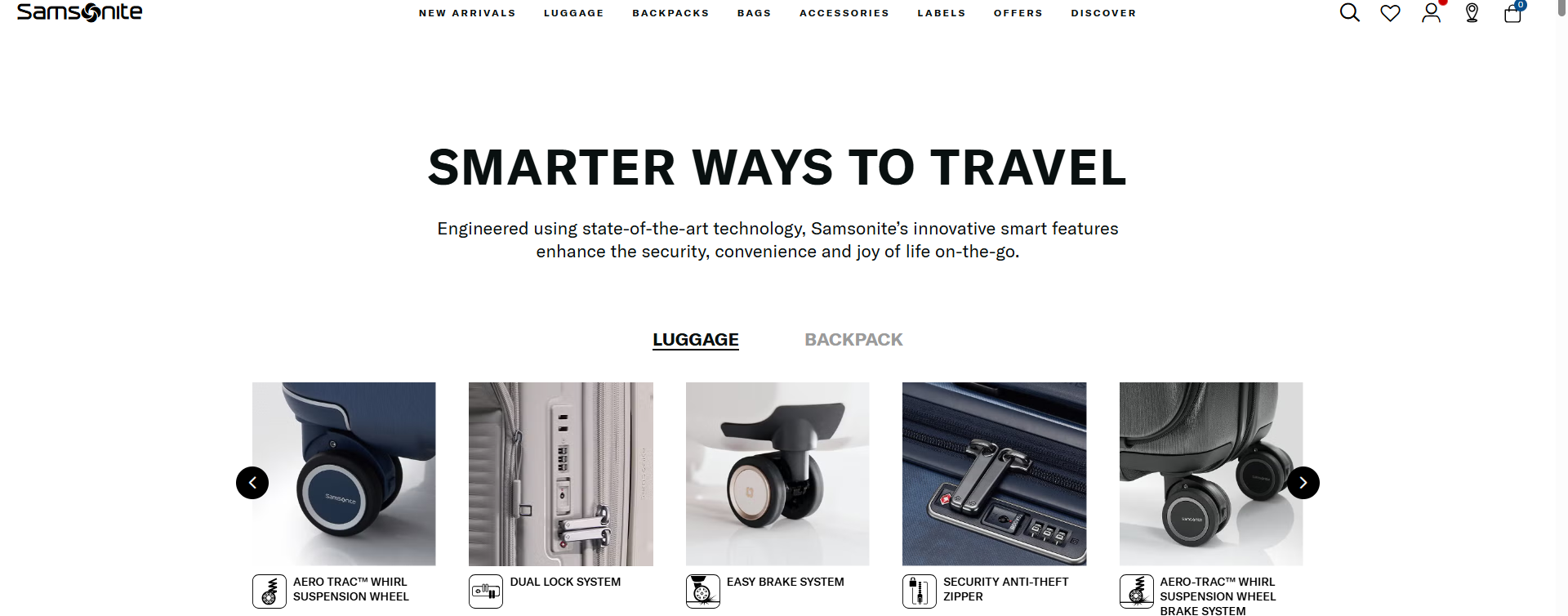
Samsonite earns a spot on this list for a different reason than the brands above it.
This is not a riding suitcase brand. You won’t find a throttle, a scooter mode, or a hub motor rated for a 110 kg rider. What Samsonite offers instead is harder to copy: a global engineering setup, real airline partnerships, and a compliance-first approach to powered luggage.
Where the Smart Engineering Lives
Samsonite’s powered and electronic features break into two tracks.
The first is tracking. The GeoTrackR line runs on LugLoc technology. It gives bag owners real-time location data and tamper alerts — so you know the moment checked luggage gets opened without consent. Each component gets certified on its own, which matters for global use across 100+ countries.
The second track is mechanical. Samsonite’s “Smart Features” platform covers a lot of ground:
- Aero-Trac Whirl Suspension Wheel — cuts rolling vibration on rough surfaces
- Easy Brake system — foot-activated, built for buses and trains
- Puncture-resistant anti-theft zipper — physical security at the bag level
- Dual TSA lock system — airport-compliant locking on both sides
These are physical engineering solutions, not electronics. Zero battery compliance risk.
On the prototype side, Samsonite has built two standout concepts. One is a self-propelling bag that follows its owner at a distance of 6 inches. The other is an auto-check-in bag, developed with Emirates, Lufthansa, and KLM Air France. Neither has hit mass production yet — but both show clearly where the brand is going.
Who Should Be Talking to Samsonite
This is the right conversation for:
- Corporate travel programs that need proven, scalable luggage solutions
- Airline co-brand projects looking for a partner with existing carrier relationships
- OEM buyers who need a regulation-ready chassis backed by a global warranty network
Samsonite’s existing smart frame already gives B2B buyers a strong starting point — reinforced shell, suspension wheels, and a modular tracker slot built in. Add a certified sub-100 Wh removable power bank, a BLE tracker, and a lock module. You end up with a fully compliant smart bag on a tested, proven platform.
For real riding capability, look at other brands on this list. For engineering-grade reliability with global reach, Samsonite sets the standard.
5. Travelpro — Airline-Crew-Trusted Smart Luggage Supplier
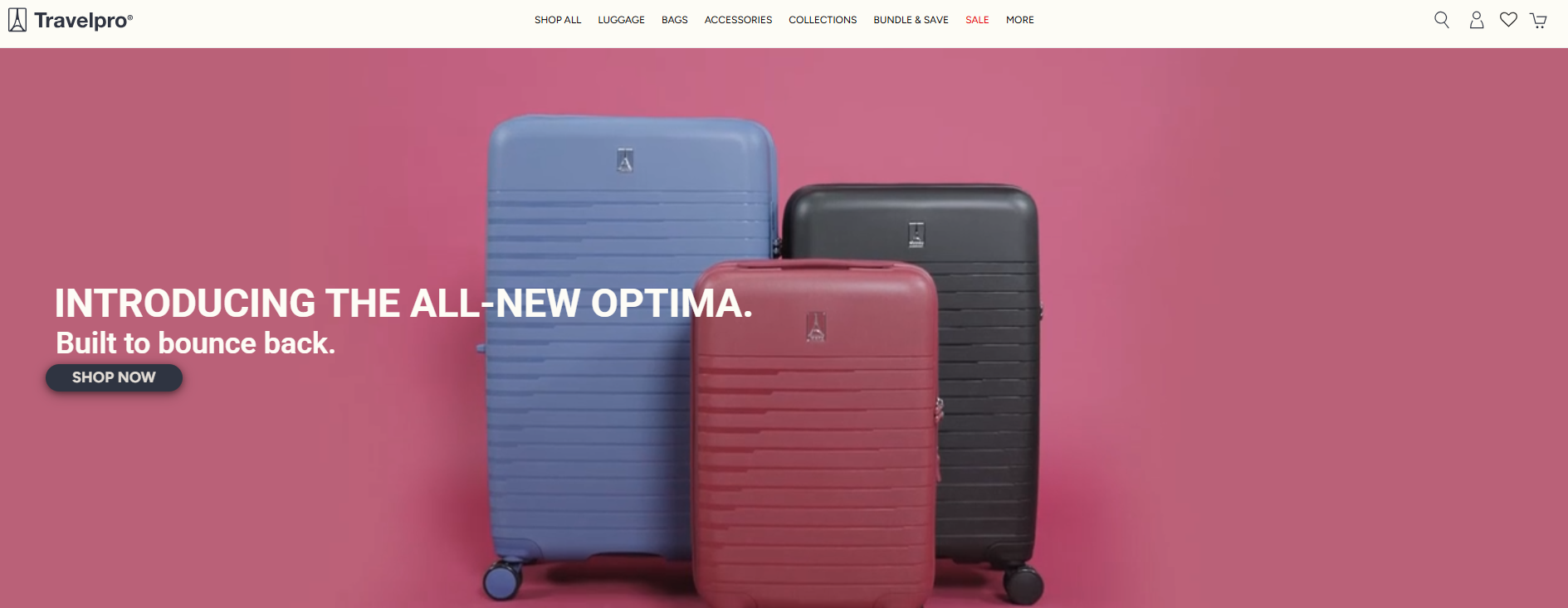
A 747 pilot invented the first vertical rolling carry-on in 1987. That one decision started Travelpro. It tells you everything about how this brand approaches luggage.
Today, over 500,000 flight crew members across 90+ airlines use Travelpro products. American Airlines, Delta, JetBlue, Southwest, Alaska, and more have made it their official or endorsed crew luggage. That is not a marketing claim. That is a real, working supply relationship.
Built for 310,000 Miles a Year
The FlightCrew™ 5 line is the clearest example of that legacy. It was built for pilots and flight attendants — not leisure travelers. Crew bags go through serious abuse: tarmac surfaces, jetbridges, tight overhead bins, repeated check-ins in every climate. Travelpro says its wheels log 186 million miles on the ground each day across all products. The FlightCrew 5 backs that up with a 3-year Commercial Use warranty. You also get modular, replaceable parts made to handle heavy professional use.
Smart Features: Compliance Over Complexity
Travelpro’s smart design is minimal by choice — and that is actually a strength.
Instead of built-in fixed battery packs, the brand uses a removable power bank pocket + external USB pass-through port setup. You bring your own IATA-compliant power bank (under 100 Wh). The bag takes care of the routing. This setup gives you:
- Zero battery compliance risk at check-in or gate
- Full FAA/IATA alignment with no airline approval needed
- Clean removal in seconds if the bag gets checked
For tracking, most users drop a third-party AirTag or Tile into the dedicated pocket. Locks are TSA-approved combination locks — no app required.
6. Away — Consumer-Facing Smart Design Leader

Away does not make a ride-on suitcase. That is not a disqualification — it is the point.
This New York-based DTC brand earns a spot on this list for one reason: its removable battery architecture. It is one of the clearest real-world models for building airline-compliant electronics into a consumer luggage shell. You are designing or sourcing a powered luggage product? Study this approach.
What Away Built
Away’s core system separates the electronics from the power source at the product level. The battery module pops out of the shell — no tools, no digging around at security. The rest of the hardware stays in the bag. That split is a big deal for airline compliance. The battery is the regulated part, so pulling it out cleanly is what keeps you legal in the air.
The USB output handles device charging, not propulsion. But the design logic behind it — battery isolation, clean removal UX, electronics integration inside a consumer shell — lines up with exactly what a ride-on luggage product needs to solve.
Pricing runs in the $300–$500 range for core hardside carry-ons. The look is minimal, hard-shell, and consistent across the line. It feels tech-forward without looking like a gadget.
Where It Fits in a Sourcing Strategy
Away is a design and compliance benchmark, not a manufacturing partner for motorized frames. Its value is specific:
- Battery compliance workflow — how to build ejectable power around IATA rules
- Electronics packaging discipline — clean integration without adding bulk
- Consumer UX around removable power — ergonomics that hold up at a security checkpoint
Your project needs a reference for premium retail positioning or battery-removal ergonomics? Away is one of the best public examples out there. You need a chassis, a motor, or a load-rated riding frame? Look earlier in this list.
Side-by-Side Supplier Comparison: Which One Is Right for You?
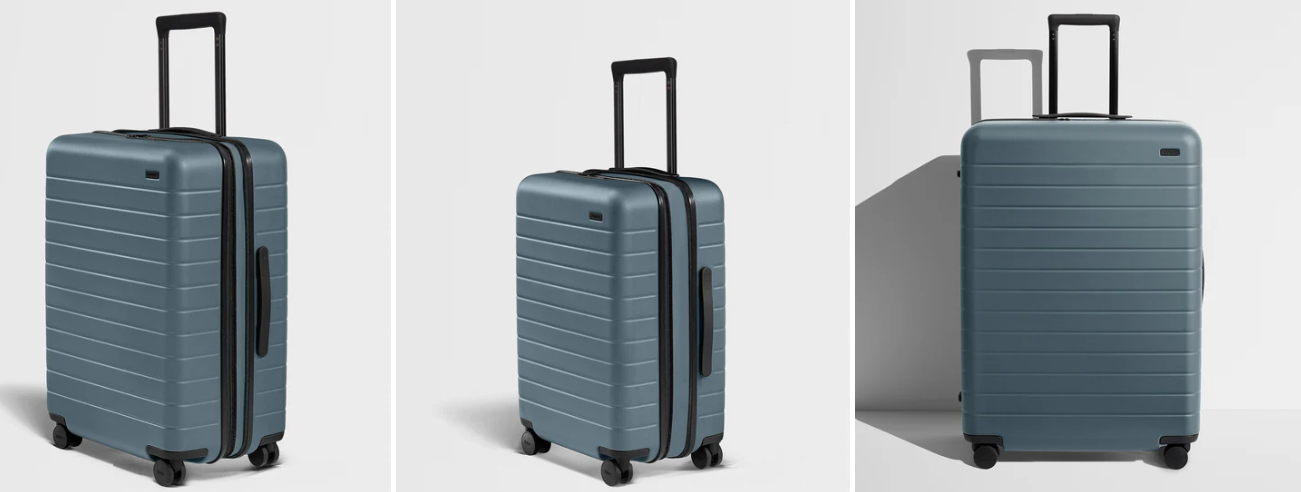
Six suppliers. Seven dimensions. One table that cuts through the noise.
| Dimension | Airwheel SE3S | Modobag 2.0 | Aliotop (OEM) | Samsonite | Travelpro | Away |
|---|---|---|---|---|---|---|
| Ride-On | Yes / 95 kg | Yes / 118 kg | Yes / 110 kg | No | No | No |
| Motor | Not disclosed | 200 W | 200 W | N/A | N/A | N/A |
| Battery | 73 Wh, removable | UL-certified, ~100 Wh | 93–97 Wh | Tracker only | Removable bank | Removable bank |
| Range | 8–10 km | ~10 km (6 mi) | Not published | N/A | N/A | N/A |
| Carry-On Compliant | Yes | Yes (TSA/FAA/IATA) | Unconfirmed | Yes | Yes | Yes |
| OEM/ODM | Limited | No | Full ODM | B2B programs | Co-brand programs | No |
| Price Tier | Mid-premium | USD 1,400–1,600 retail | USD 120–260 FOB est. | Corporate contract | Corporate contract | USD 300–500 retail |
The Three-Question Filter
Not sure which smart riding luggage supplier fits your project? Run it through these three questions:
- Do you need ride-on capability? Drop Samsonite, Travelpro, and Away from your list right away.
- Are you buying one unit or five hundred? Single buyers should go with Airwheel or Modobag. Volume buyers should talk to Aliotop — and ask for UN38.3 documentation from the start.
- Is airline carry-on compliance a must? It should be. Any supplier that can’t give you a battery Wh rating and a UN38.3 test summary isn’t ready to have a serious sourcing conversation.
Conclusion
The smart riding luggage market is growing fast. The supplier you pick today shapes your product’s reputation tomorrow.
Each option on this list brings something different. Hangzhou Aliotop is a solid OEM/ODM partner for brands that need reliable production. Airwheel and Modobag suit entrepreneurs who want a strong innovation track record. Samsonite, Travelpro, and Away already carry deep consumer trust — useful for retailers who need that built-in credibility on the shelf.
Your next move? Focus on three things:
- Your target market — who you’re selling to
- Your minimum order requirements — what volume you can commit to
- Your customization needs — how much flexibility your business model requires
Once you’re clear on those, reach out to your top two or three candidates. Request samples before you commit to anything.
The right smart riding luggage supplier isn’t just a vendor. It’s a competitive edge you carry with you.