
When your buyer sends back a sample with three revision requests and radio silence follows for two weeks, you already know the risk of picking the wrong manufacturing partner—especially from overseas. For sourcing managers and brand owners looking for a reliable custom travel bag manufacturer in South Korea, what matters is verified production capacity, real OEM/ODM flexibility, and factories that actually answer their emails. This guide cuts through the noise, breaking down South Korea’s most credible Korean bag factory operations, from luxury OEM giants to specialized technical producers, alongside the exact verification steps, sample-testing protocols, and contract safeguards that separate trustworthy partners from costly gambles. Whether you’re vetting your first supplier or switching from an unreliable one, you’ll walk away with a decision framework built for real B2B sourcing.
South Korea Premium Travel Bag Market Landscape
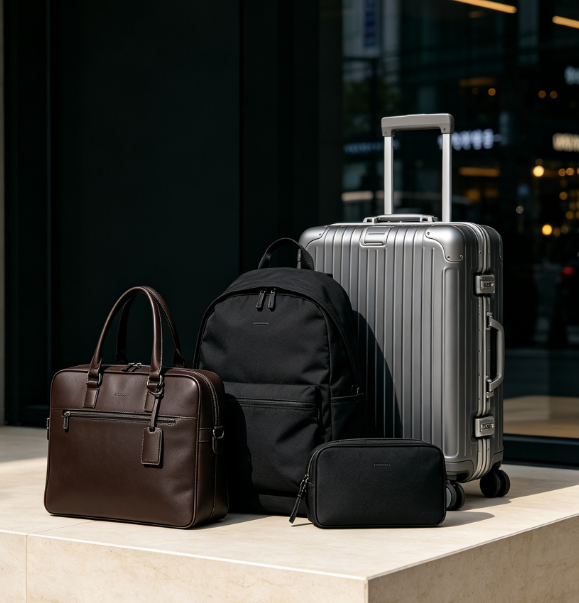
Numbers tell the story here. South Korea’s premium travel bag segment sat at USD 0.7B in 2024, with projections reaching USD 1.2B by 2033—a 6.3% CAGR. The broader bags and containers market hit USD 2,458.6M in 2024, expected to climb to USD 3,185.3M by 2030, and travel bags remain the fastest-growing category within it.
International names like Rimowa, Tumi, and Samsonite still dominate brand recognition. But local Korean bag factory operations are carving out share through OEM flexibility and design-forward manufacturing.
70–80% of Korea’s bag volume relies on imports from China, Vietnam, and Indonesia. Domestic production concentrates on small-batch premium leather goods and technical fabric assembly—exactly where a high quality travel bags supplier with OEM ODM capability adds the most value for private label travel bags buyers.
Pricing tiers matter for sourcing decisions:
– Under $50: 30% of sales volume, under 15% of value
– $50–$150: 40–45% volume, roughly 35% value
– $150+ (Premium/Luxury): under 25% volume, over 40% of market value, and growing faster than the overall market
For buyers evaluating wholesale travel bags Korea options, this tier data signals where margin and growth actually concentrate.
Lucky Factory (Lucky Planet) –Specialized Manufacturer of Travel Bags
Lucky Factory was founded in 2006 by Yun Hyesuk. The company built its business by sourcing fabric in China, then bringing production home to Yongin-si, Gyeonggi-do—about 30-40km from Seoul. Two years later, when Korea’s luggage market was still stuck in black and gray, the factory launched colorful hardcase luggage. It was one of the first to do so.
Today the company runs as a small-batch Korean bag factory with 1-50 employees. It operates under its own brand, Lucky Planet, and also produces licensed lines for Warner Bros. and Hello Kitty. That IP experience matters for OEM ODM bag manufacturer partnerships with streetwear and designer brands.
Key sourcing data:
– MOQ: 500-2,000pcs per design, or 200-500pcs per color for multi-SKU runs
– OEM pricing: roughly 30-40% of retail (₩100,000-₩250,000 for 24-28″ hardcase)
– QC benchmarks: ≥3,000 zipper/handle cycles, ≥5km wheel-rolling tests
– Sample lead time: 2-4 weeks
For niche private label travel bag brands that want color-driven, IP-licensed designs, this factory fits better than volume-focused manufacturers.
Simone Acc Collection Ltd. – A giant in luxury luggage and handbag OEM manufacturing
One company in Uiwang-si, Gyeonggi-do handles 10% of the world’s luxury handbag ODM/OEM supply. According to its IPO roadshow disclosures, Simone Acc Collection controls roughly 30% of the North American luxury handbag market, and all of the top 7 US luxury handbag brands are clients.
Scale breakdown:
– Annual production: over 18 million luxury handbags, exporting $640M+
– Revenue concentration: top clients drive 80%+ of income; Tapestry’s Kate Spade alone accounts for roughly 80% of sales
– Product mix: 85.5% handbags, 14.4% small leather goods
– Regional sales: 62.3% Americas, 12.7% Asia, 25% Europe/other
Manufacturing runs across Korea, Vietnam, and Indonesia. Korea handles R&D and sample development; Southeast Asia does high-volume production for Michael Kors, Coach, and Tory Burch.
The catch for smaller buyers: MOQs aren’t published, but production math suggests thousands of units per style, tens of thousands annually. This Korean luggage manufacturer works best for established brands with year-round demand, not first-time private label travel bag buyers testing small batches.
Lovely Heart (LHCOMPANY) – Fashion luggage manufacturer with 25 years of experience
Seoul’s Dobong-gu district holds a factory that’s been running since 1989. Lovely Heart—also listed as LHCOMPANY—has clocked over 35 years in operation, with core craftsmen carrying 25-30 years of leather-making experience. President Dae Hee Kim runs a lean 1-50 person team, and every product ships 100% Made in Korea, no outsourcing to third countries.
Their line splits into two tiers: Black Label uses imported Italian leather for high-end handbags and wallets, while Red Label targets budget-friendly fashion pieces without sacrificing material quality. This factory currently focuses on handbags, wallets, and leather phone cases—not travel bags directly.
Japanese OEM directories rank Lovely Heart among Korea’s Top 7 premium leather goods manufacturers. Their existing tote-bag structures and Black Label leather expertise translate into Weekender bags (30-40L) or 2-3 day business travel totes. Buyers wanting a Korean bag brand manufacturing partner for small-batch, craft-focused private label travel bags should start with a factory visit. Typical trial orders run 50-200 pieces before scaling.
EQ Fishing Co., Ltd. – Specialized Manufacturer of Protective Cases and Bags
Not every buyer needs a soft-sided suitcase. Some need a box that survives a boat deck, saltwater spray, or a drone drop-test. When standard travel bags won’t cut it, these buyers turn to EQ Fishing Co., Ltd., a Korean manufacturer that specializes in protective luggage.
The factory runs injection molding lines (250-800T) for PP/ABS fishing hard cases, plus 20-50 EVA thermoforming units for precision equipment housings like drones, gimbals, and survey instruments. Production capacity hits 10,000-50,000 hard cases monthly, with EVA/equipment cases scaling to 30,000-100,000 units. Standard lead time runs 25-35 days; complex multi-layer molds stretch to 35-60 days.
ISO 9001 certification is the baseline. Export-focused lines often add BSCI/SEDEX audits for European and American fishing brands.
The lineup includes 30L waterproof backpacks using 500D-900D TPU/PVC coated fabric with roll-top sealing, plus ABS fishing cases with 2.5-4mm wall thickness. EQ is a travel accessories manufacturer for brands that need certified protective capability. MOQs start at 300-500 pieces, and custom EVA mold development takes 20-30 days.
Haze Korea Co., Ltd. – An Analysis of the Wholesaler’s Role
Not every “Korean bag factory” listing is actually a factory. Haze Korea Co., Ltd., registered at Gimpo-si, Gyeonggi-do under representative Kim Jin, has a confirmed local business identity but no verifiable OEM production evidence. Public traces link it to Korea-side supply or agency structures, similar to how beauty brand coralhaze uses exclusive Japan distribution deals. That’s a distributor pattern.
6-Point Wholesaler Verification Checklist:
– Address: Office or warehouse only, or an actual production site?
– Certifications: Manufacturing license, factory registration, floor photos?
– Pricing structure: Stock or tiered wholesale pricing vs. mold fee plus sample fee and MOQ quote?
– Lead time: Ship-on-order vs. sampling or scheduling required?
– Customization: Fixed SKUs vs. mold or formula flexibility?
– Trade chain: Exclusive distribution mentions signal a trading role.
For small-batch test orders or SKU sourcing, distributors like this work fine. For private label travel bags requiring deep customization, demand factory proof before committing.
Cypher Teams & Five Star Corp – Cost-effective technology-driven manufacturer
Hard-shell backpacks cost differently than soft-sided luggage. Cypher Teams builds its cases from PC (polycarbonate) plus carbon fiber or color composite shells — the same material class used in bulletproof gear, hard luggage, and jet fighter components. Shells run 26L to 40L and expand to roughly double capacity through zip-around gussets. They fit laptops up to 17.3 inches and weigh around 1.33kg (2.9lb).
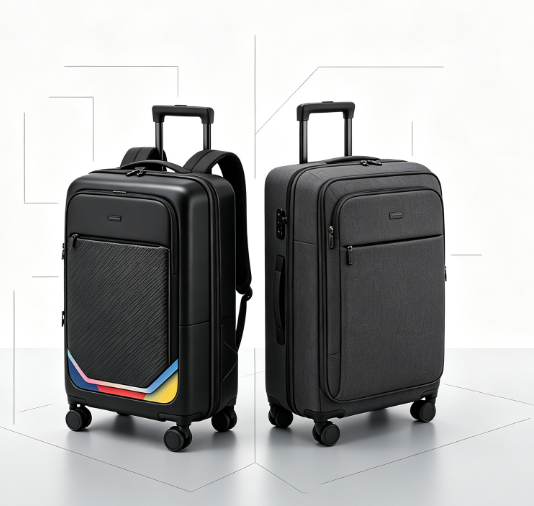
Built-in features include TSA-approved locks, YKK Aquaguard waterproof zippers, and internal USB-A and USB-C charging ports wired for power banks. Shells survive repeated hammer-strike tests without damaging stored electronics. That’s a concrete durability benchmark for buyers comparing suppliers.
Five Star Corp, running since 1991, takes a different cost lever: PC or ABS shells with 600D polyester, not carbon fiber or CORDURA. FOB pricing runs $18 to $28 per piece with TSA locks and USB channels, dropping to $12 to $18 per piece on standard hardware. MOQ is 300 to 500 pieces per color.
Target buyers are 25 to 45 year-old professionals, retail price $79 to $149, needing IPX3 to IPX4 water resistance without luxury markup. That’s where a mid-tier luggage manufacturing company in Korea competes on verified specs, not brand premium.
How to Verify the Credibility of South Korean Travel Bag Manufacturers
A polished website and a slick sample photo don’t make a factory real. Before you wire a deposit to a Korean bag factory, run these checks. Each one filters out a specific type of risk.
Cross-verification between B2B platforms and official channels
On Alibaba or Global Sources, search “Korean luggage manufacturer / trolley bag OEM / suitcase factory” and filter by South Korea and Manufacturer/OEM type. Then check three numbers:
-
Platform history: 3 years or more. Under 1 year is high-risk.
-
Annual transaction volume: $100,000 USD or more signals a stable export track record.
-
Reorder rate: 25% or higher suggests reliable delivery and quality.
Cross-check the company through KITA, KOTRA, or Kompass Korea. Search the Korean company registration number (사업자등록번호) to confirm the name, address, and legal representative match the business license. Frequent name changes or representative swaps are red flags.
List of Required Documents
Request all of this in one message:
-
Business Registration Certificate with registration number
-
Export country breakdown for the past 12 months (for example, Japan 40%, US 30%, EU 20%)
-
Factory address with a Google Maps link
-
A 3-minute unedited factory video showing the cutting room, sewing line, assembly, QC, and packaging
If they only send polished promo footage of a showroom, consider that a warning sign.
Verification of Production Capacity and Certifications
Ask for 3 representative export orders from the last year: customer country, model, quantity, and lead time. A single order of 3,000 to 5,000 pieces signals real mass-production experience. For ISO 9001 or BSCI certificates, get the certificate number and verify it on SGS, TÜV, or BV’s website. Don’t accept cropped screenshots.
For a luggage manufacturing company Korea partnership worth committing to, a third-party factory audit ($600 to $1,200 USD) closes the loop before any large purchase order goes out.
Evaluation Dimensions for OEM/ODM Customization Capabilities
Five dimensions separate a genuine OEM/ODM manufacturer from an assembly-only workshop: design depth, logo and craft options, sample turnaround, cost structure with negotiable MOQ, and quality certification resilience. Skip any of these and you’re gambling on production capability you haven’t verified.
Logo Production Options and Cost Implications
Not all logo methods cost the same. Factories that quote a flat “customization fee” without breaking this down are hiding margin.
-
Screen printing: Plate-making runs ¥300–800 per version. Unit cost adds ¥0.05–0.30/piece, dropping below ¥0.1 at 3,000+ units. Lowest barrier, usually no extra R&D fee.
-
Emboss/deboss logos: Steel or copper molds cost ¥2,000–8,000/set. Unit cost is often near-zero once amortized, but deep customization adds 15–20 extra days for mold tooling.
-
Metal nameplates: ¥0.50–2.00/piece for basic aluminum or zinc alloy, up to ¥3–5 for electroplated designs. Molds run ¥5,000–20,000/set, typically amortized at 3–8% of BOM cost under ODM pricing.
-
Woven labels: Sampling costs ¥200–500/version. Unit price ¥0.10–0.60/tag standard, up to ¥2 with anti-counterfeit thread. MOQ usually sits at 3,000–5,000 pieces per design.
Ask for mold fees itemized separately, not folded into “design service” quotes. At order volumes above 5,000 units, push for mold-fee waivers or per-unit amortization. OEM setups at that scale typically run 10–18% cheaper per unit than ODM.
Verification of Design and Prototyping Capabilities
Request project files, not promises. A mid-size ODM should show three or more structural engineers and two or more ID designers, capable of supporting 20+ SKUs annually. Ask for CAD or 3D files from three to five recent projects to confirm real design capacity, not white-label reselling.
Sample timelines follow predictable patterns:
-
Appearance-only changes (color or logo, no tooling): 20–25 days
-
Mold-required designs: 30–45 days, with tooling alone taking 15–20 days
-
New model development, concept to production: 8–12 weeks for simplified designs
Small factories typically launch 10–30 new styles per year; larger platforms hit 50–100+.
Sample Testing and Quality Control Process
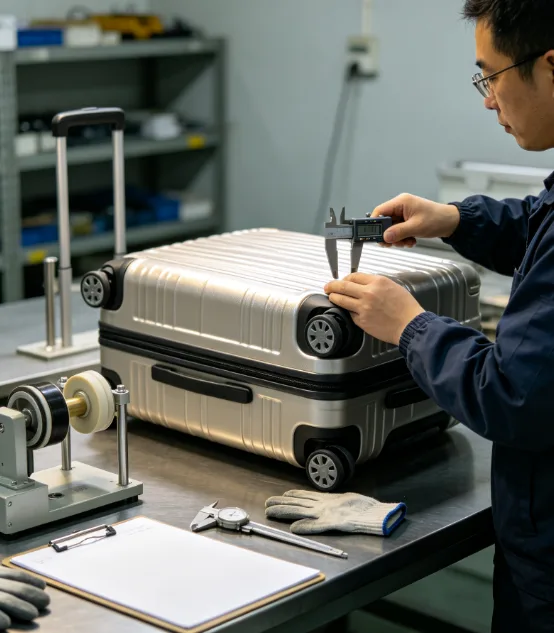
Always verify any private label travel bags order with three samples. Assign them S1, S2, S3 with recorded production dates and batch numbers. S1 goes through destructive testing: full-load drop and wheel wear. S2 covers pull-rod cycling plus hardware and stitching inspection. S3 checks packaging integrity and odor, and serves as your control sample.
Core test benchmarks to lock into your contract:
-
Drop test: 75–90cm height, hitting 6 faces, 4 corners, 2–4 edges (12–14 drops total). Shell cracks must stay under 2cm without piercing the lining. Wheel misalignment under 1mm.
-
Pull-rod cycling: 3,000–5,000 cycles for standard consumer bags, 8,000–10,000 for premium lines. Lock failure rate must stay below 1% across 100 lock attempts.
-
Wheel wear: Minimum 10km rolling distance plus 1,000–3,000 step impacts. Diameter wear loss capped at 10%.
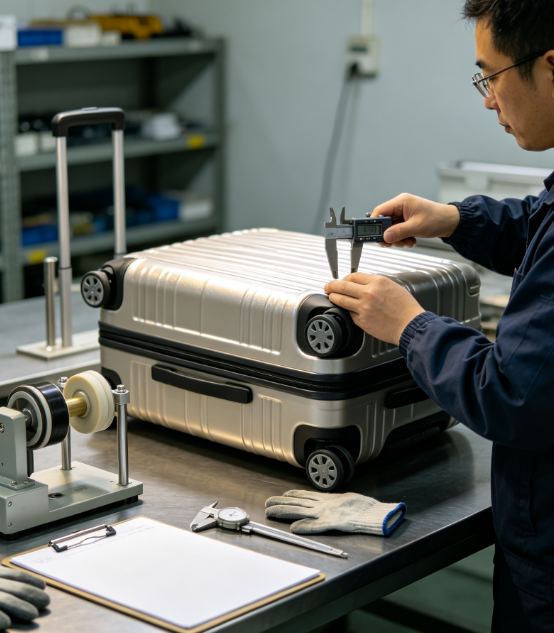
For third-party verification, insist on labs with CNAS accreditation (ISO/IEC 17025). Request reports that list exact drop height, cycle count, and load conditions instead of pass/fail summaries. Ask for individual results per sample, not averaged data.
Write these defect thresholds into your acceptance language:
-
Stitching gaps over 1cm, or more than 5 loose thread points per unit
-
Zipper snag rate above 5% across 20 open/close cycles
-
Odor rating of 3+ on a 5-point scale after 24-hour ventilation
Your Korean luggage manufacturing partner should hand over these figures unprompted. If they don’t, ask before the deposit goes out.
Key Points on Contract Signing and Risk Control
A signed PO means nothing if the contract doesn’t lock down IP ownership, mold rights, and penalty clauses before production starts. Most disputes with a Korean bag factory trace back to vague language on these three points.
IP and mold ownership must be explicit. State that all design files, structural drawings, and packaging belong to the buyer, with the factory holding only a limited, non-transferable production license. For molds, write the exact cost (e.g., ¥100,000, amortized at ¥0.5/unit over 200,000 pieces) and confirm ownership transfers to the buyer once payment clears. Require a mold logbook and a clause letting you reclaim tooling with 10 working days’ notice.
Confidentiality terms should cover drawings, BOMs, pricing, and supplier lists, extending 5–10 years post-contract. Add a non-compete restricting the factory from producing near-identical designs for named competitors for 2 years after termination, backed by a minimum penalty of ¥500,000 for leaks.
AQL and delay penalties need specific numbers. Standard practice sets Critical AQL at 0, Major at 1.5, and Minor at 4.0. Late delivery penalties run 0.1–0.5% of unpaid value per day, capped at 5–10% of total contract value.
Staged inspections—pre-production sample, mid-production check at 20–30% completion, and pre-shipment inspection at 100% production/80% packaging—protect buyers of wholesale travel bags Korea orders from surprise defects.
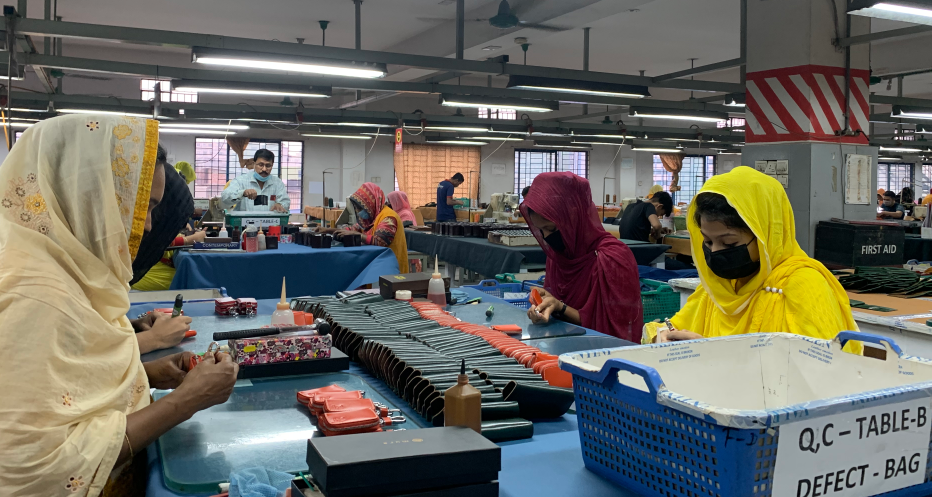
Payment structure: a 20–30% deposit, 70–80% against passed final inspection plus shipping photos, and a 10% quality retention held 15–30 days post-arrival for new suppliers.
Sunteambag Trust and Credibility Building Strategy
Trust is a stack of verifiable evidence. For a luggage manufacturing company Korea buyers can actually vet, Sunteambag builds credibility on four pillars: qualifications, compliance, case data, and third-party proof.
Minimum trust package to request:
– 3 certificate images with registration numbers and issuing bodies
– 3 material test reports (zipper durability, seam strength, fabric abrasion/tear, colorfastness)
– 3 case studies with real numbers: MOQ, lead time, defect rate, on-time delivery rate, reorder rate
– 9 factory/lab/trade-show photos, dated and location-tagged
– 5 client testimonials with initials, title, country, years of cooperation
Certification presentation follows a four-element format: certificate thumbnail + certificate number + issuing authority + validity period. Blurred screenshots don’t count—verifiability is the entire point of third-party endorsement.
For private label travel bags buyers, case studies matter more than marketing copy. A strong case shows defect rate, reorder cycle days, and repurchase percentage. Factory data (floor area in ㎡, headcount, monthly output, shipment batches) should sit on a single page, ready to hand over the moment a sourcing manager asks.
Checklist of Key Decisions for South Korean Manufacturers
Five checkpoints separate a verified Korean bag factory from a risky bet. Run through them before any deposit changes hands.
Export Records and Compliance Verification
Ask for 3–5 years of export declarations to your target market—HS codes, quantities, invoice values. Look for 3+ consecutive years shipping to the same country. Cross-check via Korea Customs UniPass or NTS registration, and confirm “Verified Supplier” status on tradeKorea, KOTRA, or EC21. The hard floor is 5+ years of operating history, 2–3 verifiable buyers in your target market, and a clean 3-year record on customs holds or recalls.
Price-Quality-Brand Three-Dimensional Scoring Model
Collect FOB quotes from 3+ factories, broken into material, labor, packaging, and testing costs. Korean pricing typically runs 10–30% above comparable Chinese factories—useful for spotting suspiciously low bids. Score each supplier: price fit (30%), pass-rate and defect data (40%, with <96% pass rate as an automatic disqualifier), and brand-tier match (30%). Only advance suppliers scoring 80+ overall.
QA Transparency and Responsiveness
Request 3 months of IQC/IPQC/FQC defect data and confirm batch-level traceability. Test communication directly. Target first-response under 12 hours and full technical replies within 2–3 working days. A dedicated English-speaking sales and QA contact is non-negotiable for OEM ODM bag manufacturer partnerships.
Long-term stability signal
Ask about their top 5 clients’ tenure. 50% or more retained over 3 years signals reliability. Confirm on-time delivery rates (≥95%) and crisis-recovery examples, like restoring production within 7 days after a supply disruption.