“How much is a leather bag original production sample?” ——Custom leather bags for corporations This is the first wall that people in charge of starting to consider OEM manufacturing encounter.
I want to understand the sense of cost before making an inquiry. It is necessary to write an approximate estimate on the approval form. However, I can’t find any specific numbers on the manufacturer’s website. If you are looking for information in such a situation, this page will help you.
We have summarized the following information about leather bag OEM manufacturing:
- Sample price and breakdown
- Conditions for Appropriation of Mass Production Costs
- Practical information required for order judgment
Once you’ve finished reading, you’ll have a basis for passing internal approvals. You will also learn the specific criteria for identifying reliable manufacturers.
Sample price market price of custom leather bags for corporations
Even if the same “leather bag OEM sample cost 1 piece” is only 5,000 yen, it may exceed 100,000 yen. This price difference is not a matter of quality. The combination of specification complexity, material grade, and processing process determines the price.
The market is divided into three main price ranges.
| Price range | Applications and conditions |
|---|---|
| Around 5,000 yen | Confirmation of backup samples, exhibitions, and simple shapes |
| 10,000 to 20,000 yen | Standard prototype. Ideal for final confirmation of design and sewing |
| Over 30,000 to 100,000 yen | When using complex designs, special materials, and custom hardware |
If you want to write an approximate estimate in the approval letter, it is realistic to use 10,000 to 20,000 yen as the standard. Many manufacturers in this price range can offset and discount when transitioning to mass production. It is also cost-effective and an easy choice to choose.
4 main causes of price differences
(1) Types of leather
The price of leather materials varies in units of 1 decimeter (10 cm×10 cm). There is a difference of 2 to 3 times between low-grade PU material and high-quality Saffiano and natural leather. Even if the tote bag is the same shape, just changing the leather grade can make a difference of several thousand yen.
(2) Metal fittings and accessories
The difference between standard metal fittings and special parts is a few thousand yen to more than 10,000 yen. If you need an original mold, it will cost you more. This is the main reason for cases exceeding 100,000 yen.
(3) Sewing difficulty
The labor cost for simple leather accessories is about 1,000 to 3,000 yen. If it is a large bag or a multi-part structure, it can go up to 5,000 to 8,000 yen.
(4) Pattern, modification, logo processing
It costs from 10,000 yen just to make the pattern. The cost of each revision is 10,000 to 20,000 yen, and the production cost of the logo engraved plate is about 10,000 yen. The more revisions you make, the higher the total cost. Thoroughly checking the specifications for the first time is the key to cost control.
“Cheap = quality risk” is not necessarily correct
A 5,000 yen sample is not a “substandard product”. Simple shapes and standard materials can be used for shape confirmation and internal approval before mass production.
Samples over 100,000 yen are the cost of special processing or using high-quality leather. Leather grade is the biggest factor in determining price. If the manufacturer is directly connected to the tanner (leather manufacturer), it may be possible to source high-quality materials at a low cost.
For manufacturers with this production offset plan, if you move to mass production in 100 lots, the unit price will drop to 2,000 to 5,000 yen. Leather bags are a mechanism that allows you to effectively recover the cost of OEM samples.
Sample fee breakdown and overall upfront cost|Know exactly what it costs and how much it will cost
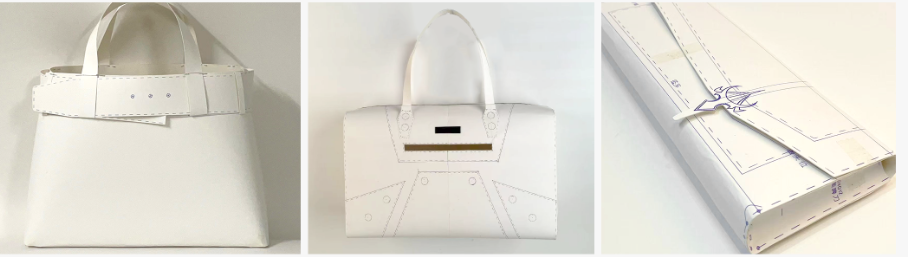
Even if you say “sample fee” in one word, it actually includes multiple cost items. If you don’t understand each item separately, you won’t be able to judge “why this amount” when you look at the estimate. It will also affect the writing in the approval letter and internal explanations.
The initial cost consists of four main items.
| Items | Role | Conditions of occurrence |
|---|---|---|
| Sample fee | Total material cost + labor cost of prototype | Every time it happens |
| Pattern and mold fee | Production of patterns and molds for mass production | Occurs in case of original shape |
| Plate fee and logo engraving plate fee | Logo design printing and engraving plate | First time only (reusable) |
| Design fee | Labor costs for design and pattern creation | First occurrence, added when modified |
If you confuse them, you will get the full picture of the cost. In particular, you should keep in mind the difference between “sample fee” and “mold fee”.
“Sample fee” and “mold fee” are two different things.
This is the distinction between these two that often causes confusion in internal explanations.
- Sample cost: The total cost (material + labor) to make one prototype. The purpose is to check the shape, sewing, and leather texture.
- Mold fee: The cost of creating patterns, molds, and dies for mass production. Once made, it is an “asset” that can be shared and diverted during mass production.
In the approval letter, write separately as “sample = total amount of prototype, mold cost = tool cost for mass production”. It will be easier to get approval.
Example of actual upfront cost breakdown
If you look at the specific numbers, you can get an idea of the total amount. Below is an estimated breakdown of the initial cost for a standard custom leather bag 1.
| Items | Approximate amount |
|---|---|
| Sample production cost (material + labor) | 20,000 yen |
| Pattern and Die Cutting Fee | JPY 15,000 |
| Logo engraving plate and plate production cost | 10,000 yen |
| Material cost (additional special materials) | 7,500 JPY |
| Design fee | 5,000 yen |
| Total initial cost (approximate) | Approx. 57,500 yen |
This amount is only accrued for the first time. If there is no design change, there will be no re-billing for the type and plate costs for the second and subsequent mass production. The actual additional cost is only the sample modification cost. Improving the accuracy of the first specification is the biggest point in reducing the total cost.
Points to check when receiving a quote
When you receive a quote from the manufacturer, check the following three points:
- Is the initial cost and mass production unit price listed separately (it is difficult to compare if they are mixed)
- Is the mold fee and version fee “only for the first time” or “incurred every time”?
- Whether sample costs are offset or applied at mass production
If the quotation does not specify these three points, there is a risk of incurring additional costs later. Whether a manufacturer can provide a transparent quote is one of the criteria for choosing a reliable OEM partner.
Can sample costs be allocated to mass production costs? Cost recovery mechanism and negotiation points
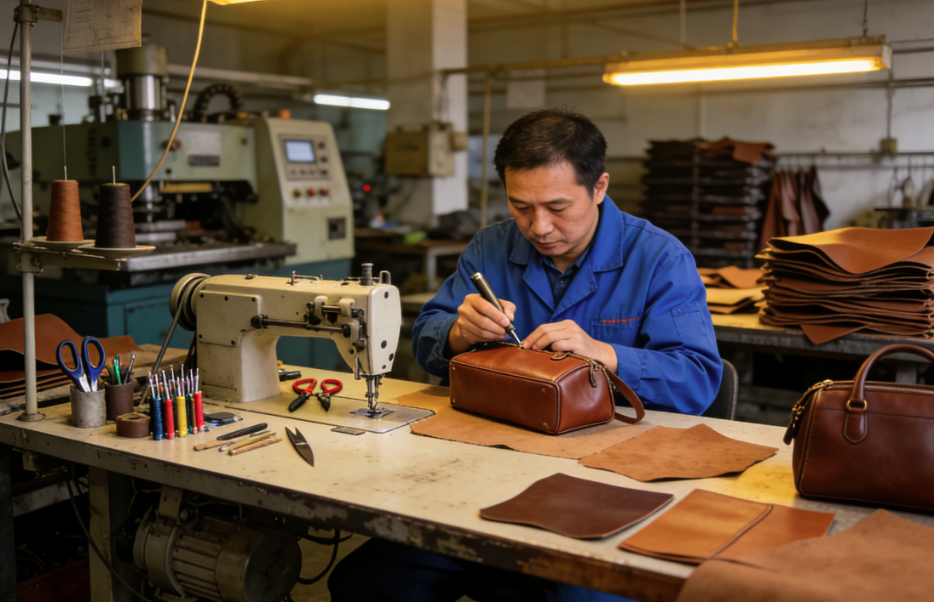
In conclusion, whether it can be appropriated depends on the preliminary negotiation with the leather goods OEM manufacturer. There are many people in charge who give up because they will not receive the sample fee. However, in reality, there are a certain number of manufacturers that offer offsets and discounts when transitioning to mass production. By firmly grasping the timing and basis of negotiations, the actual burden of initial costs can be greatly reduced.
3 points to keep in mind in negotiations
(1) Specify the appropriation conditions before placing an order.
It is important that the agreement to “offset the sample cost when moving to mass production” should not be verbal. Let’s have it clearly stated in the quotation and purchase order. Even if the person in charge changes, the conditions will be carried over. Be sure to leave it in writing.
(2) Minimize the number of revisions
The production cost of the modified sample is approximately 70% of the material and sewing cost of the first sample. The more corrections you make, the more the total cost will be. The room for appropriation negotiations will also be narrowed. Taking enough time to check the initial specifications is a shortcut to keeping the overall cost down.
(3) Propose a piecework settlement method
For large projects or projects with high risk of specification changes, we can propose payment to the manufacturer using the piece-based settlement method. By paying in installments according to the progress of the project, you can also prepare for the risk of interruption. Since the pandemic, more and more suppliers have supported this payment method. There is a lot of room for negotiations to be accepted.
Characteristics of cases where appropriation negotiations are easy to pass
- Clear mass production lot: If you can show the prospect of ordering more than 100 pieces, your bargaining power will increase.
- Demonstrating intention to continue trading: Attitude as a long-term partner rather than a one-time transaction is evaluated
- Specifications are fixed: Projects with low risk of correction are more likely to be accepted by manufacturers
The recovery of sample costs is not determined by “luck”. The difference between information and negotiation readiness will determine the outcome. Let’s put the appropriation conditions on the agenda from the stage of requesting a quote. That is the shortest route to bring costs close to virtually zero.
Information to prepare before requesting a quote|Checklist for smooth business negotiations
Underprepared inquiries reduce the accuracy of the estimate. If you contact us with ambiguous information, the manufacturer can only provide an “approximate range (accuracy ±50%)”. Interactions increase by 3-5 times. In some cases, the final cost is 10-20% higher.
If you organize the following items before making an inquiry, you can get a highly accurate estimate in the first exchange.
Checklist of required checklists
[Specifications and design]
– Dimensions of the bag (length×width× gusset mm) and shape image (reference image and sketch)
– Desired material (e.g., genuine leather/PU leather, thickness) and surface finish (e.g., matte, glossy)
– Logo insertion, location, processing method (foil stamping, engraving, silk printing, etc.) and color specification
[Quantity/Schedule]
– Sample quantity (usually 1-3 pieces)
– Expected number of first mass production lots (e.g., 100 pieces, 500 pieces)
– Desired delivery date and internal approval deadline
[Application and quality requirements]
– Purpose of use (novelty, employee, sales,
etc.) – Functional requirements such as durability and load capacity, if any,
[Budget feeling]
– Expected range of sample cost (e.g., about 1 to 30,000 yen)
– Target mass production unit price (e.g., 3,000 yen or less)
How to use quotations to make it easier to pass internal approval
If you assemble a quotation from a SPIN perspective, it will be easier to get approval.
- Show the current issue in numbers: Compare the current novelty unit price ×number = annual cost”
- Simply present ROI: Add effect estimates such as “Original leather bags increase customer unit price by ○%”
- Request a cost breakdown by function: If you ask them to list the material cost, labor cost, and mold cost separately, it will be easier to explain to your boss
Having these in place during the first inquiry will change the speed of business negotiations. Clarifying not only “what you want to make” but also “when, how much, and in what quality” is the first step to building a relationship with a reliable leather goods OEM manufacturer in the shortest possible time.
Frequently Asked Questions (FAQs)|Resolve questions that corporate representatives have before placing an order
There are many questions that are more important than those that you feel are “difficult to ask” before placing an order. We have summarized the questions that often arise in the production of custom leather bags for corporations from a practical perspective.
Q1. Can I place a mass production order without samples?
I don’t recommend it. Many manufacturers offer free estimates and meetings. After that, it is standard to produce a paid sample and then place an official order.
If you proceed to mass production without checking the sample, there is a risk that discrepancies in sewing, shape, and leather texture will be discovered after delivery. Please be sure to do sample confirmation first.
Q2. Can sample costs be recorded as expenses?
Yes. The account is generally “sample cost” or “sales promotion cost”.
However, there are cases where samples given to specific business partners are classified as “entertainment expenses” rather than “advertising expenses”. In addition, if the sample unit price is less than 100,000 yen, it can be treated as an expense for the business year. If it is 100,000 yen or more, it will be subject to depreciation as a fixed asset. We recommend that you check with the accountant in advance.
Q3. When is the timing of payment?
Many manufacturers standard installment payments of half a payment at the time of ordering and the balance before delivery. For large projects or projects with high risk of specification changes, it may be possible to negotiate a transaction settlement method.
Please check the payment terms at the stage of the quotation and be sure to specify them.
These questions can be used as they are in internal approval materials. If you check this list before contacting a leather product OEM, you can exchange information with high accuracy from the first business meeting.
Summary|The first step starts with a “sample”
The sample price for custom leather bags for corporations ranges from 5,000 yen to over 100,000 yen. There is a good reason for the difference. Materials, mold costs, and number of processes – let’s understand the breakdown of each. That will be a shortcut to internal approval. It also serves as a criterion for choosing a reliable OEM partner.
There is one important perspective. Sample cost is not a “cost” but an “investment”. By negotiating the appropriation for mass production, the initial cost can be greatly reduced. If you calculate the delivery schedule backwards in three-month increments, the overall project risk will also be reduced.
Start by requesting a custom leather bag corporate quote. It’s okay if you don’t have specific specifications yet. The first consultation is the first step to realizing your original leather bag.