
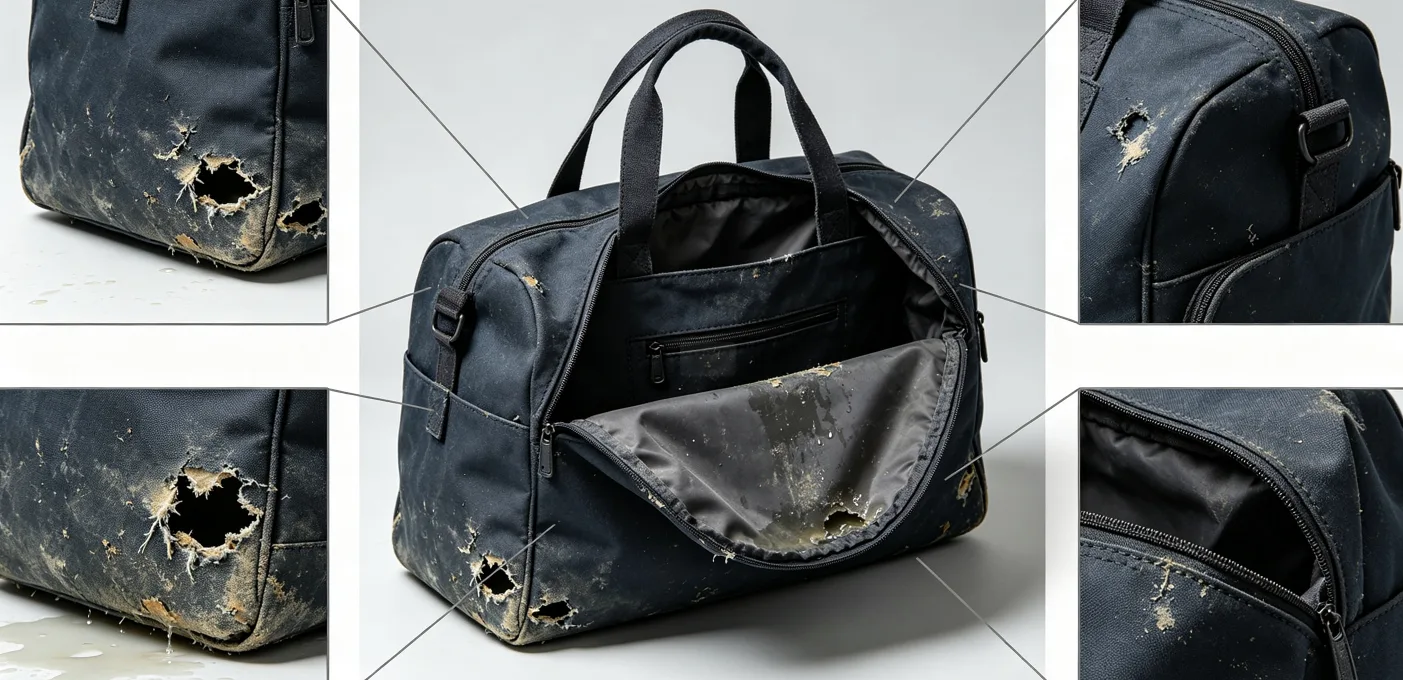
A torn corner or punctured base can turn a promising travel bag line into a costly return nightmare. The root cause usually traces back to the bottom fabric. Zippers and handles get most of the design attention, but the base material takes the real punishment—scraping against airport floors, absorbing impacts from rough handling, and bearing the weight of packed contents. Choosing between abrasion resistant fabrics like ballistic nylon, coated polyester, or PVC-backed tarpaulin affects your product’s failure rate and your brand’s reputation.
Why Bottom Fabric Durability Matters for Bags
Four failure modes drive most travel bag returns: abrasion holes, water intrusion, base collapse, and structural deformation. Industry testing treats the bottom as a high-risk zone separate from the rest of the bag. Wear-resistant textile standards require 20,000+ Martindale cycles for bottom-contact surfaces, and full-bag rolling simulations use 25 kg loads at 4 km/h over roughly 32 km equivalent distance to mimic long-term dragging.
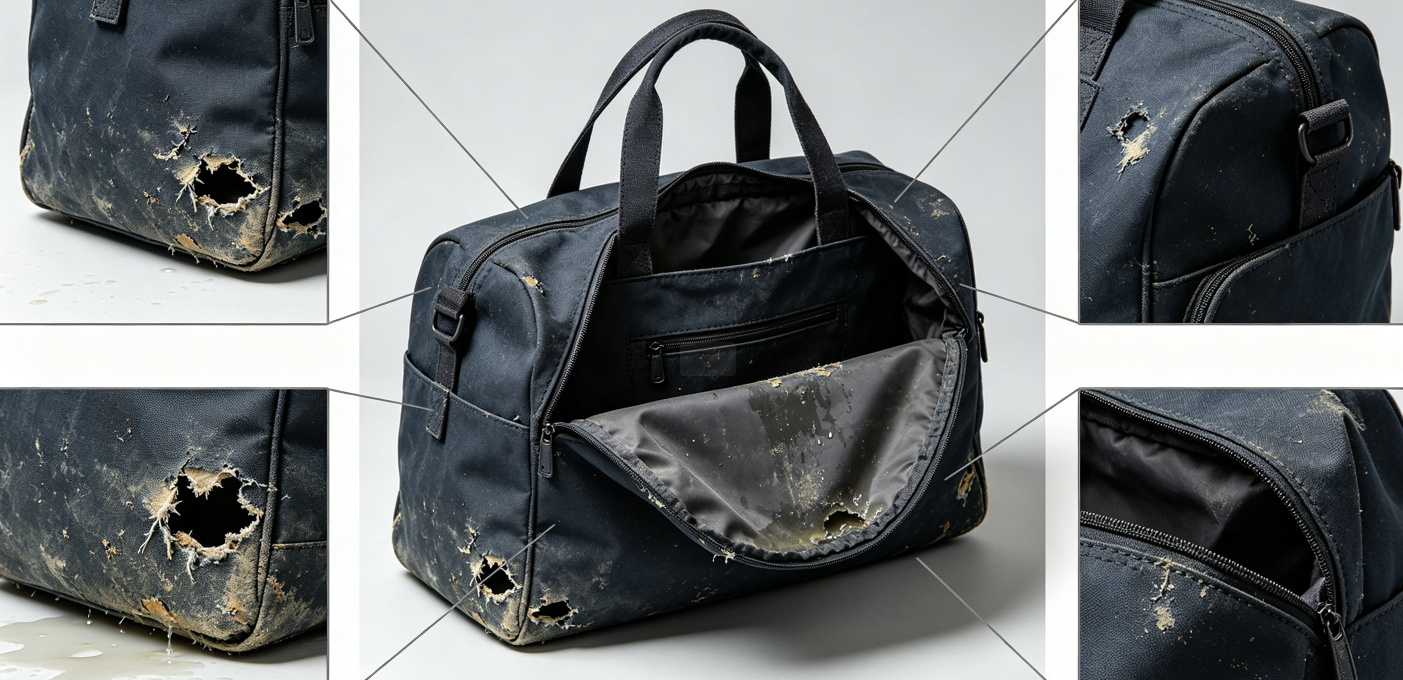
Dragging causes the majority of base failures. Corners, base edges, and wheel-adjacent zones take constant friction from airport floors, escalators, and pavement. Once the bottom fabric wears through, it rarely stays isolated—wheel alignment shifts, the frame loses stability, and structural damage follows.
Water exposure spikes complaints fast. The base hits puddles, rain, and ground contaminants more than any other panel. B2B buyers should check coating integrity, seam sealing, and base panel water resistance together—fabric weight alone doesn’t tell the full story.
Base collapse changes the user experience immediately. A sagging bottom shifts the bag’s center of gravity, increases rolling resistance, and causes uneven wheel wear. This kind of structural failure gets flagged as a functional defect far more often than surface scratches, which pushes retailers toward refunds.
Usage Scenarios Change Bottom Fabric Requirements
-
Family travel: airport floors, indoor tile, short drags—prioritize abrasion resistance, light weight, stain resistance
-
Business travel: hotels, offices, elevators—prioritize scratch resistance, smooth rolling, quiet surfaces
-
Heavy outdoor/frequent use: asphalt, gravel, wet ground—prioritize puncture resistance, tear strength, waterproof bag fabric, reinforced corners
Key Purchasing Metrics for Bag Base Reinforcement
-
Fabric abrasion cycle count (Martindale, Taber, Wyzenbeek)
-
Whether coatings expose base fabric after wear
-
Base thickness and internal board/liner support
-
Seam and corner reinforcement quality
-
Combined rolling, drop, and compression test results
Selecting materials without checking these benchmarks is how manufacturers end up with high return rates traced directly back to the base.
Core Standards for Evaluating Bottom Fabric Durability
Numbers tell the real story here. Martindale cycle counts, denier ratings, and hydrostatic pressure levels are the technical benchmarks that separate a bag that survives three years of travel from one that fails at month six.
Abrasion Resistance Thresholds
ISO 12947/Martindale testing rubs sample fabric against a standard head in a Lissajous pattern until visible wear, yarn breakage, or surface failure appears. The cycle count at that failure point shows what tier the fabric belongs to.
-
20,000 cycles: baseline for everyday, light-use bags
-
40,000+ cycles: commercial or high-frequency use
-
50,000+ cycles: high-traffic scenarios (airports, rental fleets)
-
100,000+ cycles: extreme public-use conditions
More cycles isn’t automatically better. Match the number to your actual use case.
Denier and GSM Benchmarks
Denier measures yarn thickness. Higher denier generally means thicker filaments and better tensile and abrasion potential. 600D is the cost-performance baseline in bag manufacturing. For heavier loads or high-friction bottoms, manufacturers move up to 900D, 1000D, or 1680D.
Denier alone doesn’t guarantee durability. Always check GSM (grams per square meter) alongside it. A high-denier fabric with thin GSM can still wear out fast. The minimum base combination is 600D + adequate GSM, rather than chasing a single number.
Coating and Waterproof Bag Fabric Ratings
Coating structure determines real-world water resistance:
-
Single-layer PU: cost-effective, suitable for basic protection
-
Double-layer PU + DWR: better long-term water, stain, and wear stability
Hydrostatic pressure thresholds to check:
-
≥1,500mm: basic splash and light rain resistance
-
≥3,000mm: recommended for base panels exposed to ground moisture, puddles, or outdoor conditions
Bottom fabric touches wet pavement more than any other panel. Prioritize higher hydrostatic ratings here over surface-only water repellency.
Structural Reinforcement
Construction details determine whether the fabric survives. Reinforced base boards and liners distribute friction and pressure across a wider area, cutting single-point failure risk. Dense stitching (8 to 12 stitches per inch) improves seam tear resistance. Edge binding reduces fraying, seam splitting, and edge wear over time.
Practical Selection Thresholds
|
Use Level |
Martindale |
Denier |
Coating |
Hydrostatic Pressure |
|---|---|---|---|---|
|
Basic/Everyday |
20,000+ |
600D |
Single PU |
≥1,500mm |
|
Mid-High Frequency |
40,000+ |
600D–900D+ |
Double PU+DWR |
≥3,000mm |
|
Heavy/High-Friction |
50,000+ |
Higher denier/GSM |
Full coating + reinforced base + edge binding |
≥3,000mm |
Check all three categories together: raw fabric abrasion resistance, coating protection, and structural reinforcement. Don’t rely on a single spec to justify a sourcing decision.
Main Bottom Fabric Materials Compared
Four materials show up most often in real bag production: 600D Oxford with PU coating, 1000D Cordura, 1680D ballistic nylon, and the TPU versus PVC coating question. Each fits a different budget and use case. Picking the wrong one is where most sourcing mistakes start.
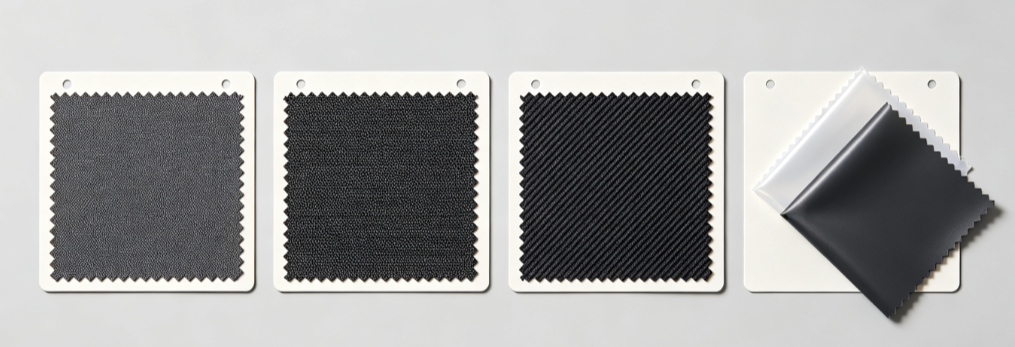
600D Oxford Fabric with PU Coating
This is the workhorse for mid-to-low-cost bags: commuter backpacks, student bags, light outdoor packs, and suitcase bottoms. Abrasion resistance runs 10,000–30,000 Martindale cycles—functional, not extreme. PU coating delivers 3,000–8,000mm hydrostatic pressure. It handles rain splash well but is not made for prolonged ground-water exposure. Expected lifespan is 3–5 years under regular use. The fabric is light, soft, low-cost, and easy to process. The tradeoff is weaker resistance to sharp scraping and long-term heavy abrasion compared to higher-denier nylon options.
1000D Cordura
Cordura is for high-end outdoor packs, tactical bags, and heavy-load commuter bags. High-strength variants reach 100,000+ Martindale cycles, putting them in the ultra abrasion resistant category. Lifespan runs 5–10 years under sustained high-friction use. The downsides are heavier weight and higher price. A typical 1000D PU-coated sample runs around 375 g/m² (±10%). This is a heavy duty material choice, not a lightweight one.
1680D Ballistic Nylon
This fabric is reserved for high-pressure bottom zones: rolling luggage shells, tool bags, functional travel gear that constantly hits the ground. Cycle ratings hit 30,000+, with strong puncture and tear resistance. The fabric is thicker and stiffer, and gives real structural support under weight and repeated dragging. Raw 1680D nylon is not inherently waterproof. It needs PU or PVC coating, or DWR treatment, to perform as a waterproof bag fabric. PU stays softer; PVC pushes harder on water resistance, closer to tarpaulin bag bottom performance.
TPU Coating vs PVC Coating
|
Factor |
TPU |
PVC |
|---|---|---|
|
Water resistance |
Strong, balanced |
Higher, more aggressive barrier |
|
Hand feel |
Softer, better rebound |
Stiffer, less flexible |
|
Best fit |
Flexible, lightweight bags |
Hot, humid, frequently soiled bottoms |
|
Cleaning |
Moderate |
Easier to wipe clean |
Choose TPU when you need softness and flexibility more than max water blocking. Choose PVC coated fabric for bags when you need aggressive waterproofing and easy wipe-down maintenance, even if the surface stiffens over time.
Quick Selection Reference
-
Low-cost general use → 600D Oxford PU coated
-
High-end, high-abrasion → 1000D Cordura
-
Extreme pressure/heavy-friction bottoms → 1680D ballistic nylon
-
Waterproof + soft hand feel → TPU coating
-
Waterproof + easy cleaning → PVC coating
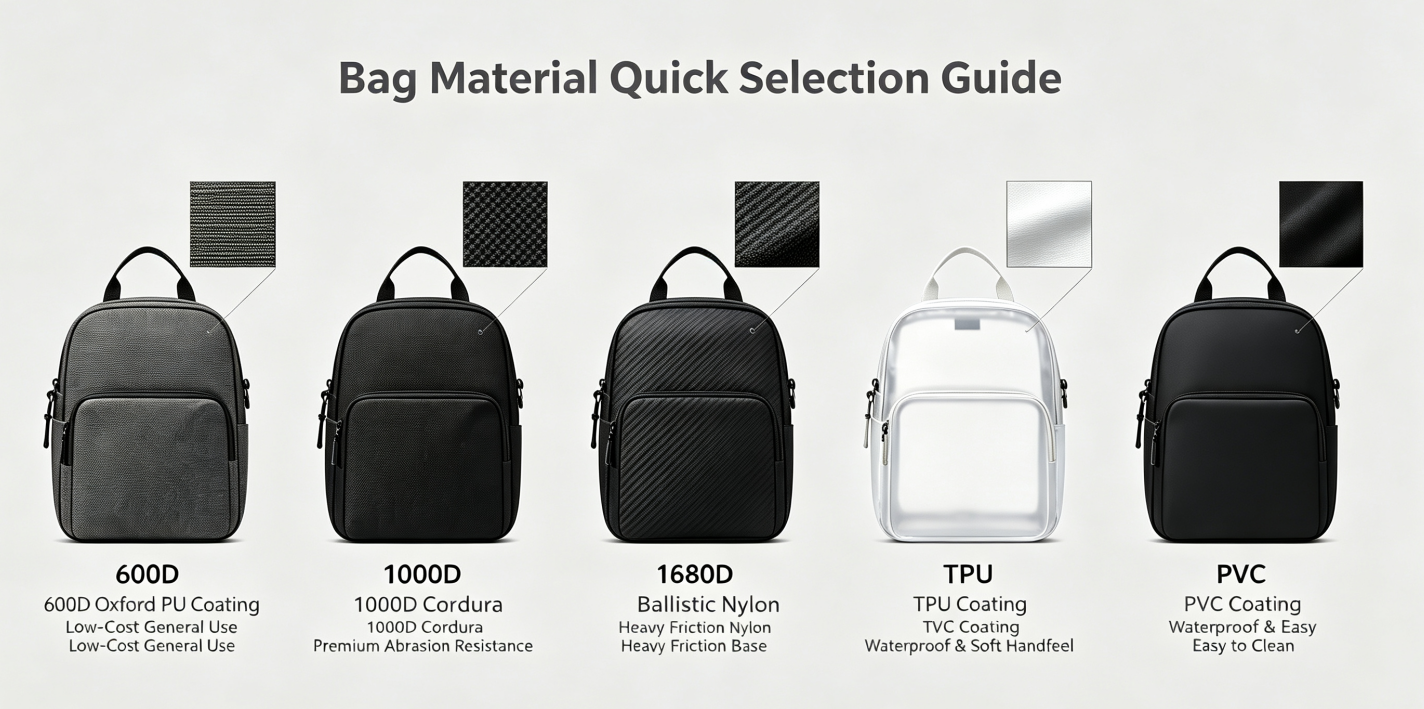
600D PU wins on cost balance for mid-tier bags. 1000D Cordura wins on wear resistance for premium outdoor lines. 1680D ballistic nylon wins for high-friction bottom zones. Between coatings, PVC beats TPU on raw waterproofing; TPU beats PVC on softness and long-term feel.
Matching the Best Fabric Solution to Your Usage Scenario
Spec sheets only tell half the story. The real test is matching fabric choice to how the bag gets used—budget travel, heavy commercial rotation, humid climates, or structural bottom support. Here’s how the leading options break down by scenario.
Light Daily Travel and Family Use
600D Oxford with PU coating remains the cost-performance standard. Common specs run 600D×600D, 72T, 195–230 GSM, with some bag samples reaching PU 3000mm or custom waterproof ratings. This fits backpacks, travel bags, and suitcase shells that need decent abrasion resistance and splash protection—but not extreme tear resistance.
One critical note: 600D alone doesn’t tell you enough. Check PU versus PVC and GSM together. A PU-coated 600D fabric typically runs 180–230 GSM, while a PVC-coated version can climb to 350–550 GSM—stiffer, more waterproof, but heavier and harder to fold. If your priority is budget-friendly daily use with basic water resistance, stick with 600D PU. If you need stronger stain resistance and higher hydrostatic pressure, move to the PVC variant, but expect a weight and flexibility tradeoff.
Heavy-Duty Dragging and Commercial Rotation
Cordura and ballistic nylon are the go-to for high-frequency, high-abrasion use. Cordura’s ballistic fabric uses a 2×2 basket weave construction, built for superior strength-to-weight ratio and resistance to abrasion and tearing. Products aimed at heavy-duty use commonly spec 1680D ballistic nylon with DWR coating—a clear step up from standard 600D Oxford.
Benchmark data makes the difference concrete: 1050D ballistic nylon runs about 12.5 oz/yd² (420 GSM), with 1,550N grab strength and 280N tear strength. Compare that to 1000D Cordura at roughly 11.0 oz/yd² (330 GSM), 5,000+ abrasion cycles, 1,245N grab strength, and 200N tear strength. If your bag faces frequent ground dragging, airport-level turnover, or repeated edge scraping, prioritize Cordura or ballistic nylon. For occasional handling or light travel, 600D PU still delivers enough durability at a lower cost.
Humid Climates and Easy-Clean Requirements
For wet or high-humidity conditions, coating type matters more than base fabric. 600D Oxford substrates can be finished with PU, PVC, or PEVA coatings, and PVC options typically offer stronger water barriers. A standard 600D PU sample rated at PU3000mm works for general rain and moisture protection. For muddy, high-humidity regions where wipe-clean performance matters, PVC or TPU coatings usually outperform basic PU.
-
TPU: better flexibility, cold resistance, and softer hand feel—good for eco-conscious, low-odor requirements
-
PVC: stronger waterproofing, easier stain removal, better wipe-clean performance—but heavier and stiffer
Leather Bottom Panels for High-Load Structures
For bags needing serious bottom-load support, full-grain, vegetable-tanned leather at 2.2mm or thicker is the practical industry starting point. Anything thinner suits decorative panels or light-load areas, not high-frequency dragging zones. If the bottom regularly contacts pavement, luggage carts, or stone flooring, full-grain leather holds up best. For production stability and reduced surface coating, vegetable-tanned leather is the preferred choice.
Layered Recommendations by Tier
-
Lightweight: 600D PU shell + partial reinforced base board
-
Durable: Cordura/ballistic nylon shell + localized leather reinforcement at high-wear zones
-
Premium load-bearing: full-grain, vegetable-tanned leather base, 2.2mm or thicker
How to Verify Real Fabric Durability During Procurement (Quality Inspection Checklist)
A test report on paper doesn’t guarantee what shows up in your container. You need four checks to separate genuine abrasion resistant fabric from marketing claims: abrasion report authenticity, stitch density, rebound feel, and corner fill density. Run these on incoming samples before signing off on any bag manufacturing materials order.
Verify Martindale/Taber Reports Before Trusting Them
Ask suppliers for the full test page — sample name, batch or color code, testing standard, lab name, test date, results in cycles or rubs, and failure criteria. Reports tested under ASTM D4966 or similar standards cover only the specific sample tested, not the entire production run. A phrase like “sample as received” signals a properly issued report, not a red flag.
Cross-check the sample number against your PO. Confirm the fabric composition and finish match. Make sure the test standard fits your bag’s real use case.
Common abrasion benchmarks for sourcing: light domestic use about 15,000 rubs; general use 20,000 rubs; heavy domestic use 30,000 rubs; heavy commercial use 40,000 rubs. If repeated batch tests show more than 20 percent variance, resample and retest.
Press-and-Rebound Test for Base Structure
Press your palm or thumb into the base panel for 3 to 5 seconds, release, and watch how fast it recovers. Good structure snaps back quickly with no lingering dent. Slow rebound, wave-like softness, or a hollow feel signals weak internal support or uneven fill. Repeat three times on the same spot. If rebound weakens by the third press, the material fatigues fast.
Stitch Density Check
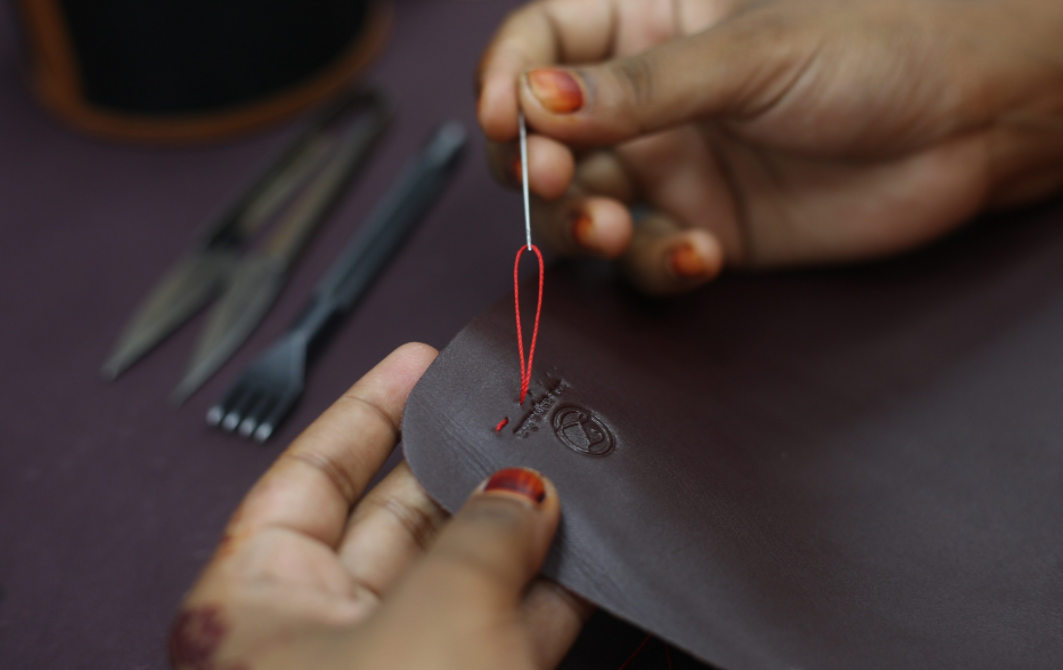
Measure stitches per inch (SPI) with a ruler. Below 6 SPI counts as high risk — seams open, pucker, or pull apart under load. Woven fabrics need 8 to 10 SPI, with 10 to 12 SPI as a safer range. Vinyl or faux leather runs 5 to 7 SPI, and denser isn’t always better because excess needle holes weaken the material. Sample three random points. If any critical stress zone falls short, flag it as non-conforming.
Corner Density Test
Press the corner-edge junction with your thumb while checking the profile from the side. Dense corners feel firm, recover fast, and hold a clean edge line. Hollow or under-filled corners feel spongy and collapse visibly, then don’t spring back, usually from insufficient padding or uneven assembly. Compare all four corners on the same sample. Any noticeably softer corner marks an assembly defect.
Minimum QC Sequence
-
Check the report — confirm it traces to your batch
-
Measure SPI — flag anything under 6 SPI
-
Press-test rebound — structure should compress and recover fast
-
Inspect all four corners — consistency matters more than one good corner
Acceptance Clause Benchmarks
-
Abrasion: require Martindale or Taber reports with visible standard, batch, and result; tier at 15k, 20k, 30k, 40k rubs by use case
-
Stitching: 8 to 10 SPI minimum on load-bearing seams; below 6 SPI equals reject
-
Sampling: inspect at least 3 points per batch; over 20 percent variance triggers retest
Common Sourcing Mistakes and How to Avoid Them
Weight and price tags mislead more buyers than any other spec. Two rolls of 600D fabric can carry GSM anywhere from 180 to 240, and that gap changes hand feel, cost, and wear-resistant textile performance. Heavier doesn’t mean better. Denier measures yarn thickness, not weave density. GSM measures weight per area, not overall strength. Judge a fabric by denier, GSM, weave density, coating, and base cloth together. Checking one number in isolation invites a bad call.
Coating and Seam Gaps Hiding Behind “Thick-Looking” Fabric
A base panel can look substantial and still leak. The culprit is coating, seams, or the zipper system, not fabric thickness. Splash-resistant and waterproof are different claims. Standard zippers fail under pressure; waterproof zippers or taped seams close that gap. Thin coatings crack and peel over time. If PVC coated fabric for bags runs too thick, keep it in the 0.2mm–0.5mm range. Beyond that, it stiffens like plastic sheeting instead of protecting. Real waterproofing comes from sealed, taped seams, roll-top closures, and water-blocking zippers, not surface-level water repellency. Always request coating thickness and hydrolysis or heat-aging test data before approving a batch.
Fabric-Hardware Mismatches That Shorten Bag Life
Durable bottom fabric paired with weak straps, thin zippers, or unlined interiors fails at the connection points first, not the fabric itself. Narrow, unpadded straps cause discomfort under load. Unreinforced strap junctions rip open early because they’re high-stress zones. Match fabric grade to hardware grade every time.
Keep these thresholds in mind. Bags under 500g need extra strap and seam scrutiny if load-bearing. A 40L capacity claim rarely reflects true usable space once linings and dividers are factored in. Bags over 1.5kg deserve a hard look at whether self-weight undermines travel bag durability.
Sunteam Bag’s Professional Approach to Bottom Fabric Selection and Construction
Real-world sourcing partners handle this differently depending on how the bag will be used. For sports and outdoor lines, Sunteam Bag recommends nylon fabric with fiberglass reinforcement for panels that hit the ground repeatedly—bottom panels, side pockets, and other high-wear zones get this treatment first. Tactical and outdoor bags treat the base as a priority reinforcement point, not an afterthought.
Commuter and household totes need a different approach. Sunteam’s custom tote line uses a double-layer reinforced base board, built from either 2mm PU leather or 600D polyester, designed to carry weight without sagging over time.
Construction Techniques That Extend Base Life
Three stitching methods run across Sunteam’s reinforcement processes:
-
Double or triple parallel stitching at connection points that take stress
-
Reinforcement patches layered onto high-wear zones
-
Bar tacking at concentrated stress points
Edge binding tape seals raw edges so they don’t fray or loosen. Paired with precision double-needle, double-thread stitching, this adds stability.
QC and Testing Standards Behind the Claims
Sunteam’s B2B tote page reports a 100% compliance rate for accessory tensile strength under its reinforcement process QC. Abrasion resistance testing simulates long-term wear to check whether fabric texture and appearance hold up.
Before scaling to full production, Sunteam recommends a 10–25 piece micro-batch test. This verifies base durability, stitch density, edge binding strength, and load capacity before you commit to a bulk order. It’s the same checklist buyers should run on any bag manufacturing materials order.