
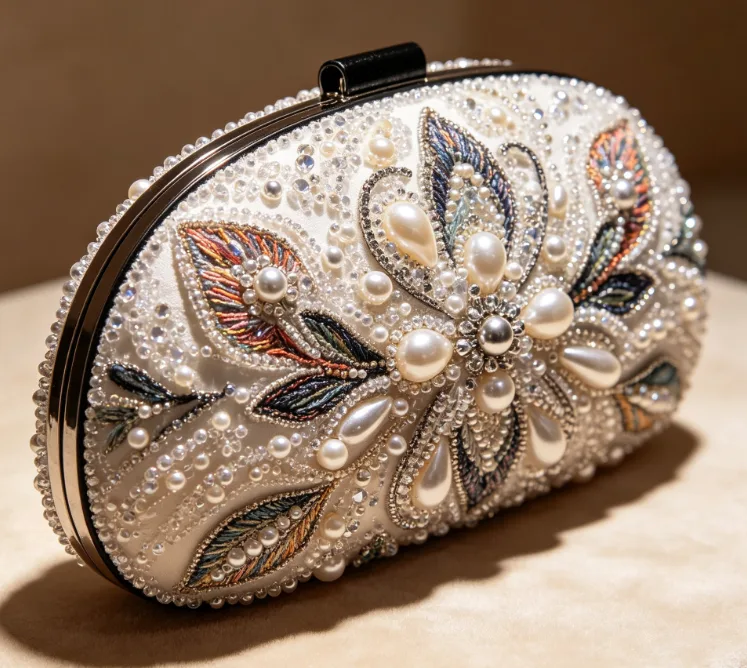
What Does a Custom Evening Clutch Bag Actually Cost?
Custom evening clutch bag prices run from $8 at the factory gate to well over $3,000 for high-end handcrafted pieces. Knowing where your order fits on that range is the difference between a smart sourcing decision and a budget shock.
Here’s how pricing breaks down across four tiers — both retail and factory/B2B:
Tier 1: Budget Custom ($25–$80 Retail / $5–$15 Factory)
Entry-level custom evening clutches are PU leather or polyester satin with basic hardware. Retail prices land in the $25–$60 range. On AliExpress or Alibaba, factory pricing runs $5–$15 per piece (MOQ: 100–300 units).
Want to add a logo? A simple heat-pressed logo or screen print adds about 10–20% to the unit cost.
Tier 2: Mid-Range Personalized ($80–$300 Retail / $20–$80 Factory)
This tier covers most personalized wedding clutches, custom satin clutch bags, and branded OEM orders. Independent designers and bridge-price brands sell these at $100–$350 retail.
At the factory level, genuine leather with quality hardware and clean construction runs $25–$60/pc. Add a box clutch silhouette, rhinestone detailing, or hand-inlaid embellishment, and the factory price moves to $40–$80/pc.
Tier 3: Premium Custom ($300–$1,000 Retail / $80––$250 Factory)
Think Alexander McQueen or Michael Kors Collection — these brands sit in the $300–$800 retail zone. OEM factory orders at this tier run $80–$200/pc for real leather, precision hardware, and structured linings.
Small-batch, high-craft pieces — crystal minaudière bags, mixed-material designs — push factory costs to $150–$250/pc.
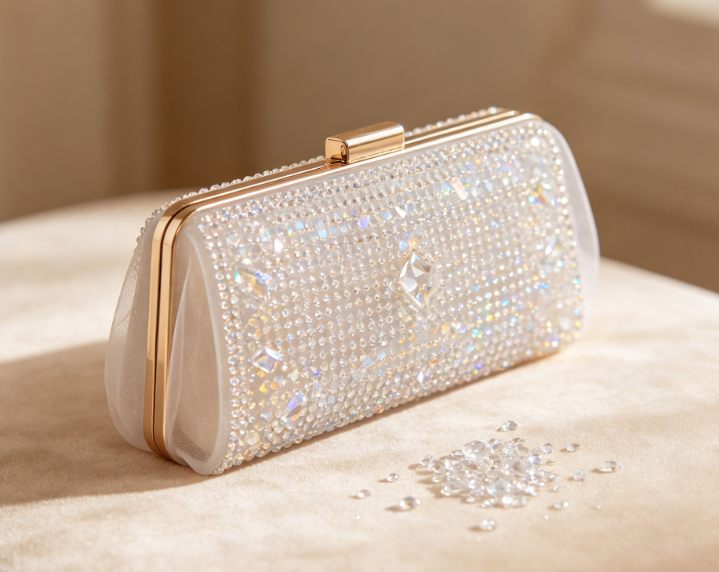
Tier 4: Luxury Custom ($1,000–$10,000+ Retail / $300–$3,000+ Atelier)
This tier includes Judith Leiber crystal minaudières ($3,900), Chanel quilted satin clutches ($4,200), and Dolce & Gabbana crystal box bags ($2,700).
A single piece at this level — top-grade leather, full handwork, custom hardware, hand-set crystals — takes 20–80 hours of skilled labor. Atelier cost alone clears $1,500–$3,000 per piece, before any brand markup.
One rule holds across all tiers: factory-to-retail markup runs 2.5–5× for mid-range brands. For luxury positioning, that number jumps to 5–10×.
A factory sample at $400 can become a $3,000–$4,000 retail product. That’s the same pricing logic behind most collectible custom minaudière bags you see on the market today.
How Material Choice Drives the Custom Evening Clutch Bag Price
Material is the single largest cost variable in any custom evening clutch bag. It accounts for 40–60% of total production cost. Get the material decision right, and the rest of the budget falls into place. Get it wrong, and no amount of negotiation will save your margins.
Picking between a synthetic body and premium Italian leather isn’t just an aesthetic call. It’s a pricing decision. It can swing your unit cost by 2–5× before you’ve touched embellishment, hardware, or labor.
Material Tiers and What They Cost
Here’s how the most common evening clutch materials map to real factory and retail pricing:
|
Material |
Factory Cost (per unit) |
Typical Retail Range |
|---|---|---|
|
PU / synthetic “vegan” leather |
~$10–$20 |
$35–$80 |
|
Polyester or standard satin |
~$8–$15 |
$25–$60 |
|
Velvet / mid-grade satin |
~$12–$20 |
$35–$80 |
|
Genuine cowhide leather |
~$25–$50 |
$400–$1,000+ |
|
Silk satin with premium hardware |
~$30–$60 |
$90–$300 |
|
Acrylic / resin box clutch |
~$25–$55 |
$90–$300 |
|
Beaded / crystal embellished |
~$50–$150+ |
$300–$900 |
|
Exotic skins + crystal + brass frame |
$150–$400+ |
$2,000+ |
The jump from synthetic to Italian leather moves material cost from $20 to $50 per unit. That’s a 150% increase on that single line item. Take a clutch with a total ex-factory cost of $30 using synthetic. Upgrade to premium leather, and the unit cost climbs to $60–$70 once you factor in cutting waste and finishing. That change often doubles both wholesale and retail targets.
Embellishment Is Its Own Cost Multiplier
Crystal and bead-work don’t just add sparkle — they add serious cost. Two factors drive this: the material cost of the stones themselves, and the intensive hand-labor needed to set them.
A partial crystal motif might add $15–$40 to unit cost. Full-surface crystal coverage on a custom minaudière bag can double the labor on a small clutch. It also pushes the total into the next retail tier — often $100–$300 higher than a comparable unembellished piece.
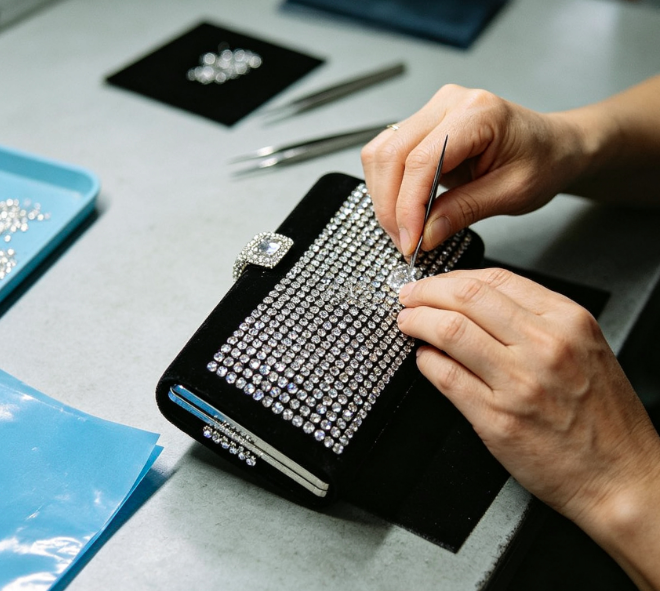
Designer beaded clutches retail at $300–$900. Woven designer alternatives sit at $400–$1,200+. The bead-work premium is real, but you can control it. Choosing partial motifs over full coverage is one of the highest-impact decisions in any luxury clutch bag customization project.
Hardware: Small Component, Significant Impact
A frame upgrade from standard zinc alloy to precision brass or branded custom hardware adds $10–$20 per unit in direct cost. On a clutch with a base cost of $25–$30, that’s a 30–80% increase in hardware spend. It also drives a $30–$80 higher retail price, depending on your markup structure.
Custom-molded logo closures carry one-time tooling fees on top of that. One practical move: standardize the same frame across multiple styles. This spreads the tooling cost and lowers what you pay per unit over time.
A Practical Way to Think About Material Budgeting
Work backwards from your target retail price:
-
$60–$80 retail target → ex-factory around $12–$20 → material budget of $5–$10/unit
-
$300–$500 retail target → ex-factory around $60–$100 → material spend of $25–$50/unit (enough for good leather or refined fabric plus quality hardware)
-
$1,000+ retail target → premium or exotic materials, custom hardware, and hand-finishing are all expected at this tier
One cost-control principle works across all tiers: invest in what’s visible, economize on what’s hidden. Use a premium Italian leather or silk satin exterior, then pair it with a more affordable interior lining. You save several dollars per unit without touching the perceived quality that justifies your retail price.
5 Key Factors That Affect Custom Evening Clutch Bag Pricing
Two buyers walk into the same factory. They both want a custom evening clutch. One walks out with a quote of $18/unit. The other gets $95/unit. Same supplier — two completely different products. Here’s what creates that gap.
These five factors won’t just help you decode a supplier’s quote. They’ll help you control your costs before the conversation even starts.
1. Material Selection (Outer Fabric, Lining, and Hardware)
Material is where your budget gets made or broken. In nearly every custom bag category, material cost accounts for 40–60% of total production expense — evening clutches are no exception.
Break that down further:
– Outer fabric or leather makes up more than 50% of the base product cost
– Hardware (frame, clasp, chain, logo plate) accounts for about 15% of total unit cost — and goes higher when you specify custom plated brass or crystal-set frames
The real cost lever is the material upgrade path:
|
Outer Material |
Cost Impact |
|---|---|
|
PU / synthetic leather |
Baseline |
|
Genuine lambskin or calfskin |
2–4× higher per square foot vs. PU |
|
Special coatings (metallic foil, glitter lamination) |
+10–20% over base fabric |
|
Silk lining vs. polyester lining |
+30–50% on lining cost per meter |
|
Exotic skins, crystal mesh, or mother-of-pearl inlay |
Pushes into $800–$2,500+ retail territory |
Even the zipper matters. Switching from generic hardware to a YKK zipper or custom-molded clasp adds $0.30–$1.00 per unit. Small per piece, but it adds up fast at volume.
One practical rule: outer fabric and hardware are what your customer sees and touches. Lining quality matters, but it has less impact on how the product feels to the buyer. Put your material budget where it shows.
2. Design Complexity and Workmanship
Labor cost rises in direct proportion to design complexity. Every extra process — a pleated front, a beaded motif, hand-painted edges — adds skilled minutes. Skilled minutes cost money.
Key workmanship cost drivers for evening clutches:
-
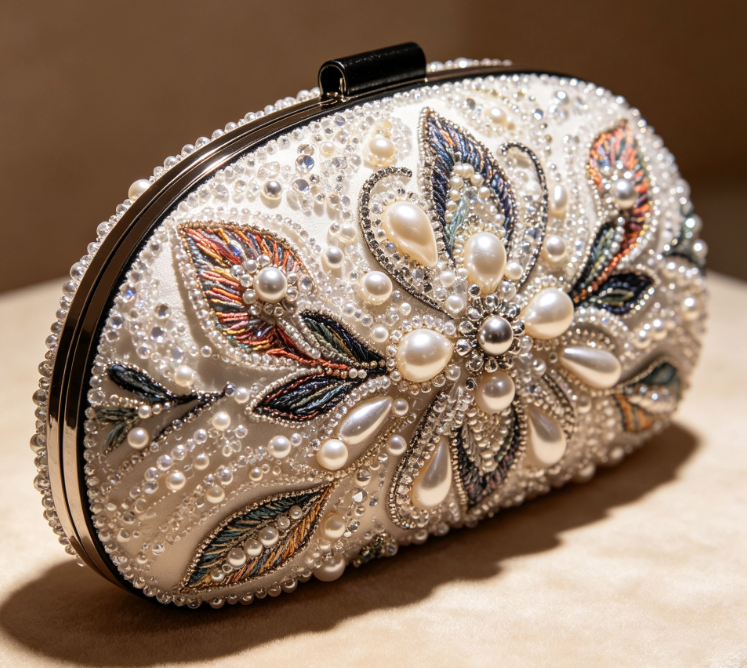
Intricate beading, embroidery, or appliqué: adds 30–60 minutes of skilled handwork per piece, pushing factory cost up by $5–$15/unit at standard Asian production rates
-
Complex cutting patterns (asymmetrical shells, ruched satin fronts): more material waste plus more cutting time = 5–15% added to unit cost
-
Fine finishing operations (detailed top-stitching, laser etching, edge painting): can add 5–20% to labor cost, depending on the number of steps
-
Structured hard-case frames vs. soft envelope clutches: framed minaudière-style bags need the shell, padding, cover fabric, lining, and frame all assembled together — that’s about 1.5–2× the labor time of a basic stitched envelope pouch
Before requesting a quote, list every single process your design requires. Each extra 10 minutes of production time raises your unit cost. To control costs without losing visual impact, concentrate embellishment on one focal area — the clasp or a front motif — rather than spreading it across the whole surface.
3. Order Quantity (MOQ and Volume Tiers)
This factor has the biggest effect on per-unit pricing. It’s also the one buyers most often underestimate.
Factories set Minimum Order Quantities per style and colorway because pattern development, fabric sourcing, and sampling all carry fixed costs. More units produced means those fixed costs get spread thinner.
Here’s what that looks like in practice:
-
Orders below 100 units per color often carry a 10–30% surcharge on unit cost
-
Scaling from 100 to 1,000 units can cut per-unit price by 15–30% — through volume alone
-
One-time tooling fees for custom clasps or logo hardware run $150–$500 per design. At 100 units, that adds $1.50–$5.00/unit. At 1,000 units, the same fee drops to $0.15–$0.50/unit
Request quotes at three tiers: 100 / 500 / 1,000 units. The spread between those numbers shows you how the factory is structured — and where the real price break points are.
4. Customization and Branding (Logo, Print, Packaging)
Adding your brand identity — a monogram, logo closure, or custom print — brings two types of costs: one-time setup fees and per-unit production charges. Both need to go into your unit cost calculation.
Here’s how the main logo methods break down:
|
Method |
Setup Fee |
Per-Unit Cost |
|---|---|---|
|
Screen printing |
$30–$80 per color |
$0.20–$0.80 |
|
Embroidery |
$30–$60 digitizing |
$0.30–$1.50 (by stitch count) |
|
Debossing / hot stamping |
$50–$150 die fee |
$0.10–$0.50 at scale |
|
Custom metal logo / clasp |
$150–$500 tooling |
$1.00–$4.00 per piece |
Other variables that push branding costs higher:
– Each extra print color needs separate setup and ink — expect 10–30% more vs. a single-color design
– Multiple print locations (front panel + interior label) each carry separate setup charges
– Foil stamping, embossing, or texture effects add $0.20–$1.00/unit over standard printing
– Custom Pantone color matching has a flat setup fee plus a 5–10% material cost increase
Don’t skip over packaging. Custom dust bags, branded boxes, and printed hang tags add $0.50–$3.00/unit to your landed cost. For a mid-range custom clutch sold as a gift or wedding keepsake, that cost is unavoidable. Together, logo and packaging often account for 10–20% of total COGS when premium presentation is part of the product.
5. Manufacturing Location, Logistics, and Trade Terms
Your ex-factory price is not your real cost. Where the bag is made, how it ships, and what trade terms you agree to — all of that shapes your true landed cost per unit. That landed cost determines what retail price is actually workable.
Labor rate by region creates the most visible gap:
-
A design needing 45 minutes of skilled handwork costs $2–$4 in labor at a well-run Chinese or Southeast Asian factory
-
The same 45 minutes costs $10–$25 in a European or US workshop
-
That one difference alone can shift your ex-factory price by $8–$20/unit before anything else changes
Shipping and duties add another layer:
– Ocean freight rates shift by season — pre-holiday peak periods can raise costs 20–50% versus off-peak rates
– Import duties on bags and accessories run 5–15% of customs value, depending on the destination country. Add this on top of ex-factory price and freight to get your true landed cost
Incoterms affect who absorbs these costs. Moving from FOB (you handle freight and duty) to DDP (supplier handles everything) raises your invoice price, but makes landed cost easier to calculate. Neither option is the clear winner — what matters is comparing all quotes on the same basis.
Once you have your landed cost, use the standard fashion pricing formula:
– Wholesale price = 2.0–2.5× landed cost
– Retail (MSRP) = 4.0–5.0× landed cost
A clutch with a $25 landed cost becomes a $100–$125 retail product under this model. For a premium personalized wedding clutch or branded custom minaudière bag, knowing this multiplier is what keeps your margin healthy — and keeps you from underpricing a product you’ve invested in.
Quick Reference: 5-Factor Pricing Checklist
Work through this checklist before requesting any factory quote:
-
✅ Material: Specify outer fabric/leather grade, lining quality, and hardware finish — these three items make up 40–60% of your COGS
-
✅ Workmanship: List every production process and estimate time per step — each extra 10 minutes raises cost directly
-
✅ MOQ: Request quotes at 100 / 500 / 1,000 units — expect a 15–30% unit cost reduction scaling from 100 to 1,000
-
✅ Branding: Confirm logo method, add setup fees ($30–$500) plus per-unit charges ($0.10–$4.00), and include packaging ($0.50–$3.00/unit)
-
✅ Landed cost: Add freight (factor in seasonal surcharges) + import duties (5–15%) + your markup multiple (4–5×) to confirm your retail target holds up
Wholesale vs Retail: Custom Evening Clutch Bag Price Comparison for Bulk Orders
Bulk ordering saves real money. The numbers are simpler than most buyers think.
Take a standard 20 cm custom metallic leather evening clutch priced at $159 retail. Here’s how wholesale pricing changes as order quantity goes up:
|
Order Quantity |
Per-Unit Price |
Discount vs. Retail |
Total Savings |
|---|---|---|---|
|
1 pc (retail) |
$159.00 |
— |
— |
|
10 pcs (wholesale) |
$132.20 |
~17% off |
$268 saved |
|
30 pcs (wholesale) |
$114.00 |
~28% off |
$1,350 saved |
A 10-piece wholesale order cuts $26.80 per bag vs. retail. Go up to 30 pieces, and you save $45.00 per bag — that’s $1,350 total compared to buying 30 units at retail ($4,770 vs. $3,420).
The discount follows a clear volume curve. Per-unit price drops by 10–12 percentage points between the 10-piece and 30-piece tiers. For custom evening clutch bags in this spec range, wholesale pricing lands at 72–83% of retail, depending on which MOQ tier you choose.
How to Compare Wholesale vs. Retail Costs Before You Order
Run through this quick calculation before placing any bulk order:
-
Get the retail baseline — confirm the single-unit price for your chosen design and customization options
-
Request tiered quotes at 10, 30, and 50 units — ask for the per-unit price, total order cost, and what customization each tier includes
-
Calculate your savings per unit — subtract the wholesale unit price from retail, then divide by retail to get your discount percentage
-
Set a target threshold — for custom evening clutches, a solid wholesale discount starts at 20–30% off retail. A supplier’s 30-unit quote that doesn’t hit that range? Keep comparing.
-
Confirm MOQ and any add-on fees — most wholesale suppliers require at least 10–12 pieces per color or style. Custom branding or color matching adds a $1–$5 per-unit surcharge or a flat setup fee on top
For personalized wedding clutches, OEM evening bag orders, or private label clutch bag programs, even a 10-unit wholesale order gives you clear per-unit savings. At 30 units, the numbers shift well in your favor.
Personalized vs Custom-Built: Which Option Fits Your Budget?
“Custom evening clutch bag” means two very different things. The price gap between them can hit 3–5×.
Personalized customization starts from an existing base design. You pick the material, add a monogram, choose a color, or request a logo. The pattern is already set. Most custom satin clutch bags, monogram evening bags, and personalized wedding clutches on the market use this approach.
Custom-built from scratch means starting with zero — original pattern, unique silhouette, custom hardware, every detail designed fresh. High-end custom minaudière bags and one-off luxury clutch bag customization projects go through this process.
Here’s what that difference looks like in real numbers:
|
Option |
Factory Cost |
What You Get |
|---|---|---|
|
Personalized (base design + logo/monogram) |
$20–$80/pc |
Existing pattern, custom branding, color selection |
|
Custom-built (original design, one-off) |
$100–$400+/pc |
Unique pattern, full design control, artisan finishing |
The cost gap runs 3–5× per unit. Pattern development time, sampling, and skilled labor for a new design drive most of that difference.
Which Option Fits Your Situation?
-
Sourcing personalized wedding clutches or private label clutch bags in volume → Personalized customization is the right call. You get a branded product at a manageable unit cost. Factory MOQs start at 50–100 pieces.
-
A designer or brand launching a signature piece → Custom-built from scratch makes sense. Budget for a longer lead time — 8–12 weeks versus 4–6 weeks for personalized. Also plan for a one-time sampling cost of $150–$400, separate from production pricing.
-
Budget under $80/unit ex-factory → Stay in personalized territory. True custom-built construction rarely lands below $100/pc once design, sampling, and handwork are factored in.
The straight truth: for most OEM evening bag buyers and custom bridal clutch bag orders, personalized customization delivers 90% of the visual impact at a fraction of the custom-built price. Save the full custom-built route for hero products where the unique design is the core selling point.
Custom Evening Clutch Bag Production Timeline & Sample Fees Explained
Most sourcing timelines fall apart not because of bad products — but because buyers underestimate how long the process takes.
For a custom evening clutch bag, the realistic window from first inquiry to goods in hand runs 6–16 weeks. Simple personalized styles land at the shorter end. Custom minaudière bags with detailed beading or custom hardware push toward 12–16 weeks.
Here’s how a full production cycle breaks down:
|
Phase |
Timeframe |
|---|---|
|
Inquiry + spec confirmation |
2–5 business days |
|
Sampling / prototype |
7–21 business days |
|
Sample review + revisions |
1–3 weeks per round |
|
Material sourcing |
5–15 business days |
|
Bulk production |
15–35 business days |
|
QC + packing |
3–7 business days |
|
Shipping + customs clearance |
5–40+ business days |
Plan for at least two sample rounds. Here’s what that looks like in practice:
-
You receive a first sample
-
You request revisions
-
You review a second version
-
You approve bulk production
That revision cycle adds 2–6 weeks on its own. Suppliers rarely include this in the lead time they quote you upfront.
What You’ll Pay for Samples
Factories charge sample fees apart from bulk production costs. Most require 100% of the sample fee plus shipping paid before work begins. Ask for all three line items in your quote:
-
Sample price
-
Sample production lead time
-
Sample shipping cost
Rush orders are possible. They do carry surcharges, and they work only if materials are already in stock. Simple monogram or color customization can move in 1–3 days. A hand-embroidered custom bridal clutch bag or a structured luxury clutch bag customization project needs 2–6 weeks for sampling alone — before bulk production even starts.
One practical tip: confirm whether a supplier’s quoted timeline is in business days or calendar days. A “30-day” production quote can mean very different things. That gap has derailed more than a few wedding-season orders.
FAQ: Your Top Questions About Custom Evening Clutch Bag Costs Answered
These questions come up in almost every custom evening clutch inquiry. Here are straight answers with real numbers.
Q: How much does a custom evening clutch bag cost at the factory level?
Most orders fall into three price tiers:
– Basic satin styles: $6–12/pc (MOQ 300–500)
– Mid-range metal-frame clutches with rhinestones: $12–25/pc (MOQ 100–300)
– High-embellishment crystal hardcases: $30–60+/pc (MOQ 50–100)
Q: What does sampling cost, and is the fee refundable?
First prototypes run $80–250. Revision samples drop to $50–150 each for minor changes. Most factories don’t refund sample fees. That said, some suppliers credit the sample cost against your first bulk order. Confirm this detail upfront before you commit.
Q: Can I order multiple styles or colors in one batch?
Yes, but splitting 300 units across four colorways (75 pcs each) counts as four separate small runs. You’ll face a 10–25% per-unit surcharge compared to placing the full quantity in one color.
Q: How much does adding a removable chain cost?
A standard nickel or light-gold chain adds $0.30–0.80/unit. Heavier decorative chains push the cost closer to $1.50/unit.
Q: What’s the cost of upgrading hardware or lining?
A custom logo clasp or unique frame needs a one-time mold fee of $300–800, plus $0.20–1.00 extra per unit. Switching from plain polyester lining to jacquard adds another $0.20–0.80/unit.
Q: Do rush orders cost more?
Cutting lead time by 30–40% adds a 10–25% surcharge to your unit cost. Plus, it’s only possible when materials are already in stock.