
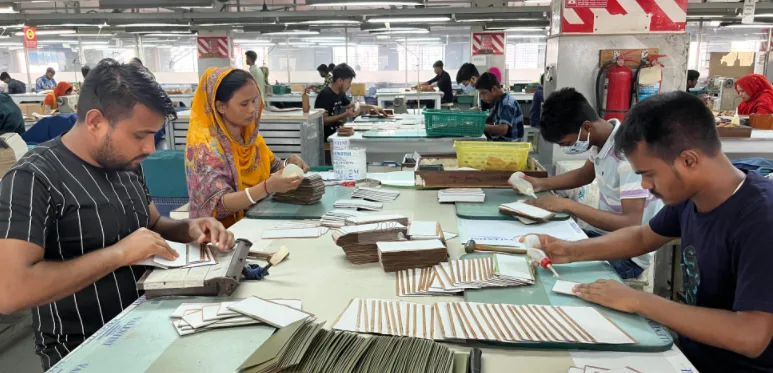
What This Guide Covers — And Why It’s Structured This Way
The title delivers on its promise: a complete pricing guide for custom clutch bags. It’s built around four variables that move the number — material, customization method, order quantity, and hidden costs.
The structure has a reason behind it. Each section follows a clear logic chain: problem → analysis → actionable answer. No filler. No vague category labels.
You get the specific cost levers you control as a buyer. Sourcing wholesale clutch bags? Pricing personalized wedding clutch bags? Launching a custom logo clutch bag line from scratch? This guide covers all of it — with direct answers, not guesswork.
Quick Answer: Custom Clutch Bag Price Ranges at a Glance
Four price tiers cover most custom clutch bag scenarios on the market:
|
Tier |
Price Range |
Typical Use Case |
|---|---|---|
|
Budget |
$5–$15 |
Promo giveaways, basic fabric, simple logo print |
|
Mainstream |
$15–$40 |
Satin, velvet, or PU with beading, sequins, or monogram |
|
Boutique |
$40–$100 |
Vegan leather, bridal custom, small-batch occasion pieces |
|
Designer |
$100–$200+ |
Genuine leather, brand-grade finishing, premium custom print |
These aren’t rough guesses — the numbers come from real market data across multiple sourcing channels. AliExpress custom satin and embroidered clutches tend to land at $15–$40. UK personalized clutch bags from boutique retailers run $27–$45. Print-on-demand platforms like Contrado start at $129.95 for a single custom piece.
Your tier comes down to two things: material and customization method. You control both. The sections below break down how each choice shifts your per-unit cost.
Factor #1: Material Choice — The Biggest Price Driver
Material is where your per-unit cost is won or lost before a single stitch is made.
In most manufacturing setups, direct materials account for 50–70% of total production cost. Custom clutch bags work the same way. The fabric or leather you pick does more than change how the bag looks. It sets the floor on everything else: labor complexity, hardware compatibility, finishing requirements, and your final FOB price.
Here’s how the major material tiers stack up:
|
Material |
Typical Per-Unit Cost Range |
Key Characteristic |
|---|---|---|
|
Canvas / Nylon |
$5–$12 |
Lightweight, easy to print on, lower durability |
|
Satin / Velvet |
$8–$20 |
Popular for weddings and events, works well with embroidery |
|
PU Leather |
$12–$28 |
Animal-free, consistent texture, wide color range |
|
Vegan / Microfiber Leather |
$20–$45 |
Premium look at mid-range cost, boutique positioning |
|
Genuine Leather |
$40–$85+ |
Top durability, highest material cost, brand-grade finish |
The gap between satin and genuine leather goes beyond looks. It’s a 3–7× price multiplier on the material line item alone. Move from PU to full-grain leather and your unit cost can pass $60 — before any customization is added.
Why Material Grade Raises More Than Just Material Cost
Going with a premium material doesn’t stop at a higher raw material price. It pulls up conversion costs too.
Genuine leather needs specialized cutting, edge finishing, and stitching techniques. More skilled labor hours go into each piece. Custom tooling may be required too. These costs stack on top of the base material premium. A bag that runs $18 in PU leather can hit $55+ in genuine leather — same construction, very different bill.
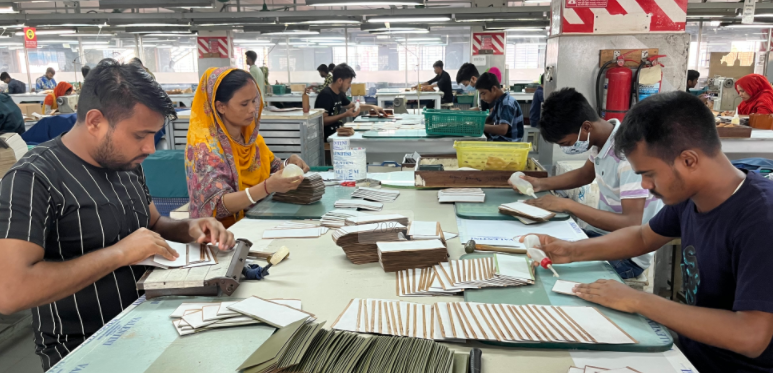
The practical takeaway: Lock in your material tier before you request quotes. That one decision shapes your total custom clutch bag cost more than anything else. It’s also the easiest thing to adjust when your budget needs to come down.
Factor #2: Customization Method — How Personalization Affects Cost
Pick the wrong personalization technique and your unit cost jumps before production even starts.
Customization methods split into two categories. Each one hits your invoice very differently: visual personalization and structural personalization.
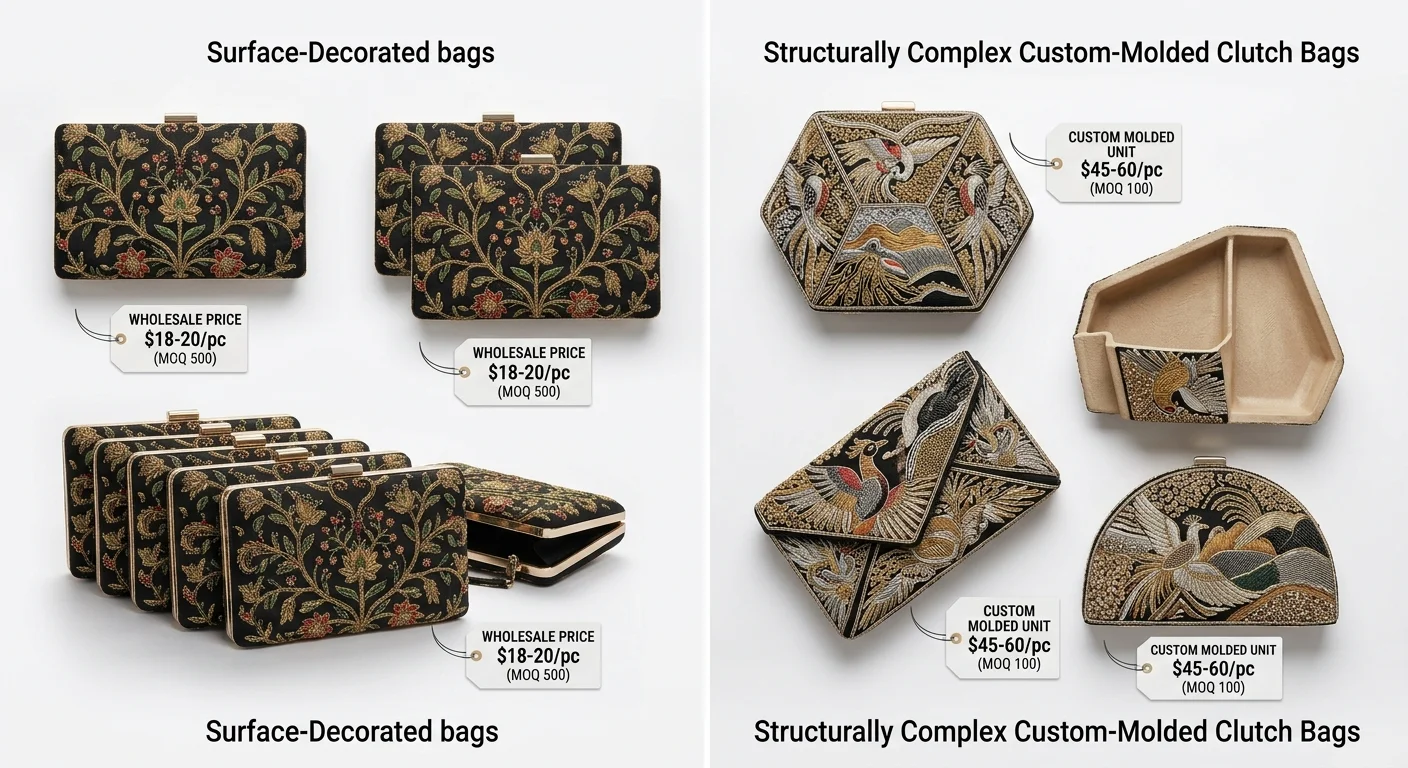
Visual personalization covers logo printing, embroidery, monogramming, and foil stamping. It changes the surface. The bag’s construction stays the same across all units. The base product doesn’t change, so this type of customization adds just 3–8% to your per-unit cost. It’s the budget-friendly default for most wholesale clutch bag orders.
Structural personalization covers unique hardware shapes, custom frame molds, and custom closures. It changes physical components. That means new tooling. Tooling is expensive — custom molds run $500–$3,000+ for clutch bag components alone. That one-time cost spreads across your order volume. At 500 units, a $1,500 mold adds $3.00 per bag. At 100 units, it adds $15.00.
Here’s a clear breakdown by method:
|
Customization Method |
Typical Cost Add-On |
Notes |
|---|---|---|
|
Screen / heat-transfer print |
+$1–$3/unit |
Best for logos, flat graphics |
|
Embroidery |
+$3–$8/unit |
Stitch count drives price; popular for monogram clutch bags |
|
Foil stamping / debossing |
+$2–$5/unit |
Requires a stamping die (~$80–$200 one-time) |
|
Beading / sequin detailing |
+$5–$15/unit |
Labor-intensive; cost scales with coverage area |
|
Custom hardware (frames, clasps) |
+$8–$25/unit + tooling |
Tooling cost spreads over order volume |
The Rule That Saves Your Budget
Keep structural parts identical across all variants. Change the surface, not the shape. This one decision holds your personalization premium under 10% of base unit cost. You still get a fully branded, custom logo clutch bag — without the tooling bill.
Request unique physical shapes per design, and costs climb fast. For embroidered clutch bag orders under 500 units, stick to surface methods. Save structural changes for high-volume runs. That’s where tooling cost spreads thin enough to make sense per unit.
Factor #3: Order Quantity (MOQ) — The Wholesale Discount Math
Order quantity is the single lever that controls how much discount a supplier can afford to give you.
The math is straightforward. Fixed costs — setup, tooling, sampling, overhead — exist no matter how many units you order. Spread those costs across 100 bags, and each unit carries a heavy burden. Spread them across 1,000 bags, and that burden drops to near zero. That’s why bulk clutch bag orders reach pricing levels that small orders can’t touch.
Here’s how wholesale discount depth shifts with volume:
|
Order Quantity |
Typical Wholesale Discount Off Retail |
What It Means |
|---|---|---|
|
50–100 units |
20–30% off retail |
Margin is tight; fixed costs dominate |
|
200–500 units |
35–45% off retail |
Standard wholesale territory |
|
500–1,000 units |
45–55% off retail |
Strong discount, competitive FOB pricing |
|
1,000+ units |
55–60%+ off retail |
Full bulk pricing, best per-unit cost |
Industry-wide, wholesale discounts in the 40–60% off retail range are the norm. Reaching the high end means your order volume has to clear the break-even test first.
The Break-Even MOQ Formula
Suppliers don’t set MOQ at random. The number comes straight from cost structure:
MOQ = (Fixed Costs + Variable Costs) ÷ Profit Per Unit
A concrete example: fixed costs at $1,000, variable costs at $500, profit per unit at $10 — your break-even MOQ lands at 150 units. Below that, every order loses money. No serious manufacturer will discount below it.
The practical rule: every order needs to generate gross profit of at least 4–5× its overhead cost. That’s the threshold where a supplier has real room to move on price.
What This Means for Your Clutch Bag Order
Sourcing personalized wedding clutch bags or placing a custom logo clutch bag order? Start at the 200–500 unit range. That’s the zone where wholesale discount depth becomes meaningful. You’re not overcommitting on inventory, but you’re getting real pricing.
Drop below 100 units and two things happen. Your per-unit cost rises. The supplier’s discount room shrinks to almost nothing. Push above 1,000 units and you reach the deepest pricing tier — but your demand has to support that volume. Jumping from 500 to 5,000 units makes sense only if your sales are close to that ceiling.
One key takeaway: a bulk discount is worth taking only when the larger order size offsets the lower per-unit margin. Don’t chase a better per-piece number if the total inventory risk doesn’t add up.
Factor #4: Size & Design Complexity — The Hidden Price Escalators
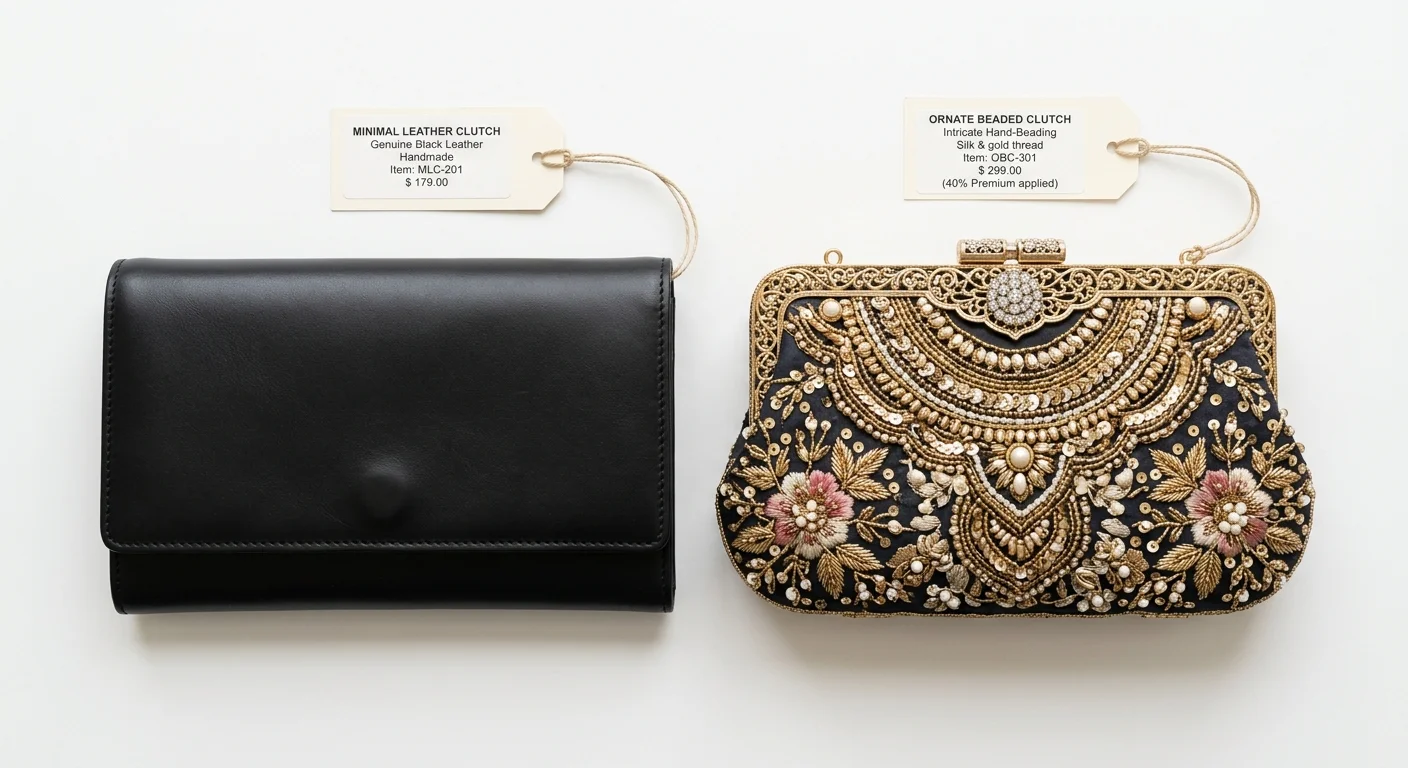
Two bags. Same material. Same customization method. Same order quantity. Different price — sometimes by 40% or more. Size and design complexity are why.
Most buyers never see these costs coming. They don’t show up as a separate line item. Instead, they’re built into production time, material waste, tooling scale, and quality inspection frequency. The more complex or oversized the design, the more each of those variables pushes the price up.
Here’s how size and complexity move your unit price:
|
Design Variable |
Cost Impact |
|---|---|
|
Larger bag dimensions |
More material per unit + heavier tooling |
|
Intricate frame shapes or closures |
Custom mold scale-up; can add 2–3× tooling cost |
|
Multiple interior compartments |
Extra stitching operations, longer cycle time |
|
Tight finishing tolerances |
More QA checks, higher rejection rate |
|
Ornate surface patterns (large coverage area) |
Embroidery or beading cost scales with coverage area |
The Two Rules That Keep Complexity Costs Under Control
Keep decorative elements contained. A monogram on a 3×3 cm area costs far less than an all-over embroidered pattern. Embroidery and beading pricing scales with how much surface area you cover — not just the technique itself.
Standardize structural geometry across SKUs. Each design that needs its own frame shape or closure mold adds to your tooling bill. One shared structural template across all variants cuts that cost out. You pay for the mold once, not multiple times.
Design complexity is the easiest cost factor to miss — and the easiest to fix before you send specs to a supplier. A few decisions at the design stage can save you a significant amount per unit at scale.
Pricing by Buyer Type: Real Budget Scenarios
Same bag. Very different budgets. That’s the reality of custom clutch bag sourcing — the right price depends on who you are as a buyer.
Here’s how three common buyer types approach this:
The Event Planner or Wedding Buyer (50–200 units)
Budget corridor: $15–$35 per unit, total project spend $1,500–$7,000.
This buyer needs a finished, guest-ready product — satin or velvet, monogrammed or foil-stamped, delivered on a fixed event date. Design flexibility is low. Timeline pressure is high. The best fit is a surface-customized bag (embroidery or heat-transfer logo) built on a standard structural template. Structural changes — custom frames, unique closures — push the budget out of reach at this volume.
The Brand or Retail Buyer (200–1,000 units)
Budget corridor: $20–$55 per unit, total project spend $8,000–$40,000.
This is the core wholesale clutch bag buyer. The volume is high enough to bring real per-unit discounts. The margin is wide enough to cover a one-time sampling fee ($150–$300) and basic tooling. At 500 units, a $1,500 mold adds just $3.00 per bag — at that point, structural customization becomes a real option. Payment moves in stages: deposit first, then pre-production approval, then the balance before shipment.
The Private Label or Startup Buyer (100–300 units)
Budget corridor: $18–$45 per unit, total project spend $3,000–$12,000.
First-order costs are tighter here. Fixed costs — sampling, setup, development — spread across fewer units. So your per-piece cost runs higher than a volume buyer at the same spec. The smart move: keep structural components the same across SKUs. Limit revision rounds. Treat sampling cost as an upfront investment that pays off on future reorders.
The universal rule across all three: know your hard budget cap before you ask for quotes. A supplier who knows your ceiling can work within it — swap materials, simplify the closure, adjust the customization method. That’s far more useful than getting a number you can’t act on.
Hidden Costs Most Buyers Overlook
Budget only for unit price and freight? You’re likely underestimating your total landed cost by 18–35%. That gap doesn’t come from one big surprise. It comes from eight or nine small ones that never show up in a supplier quote.
Here’s where the money disappears:
Tooling and sample fees often get invoiced as a separate line item — or folded into your unit price across 3–5 orders without any clear notice. Custom molds can run $1,000–$30,000 as a one-time charge. Each sample revision round adds $50–$300. On top of that, courier fees run $30–$80 per shipment. None of it gets credited toward your order.
Packaging upgrades add another 2–5% of product cost. Most suppliers quote plain bulk cartons by default. Retail boxes, barcodes, and multi-language labeling all cost extra. Custom packaging dies alone run $300–$2,000 per design.
Freight surcharges can push your final logistics bill 30–50% above the quoted rate. Fuel surcharges, peak season fees, and port congestion charges almost never appear in the initial number. So the quote you see is rarely the number you pay.
Third-party inspection runs $250–$350 per man-day in Asia — roughly 2–4% of product cost. Skip it, and the risk is real. Defect-related losses average 5–12% of revenues across the industry.
Payment processing and FX exposure add another 1–3% before a single unit ships.
Here’s a simple working rule: start with the ex-factory unit price, then add 18–35% to get a realistic landed cost. Break that uplift into specific buckets — tooling, samples, compliance, QC, packaging, logistics, financial fees, warranty reserve. Build each one into your model. That’s the budget that holds up.
How to Get an Accurate Custom Clutch Bag Quote (Without Getting Burned)
Most buyers send a vague email — “I need 500 clutch bags, custom logo, what’s the price?” — then wonder why the quote looks nothing like the final invoice. The gap isn’t supplier dishonesty. It’s missing information.
Suppliers quote what you give them. Give them vague specs, and they fill the blanks with guesses — the cheapest materials, the simplest structure, and a logistics term that drops all hidden costs on your side. That’s how an $18 quote becomes a $31 landed cost.
Here’s the exact information that closes that gap:
Bag specs to confirm before quoting:
– Dimensions: length × height × depth in cm (e.g. 25 × 13 × 4 cm). Skip this, and expect ±15–30% variance between quote and final price.
– Material + thickness: specify PU at 0.8–1.2 mm, or canvas at 10 oz — not just “PU leather.” Factories default to the cheapest grade without a clear spec.
– Structure details: number of card slots, interior zip pockets, lining material, closure type, hardware finish. Each extra pocket adds $0.05–$0.20 per unit.
– Branding method + artwork: vector files, Pantone color codes, logo size, and placement. Missing Pantone alone causes ±10–25% print cost variance at finalization.
– Quantity per color: a split of 500 black / 300 champagne / 200 red is not the same cost as 1,000 units in one color. Screen print setup fees run per colorway.
– Incoterms + destination: FOB, EXW, or DDP — plus your destination port. Without this, freight and duty costs stay invisible until your cargo arrives.
Flag any quote right away if it contains:
– Terms like “standard PU,” “standard hardware,” or “standard packing” with no defined specs
– No separation between unit cost, tooling fees, sample charges, and print setup
– No stated Incoterm
Before you commit, run one stress test. Recalculate your margin with freight up 20%. Then recalculate again assuming air freight instead of sea freight. Air freight can triple your logistics cost. Margin goes negative under either scenario? Renegotiate specs or price before signing. That single check has saved more sourcing budgets than any other step in this process.
Request a pre-production sample that matches bulk spec exactly — same material grade, same hardware — before approving mass production. Get lead times in writing: 5–10 working days for samples, 30–45 days for production after approval. Also confirm the defect resolution policy (repair, credit, or remake) tied to a defined AQL threshold before any deposit changes hands.
FAQ: Custom Clutch Bag Pricing Questions Answered
Eight pricing questions come up every time buyers research custom clutch bag costs. Here are direct answers — with real numbers behind each one.
Q: How much does MOQ change my per-unit price?
Moving from 100 to 1,000 units on a basic PU clutch cuts your FOB cost by 10–30%. The tradeoff is real though. Cash exposure rises with every unit you add. More volume means better pricing — and more inventory risk.
Q: How much more does genuine leather cost versus PU?
Genuine leather adds a 30–50% premium over a comparable PU build. Basic PU clutches run $3–$8 FOB. Genuine leather equivalents start at $12–$25 FOB and climb from there.
Q: What’s the split between materials and labor in my unit cost?
Here’s how soft-construction clutch bag costs break down:
– Materials: 30–40% of FOB cost
– Labor: 20–30%
– Hardware: 10–15%
– Factory overhead: 10–15%
Q: How do I calculate a realistic landed cost?
Start with your FOB price. Then stack on each cost layer one by one:
– International freight
– Import duties (US–China soft goods can hit 25%+ in 2026)
– Insurance
– Customs broker fees
– Local trucking
Also spread your tooling and sampling fees across the full order volume. Those costs are easy to miss but they add up fast.
Q: What retail price should I expect from my production cost?
Two solid benchmarks to work from:
– Handmade or small-batch: 2–3× total production cost
– Brand or wholesale model: 4–5× landed cost for MSRP, 2–2.5× for wholesale accounts
So a $25 landed cost should target a $100–$125 retail price under the brand model.
Q: How do I price customization add-ons and stay profitable?
First, isolate the incremental cost — extra materials plus added labor time. Then apply the same markup you use on the base product. Keep customization costs separate. Don’t let them eat into your base margin.