
What’s the Real Difference Between a Custom Clutch Bag and a Wristlet?
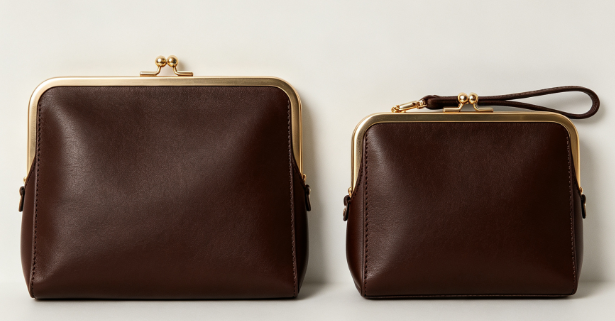
The difference comes down to one structural detail: the wrist strap.
A custom clutch bag has no permanent strap. You hold it in your hand, tuck it under your arm, or carry it with both hands in front — the bag becomes the visual centerpiece. Detachable chains or short loops are fine as add-ons, but the core definition stays the same: no fixed strap.
A wristlet is built around a short loop strap — 16–20 cm in circumference — made to slide over the wrist and hang loose. That strap isn’t decorative. It’s the entire point. Your hands stay free. The bag stays close.
Size, Structure, and What Fits Inside
The size gap is real but modest:
-
Custom clutch bags run 22–28 cm long × 11–14 cm high, with a flat or semi-structured profile. You get one main compartment and minimal internal pockets. It fits a phone, card wallet, keys, and lip gloss — built for a few focused hours, not an all-day haul.
-
Wristlet wallets are more compact: 16–20 cm long × 9–11 cm high. Most include built-in card slots and a zip-top closure. Think of it as a wallet that grew into a bag.
Closure styles also differ. Clutches use magnetic flaps or metal turn-locks — closures that photograph well and push a premium look. Wristlets go with a full-length top zipper: secure, quick, and practical.
What This Means for Your Custom Order
Brief your supplier with precision. Vague terms lead to expensive sample revisions.
|
Spec Point |
Custom Clutch Bag |
Custom Wristlet |
|---|---|---|
|
Strap |
None (detachable chain: optional) |
Fixed or detachable short loop, 0.8–1.5 cm wide |
|
Closure |
Magnetic flap / turn-lock / top zip |
Top zip (standard) |
|
Interior |
1 main compartment + 0–1 slip pocket |
Card slots + 1–2 compartments |
|
Carry style |
Hand-held, arm-tucked |
Wrist-hung, hands-free |
One quick note on terminology: “evening bag” describes an occasion, not a structure. An evening bag with a chain strap is a mini shoulder bag — not a clutch. Use “evening clutch“ to specify a strap-free hand-carry style. Use “zip wristlet with card slots” to cut ambiguity with your OEM clutch bag supplier.
Custom Clutch Bag: Best For Brands That Want Premium, Fashion-Forward Appeal
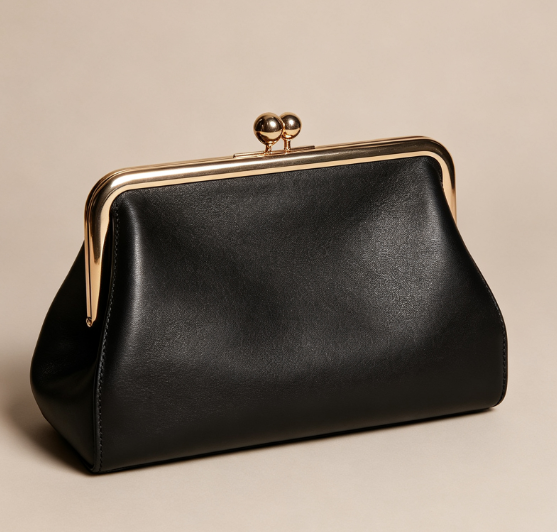
The clutch bag earns its place in premium brand strategy for one simple reason: it stays in the frame.
At a gala dinner, a product launch, or a wedding reception, a clutch sits at eye level. Guests hold it in hand, tuck it under an arm, or place it on a table. That 100–150 cm² of visible surface area lands right in the visual focal zone of every close-up photo taken that evening. For brands that want logo exposure without feeling loud, few accessories match this kind of visibility.
The Scenes Where Clutches Do the Work
Formal events and galas are the clutch’s home territory. About 70–80% of female guests at high-end evening events choose a strap-free or hidden-chain hard-shell clutch. The reason is simple: it complements formal silhouettes without competing with them. Black, gold, and silver are the most versatile color choices. They pair well with over 80% of standard eveningwear palettes.
Weddings are another high-volume opportunity. A single wedding event can generate 20–100 custom pieces — bridesmaids’ sets, VIP guest gifts, or bridal accessories. Soft satin and champagne gold finishes dominate this space. A foil-stamped wedding date or monogram adds a personal touch that guests hold onto long after the event. Photographers notice it too. Matching clutches in a bridal party create a unified visual identity across every shot. That’s the kind of content wedding planners use to build their portfolios.
Holiday gift sets and brand gifting programs are where clutches outperform traditional corporate gifts. The US$80–150 per-unit budget is standard for mid-to-high-end corporate gifting. A custom clutch fits right in that price range. Better still, it functions as the gift box itself. Load it with a lip product, a fragrance sample, and a brand story card. You’ve just extended the brand touchpoint from a few weeks to well over a year of active use.
Customization That Signals Quality
The craftsmanship choices you make at the specification stage separate a forgettable promotional item from a branded accessory people carry for real.
Blind embossing (0.3–0.8 mm depth, logo width 2–4 cm) creates a subtle shadow effect under light. This gives you the “visible but not shouting” look that minimalist and high-fashion brands prefer. Tooling costs run US$50–150 per design. Per-unit embossing costs drop to around US$0.30–1.00 at 100–500 pieces.
Foil stamping in gold, rose gold, or silver works very well in event settings. Under venue lighting or camera flash, a foiled logo catches light and becomes a natural focal point in photos — no oversized branding needed. Keep the stamped area under 10–15 cm². That’s what makes it read as premium rather than promotional.
Hardware selection carries more weight than most buyers expect. Metal frames, turn-locks, and chain details make up 20–40% of material costs on a structured clutch. They’re also the first thing a recipient notices. Gold hardware against a black or deep jewel-toned body, silver against white or ivory — the contrast ratio matters more than you’d think.
Which Brands Should Lead With Clutches
-
Fashion labels and independent designers: clutches pull double duty as runway accessories and limited-edition retail pieces. A signature clutch in 1–3 seasonal colorways builds a strong brand visual — no full accessories line required.
-
Wedding planners and bridal brands: per-event volume stays manageable at 20–100 units, customization is straightforward, and the photography ROI is high.
-
Corporate gifting and VIP programs: for female-skewing client lists, a custom clutch replaces the standard scarf or leather card holder with something that gets real use — in both professional and social settings.
-
Collab and limited-edition campaigns: beauty × fashion partnerships or holiday drops with 500–5,000 unit runs get a natural scarcity signal from the clutch format. A numbered limited-edition clutch sparks conversation in ways a tote bag just doesn’t.
Quick spec guide by use case:
– Evening/red carpet → high-gloss finish + metal hardware + foil-stamped logo
– Wedding/romantic → satin or soft sheen + pastel palette + beading or fine metalwork
– Corporate gifting → matte leather or PU + subtle blind emboss + brand color lining
– Collab/limited edition → bold color + foil stamp + co-branded interior lining
Custom Wristlet: Best For Brands That Want Everyday Usability and Promotional Reach
One wristlet, used three times a week, builds up to 150 brand impressions per user per year. Push that across 1,000 units — you’ve got 150,000 natural, offline touchpoints. Zero ad spend.
That’s the real reason to choose a wristlet wallet custom for your brand. It’s not a keepsake. It’s a working accessory. It goes where your customer goes — commutes, check-in counters, concert gates.
Where Wristlets Get Used
The use case shapes everything — structure, material, and print placement all follow from it.
Daily commuting and errands are the wristlet’s home ground. A compact 15–20 cm body with 2–4 card slots, a clear transit card window, and a main zip compartment covers what a commuter needs. No bag required. That’s exactly why it gets pulled out daily instead of sitting in a drawer.
Travel and hotel stays are a strong fit for hospitality brands. One wristlet holds a room key, boarding pass, and payment card in a single secure loop. Industry data shows 60–70% of hotel guests use a branded welcome gift at least once during their stay. A well-designed wristlet also travels home with them — brand exposure continues long after checkout.
Events and festivals add another layer. Attendees wear wristlets for 4–8 hours straight. A reusable wristlet outlasts the event by months. Compare that to single-use paper wristbands — reusable wearables deliver 3–5× more total brand exposure time. That’s a solid return on a low per-unit cost.
Trade shows and corporate gifting round out the picture. Pair a wristlet with a brochure and pen — the full set lands within a $3–5 per set budget (wristlet component: $1–2 at 500–2,000 unit volumes). Practical small items like this hold a 6-month retention rate of 40–60%. Printed materials alone? That number drops to 10–20%.
Customization That Works At This Price Point
The wristlet wallet custom format gives you more branding surface than the unit cost suggests.
-
Wrist strap exterior: 1.5–2 cm wide × 15–20 cm long — enough room for a continuous logo repeat or brand slogan
-
Main body (front + back): ~8–10 cm × 5–7 cm per face — total printable area hits 40–80 cm², several times larger than a standard silicone wristband
-
Zipper pull and hardware: laser-etched mini-logo adds a brand touchpoint with no meaningful cost increase
Choosing a print method is simple:
– Screen printing for single or dual-color logos: adds just $0.10–0.20 per unit at 500+ pieces
– Heat transfer or digital print for full-color or complex graphics: adds $0.20–0.50 per unit based on coverage
You have a logo, a brand color, and a tagline — this surface area covers all of it. Add a QR code linked to a campaign page or social handle, and each unit becomes an offline-to-online bridge.
Which Brands Should Lead With Wristlets
-
Corporate gifting teams (HR, marketing, admin): wristlets fit the $1–3/unit budget and deliver the “high-frequency use” that most branded giveaways miss entirely
-
Hotels and travel brands: use as a room-key holder or welcome gift — useful on day one, kept long after checkout
-
E-commerce and DTC brands (fashion, beauty, fitness): offer as an order threshold gift or member exclusive; industry benchmarks show high-perceived-value free gifts can lift repeat purchase rates by 5–15%
-
Event organizers and music festivals: swap out disposable entry wristbands for something attendees hold onto
Quick spec guide by use case:
– Corporate gifting → PU or nylon body + screen-printed logo + card slots
– Hotel/travel → water-resistant material + brand color strap + room-key window
– Trade show → large-face digital print + QR code + low MOQ at 500 pieces
– E-commerce gift → full-color design + brand-matched lining + social handle on strap
Side-by-Side Comparison: Clutch Bag vs. Wristlet Across 6 Key Factors
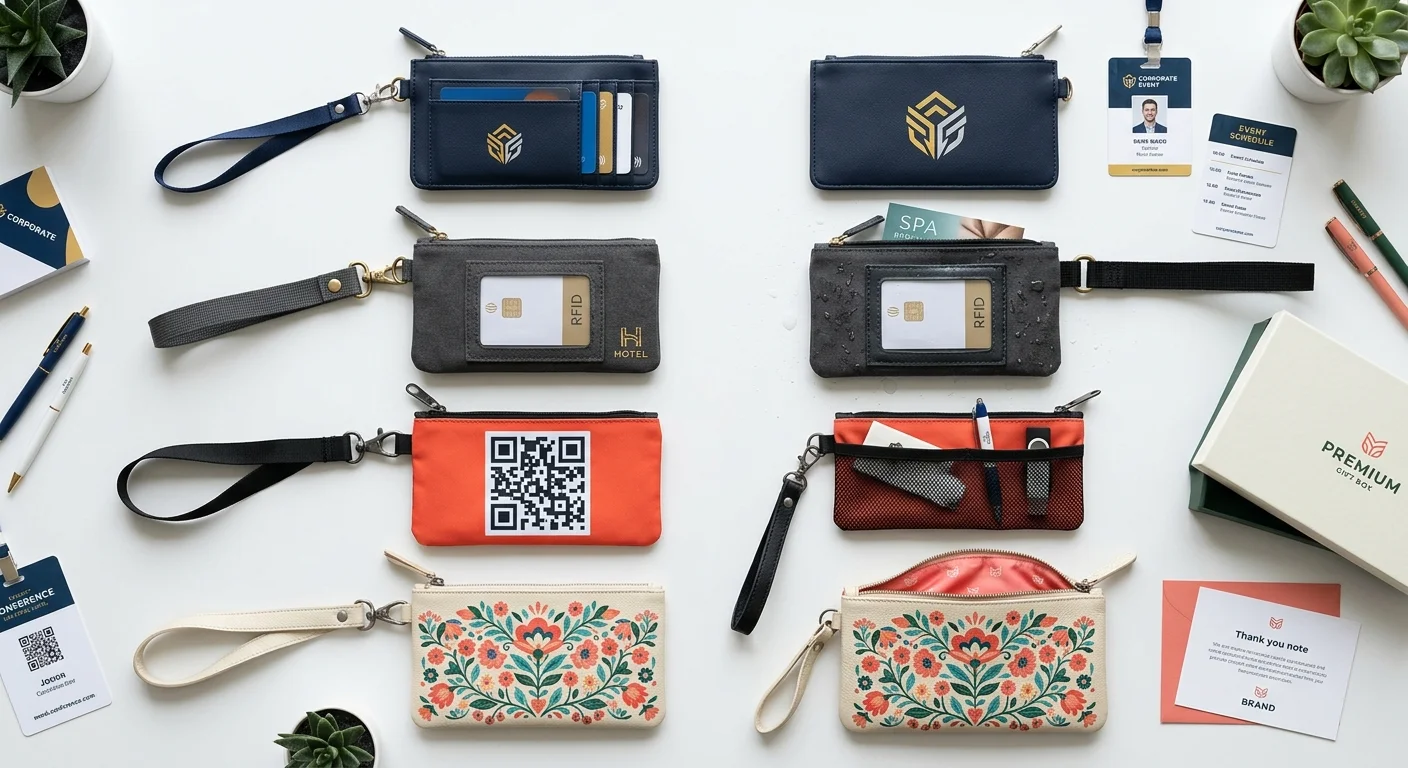
Six factors separate these two formats. Each one changes which product fits your brand strategy.
|
Factor |
Custom Clutch Bag |
Custom Wristlet |
|---|---|---|
|
Carry style |
Hand-held or arm-tucked; no fixed strap |
Short loop strap; hangs from wrist |
|
Hands-free rating |
~0% — one hand always occupied |
~100% — wrist bears the weight |
|
Security level |
Low — easy to misplace on tables or seats |
High — stays attached to the wearer |
|
Capacity |
Moderate–high (8″ × 5″); fits phone, wallet, keys, cosmetic |
Low–moderate (7″ × 4″); fits cards, cash, keys, smaller phones |
|
Style register |
High-formal — galas, weddings, red carpet |
Medium — casual to semi-formal, everyday carry |
|
Brand customization fit |
Large flat surface; suits oversized metal logos, full-face prints |
Smaller body; suits embossed logos, woven labels, partial embroidery |
The Two Hidden Differences That Don’t Show Up in Spec Sheets
1. Social media visibility — clutch wins on single-shot impact
A clutch held at hand level sits in the foreground of every event photo. Its structured body doesn’t fold or crease under venue lighting. That flat front face gives you 40 square inches of printable surface — 25–35% larger than a wristlet’s equivalent area. For limited-edition drops or collab campaigns where a single hero image does the selling, that visual real estate matters.
Wristlets tell a different story. The short strap keeps them close to the wrist. In group shots, sleeves, bags, or body angles cover them up. Logo exposure in event photography runs noticeably lower than a hand-carried clutch.
2. Everyday wear frequency — wristlet wins on cumulative reach
Clutches are occasion accessories. Most consumers reach for one a handful of times per year — formal dinners, weddings, special events. Between uses, it sits in a drawer.
A wristlet goes out multiple times a week. Coffee run, grocery store, transit gate — it moves with the user through every routine errand. That loop strap swings at the wrist during every card swipe and phone check. The logo is small, but the same people see it again and again over months of use. That kind of repeat exposure adds up.
Material and Cost Reality for B2B Buyers
Structure drives cost — not size.
Custom clutch bags use rigid PU shell, satin, or formed leather with metal turn-locks and decorative hardware. Hardware and surface finishing alone can account for 20–40% of unit cost. FOB pricing on standard PU/satin hard-shell clutches runs US$4–10. Premium leather and heavy decoration push well above that.
Custom wristlets use flexible PU, canvas, or vegan leather. They’re lighter, with simpler zip hardware and card-slot stitching. FOB pricing lands at US$2–6 for standard configurations. At the luxury retail end, a wristlet’s added internal structure — card slots, layered compartments — can price it 15–25% higher than a similar-sized clutch from the same brand. The Saint Laurent reference point makes this clear.
Bottom line for sourcing decisions:
-
Your priority is single-event visual impact and premium gifting? The clutch delivers more per occasion.
-
Your priority is sustained brand exposure across everyday use? The wristlet builds value over time.
Neither option is the clear winner. The right choice comes down to where and how often your customer encounters your brand.
MOQ, Cost & Lead Time: What to Expect When You Order Custom
Budget surprises kill good sourcing decisions. Get the numbers straight before you brief a factory. Here’s the real picture for custom clutch bags and wristlets.
MOQ: Wristlets Start Lower
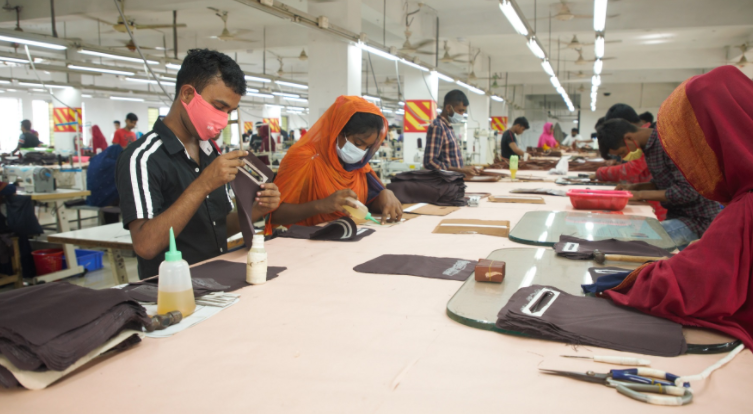
Wristlets have a simpler build — fewer components, lighter hardware. That keeps entry MOQs low:
– PU or canvas body with screen-printed logo: 50–100 pcs
– Standard designs using stock materials: 50–100 pcs per style/color
Clutch bags involve more hardware and structural steps. That pushes minimums higher:
– Standard PU clutch with existing molds: 100–200 pcs
– Genuine leather or complex hardware styles: 100–300 pcs
– Custom patterns with new molds: 150–300 pcs+
One detail matters a lot: confirm whether MOQ applies per style, per color, or per material. Custom hardware — a unique clasp or metal logo plate — often has its own MOQ of 500–1,000 pcs. That can push your overall bag MOQ up, even if the sewing minimum stays low.
What Drives Per-Unit Cost
Five variables move the price:
-
Material: PU entry runs 50–100 pcs at the lowest unit cost. Genuine leather adds 30–100% per unit at 100–300 pc MOQs. Specialty vegan leather sits 20–50% above PU.
-
Branding method: Screen printing adds $0.10–0.20/pc at 500+ pcs. Embroidery costs more but reads as premium — it’s efficient at ≥100 pcs. Deboss or metal logo tooling costs $500–2,000 as a one-time fee, then $0.20–0.80/pc to run.
-
Hardware: Stock zippers and clasps add $0.50–2.00/bag. Custom metal hardware brings extra tooling costs on top of that.
-
Interior construction: Card slots, zip pockets, and full lining add 10–30% to unit cost. A plain unlined pouch costs less.
-
Packaging: Polybag runs under $0.20/pc. Branded rigid boxes add $1–4/pc.
Volume discounts are real. Moving from 100 to 300+ pcs cuts unit cost by 10–20%. At 1,000+ pcs, you’re looking at 20–30% savings compared to small runs.
Lead Time: Plan Further Ahead Than You Think
|
Order Type |
Sample |
Bulk Production |
Total Timeline |
|---|---|---|---|
|
Simple wristlet (stock materials, standard print) |
7–14 days |
25–35 days |
~5–8 weeks |
|
Standard clutch (existing molds, PU/satin) |
7–14 days |
25–40 days |
~6–9 weeks |
|
Full custom (new patterns, custom hardware) |
2–4 weeks |
30–60 days |
60–120 days |
For projects with new metal hardware, specialty leather, or original patterns, plan for 60–120 days from finalized tech pack to shipment. Add 7–10 days for cross-border freight. Stack on a 3–5 day buffer for QC revisions.
Before you send any RFQ: lock in your target quantity band (50–100 / 100–300 / 300+ pcs), pick your material tier, and decide your logo method. These three decisions control which factories quote you, what pricing tier you get, and whether your timeline actually works.
Which Custom Bag Is Right for Your Brand? A Decision Guide by Brand Type
Brand type determines everything. Your logo hits differently on a structured satin clutch at a gala versus a nylon wristlet at a trade show — and your customers notice every bit of that difference.
Here’s how different brand categories map to each format.
Fashion Labels and Luxury Brands → Custom Clutch Bag
Clutches are “styling-first” accessories. Social media exposure, KOL partnerships, and red-carpet moments drive revenue for fashion brands. The clutch delivers on all three. Its clean silhouette puts premium materials, refined hardware, and craftsmanship front and center. That’s what luxury and high-fashion positioning needs. At galas and evening events, formal clutch styles make up 70–80% of accessory choices among female guests. Your product ends up in the majority of photos taken that night.
For high-end wedding and luxury gifting brands, the clutch signals scarcity and ceremony. Rigid structures, multi-layer material combinations, and hand-stitched edges justify a 15–30% price premium over comparable wristlets. Your VIP recipients feel that difference the moment they hold it.
Corporate Gifting and Promotional Campaigns → Custom Wristlet
Three things matter here: volume, visibility, and frequent daily use. All three point to the wristlet. Its front face holds 80–110 cm² of continuous print area. A hard-shell clutch tops out at 50–70 cm² — it can’t match that. At $1–2 per unit for standard PU or canvas builds at 500–2,000 pieces, it fits inside most corporate gifting budgets with room to spare.
The wristlet strap adds a real functional edge too. Hands stay free during meetings, conferences, and busy trade show floors. That usability is why recipients keep it — and keep reaching for it.
Event Planners, Hotels, and Travel Brands → Custom Wristlet
Room key, boarding pass, transit card, small cash. The wristlet handles all four in one compact loop. Hospitality data shows 60–70% of hotel guests use a functional branded welcome gift during their stay. A well-structured wristlet with a clear card window and 2–3 internal compartments solves a real problem guests run into at check-in. That practical value keeps the bag in use long after the event ends.
For festival and conference organizers, compare it to single-use paper wristbands. Reusable branded wristlets deliver 3–5× more total brand exposure time — at a fraction of the cost difference per unit.
Not Sure Yet? Use This Quick Decision Checklist
Answer each question. Count your responses. The pattern points you to the right format.
|
Question |
Clutch |
Wristlet |
|---|---|---|
|
Primary use: formal events (galas, weddings, VIP dinners)? |
✓ |
|
|
Need large-area logo printing for high visibility? |
✓ |
|
|
Users need hands-free carry during the event? |
✓ |
|
|
Priority is perceived gift value over usage frequency? |
✓ |
|
|
Need internal card/key/cash compartments? |
✓ |
|
|
Want repeat daily use, not just occasional occasions? |
✓ |
Left column wins → Lead with a custom clutch bag. Your brand lives in occasion-driven, high-ceremony settings where visual prestige carries the most weight.
Right column wins → Lead with a custom wristlet. Your brand needs practical reach and steady logo exposure across real, everyday moments.
Running Both? Here’s How to Differentiate Them
Some brands carry both a premium gifting line and an everyday membership program. Ordering both formats makes strong sense for them. The key is keeping the two products separate in positioning — not just in SKU.
-
Clutch (flagship/ceremonial line): Genuine leather or multi-layer material, metal turn-lock, stitch density at 6–7 stitches/cm. Keep branding subtle — an interior deboss or small metal logo plate at 1–2 cm works well. Target cost: $30–60/unit. Lead time: 12–14 weeks. Pack in rigid gift boxes with satin lining.
-
Wristlet (everyday/membership line): Durable synthetic leather or nylon, full-face screen print at 8–11 cm wide for strong brand visibility, detachable strap for flexible event use. Target cost: $10–25/unit. Lead time: 3–5 weeks. Pack in lightweight drawstring pouches for bulk distribution.
Two products, two stories, one brand. The clutch ties your name to a milestone moment. The wristlet keeps your brand in hand through every ordinary Tuesday.
How to Brief Your Custom Bag Manufacturer: Questions to Ask Before You Order
Vague briefs cost money. A missing spec on your first RFQ leads to extra sample rounds, delayed timelines, and unit prices that blow your budget. Lock down these details before you contact any OEM clutch bag supplier or custom logo bag manufacturer.
Core specs to confirm upfront:
-
Dimensions: External and internal measurements (L × H × W in cm or mm), plus tolerance — e.g., bag height 120 mm ±5 mm
-
Material: Fabric type, weight (GSM), and grade — e.g., 600D polyester or specified PU tier
-
Logo method and placement: Screen print, emboss, embroidery, or metal plate — include max print area and Pantone color codes
-
Hardware: Zipper brand (YKK or SBS), plating color, and pull-test requirements (e.g., clasp load ≥15 kg)
-
Lining: Fabric type and GSM — e.g., 190T polyester at 80 gsm
-
Packaging: Polybag dimensions, carton count, and outer box labeling format
Questions that filter serious suppliers from the rest:
-
Do you provide Proto, Sales, and PP samples — and how many revision rounds are included?
-
Can you share factory audit reports (ISO 9001, BSCI) and material compliance certificates (REACH, CA Prop 65)?
-
What’s your AQL inspection standard for final production?
-
What’s your capacity for this bag type each month? Which markets do you export to most?
On cost and timeline — get this in writing:
Your quote should list sample fees, tooling costs, per-color MOQs, and trade terms (FOB/EXW) before you issue a PO. For wholesale clutch bags or branded wristlet wholesale orders, ask suppliers to break down cost components one by one — material, hardware, labor, and packaging as separate line items. That breakdown shows you straight away whether you’re dealing with a professional operation or not.
Ready to move forward? Submit your spec draft and get an initial quote plus a sampling recommendation within 48 hours.