You found the leather backpack you love — the rich texture, the timeless look, the kind of bag that turns heads. Then halfway through a long commute or a tough hike, it hits you: a damp, clingy feeling spreading across your back.
Breathability is one of the most overlooked factors in leather backpack manufacturing. Yet it decides whether your product is truly wearable — or just good-looking on a shelf. For brands, this directly impacts end-user comfort, product performance, and ultimately customer retention.
The type of leather matters. So does how the back panel is built. Even the stitching on your shoulder straps affects airflow, comfort, and how the body holds up under load — all critical considerations in OEM leather backpack development and custom backpack production.
This guide breaks down what drives breathability from a product design and material selection perspective. You’ll learn how to evaluate and source a leather backpack that not only looks great, but also aligns with functional design standards, ergonomic requirements, and real-world usage — helping your brand deliver products that work with the user, not against them.
Why Leather Backpacks Have a Breathability Problem
Leather is dense. That’s the core of the problem — and also part of what makes it worth understanding.
Even full-grain leather has limits. It keeps the hide’s natural pore structure, so some moisture and air can pass through. But leather panels are thick. Press one flat against your back under a full load, and airflow drops fast. Heat builds. Sweat has nowhere to go.
Synthetic and bonded leather make things worse. These materials have no pore structure at all. Air and moisture can’t pass through in either direction. They get trapped between the panel and your back. That creates the exact conditions for odor, bacterial growth, and long-term material breakdown.
Picture a waterproof layer sitting directly against your skin. Research on similar non-breathable surfaces shows trapped humidity can climb from around 55% to 90% during sustained wear. Temperature rises too — not by much, but enough to make a two-hour carry feel genuinely uncomfortable.
So Why Does It Still Matter?
From my perspective, breathability in a leather backpack has never been a lost cause. It’s not a limitation of leather itself — it’s a question of how the product is designed and executed.
I’ve seen that full-grain leather can perform surprisingly well when it’s paired with the right structure. Once you add air mesh back panels and breathable foam-padded straps, the difference becomes obvious. Heat and moisture are managed much better than most people expect.
To me, the leather is only one part of the equation. What really makes the difference is how everything is put together around it. That’s exactly where custom leather backpack manufacturing comes in — turning a good-looking material into a product that people actually want to use every day, not just admire.
How Leather Type Influences Airflow
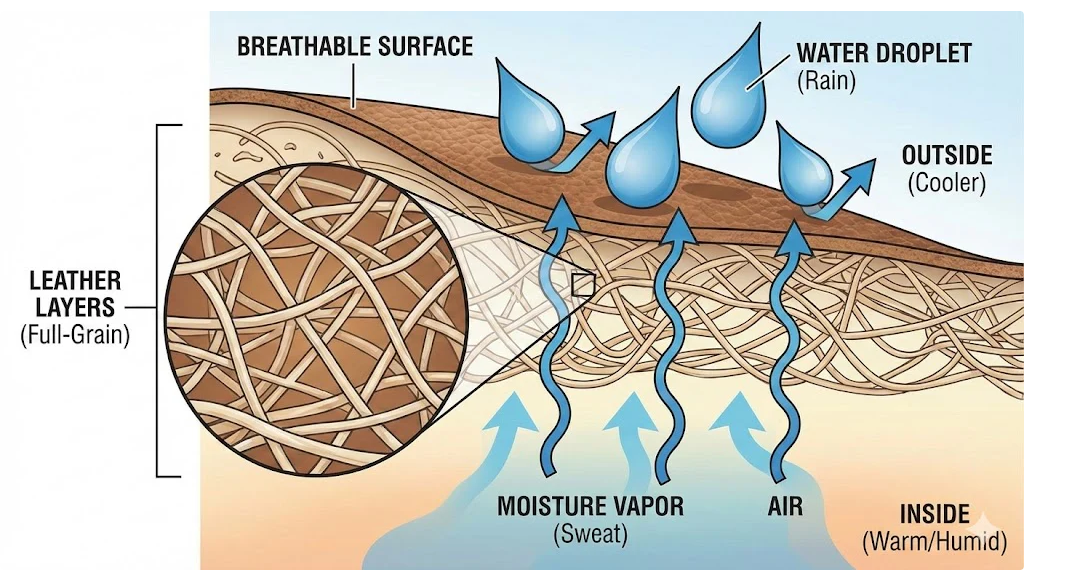
Not all leather breathes the same — and the difference is significant. The hide type, tanning method, and post-treatment each control how much air and moisture can move through the material while you carry the bag.
Full-Grain vs. Top-Grain: The Pore Structure Gap
Full-grain leather keeps 100% of its natural pore structure intact. Those tiny openings let water vapor pass outward. At the same time, the hide’s density blocks liquid water from pushing through. The result: maximum airflow at skin level with no loss of water resistance.
Top-grain leather gets sanded during production to remove surface flaws. That sanding closes pores. You end up with about 70–80% of the original pore openness — an estimated 20–30% reduction in airflow compared to full-grain. It still breathes, but far less.
How Tanning Method Changes Things
The tanning process matters just as much as the hide grade.
-
Chrome-tanned leather delivers high water vapor permeability — well above synthetic materials like nylon canvas (thermo-physiological index 33.33 vs. 8.15 in hot climates). It holds that breathability long-term with no surface coatings needed.
-
Vegetable-tanned leather starts with higher natural porosity. Over time, fiber tightening cuts breathability by about 10–15%. Left untreated, it still holds over 80% of its initial airflow even after extended use.
-
DriTan leather takes a different approach — it controls pore retention during the tanning process itself. It reaches up to 1,300 minutes of water resistance in immersion tests while keeping vapor flow intact. Airflow beats standard chrome-tanned leather through density control, not surface sealing.
What Happens After Tanning: Treatments and Coatings
This is where many leather backpacks lose their breathability — not at the factory, but after purchase.
|
Treatment |
Airflow Impact |
Reversible? |
|---|---|---|
|
Conditioning |
5–10% temporary pore clogging; recovers 90% after 24 hours drying |
Yes |
|
Waxing |
20–40% permanent reduction; seals fiber pathways |
No |
|
Waterproof coating |
50–70% airflow drop; seals pores shut |
No |
Waxing and waterproof coatings do the most damage. They look like upgrades — extra protection, shinier finish — but they permanently block the pore structure that gave the leather its breathability. A conditioner is the one treatment you can reverse.
The takeaway: breathability matters? Go with full-grain or chrome-tanned leather in its natural state. High-density full-grain leather also holds its shape under pressure — it retains over 70% of its initial breathability after 1,000+ stress cycles. Long-term use won’t chip away at the airflow you started with.
The Role of Back Panel and Shoulder Strap Design in Leather Backpack Breathability
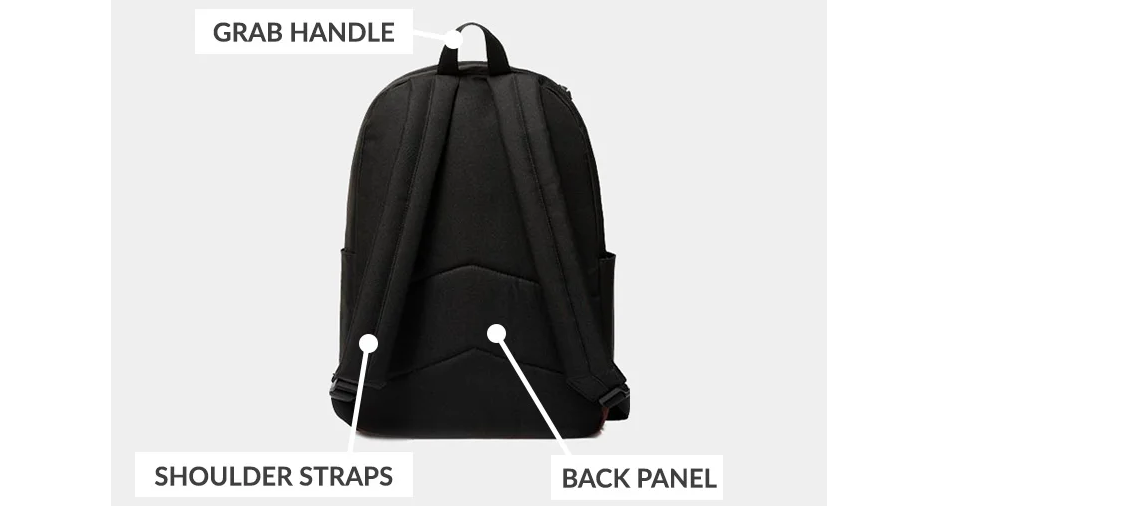
Leather alone can’t solve the breathability problem. The real work comes from how the bag is built to sit against your body.
Back panel and shoulder strap construction separate a leather backpack you can wear all day from one that soaks through your shirt by noon. Even a full-grain leather bag handles warm conditions well — as long as the structural design manages heat and airflow at the contact points.
Back Panel Design: How Air Gets Moving
The panel between the leather and your spine is where most breathability engineering happens.
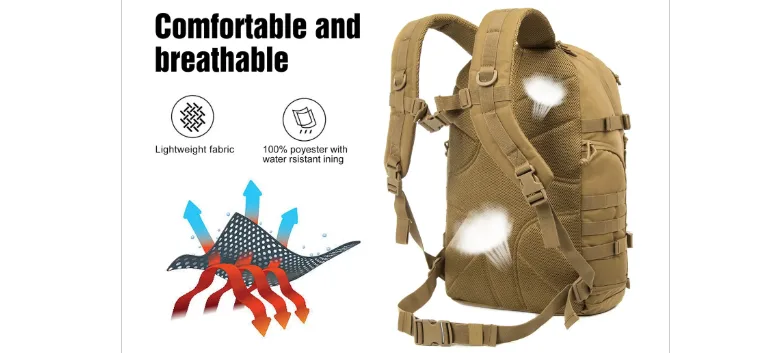
3D spacer mesh panels use vertical monofilament yarns to build an internal air pocket structure. They hold a 20–40 mm gap between your back and the leather shell. That gap gives air room to circulate. The results are measurable: Hohenstein Institute testing shows ventilated systems cut perspiration by up to 25% compared to standard packs during movement. In factory trials, a ventilated back panel stayed dry after 30 minutes of loaded walking. A standard panel was wet.
Other panel formats also do useful work:
-
Perforated EVA foam with vertical grooves pushes heat upward and out, giving you solid cushioning with moderate airflow
-
Contoured molded foam with 3D ridges channels hot air out to the sides — a stretch air-mesh cover boosts this further
-
Suspended (trampoline) panels hold that 20–40 mm gap even under 10–20 kg loads, moving air across three sides at once
Shoulder Straps: The Overlooked Airflow Point
Straps create their own heat zone. Narrow, flat straps press leather — or dense foam — straight against your shoulders. Heat gets trapped with nowhere to go.
Well-designed straps put 3D spacer mesh or open-weave polyester on the underside. That breaks direct skin-to-fabric contact and keeps air moving. Ergonomic contouring also takes pressure off contact points, which cuts localized heat buildup during long carries. In real use, ventilated straps dry in 5–15 minutes after sweating. Leather straps without mesh backing can take hours.
Suspended back panels and breathable straps working together under load reduce the heat and humidity that builds against your back. That heat trap is the core discomfort problem with leather backpacks — and good structure addresses it.
Matching Design to Use Case
|
Use Level |
Back Panel |
Strap Design |
|---|---|---|
|
Light daily carry |
Simple channels + 3D mesh |
3D mesh straps |
|
Moderate (hiking) |
Suspended panel + wide channels |
Wide mesh-backed straps |
|
Heavy / high-intensity |
Tensioned frame + spine cutouts |
Full mesh straps |
The right combination won’t make a leather backpack feel like an ultralight mesh pack. But it closes the gap — bringing sweat reduction, drying time, and comfort much closer to synthetic benchmarks without giving up what makes leather worth carrying in the first place.
How Breathability Affects Physical Performance and Load-Bearing Capacity
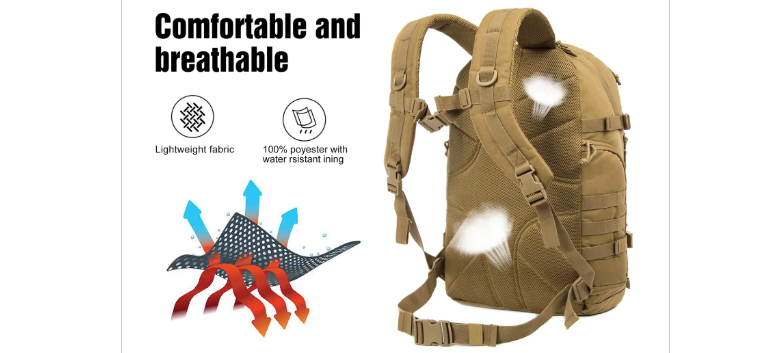
Comfort is one thing. What breathability does to your physical output is a different matter.
A trapped back panel heats up fast. Your core temperature climbs. At VO2 levels above 50 ml/kg/min — the effort level of a loaded pack on a long commute or hike — core temp rises 2°C even in mild conditions (24°C, 17% humidity). That heat doesn’t just make you uncomfortable. It starts a cycle. You shift the pack. You adjust your posture. The load spreads unevenly. Each adjustment hits different muscle groups. Over time, that broken load distribution burns you out faster than the weight alone ever would.
How Much Weight You’re Carrying Changes Everything
Breathability matters more as load increases. The relationship isn’t linear — it has thresholds.
|
Pack Type |
Weight Range |
Breathability Impact |
|---|---|---|
|
Day pack |
Under 10 kg |
Negligible — low metabolic heat output |
|
Travel pack |
10–20 kg |
Critical — moderate overheating risk |
|
Work/field pack |
Over 20 kg |
Essential — sustained high VO2, frequent adjustments |
Under 10 kg, your body produces manageable heat. Poor ventilation is annoying, not damaging. Cross into the 10–20 kg range and overheating risk becomes real. Above 20 kg, sustained hard effort means a non-breathable back panel works against your endurance and load capacity. Full stop.
The Energy Cost Nobody Talks About
Research on breathable vs. non-breathable materials in athletic use points to something clear: better breathability frees up energy. Wool studies found athletes cut energy spent on thermal self-regulation by over 50% compared to less breathable fibers — measured across 30 minutes of activity followed by 30 minutes of rest. That freed energy went straight toward performance and sustained load carriage.
The same principle applies to leather backpack design. A bag that controls heat at contact points — through ventilated back panels and breathable straps — cuts the thermal work your body has to do. Less energy spent fighting heat means more left for distance, pace, and carrying capacity.
Breathability vs. Durability vs. Style: Finding the Right Balance in Leather Backpacks
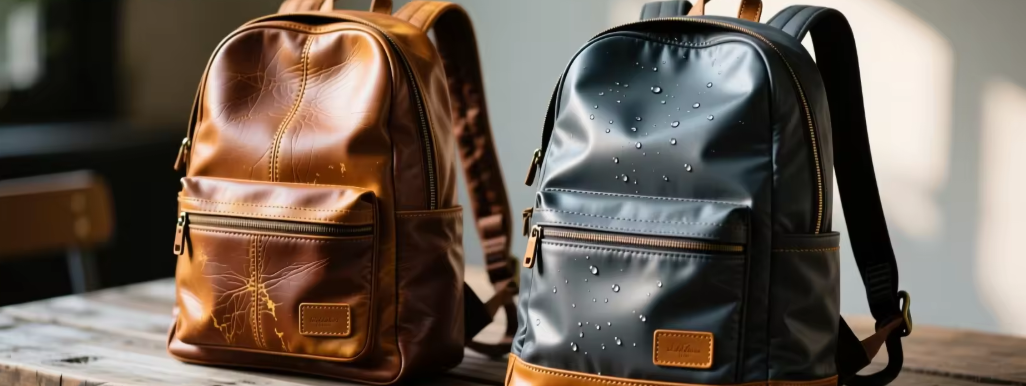
Most custom leather backpack decisions come down to three competing priorities. Get the balance wrong, and you pay for it in one direction or another.
The good news: leather handles this tension better than any synthetic material. Full-grain leather is both breathable and weather-resistant. It lets moisture vapor pass outward, yet stays dense enough to block liquid water. So you don’t have to trade airflow for protection. Hiking packs use aggressive mesh ventilation channels — but those break up the clean lines most leather buyers want. Full-grain leather gives you airflow without ruining the look.
Durability follows the same logic. Full-grain leather keeps 85% of its original strength after 10 years. With regular care, it can last 15–20+ years. Condition it every 3–6 months, and you add another 30% to that lifespan. Keep it out of direct sun — UV exposure alone strips 20% of tensile strength within six months.
Match your priorities to your use case:
|
Use Case |
Breathability |
Durability Focus |
Style |
|---|---|---|---|
|
Office carry |
Low — inherent leather is enough |
High — full-grain, 2mm+ thick |
High |
|
Weekend travel |
Medium — light rain resistance |
High — waxed finish, padded compartments |
Medium-High |
|
Active commute |
High — sweat and rain exposure |
Medium-High — water-resistant oils |
Medium |
Patina ties all three together over time. It strengthens the surface, resists scratches, and deepens the look. You get better durability and better style in one process — and breathability stays untouched throughout.
Conclusion
Breathability in a custom leather backpack isn’t a luxury feature. It’s the difference between a bag that works with you and one that fights you by midday.
The right leather type, a well-designed back panel, and airflow-friendly shoulder straps change how your body handles heat, fatigue, and load across hours of real use. These aren’t small details. They’re the design choices that separate a backpack you put up with from one you actually reach for every day.
You know what to look for now — so don’t settle for looks alone. Before buying your next leather backpack, run through the checklist: grain type, airflow channels, mesh integration, and strap padding. Your back will feel the difference. So will your performance.
The best leather backpack isn’t just the one that looks good walking in. It’s the one that still feels good walking out.