
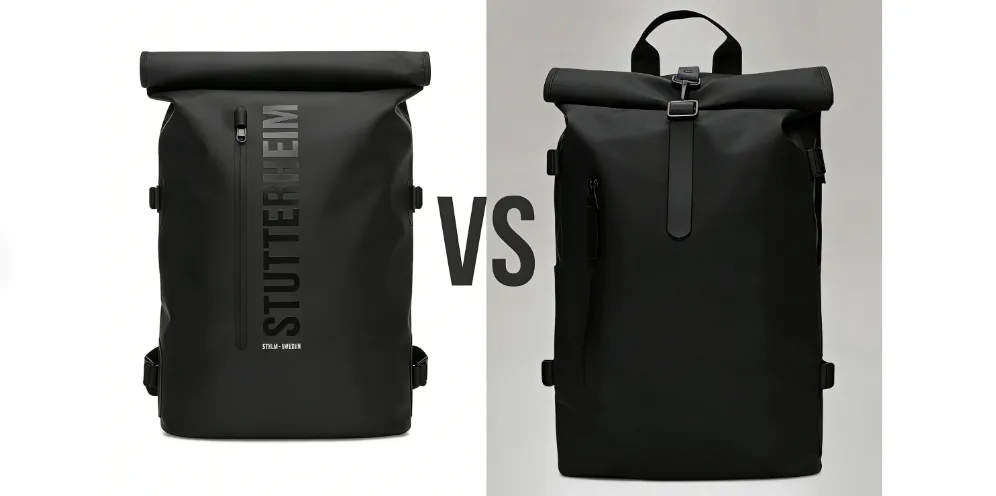
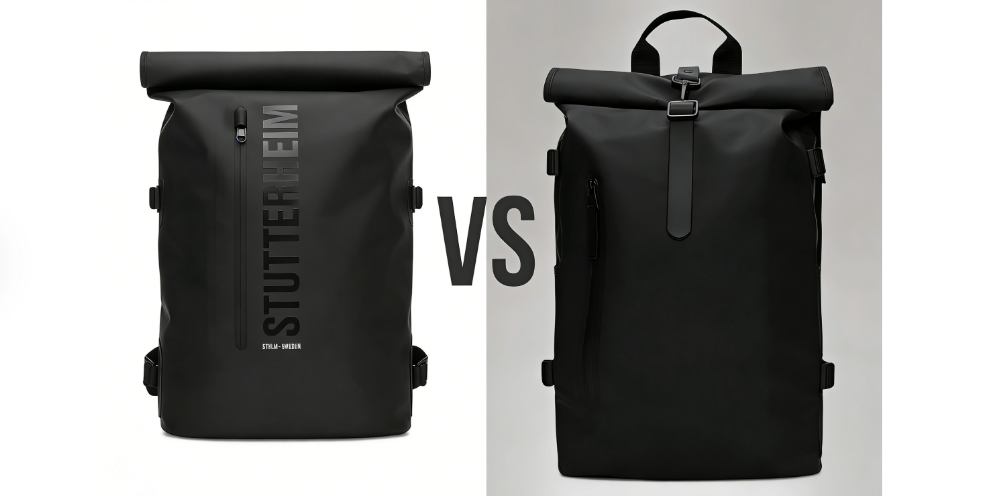
You’re paying over $200 for a Scandinavian waterproof backpack. But what are you really buying beyond the clean design both brands share?
Rains backpack and Stutterheim look similar on the surface, yet their construction choices are fundamentally different. Rains relies on PU-coated polyester. Stutterheim uses TPU-laminated fabric. That single decision can mean the difference between a bag that looks good for a few rainy seasons and one that survives a decade of daily commuting.
Most reviews stop at aesthetics. We don’t. At Sunteambag, we manufacture waterproof bags ourselves, and we know that welding methods, fabric sourcing, and quality control determine long-term performance far more than branding.
So which construction actually fits how you use your bag? Which material ages better, resists cracking, and holds waterproof integrity over time?
This breakdown compares the two approaches through fabric structure, seam construction, water resistance standards, and durability testing—so you can understand exactly what you’re paying for, without the marketing noise.
Rains Vs Stutterheim Waterproof Bag Manufacturing Analysis
Where these bags are made affects how they perform. Rains uses specialized rainwear factories in China with over 15 years of experience. Stutterheim partners with European workwear facilities. They prototype each design in their Stockholm workshop first.
Material construction shows the key difference:
-
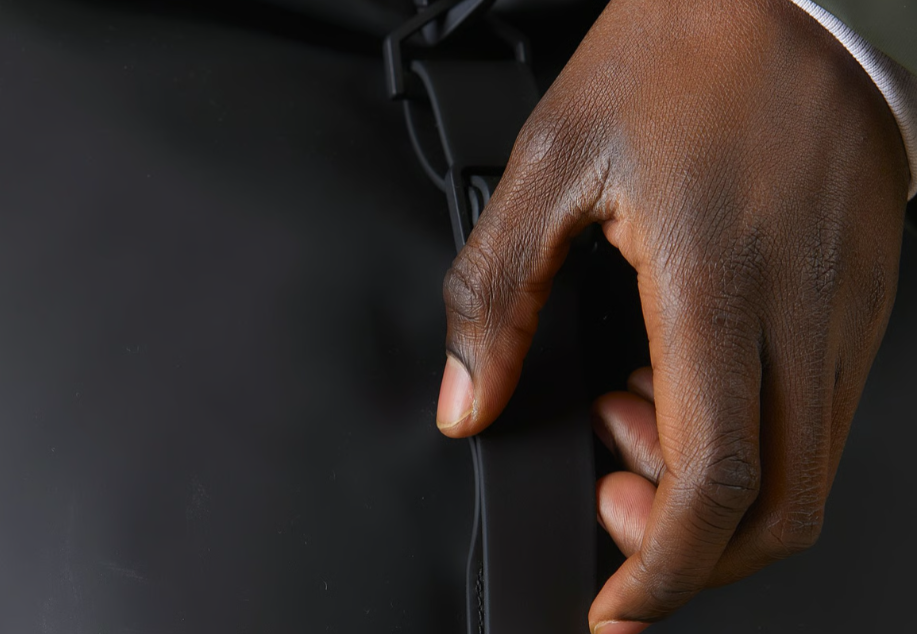
Rains approach: PU-coated polyester with ultrasonic welding removes needle holes. Heat and vibration fuse seams. No thread goes through the material. This creates a lightweight, flexible bag you can pack easily.
-
Stutterheim method: 530 g/m² PVC-coated cotton with double-welded seams. This same fabric handles over 20,000 mm water column pressure. They use it across their raincoats and most bags. You get three finish options (Matte, Opal, Regular). All achieve 100% waterproof certification.
Durability timelines show a clear gap:
Rains’ PU-coated polyester lasts 3–5 years with regular use. Store it carefully and you can extend this to 10 years. PU hydrolysis is the main weakness over time. This happens with most PU materials. Personally, I find Rains perfect for stylish, everyday use without worrying too much about heavy-duty performance.
Stutterheim’s heavy PVC backpack construction and workwear-grade double-welding aim for lifetime use. They engineer bags using the same methods proven in storm-grade outerwear. These techniques have stood the test in harsh conditions. I appreciate Stutterheim for its durability and premium feel, though it comes with a higher price.
The manufacturing gap explains the price difference. Rains keeps prices accessible through Chinese production. Stutterheim invests in European workwear standards. They also use heavier-duty materials that cost more.
Rains Waterproof Bags: Manufacturing Process & Material Technology

Rains uses 3-layer (3L) fabrication technology for its waterproof bags. A waterproof membrane sits between outer and inner fabric layers. You get bags that block wind and water. Plus, they stay flexible with mechanical stretch.
The core material is PU-coated polyester. This fabric dominates the affordable waterproof bag market. Heat and pressure bond PU coating to polyester. Rains’ Chinese bag factories control coating thickness precisely. The result? Zero leakage at 1,000mm water column pressure. That’s more than enough for heavy rain in cities.
Technical Performance Standards

Quality control tracks clear numbers:
-
Adhesion strength: Minimum 15 N/25mm keeps the coating bonded to base fabric
-
Peel resistance: Over 10 N/25mm at 180° peel angle stops delamination
-
Temperature tolerance: Materials tested from -40°C to +80°C for different climates
-
Seam overlap: Minimum 15mm width needed for all welded joints
Ultrasonic Welding Technology

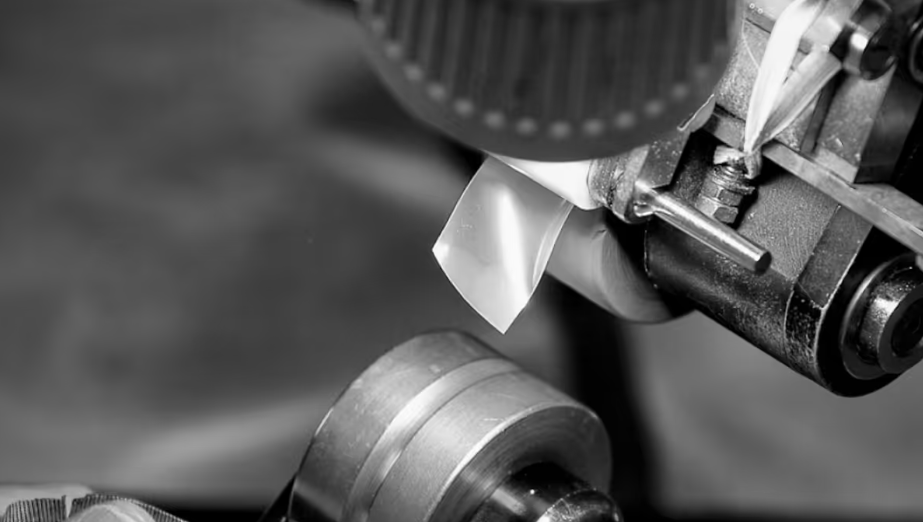
Rains drops traditional stitching. Ultrasonic welding does the job instead. High-frequency vibrations (20-40 kHz) create heat in one spot. This melts and fuses PU-coated materials. No punctures happen. No needle holes mean zero water gets in.
The speed boost is huge. Production lines hit 200 meters per minute during rotary die cutting prep. Hand-stitched seams? They max out at 2-3 meters per minute.
Welding temperatures sit at 380-420°C for PVC joints. Materials bond in milliseconds. Quality vision systems watch every weld as it happens. Temperature, speed, or pressure goes off? The system rejects it automatically.
Six-Step Manufacturing Process
Chinese facilities make Rains bags through set workflows:
-
Material inspection: TPU sheets, PVC panels, and PU-coated polyester rolls get water resistance tests
-
CAD pattern cutting: Laser cutters follow digital templates. Precision hits 0.5mm
-
Welding prep: HF welding molds take 7-10 days to develop for each new design
-
Seam joining: Ultrasonic or HF welding creates 15mm+ overlaps on waterproof joints
-
Hardware attachment: Zippers, buckles, and straps go on through hybrid welding plus stitching on non-critical spots
-
Final testing: Every bag gets 1,000mm water column testing plus tensile strength checks
High-volume runs hit 100,000+ units. This scale drives Rains’ competitive prices. Steel rule dies for mass cutting cost far less than low-volume methods.
Hot melt adhesives at 120-180°C bond reinforcement patches. Solvent-based options handle temperature-sensitive parts. The mechanical stretch in 3L fabric stops stiffness. Your bag flexes like it should when you pack it full.
Stutterheim Waterproof Bags: European Craft & Premium Materials

Stutterheim builds its waterproof bags with PVC-coated fabric. The Rain Duffel Bag 50L tops their range. It hits 8,000mm water column pressure rating. That’s eight times more than heavy urban rain needs. Every bag shows the “Designed in Stockholm” label. Production follows Scandinavian design standards.
Material Build & Waterproof Design

The core uses polyester and PVC composite shells. Their wet-weather line includes two main models. The shoulder bag holds 10L. The rain packer backpack carries 20L. Both use the same polyester-PVC mix. This balances structure with waterproof performance.
Stutterheim splits bag types into two groups. “Sturdy waterproof PVC” models handle heavy-duty use. These use thicker material. It holds shape better and resists wear. Their “lightweight water-repellent nylon” range fills different needs. The PVC tier gives better waterproof performance. You’ll find this in duffel bags and backpacks made for tough weather.
Built for Heavy-Duty Use

The Rain Duffel Bag 50L shows how Stutterheim builds bags:
-
Classic tube shape spreads weight along the long axis
-
Single large main space with full-width top zip cuts seam stress
-
Dimensions: 57cm height × 32cm width × 24cm depth holds 13.2 gallons
-
Top handles with padded wrap spread weight across your hand
-
Adjustable padded crossbody strap handles heavy loads with multiple grip spots
-
Front zip pocket keeps small items separate from main cargo
Water-resistant zippers seal the main space. The closed design stops water from getting in. This matches how Stutterheim waterproofs their raincoats. Personally, I feel this gives extra peace of mind on rainy days, knowing my essentials stay dry.
Core Manufacturing Differences: Materials & Construction Methods
We purchased backpacks from these brands to analyze their materials and construction, combined with data from their official websites. By examining both firsthand and published specifications, we can compare their waterproof performance, durability, and design choices in a practical context.
PU-Coated Polyester Backpacks (Rains)

Rains backpacks mainly use PU-coated polyester, with waterproof performance ranging from 3,000–10,000 mm HH, and high-end three-layer PU reaching 20,000 mm HH. However, prolonged use, friction, and repeated washing can reduce waterproofing to below 5,000 mm HH, with high-contact areas like shoulder straps showing wear within 1–3 years. PU is breathable (MVTR 8,000–25,000 g/m²/24h), making it suitable for daily commuting and city travel.
Sunteam Bag’s factory has also encountered PU cracking and hydrolysis issues in production. To address this, we strictly control coating thickness, heat-press processes, and material storage, ensuring backpack durability and stable waterproof performance.
PVC Laminated Backpacks (Stutterheim)
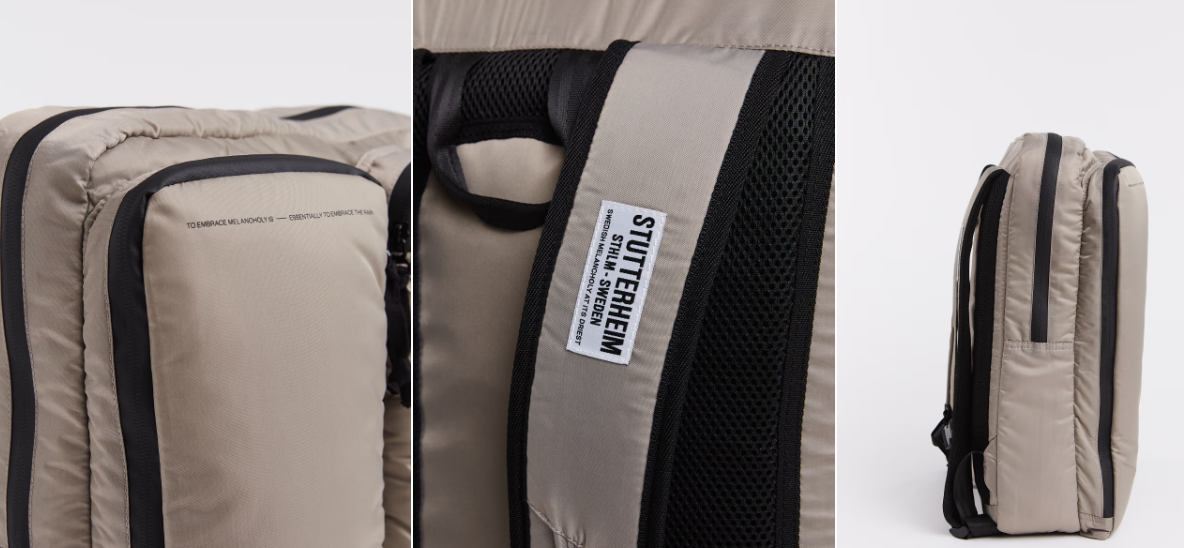
Stutterheim backpacks use PVC laminated materials, typically exceeding 10,000 mm HH, with many models reaching over 20,000 mm HH. The non-porous PVC film achieves “100% waterproof” performance and excellent hydrolysis resistance, with a lifespan of 10–20 years. PVC has almost no breathability, making it better suited for short urban trips or long-lasting waterproof requirements.
Sunteam Bag’s factory experience with PVC backpacks shows that plasticizer migration and UV exposure are the main aging factors. Despite this, waterproof performance remains reliable over time with proper handling.
PU backpacks are lightweight and breathable, ideal for daily use and commuting but have limited longevity. PVC backpacks are highly waterproof and durable but lack breathability. Sunteam Bag’s factory experience demonstrates that precise control of coating and lamination processes directly determines a backpack’s waterproof performance and lifespan.
Design Philosophy & Functional Differences
Rains builds bags for city commuters who want weather protection without extra weight. Stutterheim designs for harsh Scandinavian storms. Complete waterproofing beats light weight here. These different views shape how each brand makes their bags.
Rains: Adaptive Design for Urban Mobility

Rains uses adaptive design principles. They take waterproof tech from rainwear and adapt it for daily bag use. The result? Light PU-coated bags that fold flat when empty.
Core design priorities:
– Minimalist look drives material choice—smooth PU surfaces create clean lines
– Lighter weight through thinner coatings (0.1–0.15mm vs 0.3–0.4mm TPU)
– Flexibility for commuters who fold bags into briefcases or lockers
– Affordable prices via variant design—same base pattern across multiple sizes
Their variant design approach shows in product lines. The MSN Bag comes in Mini (12L), Regular (16L), and XL (20L). Same ultrasonic welding method. Same 420D nylon base. Just the size changes. This keeps R&D costs low. Production scales up easier.
Function serves the daily commute. Roll-top closures adjust volume. Padded laptop sleeves protect electronics. But breathability gets lost. The sealed PU traps moisture during long wear.
Stutterheim: Original Design for Storm Performance

Stutterheim builds from original design principles. Their raincoat heritage comes from gear made for Swedish fishing workers. That same approach transfers to bag making. Each piece keeps gear dry in hours of rain.
Engineering-driven priorities:
– Maximum water resistance through thicker PVC laminates (0.3–0.4mm+)
– Strong build using double-welded seams tested to workwear standards
– Long-term performance over light portability
– Material honesty—heavy-duty fabrics that show their protective power
The Rain Duffel 50L shows their functional design philosophy. The tube shape spreads 10+ kg loads out well. Strong base panels resist concrete wear. Wide-mouth openings give full gear access in rain without exposing contents. Every design detail answers a specific storm-use need.
Stutterheim accepts trade-offs Rains won’t make. Their bags weigh 30–50% more for the same volume. PVC stiffness prevents compact folding. Prices climb 40–60% higher. But the engineering shows: 8,000mm+ hydrostatic ratings and 10+ year service life justify the extra weight for users facing real weather challenges.
Price-to-Value Analysis: Manufacturing Cost Breakdown

Rains bags cost $80–140. Stutterheim bags run $110–170. Three factors explain this gap: materials, where they’re made, and bag production volume.
Direct Material Costs: PU vs PVC Impact
Rains’ PU-coated polyester costs $3.50–5.00 per square meter at wholesale volume. A standard backpack needs 1.8–2.2 square meters of material. Fabric cost: $7–11 per bag. Add zippers ($2–3), webbing straps ($1.50), and hardware ($2–4). You get $12.50–18.50 per unit in direct materials.
Stutterheim’s PVC-laminated construction runs $8–12 per square meter. That’s more than double what Rains pays. The heavier 530 g/m² fabric needs thicker lamination layers. The same backpack size needs $14.40–26.40 in fabric alone. Premium water-resistant zippers add $4–6. Reinforced webbing costs $3–5. Hardware totals $3–6. Direct materials hit $24.40–43.40 per unit.
Labor & Overhead: Geography Drives Variance
Rains makes bags in Chinese facilities. Skilled sewing operators earn $8–12 per hour there. Ultrasonic welding cuts build time to 18–25 minutes per bag. Labor cost per unit: $2.40–5.00. Overhead (rent, utilities, equipment wear) adds $4–7 per bag at 100,000+ unit runs.
Stutterheim partners with European workwear facilities. Workers there earn $25–40 per hour. Double-welded PVC seams need manual checks. Build time stretches to 35–50 minutes per bag. Labor jumps to $14.60–33.30 per unit. Smaller runs (5,000–15,000 units) push overhead to $12–18 per bag.
Total Manufacturing Cost Comparison
Rains production cost breakdown:
– Direct materials: $12.50–18.50
– Direct labor: $2.40–5.00
– Manufacturing overhead: $4–7
– Total per unit: $18.90–30.50
Stutterheim production cost breakdown:
– Direct materials: $24.40–43.40
– Direct labor: $14.60–33.30
– Manufacturing overhead: $12–18
– Total per unit: $51–94.70
Retail prices use a standard 2.5–3.5× markup over manufacturing cost. Rains’ $80–140 pricing shows a 2.6–4.6× markup. Stutterheim’s $110–170 range runs 2.1–3.3× markup. Tighter margins support the premium brand while covering European labor costs.
Sustainability & Environmental Impact of Manufacturing Methods
Making waterproof bags creates environmental costs before you open the box. The coating type, factory location, and production scale set your bag’s carbon footprint.
Carbon Emissions: PU vs PVC Production
PU coating manufacturing generates 3–6 kg CO₂e per kg of polymer from start to finish. This includes raw material extraction and processing. Fossil-based materials drive these numbers up. Solvent-based PU formulas add VOC emissions during application. Waterborne options cut this impact by 30–50%.
PVC production releases 1.9–3.0 kg CO₂e per kg. The chlorine content means lower per-kilogram carbon than PU. But chlorine chemistry brings different problems. Burning PVC without proper controls produces dioxins and organochlorines. EU regulations limit PVC disposal methods for this reason.
Geographic Impact: Factory Location Matters
China-based bag production (Rains’ primary method) uses grids that emit 0.6–0.7 kg CO₂e per kWh. Coal plants power most of their energy grid. A waterproof backpack needs 20–40 kWh for spinning, coating, cutting, and assembly. That creates 12–28 kg CO₂e from electricity alone.
European facilities (Stutterheim’s partners) use grids at 0.25–0.35 kg CO₂e per kWh. They run on more renewables, gas, and nuclear power. This cuts emissions significantly. The same backpack drops to 5–14 kg CO₂e from process energy. Shipping from Asia by sea adds 0.5–1.5 kg CO₂e per unit.
End-of-Life: The Recycling Reality
PU-coated and PVC-laminated bags don’t work in municipal recycling. Multi-layer materials won’t separate. PVC’s chlorine content stops mechanical recycling. Most facilities turn it away. Thermoplastic PU can recycle in theory. But laminated fabrics don’t reach recycling facilities at large scale.
Design for disassembly solves this problem. Modular construction lets you remove hardware and separate materials. Skip this step, and both coating types end up in landfills or incinerators.
Expert View: Sunteambag’s Manufacturing Know-How
We’ve run as an OEM/ODM bag maker for 11 years. In that time, we’ve made 10+ million leather bags and wallets. Our setup links a Dhaka tannery with bag making and quality checks in Wuhan, China. This means we see exactly how materials impact the final product and cost.
How we differ from both brands:
We use 70% automated lines with German and Italian machines. An Italian lead technician with 30+ years in leather runs our quality systems. Our automation sits between Rains’ high-volume Chinese making and Stutterheim’s European workwear style. We hit steady quality that meets European standards. Plus, we keep costs near Asian levels.
What we’ve learned making waterproof bags at scale:
-
Polyester fabric pricing: 210D–600D materials cost USD 1.2–3.5 per meter. Price depends on waterproof finish (PU/TPU/DWR)
-
rPET costs 8–15% more than virgin polyester. Sorting and reprocessing drives this up. MOQ sits at 500–1,000 meters per color
-
Popular deniers for sport/waterproof bags: 200D, 300D, 420D, 600D. Nylon makes up 59% of synthetic materials in sport bag making
-
Standard fabric lead times: 25–35 days for polyester/nylon with dyeing. GRS certification on recycled materials adds 5–7 days
The price gap between Rains and Stutterheim comes down to location more than material quality. China makes 50% of global bags. 70%+ get shipped to Europe and North America. Guangdong alone ships 55% of high-end bags. This scale lets Rains keep prices lower. They use similar waterproof tech but benefit from production volume.
Conclusion
Rains and Stutterheim both excel at Scandinavian rain gear craftsmanship. But their waterproof bag manufacturing philosophies differ sharply. Rains uses industrial-scale PU coating and ultrasonic welding for reliable urban performance. Stutterheim takes a different path with handcrafted TPU lamination and careful seam taping. This delivers heirloom-quality durability. The waterproof bag construction methods you pick depend on your lifestyle. Daily commuters often prefer Rains’ lightweight practicality. Design purists investing in long-term accessories tend toward Stutterheim’s artisan precision.
What matters most? Not which brand wins on paper. Find the manufacturing approach that fits how you move through life. Try to feel the difference between welded seams vs taped seams in person. Or consider the middle ground: custom solutions from specialized makers like Sunteambag. They blend industrial efficiency with personalized customization. Your perfect waterproof companion sits where technical performance meets personal values. That could mean Scandinavian minimalism, environmental responsibility, or never settling on a rainy Tuesday morning. Choose what works for you. Protect what matters. Carry with confidence.