
I’ve pressed my thumb into enough “aluminum stay” backpacks to know that half of them flex like a pool noodle under 20kg — and the seller never mentions it. Marketing copy loves to throw around terms like internal frame construction for travel bags, but the actual hardware inside the back panel tells a very different story depending on whether you’re gripping a 6061 aluminum stay, a slab of HDPE frame sheet, or an X-shaped wire that’s barely load-bearing at all. After five years of stuffing packs to their limit on multi-week trips, I’ve learned that the difference between a comfortable 20kg carry and a shoulder-wrecking one comes down to geometry and material choices most buyers never get shown. This teardown compares real frames from Osprey, Gregory, Deuter, and Tom Bihn, with load tests and three checks you can do yourself before buying.
Load Path: How an Internal Frame Transfers 20 kg+ From Shoulders to Hips
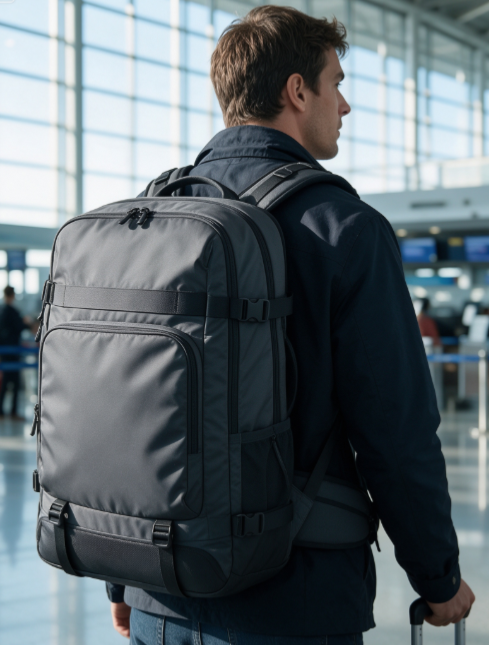
Physics doesn’t care about brand loyalty. Every internal frame has one job: redirect vertical force away from your shoulders and down into your pelvis. The load moves through a chain — pack body, then the frame or stays, then the hip belt, across your iliac crest, and into your legs. Your shoulders act as secondary stabilizers, not primary carriers.
Here’s the target math I use in the field. For loads between 10 and 20 kg, a correctly adjusted hip belt should carry 60–80% of total weight, leaving 20–40% on the shoulders for balance. Push past 20 kg, and that ratio should shift toward 75–85% on the hips. Some pack-fitting sources cite 85–90% transfer efficiency on a 30 lb (13.6 kg) load when the belt is doing its job. Miss that ratio, and you’re basically wearing a rigid daypack with delusions of grandeur.
Load lifter straps matter more than most buyers realize. Set at a 30–45° angle from the frame, they pull the upper pack inward toward your spine, tightening the shoulder-to-hip load path. If your load lifters sit flat or loose, that path breaks and weight dumps straight onto your traps.
A quick fit cue: with the hip belt loaded properly, you should see 2–3 cm of clearance at the top of your shoulder strap — not zero, not a gap you could fit a finger through twice. Pack heavy items close to your spine, between the shoulder blades, so the frame has a straight line to route force downward instead of pulling you backward.
Frame Sheet vs Stays: The Structural Difference Buyers Often Miss
The phrase “internal frame construction for travel bags” covers two very different components, and sellers rarely explain which one you’re paying for. A frame sheet is a semi-rigid plastic panel, usually HDPE, that sits inside the back panel. It keeps the pack’s shape, spreads the load broadly, and keeps hard objects from digging into your spine. Stays are narrow rigid elements like aluminum rods, flat bar stock, or carbon fiber, inserted vertically to stiffen the pack and shove weight down to the hip belt.
A frame sheet adds broad-area stiffness but not much vertical rigidity. It won’t transfer much load to the hip belt on its own. Stays do that work.
Material and thickness benchmarks I look for: Frame sheets are 3–5 mm polyethylene, sometimes listed as 0.55 in HDPE. Stays are 6061 or 7075 aluminum, with 6 mm 6061-T6 as a common upgrade spec. Tubing beats flat bar stock in stiffness, but flat bar bends easier to match your back’s curve.
When each design makes sense: Under about 12 kg, a molded polymer sheet alone is acceptable. Above 15–18 kg, you need vertical stays plus a stiff hip-transfer plate. For the 10–25 kg range, look for both, with Tom Bihn’s HDPE-plus-6061-half-stay hybrid as the benchmark example.
A pack rated over 20 kg that only mentions “frame sheet” is a red flag.
Aluminum Stay Frame Backpack Construction: 6061 Alloy in Real-World Travel Loads
Numbers don’t lie, and 6061-T6 aluminum has the numbers to back its reputation. This alloy carries an ultimate tensile strength of roughly 310 MPa (45,000 psi) and a yield strength around 276 MPa (40,000 psi). That’s why EXPED and Tom Bihn both build their frame systems around it.
Real load ratings cluster tighter than you’d expect. The EXPED Lightning 60 runs a single 6061-T6 stay and lists a 52.9 lb (24 kg) limit. A comparable EXPED women’s pack uses two stays and clocks in at 24–27 kg. That’s the sweet spot for most travel loads.
Stay sizing benchmarks from long-term pack builders:
– 1/8 in × 5/16 in: good to ~30 lb
– 1/8 in × 1/2 in: good to ~50 lb
– 1/8 in × 3/4 in: good to ~75 lb
Granite Gear’s aluminum stay add-on bumps load capacity by +8 lb for packs already north of 35 lb.
Weight cost is negligible. A pair of 1/8 in × 1/2 in stays, 24 in long, adds only about 4.5 oz total, a small price for real load transfer.
Black Diamond’s Mercury 65 uses a 6 mm peripheral hoop plus a 20 mm center stay. It confirms 6061 scales up for heavier haulers too.
HDPE Frame Sheet Backpack Designs: When Plastic Support Is Enough
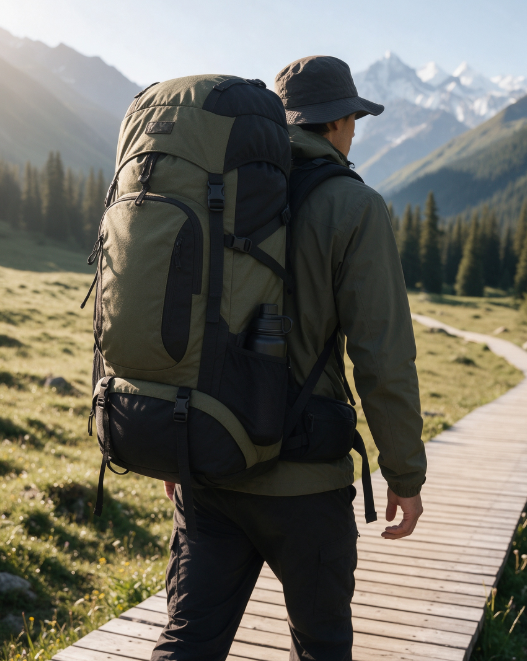
Not every pack needs a metal spine. Hill People Gear builds packs where the HDPE frame sheet “adds a moderate amount of rigidity” — nothing more, nothing less. That’s the honest use case: shape retention and back-panel protection, not full load transfer.
Thickness tells you what you’re actually getting. Tom Bihn’s Guide’s Pack runs 0.060 in HDPE. MYOG builders commonly recommend 1/16 in. One lightweight prototype maker found 0.5 mm outperformed 1 mm in stability once paired with two stays. Thicker isn’t automatically better once stays enter the equation.
Weight math matters too. A full 2 ft square of 1/8 in HDPE weighs about 2.5 lb. Push thickness up for rigidity, and you’re carrying a weight penalty fast.
The Sheet-Plus-Stay Hybrid Benchmark
The pattern that keeps showing up commercially: plastic sheet + one aluminum stay. Kelty’s Redwing 44 and the ATS Frame Sheet Insert both use this exact combo. One MYOG build hit just 3.85 oz total for sheet plus stay. That’s proof you can add real load transfer without real weight.
Design detail worth checking: a tapered sheet, narrower at the bottom, focuses load toward the lumbar and hip belt instead of spreading it evenly. Flat, untapered sheets under 12 kg loads are fine for admin pockets and daypacks. But if the listing says “HDPE frame” on anything over 15 kg with no stay mentioned, that’s shape support pretending to be a suspension system.
Carbon Fiber Frame Backpack Systems: Lightweight Stiffness Versus Failure Risk
Weight-obsessed hunters and ultralight backpackers pushed carbon fiber into internal frame construction for travel bags, and the numbers explain why. KUIU’s Icon Pro / ULTRA frame weighs 11 oz yet claims a 150 lb load rating, available in 22″, 24″, and 26″ sizes with 4 in of vertical shoulder strap adjustment. Paired into a full kit, the ULTRA 1800 system totals 3 lb 1.5 oz. Exo Mountain Gear’s K4 3600 frame system matches that 150+ lb claim at 5 lb 8 oz total pack weight, offering four torso lengths from 22 in to 26.5 in.
Stiffness here is about layup. Initial Ascent’s Integrous Frame uses a triaxial weave composite at 18 oz for a 22.5 in length. Yamatomichi’s ONE goes further, using a flexible X-shaped carbon frame at 577–622 g that flexes with your body on rough terrain rather than resisting it.
Carbon doesn’t bend and recover like aluminum, and it can crack under sharp impact or repeated stress concentration. Rokman’s 60.8 oz carbon frame claims 250 lb capacity partly by adding bulk back in. If a listing skips torso-length adjustment or geometry details, treat the weight claim skeptically.
Internal Frame Travel Bag Case Study: Tom Bihn HDPE-and-Aluminum Chassis
Tom Bihn’s Techonaut Internal Frame is the clearest teardown-worthy example of the sheet-plus-stay hybrid I keep coming back to. It’s an optional, removable insert for the Techonaut 30 and Techonaut 45, built from 0.055 in HDPE die-cut into a sheet, with a nylon webbing sleeve stitched down the center. That sleeve encases a 1/2 in (13 mm) 6061 aluminum half stay, not a full-length rod, but enough vertical spine to redirect load toward the hip belt.
This same formula shows up across Tom Bihn’s whole line, with only the stay diameter changing by model:
-
Aeronaut 30/45: 0.055 in HDPE + 0.5 in aluminum stay
-
Synapse 25: 0.055 in HDPE + 1 in aluminum stay
-
Shadow Guide 33: 0.055 in HDPE + 1 in aluminum stay, pre-shaped for spinal curve
The earlier Guide’s Pack used a slightly thicker 0.060 in HDPE sheet with a 1 in stay, proof this design language predates the current lineup.
What makes this a genuine case study rather than a spec sheet is that the stay is removable and re-bendable, so you can match it to your own spine before a long trip. That’s a real-world adjustability check most rigid frames don’t offer.
Mainstream Internal-Frame Suspension Comparison: Gregory, Deuter, and Osprey Design Evidence
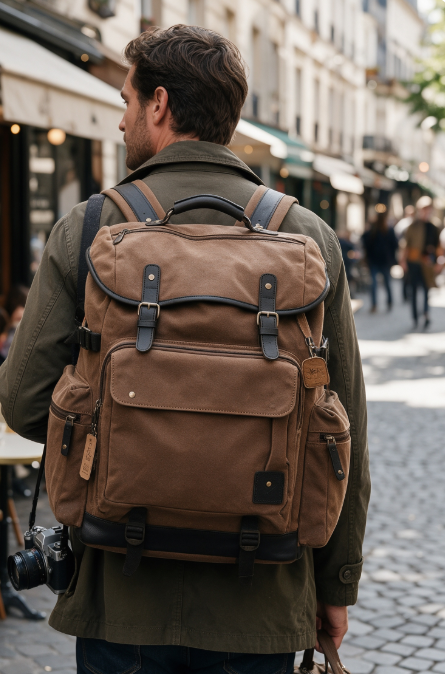
Three brands, three completely different answers to the same load-path problem. That’s what surprised me most when I lined up spec sheets side by side.
Gregory bets on hipbelt articulation. Its FreeFloat system uses a flexible panel connecting the hipbelt to the frame, letting the belt pivot and flex as you hike instead of staying locked rigid. The FreeFloat A3 on the Baltoro adds dynamic flex panels plus auto-rotating shoulder straps. Underneath, REI’s spec sheet lists a perimeter wire frame with adjustable torso length. The Zulu 55 confirms this with a 3.5 in torso range, 50 lb max carry, and a frame built from perimeter spring steel plus a fiberglass anti-barreling cross-stay. The Baltoro 100 Pro scales that up: S 15–18 in, M 17–20 in, L 18–20 in torso fits, with 95/100/105 L capacity depending on size. Gregory’s Jet Stream Direct Transfer suspension targets 35–65 L packs carrying 25–30 lb. The Z30 runs a hybrid internal/external frame.
Osprey answers with tensioned mesh over hipbelt flex. Anti-Gravity uses a seamless 3D mesh backpanel running unbroken from shoulders to hips, paired with a wire frame in the Atmos AG line. The LightWire suspension pairs an HDPE frame plate with a 6061-T6 aluminum central structure, funneling weight straight to the lumbar belt. The Atmos AG 50 weighs 4 lb 12 oz (2.15 kg) medium; the Exos 58 drops to 2.63–2.68 lb using 100D nylon. Osprey also adds extendable, angle-adjustable shoulder pads for custom fit.
Deuter’s Aircontact line confirms a suspension system exists, but published specs stay vague. The clearest detail is the Aircontact Zero 60+10, which trades airflow for weight savings.
Gregory prioritizes hipbelt movement, Osprey prioritizes frame-to-mesh load transfer, and Deuter’s documentation simply doesn’t give you enough to verify claims. That’s a red flag worth noting before you buy.
X-Frame, Ladder, Single-Stay, and Wire Geometry Under Uneven Loads
Geometry decides whether a stay works — not just its material. For single-stay systems, structural engineering data sets a clear benchmark: the stay should sit along the line of resultant load, with a 45° slope to avoid overstressing the component. Most backpack designers land in a 40°–60° range for the same reason. Go shallower than that, and support forces spike — the same failure pattern seen in wire-ladder systems where a small angle change drives outsized tension.
X-frame wires behave like uneven-load ladders. Load doesn’t spread evenly across the wire. It depends on sag, stretch, and elastic properties, just like helical wire tests showing the largest strain concentrated near strand-end grips. On a pack, that means an X-wire frame under 20kg often transfers load unevenly between the two diagonal runs instead of splitting it 50/50.
Double-stay setups fix this by running stays parallel wherever possible, so neither reduces the strength of the other. That’s the mechanical reason a two-stay pack (like the EXPED women’s model referenced earlier) handles uneven loading better than a single flexing wire ever will.
Torso Length, Hip-Belt Connection, and the Actual Weight Distribution Test
Get the torso length wrong, and no frame material saves you. Measure from the C7 vertebra — that bony bump at the base of your neck — down to your iliac crest, the top ridge of your hip bones. Most adults fall in the 15–19 in range, with the full practical spread running 14–21 in. Match your pack’s frame size to that number, not your height. A sizing mismatch beyond ±1–2 cm (±0.4–0.8 in) shows up fast in a load test.
Diagnosing a bad torso match:
-
Hip belt sliding below the hip bones → torso too long
-
Hip belt riding on the lower back → torso too short
-
Visible shoulder gap after tightening → torso too long
-
Weight stuck entirely on shoulders → torso too short
For the actual test, load 10–20 lb, buckle the hip belt first over the iliac crest, then walk, bend forward, and twist side to side. A properly seated belt should carry 70–80% of pack weight, with 2–3 finger widths of clearance once buckled—snug, not choking. If the frame can’t hit that ratio at test weight, it won’t hit it at 20 kg on the trail.
Three On-Site Tests for Detecting a Fake or Underspecified Internal Frame
Forget the spec sheet for a minute. Here’s what I actually do in-store before handing over money.
Test 1: Material verification. Ask the retailer for the certificate behind the label — a material test certificate for steel stays, a mill certificate for aluminum. No paperwork, generic “aluminum frame” text with no grade number, or a finish that doesn’t match the product photos? Walk away. This catches sellers who print “6061 aluminum” on a tag wrapped around a softer, unspecified alloy.
Test 2: Dimensional check. Measure the frame’s width, depth, and stay thickness against the listed spec. Acceptable tolerance runs ±2 mm for smaller stay dimensions, ±5 mm on larger frame sections. If the sheet is listed at 3–5 mm HDPE but calipers show 2 mm, that’s a section swap, not a rounding error.
Test 3: Rigidity push test. Press firm, flat-hand pressure perpendicular to the frame face, mid-panel. Movement should stay under 2 mm. Anything that bows, twists, or rattles under moderate push means the internal frame construction for travel bags you’re buying is decorative and won’t carry load.
Internal Frame vs External Frame Bag Performance Above 15 kg
Fifteen kilograms is the real fork in the road, not 20. Field guides put the crossover at 15 kg / 33 lb — below it, internal frames win on balance; above it, external frames start earning their keep. Modern internal frames top out around 14–23 kg (30–50 lb), with select packs pushing 16–18 kg. External frames handle 27–40 kg (60–90 lb) routinely, with heavy-duty models rated to 68 kg (150 lb).
Selection benchmark I use:
– Under 12 kg → internal frame, no debate
– 12–25 kg → fit and torso match decide it, not frame type
– Over 25 kg → external frame carries easier, period
One controlled study found no significant difference in metabolic cost between the two frame types at 33% body weight load. Geometry matters more than frame category. Position matters too: shifting load higher in an internal-frame pack dropped VO2 from 22.2 to 18.6 ml/kg/min and perceived effort from 3.7 to 2.8 RPE.
Internal Frame Travel Bag Buying Checklist for a 20 kg+ Load
Ten years of watching hikers overpack the wrong frame taught me that a checklist beats a sales pitch every time. Below is the exact list I run through before any pack crosses the 20 kg threshold.
Frame and load transfer
– Peripheral frame or HDPE frame sheet plus internal stays, required once loads pass 9 kg (20 lb)
– Hip belt engineered to move 75–80% of total weight at 20 kg+, up from the 65–75% benchmark acceptable at lighter loads
– Load lifters that reach 45°–60° when cinched
– Published comfort ceiling of 14–23 kg (30–50 lb) — the Durston Kakwa 55 is a solid reference point, rated for 20 kg
Fit and sizing
– Torso length matched to a manufacturer chart: Small 38–43 cm, Medium 43–48 cm, Large 48–53 cm, XL 54 cm+
– Hip belt sized to actual hip bones, not waist: S 66–86 cm, M 81–101 cm, L 96–116 cm
– 2–3 cm clearance above the shoulder once loaded
Volume and hardware
– Pack body in the 35–80 L range for multi-day travel; 75+10 L for week-long trips
– Padded hip belt, ergonomic shoulder straps, balance straps, and strong side compression
Any listing missing three or more of these? Keep shopping.