
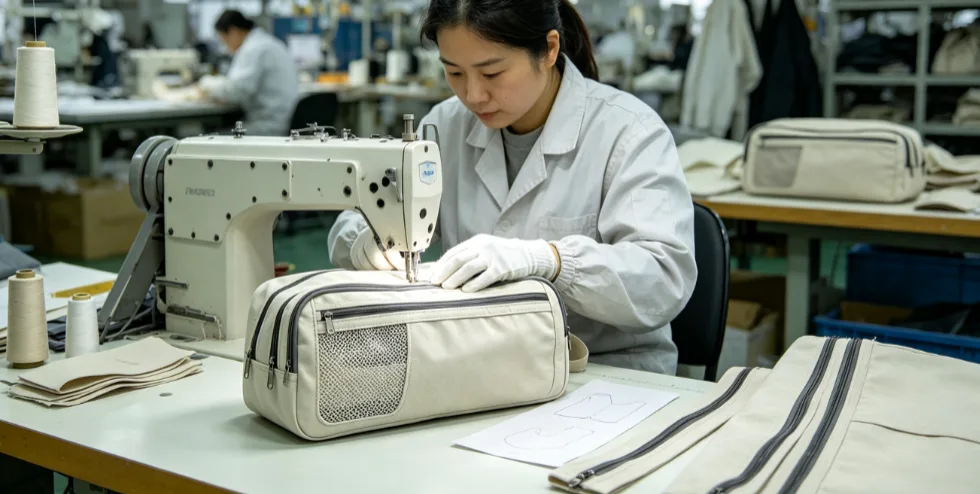
A shoe bag that traps moisture doesn’t just smell bad—it can quietly ruin a customer’s unboxing experience and trigger costly returns. For brands and buyers sourcing at scale, ventilation is now a functional requirement that separates reliable suppliers from the rest. Yet not all “breathable” claims hold up under real airflow testing, and the difference between a mesh panel design and basic perforation can significantly impact moisture control and odor resistance over time.
Why Ventilation Matters in Custom Shoe Bag Manufacturing
Relative humidity above 60% RH is where things start going wrong inside a sealed shoe bag. Footwear storage guidelines recommend 40%–50% RH as the safe zone, with 30%–50% RH acceptable and 18–22°C (60–70°F) as the ideal temperature range. Cross that threshold, and mold risk climbs fast—especially in the 20–30°C + >70% RH combination that storage researchers flag as high-risk.
Here’s the problem chain inside a non-breathable bag:
-
Moisture retention creates a microclimate around the shoe
-
Stagnant air lets mold spores settle and multiply
-
Organic residue and sweat feed that mold once it starts
Above 50% RH, rubber soles hydrolyze faster and fabric linings mildew more easily. Sneakers, mesh uppers, and fiber-lined shoes suffer most in fully enclosed packaging. That’s why moisture control shoe packaging built around breathable fabric construction matters for material longevity, not just comfort at unboxing.
Mesh Panel Design: The Most Common Ventilation Solution
Walk through any factory producing breathable fabric shoe bag lines, and you’ll see mesh panels everywhere. Most finished bags put mesh on the side panels or upper half of the shoe compartment, then pair it with dual zippers so air can flow across. Product spec sheets tend to call this “side mesh ventilation panels.”
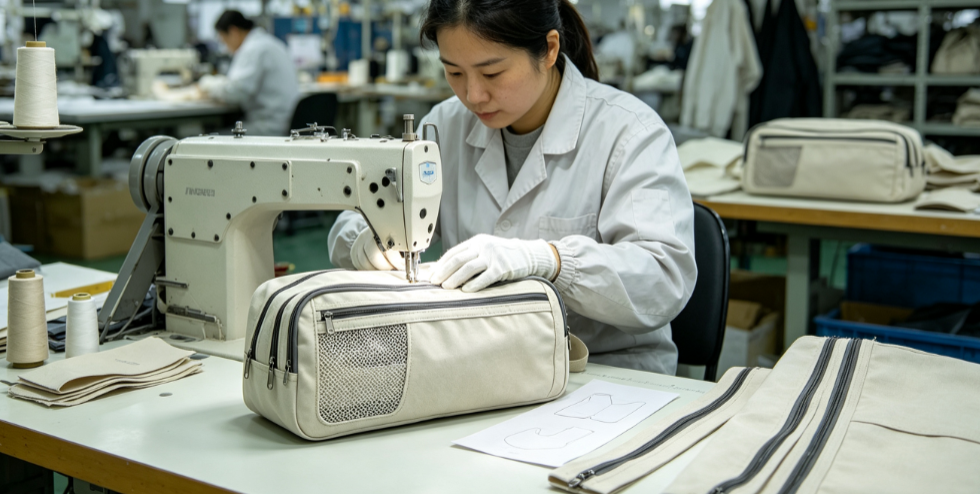
Some designs take it further. Mesh becomes an internal divider that keeps damp shoes separate from the main compartment but still lets air move through. You’ll see this listed as “expandable shoe compartment with mesh panel for breathability.”
Construction detail matters here. Mesh sections get stitched to the main fabric, with edges bound or taped so they don’t fray. Full-mesh bags rarely make structural sense. Manufacturers usually window the mesh at the toe, heel, or side zones where heat and moisture build up, and keep the rest of the bag load-bearing.
Single-Layer vs. Sandwich/3D Mesh
Two mesh types show up in custom shoe bag manufacturing:
-
Single-layer mesh: Lightweight, direct airflow, typically 80–150 GSM. Best for side windows and minimalist bags where drying speed is the priority.
-
Sandwich/3D/spacer mesh: Multiple layers with a support yarn air gap that gives you breathability plus cushioning and structure. Better for compartments that need to hold their shape.
Quick sourcing rule: choose single-layer mesh if fast drying matters most; choose spacer mesh if you care more about protecting shoe shape.
When you evaluate an OEM shoe bag production partner, ask for mesh GSM, hole size, edge binding method, and side-window area ratio. Don’t settle for marketing claims about “breathable material.”
Ventilation Hole & Perforation Techniques for Custom Shoe Bags
Perforation gives you a different trade-off than mesh. You keep more of the base fabric’s strength while still getting precise airflow control through the vent holes.
Hole Size Ranges That Matter
Two categories cover most use cases:
-
Micro-perforation: 0.5–2 mm diameter, with fine variants under 1 mm. This range balances breathability with dust and debris resistance.
-
Macro-perforation: 6–8 mm holes built for strong air exchange—sneaker storage or humid climates, for example. Protection drops as hole size grows.
Density matters just as much as size. Packaging-grade micro-perforation typically runs 25 or 6 holes/cm². Needle-punched micro-hole processes commonly hit 40–60 holes/cm², sometimes narrowing to 45–55 holes/cm². Industrial punching equipment can produce holes from 40 µm to 800 µm, with some machinery hitting 0.1–1.5 mm precision.
Balancing Airflow and Protection
Larger holes mean higher single-point airflow but let in more dust and moisture. Higher density increases total open area but weakens material strength if pushed too far. Most suppliers land on one of two strategies:
-
Small holes, high density: suited to lightweight or travel shoe bags where a clean visual finish matters
-
Large holes, low density: better for sports shoes or fast odor and moisture release in humid storage
Where Holes Get Placed
-
External window perforation: branded, but wears faster at the window edge
-
Interior liner perforation: functional, keeps the outer appearance clean
-
Back or side panel perforation: creates passive airflow channels for hanging or upright storage
-
Matrix hole patterns: the most common choice for even airflow and a tidy appearance
Sample Specs Worth Requesting
-
Balanced sample: 0.8–1.2 mm holes, 40–60 holes/cm² for daily-use bags
-
High-ventilation sample: 6–8 mm holes for sports shoes and humid conditions
-
Protection-first sample: sub-1mm holes, windowed or interior placement
Manufacturing Methods
-
Needle or heat-pin punching: standardized, ideal for regular hole arrays at scale
-
Laser or heat-cut perforation: cleaner custom patterns, but you need to control edge heat to avoid brittleness
-
Die-punch tooling: reliable for fixed matrix or zoned perforation in high-volume runs
When vetting an OEM shoe bag production partner, ask directly: What hole diameters can they produce (0.5 mm, 1 mm, 2 mm, 6 mm, 8 mm)? What is their density range in holes per square centimeter? Can edges be heat-sealed or bound to prevent fraying? These questions separate suppliers who understand non-woven ventilated shoe bag engineering from those outsourcing generic templates.
Mesh, Nylon, or Non-Woven: A Breathable Material Comparison
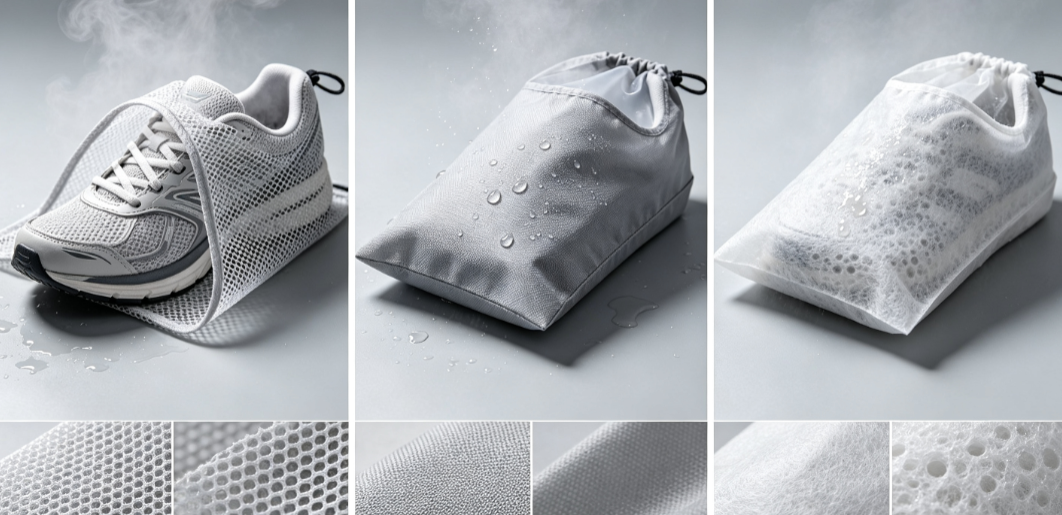
Not every breathable fabric shoe bag material performs the same way once it’s actually storing a damp shoe. The choice between mesh, nylon composites, and non-woven fabric depends on matching material science to real use conditions, not on what looks airy on a spec sheet.
Polyester Mesh / Air Mesh
A 50% polyester / 50% nylon air mesh blend is the industry-standard spec, and some suppliers back it with Oeko-Tex Standard 100 certification. But mesh has a ceiling. In packed conditions, like a suitcase, airflow becomes static. One industry test measured treated mesh at just 12–18 g/m²/24h water-vapor transmission, far below the 300+ g/m²/24h benchmark needed for real drying performance in humid climates. Mesh works best for visible, lightweight, quick-dry storage. It’s not built for sealed travel environments.
420D Nylon Composite Mesh
Nylon shells add water resistance and abrasion resistance that mesh alone can’t provide. A tri-layer construction gives the strongest engineering approach: a hydrophobic ripstop nylon outer, an open-weave inner mesh, and spacer channels in between. One notable detail is that untreated PP mesh is the recommended inner layer, since polyester mesh tends to hold moisture rather than release it. This composite structure fits sports shoes, travel use, and damp footwear better than mesh-only designs.
Non-Woven Ventilated Shoe Bag
Non-woven ventilated shoe bag material is the budget option. It’s marketed as breathable, foldable, odorless, and reusable, and some recycled versions carry ISO, ISCC, REACH, and GRS certifications with an open-pore structure for air circulation. The trade-off is durability: non-woven typically offers less structural airflow than mesh or nylon composites, making it better suited for dust protection and low-cost breathability than for heavy-duty moisture control.
Quick Sourcing Comparison
|
Priority |
Best Material |
|---|---|
|
Highest breathability |
Polyester/air mesh (open-weave, spacer-style) |
|
Durability + travel protection |
420D nylon composite mesh |
|
Lowest cost |
Non-woven ventilated fabric |
|
Sustainability positioning |
Recycled mesh or non-woven with GRS documentation |
Customizable Ventilation Parameters Buyers Can Request
Sourcing spec sheets rarely tell the full story. Hand your supplier a specific parameter list instead of accepting whatever “breathable” template the factory already runs.
Mesh Type and Vent Placement
Request 3D air mesh (≥6mm thickness) or honeycomb mesh, with antimicrobial treatment as an add-on. Place vents on exterior side panels, back panels, or internal windows, but keep at least one outward-facing panel for passive air exchange.
Hole Geometry and Airflow Thresholds
Vent shapes range from round, oval, and strip cuts to micro-pores and full mesh structures. Diameters run 0.5mm to 10mm, arranged uniformly or in localized clusters depending on moisture zones. For load-bearing accuracy, ask for airflow testing at 0kg, 3kg, and 5kg. Production-grade bags should retain ≥60% airflow at 5kg load.
Wet/Dry Separation With Vented Chambers
A waterproof compartment paired with 2 ventilation ports isolates damp shoes while letting moisture escape. Foldable or detachable shoe pockets using breathable mesh panels keep this separate from main-bag volume.
Reinforcement and OEM Alignment
Vent edges need reinforced binding or iron-on patch tape to prevent fraying near seams or zippers. For OEM shoe bag production, align vent specs with the brand’s use-case first, then lock hole size, density, and panel count before adding logo printing or private label details.
Manufacturer Capability Signals: What to Look for in a Ventilated Shoe Bag Supplier
Specification sheets only tell half the story. The real test is whether a custom drawstring shoe bag manufacturer can back up “breathable” claims with documented processes and test data.
OEM Scope and Sampling Speed
Look for full OEM + ODM support—concept design, sampling, bulk production, and packaging customization under one roof. A benchmark sample lead time is 3–7 days for first prototypes. The sampling workflow should follow a clear sequence: tech pack review, material recommendation, pattern development, fit revision, approved pre-production sample, then bulk sign-off. In-house sampling with fast revisions beats outsourced sampling every time.
Material and Production Range
Strong factories cover multiple material families: nonwoven/spunbond PP, woven polyester/oxford, mesh panels, coated or laminated fabrics, plus lining, drawcord, zip, and hardware options. Ask about monthly capacity by material type, number of production lines, and MOQ flexibility—many bag factories now market low-MOQ runs alongside wholesale volume.
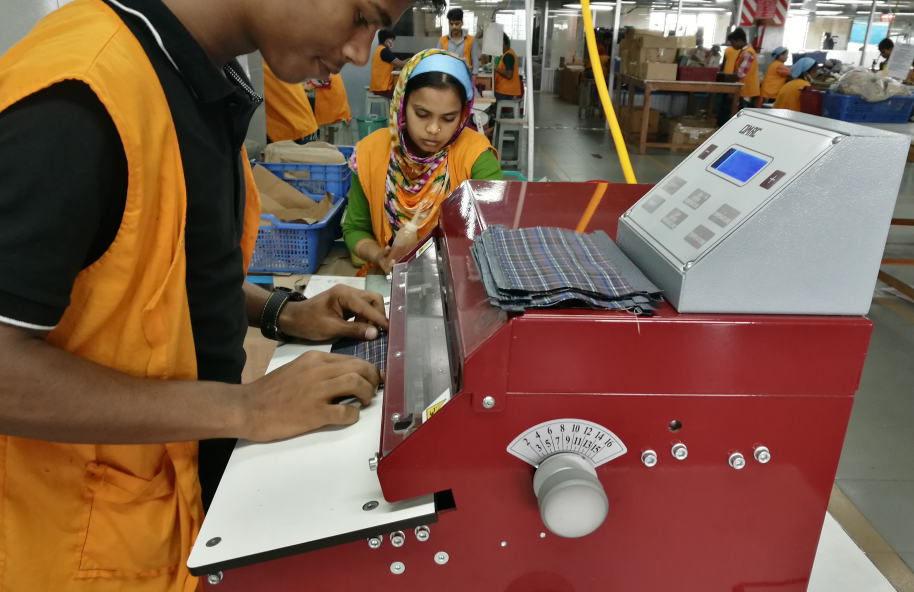
Quality-System Proof
Request certificates with scope and issue dates: ISO 9001, REACH, GRS for recycled content, and lab access for testing. For eco-friendly shoe bag material claims, documentation matters more than marketing language.
Air Permeability Testing
Credible suppliers test breathable panels against ASTM D737 or NWSP 70.1, reporting actual units and test conditions—not pass/fail statements. Breathable apparel-grade materials often reach 15,000–30,000 g/m²/day water-vapor transmission, a useful comparison benchmark.
Red Flags to Walk Away From
-
Can’t state GSM, denier, or coating type
-
No documented QC gate for breathable fabric
-
Certifications without verifiable certificate numbers
Buyer Evaluation Checklist: Verifying Airflow Performance Before Ordering
Paper specs mean nothing without lab numbers behind them. Before signing off on a bulk order, pull actual test data from your supplier, not adjectives like “breathable” or “premium mesh.”
Core Data to Request
-
Fabric structure: mesh type, GSM, yarn denier, weave pattern, layer count, finishing method
-
Hole/openness ratio: single-hole diameter, open-area percentage, holes per unit area. Micro-mesh typically runs 0.5–1.5mm, standard sports mesh 1.5–3mm, macro-mesh 3–6mm
-
Airflow reports: ASTM D737 or ISO 9237 results, measured in cm³/cm²/s, L/m²/s, or ft³/min/ft²
-
Acceptance thresholds: high-ventilation panels should hit ≥150 cm³/cm²/s @ 100 Pa; sports mesh typically ranges 200–500 L/m²/s (micro) to 1,200–3,000+ L/m²/s (macro)
Always confirm test conditions: pressure differential, sample area, humidity, tension state. Identical GSM can perform very differently at different openness levels.
Moisture and Odor Proof
Request AATCC TM200 or GB/T 21655.2-2019 drying and moisture-management reports. Look for Wetting Time ≤2.0s, One-Way Transport Index >300%, and real wear-simulation data, not lab claims alone.
Durability Under Vented Design
Ask for seam strength (ISO 13935 or ASTM D1683), abrasion resistance (Martindale ISO 12947 or Wyzenbeek ASTM D4157), and zipper durability (ASTM D2051/D2061). Abrasion testing costs roughly $75–150 per test with a 2–5 day turnaround. Request before/after wash airflow comparisons too, since vented holes can collapse or shrink after repeated washing.
Matching Ventilation Design to Use-Case Scenarios
No single ventilation approach works across every product line. A gym bag, a travel case, and a premium retail SKU each demand different airflow logic, and matching the wrong design to the use case is where most breathability complaints originate.
Gym and Sports Shoe Bags: Prioritize Cross-Ventilation
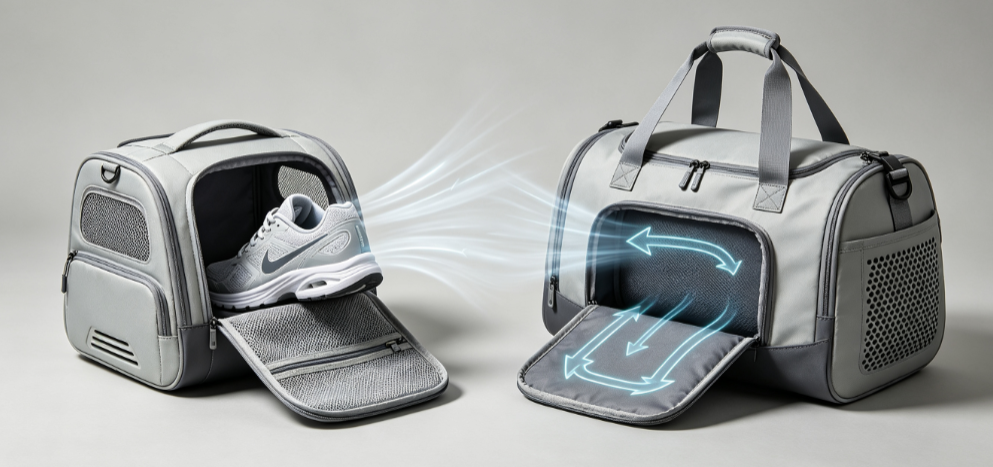
High-sweat, high-frequency use calls for mesh panel or full ventilated compartment designs. Open-weave mesh structures promote continuous air exchange and reduce odor buildup faster than any other approach. Cross-ventilation beats single-side venting. One-sided holes create dead zones where moisture stalls, so passive airflow needs an intake and outlet on opposite panels to move air through the compartment.
Hole size still matters here. Openings under 2–3 mm noticeably restrict airflow, while oversized mesh lets odor escape into the main bag. A common high-performance setup pairs an outer mesh layer with an internal separator to contain smell while keeping airflow open. Full mesh alone breathes better but leaks scent faster. PUMA’s training bags spec an external shoe section with ventilation, and Aer’s gym bags use a ventilated shoe compartment sized for men’s shoes up to size 13, both real-world benchmarks for this category.
Travel Shoe Bags: Balance Airflow With Dust Protection
Travel use needs localized mesh. A protective outer shell (Oxford cloth, TPU mesh, ripstop nylon, or polyester) handles dust and abrasion resistance, while a breathable non-woven mesh lining underneath manages slow moisture release. Ventilation windows here run smaller, with 0.8–1.2 mm micro-perforations that control airflow without sacrificing dust protection.
Double-walled construction with a 3–5 mm air gap between layers is the stronger travel spec, slowing moisture migration into the main compartment. Vented panel designs cut internal relative humidity by up to 40%. Adding a bottom-drain grommet with a removable mesh panel supports drainage and easy cleaning. One referenced test showed 92% less microbial growth after 14 consecutive days of use with this combination.
Premium Retail Bags: Hide the Ventilation
Retail-facing SKUs need airflow without visible mesh breaking the aesthetic. Hidden vents, micro-perforated zones, or breathable linings placed on interior surfaces solve this. Outer material stays high-density, matte, or PU-coated for shelf appeal, while venting moves to concealed windows or side liners. When requesting, use terms like ventilated shoe compartment, breathable lining, micro-perforated ventilation zone, hidden vent or concealed mesh window. Aer applies this logic with ventilated mesh compartments; PUMA leans toward exposed venting for sport-forward lines.
Quick Matching Guide
|
Use Case |
Recommended Ventilation |
|---|---|
|
High-sweat/training |
Full mesh panel or cross-vented compartment |
|
Travel/dust-sensitive |
Localized mesh + protective shell + micro-perforated lining |
|
Premium retail |
Hidden vent, concealed mesh, or breathable lining |
MOQ, Lead Time & Customization Workflow for Bulk Ventilated Shoe Bag Orders
Budget and timeline questions come up before hole size or mesh GSM ever do. Most custom shoe bag manufacturer programs start at 50–100 pcs per design for first orders. Customized ventilated builds—special fabric, perforation tooling, multi-round sampling—push MOQ toward 300–500 pcs, sometimes 500–1,000 pcs.
Standard workflow:
-
RFQ intake — size, material, ventilation method, logo, ship date
-
Quotation — locked once material and print coverage are confirmed
-
Sampling — 3–10 days for structure and appearance approval
-
Golden sample sign-off + deposit
-
Material booking — 5–12 days
-
Bulk production — 15–25 days standard, 25–40 days for perforated/mesh builds
-
Inspection + packing — 2–5 days
-
Shipping — air 5–10 days, sea 25–40 days
Perforation and mesh panels sit in the highest cost-impact tier alongside special fabric and Pantone-dyed colors, so budget for extra sample rounds.