
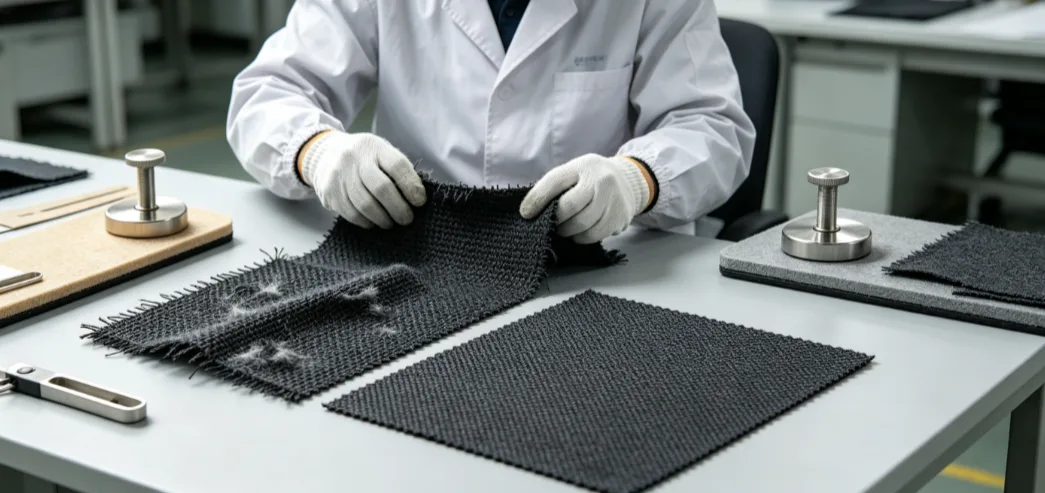
A supplier quotes you 600D polyester and calls it “premium-grade.” Another offers 900D and charges 30% more. Which one actually survives baggage handlers, monsoon season, and three years of daily commuting? If you’re nodding along, you’ve already run into the industry’s dirtiest secret: higher denier doesn’t mean better performance. Understanding how fabric weight affects custom travel bag performance is the difference between a smart sourcing decision and an expensive mistake. This guide covers what GSM and denier numbers really tell you, how 420D holds up against 1680D in real durability tests, why coating matters more than thickness for waterproofing, and how to translate all of that into a supplier spec sheet that gets you exactly what you’re paying for.
GSM vs Denier: The Two Core Concepts You Must Understand Before Sourcing Custom Bags
Two numbers get thrown around in every fabric quote, and most buyers confuse them.
Denier (D) measures yarn thickness — how much a 9,000-meter strand of yarn weighs in grams. So 600D means 9,000 meters of that yarn weighs 600 grams. Formula: D = fiber weight (g) ÷ length (9,000m).
GSM (grams per square meter) measures the finished fabric’s weight per square meter — how heavy and dense the actual woven cloth is.
Denier is like noodle thickness — a fatter noodle doesn’t guarantee a stronger dish; it depends on how it’s woven or pressed. GSM is the finished cloth on a scale — one square meter, weighed as-is.
Why “Higher Denier” Can Be Misleading
Two suppliers can both quote “600D,” yet deliver wildly different GSM: 200-230 gsm, 350-550 gsm, or 400-600 gsm — same denier number, very different fabric. The gap comes from weave pattern and coating, not the denier itself.
A tightly woven 600D fabric can outperform a loosely woven 1680D fabric in real durability tests. Denier only tells you yarn thickness, not weave density, coating, or final strength.
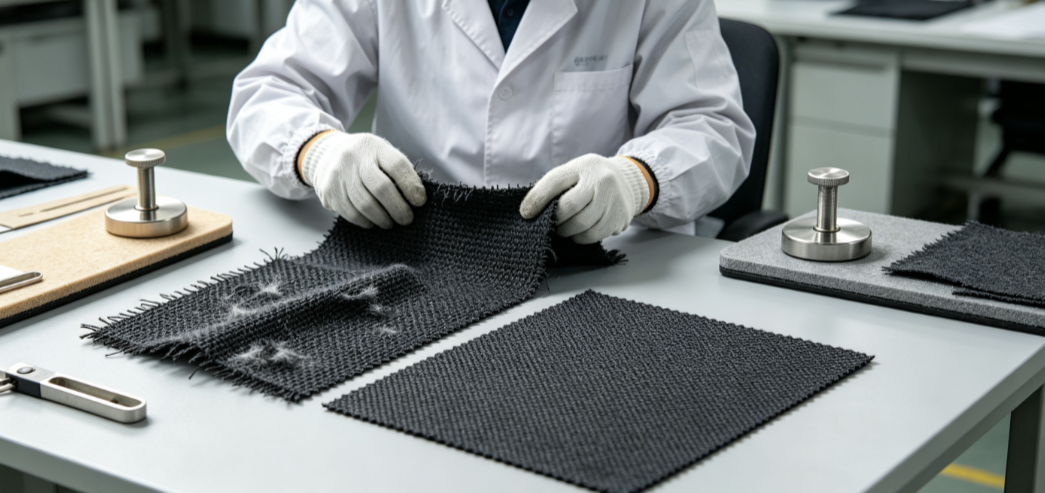
Coating matters too. A 600D Oxford with PVC coating sits around 350-550 gsm, while PVC backing pushes it to 400-550 gsm. Same denier, different weight, and different waterproofing.
When quoting suppliers, always ask for the denier value, weave type (plain/oxford/twill/dobby), coating type (PVC/PU/TPE), tested finished GSM, and intended use case.
How Fabric Weight Affects Durability: A Real-World Comparison of 420D, 600D, 900D, and 1680D
Real durability testing shows a consistent pattern: as denier goes from 420D to 1680D, abrasion resistance and tear strength both increase. But the material behind that number matters just as much. At the same denier, nylon outperforms polyester. Nylon fibers stretch under stress and recover, so they resist sudden tears. Polyester holds its shape better dimensionally but wears down faster at equivalent weight. That’s why sourcing guides say that 600D nylon beats 600D polyester in real-world abrasion and tear tests, even though both carry the same denier label.
The 420D → 1680D Durability Ladder
-
420D: Lightweight to mid tier, common in everyday backpacks and travel totes. Typical Oxford construction runs 100-180 gsm depending on weave. Best for light loads, not heavy dragging or repeated airline handling.
-
600D: The durability-cost sweet spot. Strong enough for commuter bags and short-trip luggage, and where nylon vs polyester differences start showing up clearly in wear tests.
-
900D: Classified as “heavy-duty” in most buyer guides. Built for tool bags, work packs, and gear that gets thrown around or dragged across rough surfaces regularly.
-
1680D: The heavy-duty ceiling. Common in ballistic luggage and motorcycle gear where structural integrity under repeated abuse is non-negotiable.
Abrasion Resistance Textile: The Numbers That Matter
Standard Martindale abrasion testing shows these differences:
-
1680D ballistic nylon: 50,000+ Martindale cycles, the benchmark for premium hard-wearing softside luggage.
-
1000D nylon: 50,000-100,000 abrasion cycles, compared to roughly 60,000 cycles for 1000D polyester at the same denier.
-
Standard plain-weave nylon: often only 10,000-15,000 cycles, a fraction of ballistic-grade performance.
-
600D polyester: noticeable wear typically begins around 10,000-12,000 cycles, though weave and coating shift this range significantly.
What This Means for Your Sourcing Decision
Tear resistance fabric and abrasion resistance textile performance don’t scale purely with denier. They scale with denier, fiber type, and weave density combined. If you’re sourcing for airline-checked luggage or gear that faces daily rough handling, 1680D ballistic nylon justifies its premium. If you’re building lightweight commuter bags, 420D-600D nylon delivers sufficient durability without the added weight and cost. Never sign off on a spec sheet based on denier alone. Request the weave type and Martindale/Taber cycle rating alongside it.
The Real Relationship Between Fabric Weight and Waterproofing: Coating Matters More Than Denier
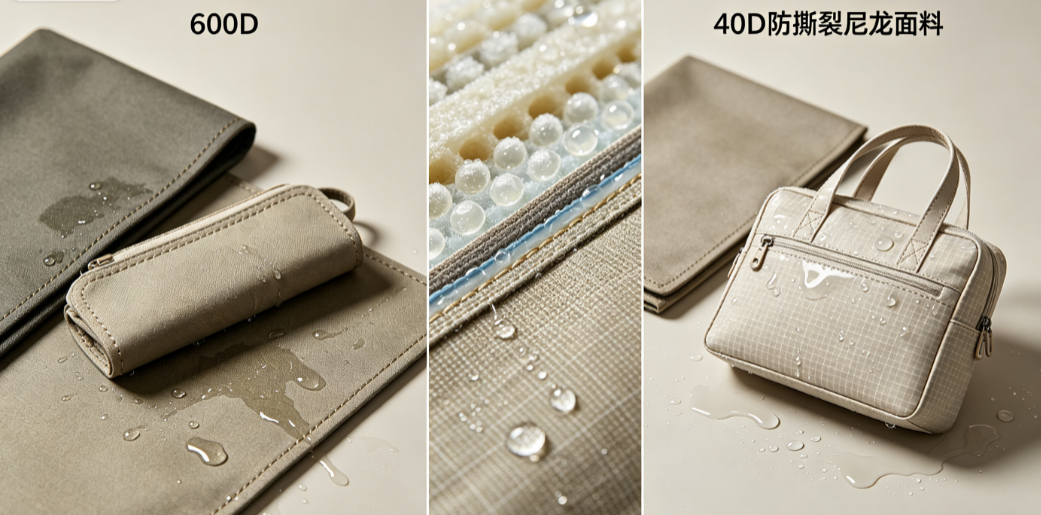
Coating determines waterproofing, not fabric weight. A 600D fabric can leak like a sieve while a 40D ripstop outperforms it in the rain. The real predictor is hydrostatic head rating (mm), coating type, and seam sealing, not the denier number printed on the spec sheet.
Hydrostatic Head Is the Number That Matters
Without a water column (hydrostatic head) rating, waterproof fabric weight claims mean nothing:
-
Around 1,000 mm: basic water resistance, not true waterproofing
-
1,500 mm+: acceptable rain protection threshold
-
5,000 mm: holds up under sustained rainfall
-
10,000 mm+: high-performance waterproof grade
A 200D fabric and a 600D fabric can both fail or pass at any of these thresholds. The denier tells you yarn thickness. It says nothing about what’s coated onto the surface.
PU vs PVC: Where the Real Difference Lives
PU coating is typically rated 1,500–10,000+ mm hydrostatic head. It’s common on backpacks, light outdoor gear, and travel bags. Lighter PU coating weights (50–120 g/m² add-on) usually sit around 1,000–1,500 mm — soft, flexible, but modest waterproofing. PVC coating often exceeds 10,000 mm, delivering near-complete waterproofing. The tradeoff is added weight and a stiffer hand-feel. Lamination and taping matter more than raw denier. A fabric can pass hydrostatic testing yet still leak through unsealed stitch lines. Taped or heat-welded seams close that gap.
Ripstop Fabric Bags: Light Doesn’t Mean Waterproof
Ripstop provides tear resistance. Waterproofing depends on the coating and seam sealing. A 40D ripstop nylon with PU coating and taped seams can hit 108 gsm, 10,000 mm hydrostatic head, and 10,000 g/m²/24h MVTR. That outperforms untreated 600D fabric while weighing a fraction as much.
Questions to Ask Your Supplier
-
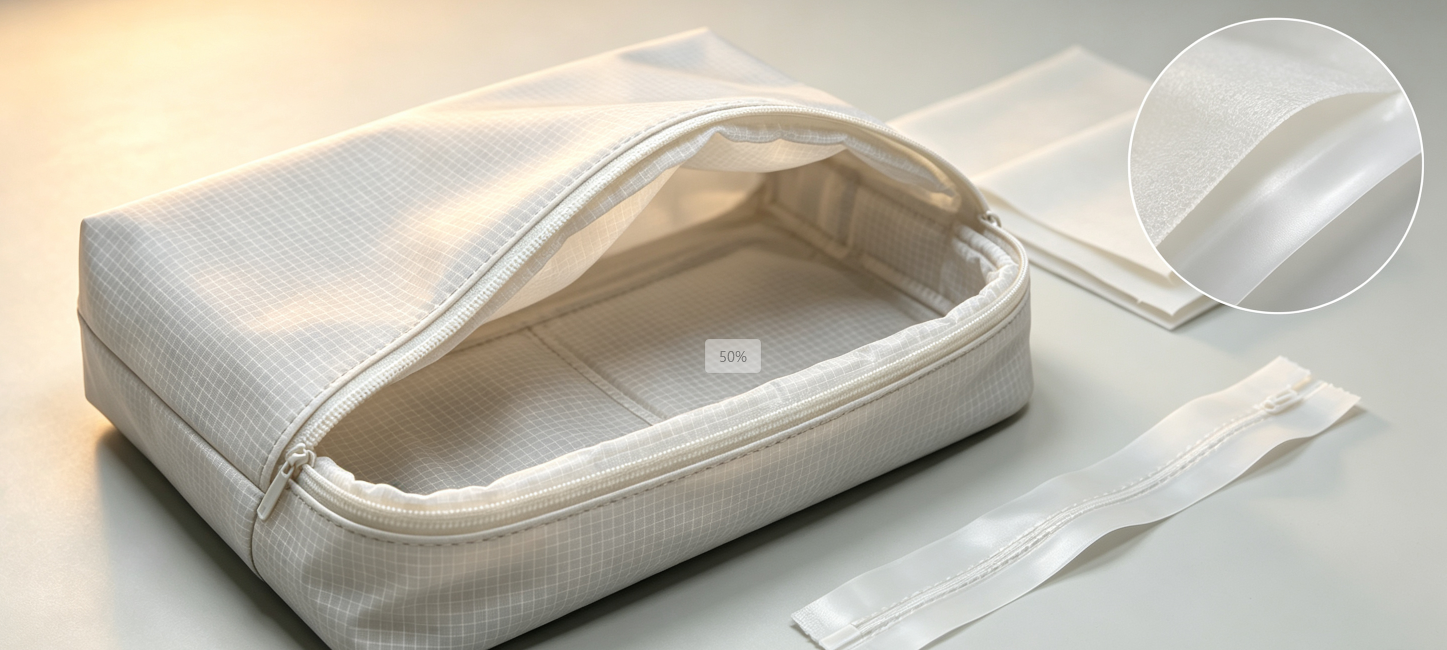
What’s the hydrostatic head rating (mm), and was it tested to ISO 811 or AATCC 127?
-
Is the PU single-layer or double-layer? Is there a TPU membrane laminated on top?
-
Are seams taped or heat-welded, or just stitched?
GSM in textile discussions often stops at weight. For waterproofing, that’s the wrong stopping point — coating type and seam construction decide whether your bag survives monsoon season or leaks on day one.
Fabric Weight’s Impact on Finished Bag Weight and Carrying Comfort
Here’s a formula every buyer should keep on hand: fabric net weight (kg) ≈ GSM × unfolded area (m²) ÷ 1,000. Add zippers, webbing, buckles, lining, foam, and the carry system on top, and you get your finished bag weight.
For reference, a 20L carry-on uses 1.0–1.4 m² of outer fabric, while a 40L travel bag needs 1.6–2.2 m². That means outer fabric alone contributes 0.10–0.55 kg on a 20L bag and 0.16–0.88 kg on a 40L bag, depending on whether you’re running 100 or 400 GSM.
GSM Ranges Mapped to Real Use Cases
-
100–130 gsm: ultralight, ~150–195g at 1.5m² — packable totes, stuff sacks
-
180–220 gsm: light structure, ~324–396g at 1.8m² — daily commuter packs
-
280–340 gsm: durable, holds 5–8kg loads, ~560–680g at 2.0m² — retail/travel bags
-
340–500 gsm: heavy-duty, ~748–1,100g at 2.2m² — tool bags, reinforced canvas luggage
In denier terms: 200–400D Oxford polyester lands around 180–350 gsm, while 500–840D ballistic nylon runs 330–500 gsm. Moving from 200D to 600D/840D adds weight across multi-panel designs, not just durability.
Fabric’s Share of Total Bag Weight
Outer fabric isn’t the whole story, but it’s a bigger slice than most buyers assume:
-
20L bags: fabric = 20–45% of net weight
-
40L bags: fabric drops to 15–35%, but each GSM step adds more absolute grams due to larger surface area
Concrete example: a 20L bag at 200 gsm carries about 180–280g of outer fabric. Bump that to 340 gsm and it jumps to 306–476g — a 126–196g increase from the outer layer alone.
The Comfort Tradeoff
Every 100g added to base bag weight is noticeable on bags under 20L, where empty-bag try-ons and loaded carrying both amplify small weight differences.
Decide where weight budget goes instead of chasing the lowest GSM. Lightweight fabric (180–240 gsm) frees up budget for thicker shoulder-strap foam, a supportive backpanel, or a padded hip belt. Heavy fabric (280–400 gsm) buys structure and abrasion resistance, but the wearer feels it as “stiff” and “dense.”
Practical positioning for sourcing conversations:
-
200D / 180–220 gsm → lightweight-durable balance, ideal for commuter and carry-on lines
-
600D / 300–350 gsm → durability-first positioning, accepts added weight for structure
Sourcing checklist: Lock your target bag’s unfolded surface area first. Calculate outer fabric weight using GSM × area. Set a finished-weight ceiling before approving any fabric upgrade — otherwise “more durable” becomes “too heavy.” For 20L carry-ons, stay in the 180–240 gsm range. For 40L travel bags prioritizing wear resistance, 280–340 gsm works as long as lighter trims offset the difference elsewhere.
The Quantified Relationship Between Fabric Weight and Sourcing Cost: 420D vs 600D vs 900D Price Comparison
Price tags rarely move in a straight line with denier. Public supplier quotes for 420D Oxford-grade fabric fall between $0.40–0.90/m (MOQ 1,000m), sometimes reaching $0.88–0.95/m. Push to 600D and the range widens to $0.40–1.50/m, with platform samples touching $0.58–2.88/yd. Go heavier still, and 900D lands around $0.70–1.50/m, while 1680D runs $1.00–1.20/m, though premium ballistic-grade samples can hit $1.80–2.60/m or $10.98/linear yard at retail.
The Real Increase Isn’t 1:1
Denier climbs faster than price. One documented case shows 420D at 215 rub/m jumping to 600D at 285 rub/m, a 32.6% increase. Denier rose 43%, so the price hike didn’t keep pace. Using platform medians: 420D ≈ $0.65/m, 600D ≈ $0.95/m, 900D ≈ $1.10/m, 1680D ≈ $1.10–1.30/m.
Weight Drives Shipping Costs Too
Heavier rolls cost more to ship. One UK freight schedule charges £4.99 under 1kg, £5.99 for 1–2kg, £7.99 for 2–2.5kg, plus a £14 bulky surcharge above 2.5kg. Jump from 420D (140–170 g/m²) to 900D (370 g/m²) and fabric weight roughly doubles (2.18x), pushing many shipments into the next pricing tier.
Simple Landed-Cost Formula
Total cost = (unit price × meters) + coating add-on (5–25% of base price) + weight-tiered freight + 3–8% loss/packaging buffer. Calculate fabric weight first: GSM × area (m²) ÷ 1,000. This number decides which freight bracket you land in before coating or MOQ discounts apply.
Choosing Fabric Weight by Use Case: A Selection Guide from Carry-On Bags to Heavy-Duty Tool Kits
Skip the spec sheet debate and start with the use case. Most B2B buyers overspend on denier because they never map fabric weight to how the bag gets used — carried, dragged, checked, or thrown in a truck bed. Match the scenario first, then let denier follow.
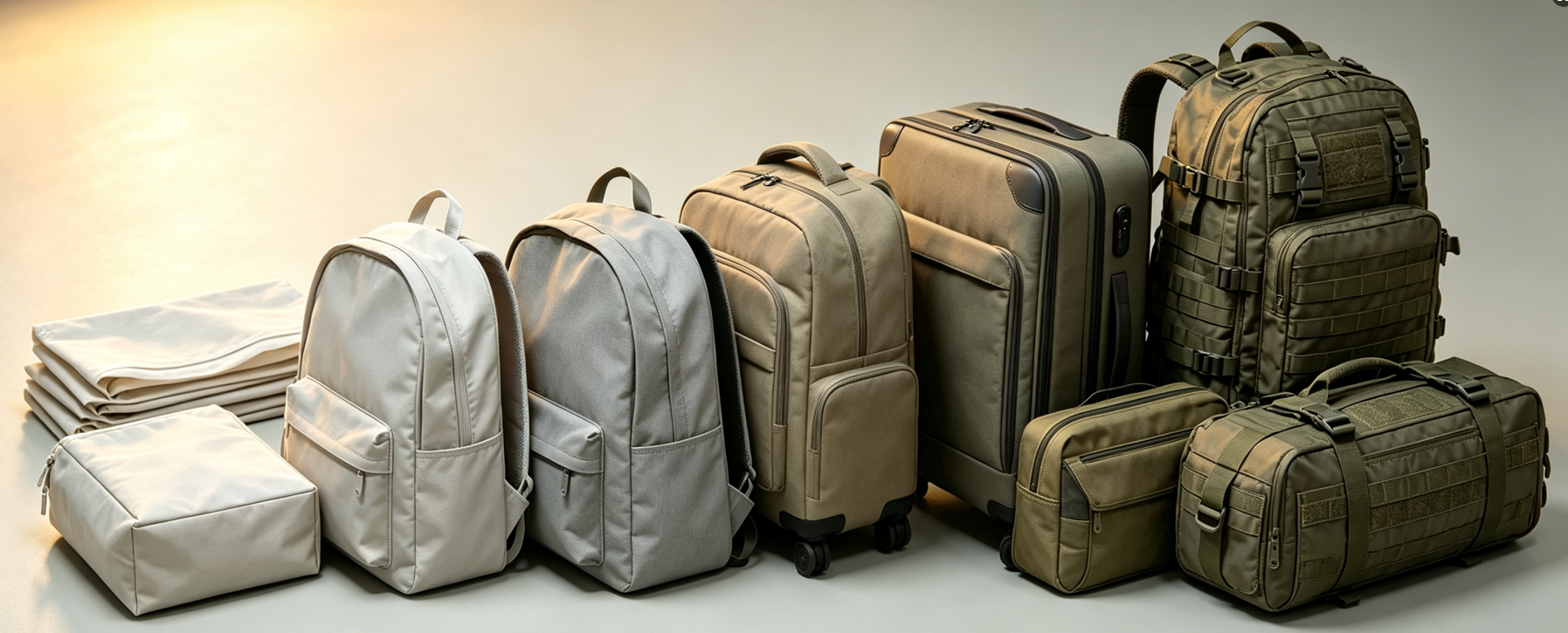
Four Weight Tiers by Use Case
-
210D–420D (carry-on and lightweight EDC). Best for business travelers, packable weekenders, and branded giveaway bags. Lightweight polyester, nylon, or ripstop keeps volume and weight down when loads stay light.
-
420D–600D (commuter and daily backpacks). The sweet spot for laptop bags, student packs, and city commuter lines. 600D polyester or 420D nylon balances stiffness, cost, and everyday abrasion resistance.
-
600D–900D (checked luggage, outdoor, and tool bags). Industry convention treats 600D as the minimum threshold here. Hard-shell luggage bodies often step up to 1200D–1680D polyester or ballistic nylon for structural drag resistance.
-
1680D (tactical and heavy-load gear). Reserved for tactical packs, military-style bags, and professional tool storage facing constant tearing and scraping.
Hybrid Construction Cuts Cost Without Cutting Durability
Reinforcing only stress points is standard practice in custom bag production:
-
600D body + 1680D base panel common on travel bags to survive floor dragging without adding weight everywhere.
-
420D body + 600D/1680D reinforced zones used on commuter and laptop bags at straps, handles, and corners.
-
900D body + 1680D at corners and zipper tracks typical for tool bags and tactical packs under repeated abuse.