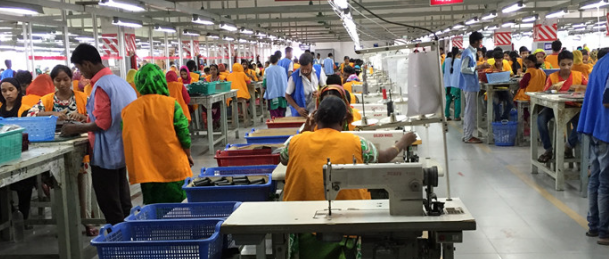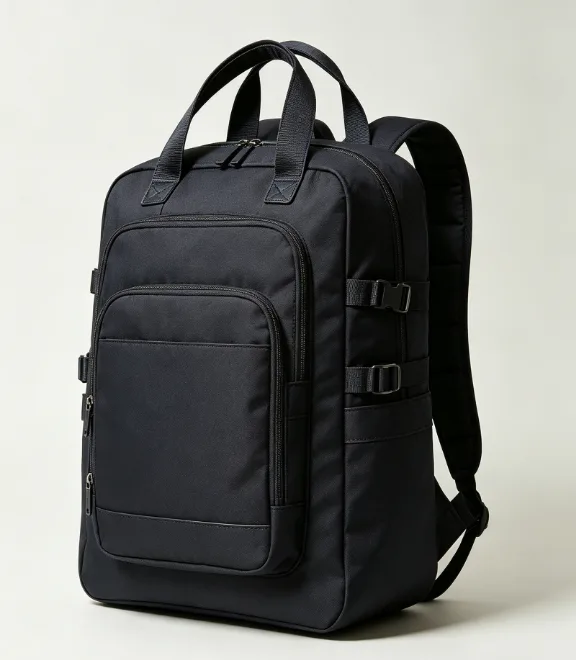
Every custom bag order forces a trade-off: lightweight fabric that shaves off grams often can’t survive baggage handlers, and material tough enough for years of abuse usually adds cost your margins can’t absorb. If you’re sourcing for a new product line or vetting a manufacturer’s material list, guessing between nylon vs polyester travel bag options—or trying to decode what a “600D” spec sheet means for real-world performance—can turn into an expensive mistake once production runs at scale.
Understanding The Weight-Cost-Durability Triangle In Travel Bag Materials
No single fabric wins on all three fronts. In wholesale bag sourcing, weight, cost, and durability pull against each other. Push one variable and at least one of the other two shifts too. Understanding why this happens is the first step to making a defensible material decision instead of guessing.
Why the trade-off exists:
-
Lighter materials use thinner structures or lower fiber density, which weakens abrasion and tear resistance unless offset by coatings or higher-denier yarns.
-
Durable materials need stronger yarns, thicker shells, or premium polymers—raising both cost and weight.
-
Cheaper materials use simpler construction, which typically shortens real-world lifespan.
The cost impact is not linear. Materials account for 30–55% of total bag manufacturing cost, so small upgrades can swing final pricing significantly:
|
Material Upgrade |
Material Cost Increase |
Final Bag Cost Increase |
|---|---|---|
|
600D → 1680D polyester |
+20–30% |
+10–15% |
|
Polyester → nylon |
+40–60% |
+20–25% |
|
ABS → PC shell |
+35–50% |
+15–20% |
Weight vs. durability benchmarks for a 28-inch bag tell a similar story:
|
Material |
Weight |
Durability Score |
|---|---|---|
|
Polycarbonate hard-shell |
7–9 lbs |
9/10 |
|
Ballistic nylon soft-shell |
8–10 lbs |
8/10 |
|
Ripstop polyester |
6–8 lbs |
6/10 |
|
ABS plastic |
10–12 lbs |
5/10 |
|
Aluminum |
12–15 lbs |
10/10 (impractical for most uses) |
Denier is the technical lever most buyers overlook. Lower denier means lighter and cheaper but less durable; higher denier adds weight and cost but improves abrasion resistance. A common upgrade path is 600D to 1200D or 1680D polyester when durability complaints outweigh cost concerns, without jumping straight to a pricier material family.
Nylon vs Polyester vs Canvas: Core Material Comparison
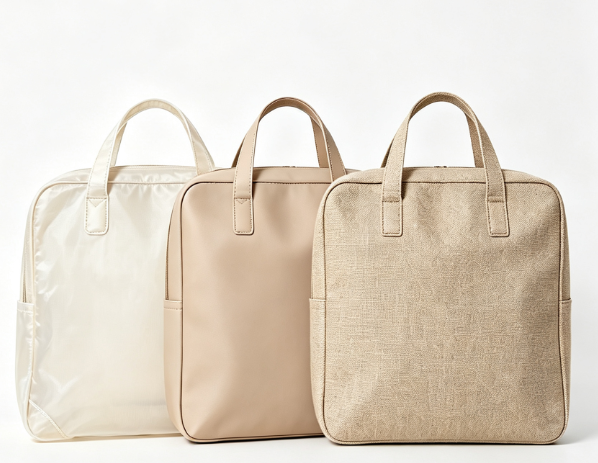
Three fabric families cover almost every custom bag spec sheet, and each one solves a different problem. Nylon gives you the best strength-to-weight ratio on the market. When abrasion resistance and low bulk matter more than unit price, it’s the go-to. Polyester trades a fraction of that raw toughness for better UV resistance, faster drying, and a lower price tag, which is why it dominates budget-to-mid-tier production runs. Canvas is the heaviest of the three, but nothing matches its rugged, premium feel for heritage-style or lifestyle bags.
Side-by-side comparison:
|
Material |
Weight |
Cost |
Durability |
Water Behavior |
UV Resistance |
Best Fit |
|---|---|---|---|---|---|---|
|
Nylon |
Lightest |
Mid–high |
Highest strength-to-weight |
Absorbs water; coatings help |
Fair–good |
Technical packs, travel, high-abrasion zones |
|
Polyester |
Light–medium |
Lowest |
Very good, slightly behind nylon |
Hydrophobic, dries fast |
Excellent |
Daily bags, branded promo, budget lines |
|
Canvas |
Heaviest |
Mid–premium |
Strong feel, lower strength-to-weight |
Soaks unless treated |
Moderate–good |
Fashion, heritage, glamping bags |
Denier benchmarks that translate spec sheets into real performance:
-
Nylon: lightweight builds run 30D–70D ripstop; performance bags push to 420D; heavy-duty packs often use 600D coated Oxford.
-
Polyester: common bag fabric denier sits between 200D–1000D—higher denier adds body and abrasion tolerance at the cost of weight.
-
Canvas: performance is driven more by weave density and treatment than fiber chemistry, expressed in thread-count-style ranges around 50–100.
A practical spec comparison: 420D nylon beats 600D coated polyester on pure weight-to-strength balance, but the polyester version holds color better for branding and costs less. That’s the trade-off buyers face in nylon vs polyester travel bag decisions.
Choose by priority:
-
Nylon — tear resistance, abrasion resistance, flex, low weight.
-
Polyester — UV exposure, water shedding, print consistency, cost control.
-
Canvas — rugged premium appearance and breathability, not ideal when weight or wet-weather performance is critical.
For waterproof bag material needs, coated nylon or coated polyester outperform untreated canvas every time.
How Denier And Coating Affect Weight, Cost, And Durability
Denier numbers show up on every spec sheet, but most buyers treat them as a black box. They shouldn’t. Denier mainly measures yarn thickness, so as the number climbs, fabric weight and abrasion durability generally climb with it. In practical sourcing terms, 210D sits at the light end, 420D lands mid-weight, and 1000D marks heavy-duty territory. That said, denier alone doesn’t guarantee finished-fabric strength. Weave pattern, fiber type, and coating all shift the final outcome, which is why two 600D fabrics from different mills can perform differently.
The numbers tell the story. 1000D nylon weighs roughly double 500D nylon in the same construction, a near-linear relationship. On the cost side, jumping from 600D to 900D adds 15–25% to fabric cost in outdoor applications, and that 900D fabric weighs 35–45% more than 600D while lasting 1.8x longer under Wyzenbeek abrasion testing. Per-yard pricing follows the same curve: 210D runs $2–4/yard, 600D climbs to $6–10/yard, and 1680D reaches $15–25/yard.
Coating changes the equation further. PU coating stays lighter and more flexible, offers moderate water resistance, and costs less than PVC lamination. PVC delivers stronger waterproofing (IPX6–IPX8 in one benchmark) but adds weight and stiffness, with a lower eco-score than TPU alternatives. TPU film sits in between: IPX7–IPX8 protection, medium weight, but a $$$ price tag. More coating thickness always means better waterproofing and heavier, stiffer fabric. There’s no way around that trade-off.
Durability doesn’t stop at fabric. Bags fail at seams, stress points, and hardware just as often as at the shell itself. Heavier fabric is slower to sew, and mismatched stitching can erase the benefit of a higher denier upgrade. Treat fabric, coating, and reinforcement as three separate layers of durability, not one.
Quick buying rule: cost-sensitive products start at 210D–420D with PU coating; balanced products land at 600D–900D; abrasion-heavy use justifies 1000D+ despite higher fabric, coating, and sewing costs.
Material Selection By Budget Tier: Entry, Mid-Range, Premium
Budget tier determines your material stack before you even open a spec sheet. Sourcing managers who treat entry, mid-range, and premium as three distinct playbooks instead of one sliding scale end up with fewer costly reworks.
Entry Tier (High Volume, Low Cost)
-
Shell: 600D polyester, often with a denser weave to hold baseline abrasion resistance without raising unit price.
-
Reinforcement: Double-layer patches at corners, base, and strap attachment points, plus bar-tack stitching at stress zones. This is the cheapest way to extend lifespan without upgrading fabric.
-
Coating: Basic PU coating with simplified water-repellent finish. This handles daily splashes, not sustained exposure.
-
Cost logic: One dominant fabric across most panels, standardized hardware, minimal decorative layers. Reinforce only high-wear points; skip everything else.
Mid-Range Tier (Balanced Performance)
-
Shell: 420D–840D nylon. 420D stays light and soft-handed; 840D adds structure and wear resistance. Many mid-tier bags mix both, with a lightweight main body and higher-denier base and sides.
-
Coating: PU or double-PU coating with localized DWR treatment. It balances weight, feel, and cost more evenly than entry-tier finishes.
-
Structure: Thicker foam or mesh at straps and back panels for comfort; mid-grade zippers and buckles to cut warranty returns.
-
Cost logic: Budget goes where users notice it most: weight, zipper smoothness, and strap comfort. Subtle color-blocking or piping gives a premium look without premium cost.
Premium Tier (Brand Equity, Long-Term Durability)
-
Shell: 500D–1000D Cordura or ballistic nylon for maximum tear resistance and a durable, “built-to-last” feel.
-
Accents: Canvas, PU or genuine leather trim, and metal hardware reinforce brand positioning at every touchpoint.
-
Structure: Full-panel reinforcement at wear zones, rigid internal framing, and top-spec zippers throughout.
Quick Rule: Entry < Mid-range < Premium in cost, but the real gap comes from stacking fabric spec, coating quality, hardware grade, and reinforcement labor, not from the base material alone.
How To Choose Based On Your Top Priority
Sourcing teams waste weeks scoring materials against ten criteria when only one matters for their product. Fix that by naming your single top priority first, then use it to eliminate anything that fails as a dealbreaker before you compare specs.
Three routing questions before you touch a spec sheet:
-
Is this decision reversible? If you can swap suppliers or adjust the next production run, move fast. If you’re locking into a 12-month contract, slow down and gather more data.
-
What are the stakes? A promotional tote carries different risk than a flagship travel line. Higher stakes justify pulling in more stakeholders and running formal weighted scoring.
-
How much time do you have? Tight launch timelines favor quick, intuitive routing over exhaustive comparison.
Decision-tree logic by priority:
-
Weight is top priority → narrow to 210D–420D nylon first, then check durability within that range.
-
Cost is top priority → narrow to coated fabrics or lower-GSM canvas, then verify minimum durability thresholds.
-
Abrasion resistance is top priority → go straight to Cordura or ballistic nylon durability, skip lighter options entirely.
-
Waterproofing is non-negotiable → treat it as a dealbreaker. Only evaluate waterproof bag material constructions.
-
Premium aesthetics is the goal → filter by surface finish, texture, and handfeel before cost enters the conversation.
Weighted scoring for close calls:
When two materials both clear your dealbreakers, use a simple template: weight 40%, cost 25%, durability 25%, appearance 10%. Rate each option 1–10 per criterion, multiply by weight, and total the scores. Highest total wins, so no more circular debate in sourcing meetings.
Common Material Selection Mistakes And How To Avoid Them
Most sourcing failures trace back to a handful of repeatable errors, not bad luck.
Fixating on one spec. Buyers lock onto denier or unit price and skip load conditions, climate exposure, and maintenance reality. A fabric that tests fine in a lab can still fail early if humidity, salt exposure, or handling stress weren’t factored in.
Chasing the lowest unit cost. Cheap material that triggers rework, returns, or warranty claims costs more over the product’s life. Total cost of ownership—not the purchase invoice—should drive the decision.
Copying last season’s spec sheet. Reusing an old bill of materials skips new use cases, updated compliance rules, and current supply conditions. That compounds a bad choice into the next production run.
Ignoring manufacturing constraints. A fabric can perform well on paper and still break the production line. Wrong seam radius, poor stitchability at higher denier, or incompatible coating pretreatment all raise cost or delay launch.
Missing the supplier checklist. Before confirming any custom bag manufacturer material options, lock down: material grade/standard, service environment, reinforcement locations, coating compatibility, certification requirements (RoHS/REACH), and backup supplier availability. Skipping this list is where rework, complaints, and inventory pileups usually start.
First-Time Custom Travel Bag Order: A Safe Starting Material Recommendation
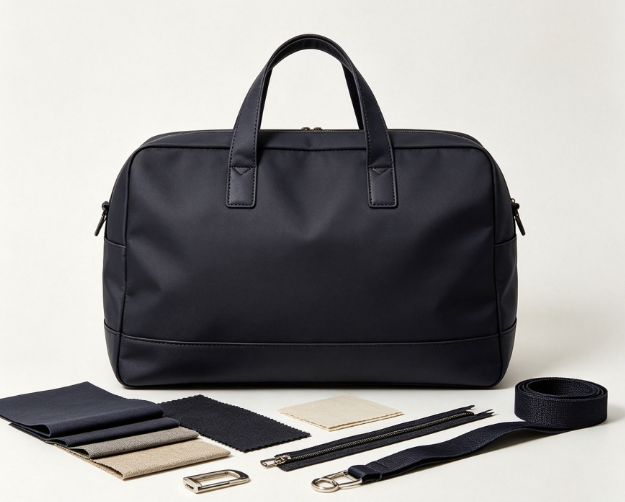
Skip the analysis paralysis on your first run. 420D nylon with PU coating balances light weight, everyday durability, water resistance, and controllable cost. Most factories will quote it at an MOQ of 300–600 pcs—low enough risk for a first collaboration.
Use this three-stage upgrade path:
Stage 1: 420D nylon + PU for first orders and market testing. Validate shape, capacity, zipper spec, and branding before spending more.
Stage 2: 600D polyester as a budget-oriented or structure-focused alternative once demand is confirmed.
Stage 3: 1000D Cordura or ballistic nylon for durability in outdoor/heavy-duty positioning, justified only after real usage data comes in.
Before sampling, send inquiries to 2–3 factories with bag type, quantity, and material preference. Request swatches first. Fabric feel and coating quality can’t be judged from a spec sheet. Run 10–20 sample pieces to check sewing and finishing before committing to bulk.