
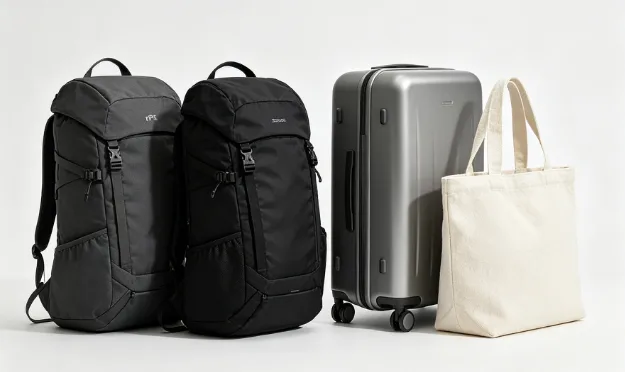
Every discarded plastic bottle tells a story of untapped potential. For the travel bag industry, that potential is reshaping how brands think about durability, performance, and environmental responsibility. As sustainability shifts from marketing buzzword to purchasing criterion, more brands and OEM buyers are asking if recycled performance fabrics can actually match the abrasion resistance, waterproofing, and structural integrity that traditional nylon and polyester have long delivered.
The answer lies in understanding the science behind RPET fabric for bags, recycled nylon weaves, and the certification systems like GRS that separate genuine eco-innovation from greenwashing. This guide breaks down how these materials are engineered, how they perform against conventional fabrics under real-world stress, and what sourcing decisions matter most when selecting a sustainable bag manufacturer for your next product line. Whether you’re evaluating suppliers or curious about what’s inside your next travel bag, you’ll get the technical clarity you need.
What Are Recycled Performance Fabrics? A Core Concept Breakdown
Two words define this category. “Recycled” means the raw material comes from pre-consumer or post-consumer waste. “Performance” means the fabric still has to hit functional benchmarks required for real-world use — it can’t just wear an eco-label and stop there.
Uster’s industry standards say recycled materials can come from industrial scrap, pre-consumer waste, or post-consumer waste like PET bottles. But to qualify as “recycled,” fibers must go through a full reprocessing cycle: spun into yarn first, then broken back down into fiber material. This is what separates genuine recycled nylon travel bag components from loosely-labeled “eco” claims.
The Four-Stage Performance Threshold
To reach performance-grade status, a fabric must go through four stages, each meeting its own spec:
-
Fiber sourcing: PET bottles, textile waste, or other recycled feedstock
-
Yarn reconstruction: must meet tensile strength standards for spinning
-
Finishing: typically DWR (durable water repellent) coating or film lamination
-
Final performance: waterproofing, breathability, abrasion resistance, and elasticity must approach virgin-material levels
This is the core distinction from ordinary recycled fabric, which claims recycled fiber content. In a genuine sustainable material sourcing standard for bags, durability, strength, and protection all have to hold up.
A Detailed Guide to Common Recycled Performance Fabrics for Travel Bags
Four material families dominate the sustainable travel bag market today, each solving a different structural problem.
Recycled Polyester (rPET): The Softbag Workhorse
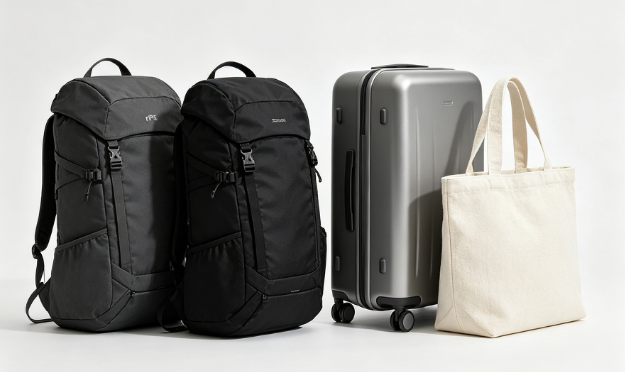
RPET fabric for bags comes primarily from discarded PET bottles and industrial PET scrap, spun into yarns that match virgin polyester in durability, waterproofing, and tear resistance. Common formats include 600D rPET oxford (mid-to-high strength, GRS-certified), diamond-check jacquard for shells, and lightweight rPET peach-skin or mesh for linings and breathable back panels. Pricing typically runs ¥40–90/meter for coated, high-performance grades. This makes rPET the default choice for softbag exteriors and liners.
Recycled Nylon: The High-Load Standard
Recycled nylon, best known through ECONYL®, is reprocessed from discarded fishing nets and industrial nylon waste. It’s treated as the gold standard for technical bags because its performance is virtually identical to virgin nylon, with the same tensile strength, abrasion resistance, and weight-to-strength ratio. With PU or TPU coating, it delivers equivalent waterproofing too. In durability comparisons, nylon consistently outranks polyester, so 420D–840D recycled nylon oxford is the go-to for hiking backpacks, expedition bags, and high-wear base panels.
Recycled Hardshell Plastics: Impact Protection
Hardshell luggage relies on recycled PC and ABS, sourced from consumer and industrial plastic waste. Covestro’s “recycled water bucket into suitcase” project proves the concept: shredded PC buckets are re-extruded and injection-molded into fully functional shell luggage. PC+ABS composite shells, priced around ¥40–90/panel-equivalent, balance lightweight construction with impact resistance for repeated travel cycles.
Recycled Cotton and Canvas Blends
For casual travel bags, rPET-cotton blends (60–70% rPET / 30–40% cotton) or rPET-hemp mixes add breathability and tactile comfort while retaining durability.
RPET vs. Recycled Nylon: Breaking Down the Manufacturing Process
Every roll of RPET fabric for bags sits behind a nine-step industrial chain that most buyers never see. Each stage is a quality checkpoint. Skip one, and the fabric’s strength or waterproofing suffers.
From Bottle to Yarn: The RPET Pathway
The process runs from collection to sorting to debaling to label removal and washing, then through flake production, melt filtration and pelletizing, spinning, drawing and twisting, weaving or knitting, and finally dyeing and finishing.
Collected bottles get compressed into bales, then debaled and manually sorted by material type. Clear bottles are prioritized for food-grade recycling, while colored bottles get diverted into fiber production. After washing and delabeling, bottles are shredded into flakes, then melted at high temperature with degassing to remove moisture and volatile contaminants. The melt passes through filtration screens, gets pelletized, then undergoes drying and solid-state polymerization (often nitrogen-assisted) to boost fiber properties.
In spinning, molten polymer extrudes through spinnerets. Some facilities pull 120 fibers simultaneously at roughly 280°C, each strand about one-tenth the diameter of human hair. Drawing increases tensile strength, cooling sets the fiber, and twisting forms usable yarn before weaving or knitting into fabric. One bag typically uses 2–3 recycled bottles, cutting carbon emissions by 50–70% versus virgin polyester.
From Fishing Nets to Fiber: The Recycled Nylon Route
Recycled nylon’s advantage is chemical depolymerization and repolymerization. This makes it perform closer to virgin nylon than mechanically recycled alternatives.
The route goes through collection and sorting, pretreatment, depolymerization, purification, repolymerization, melt spinning, drawing, and weaving or finishing.
Waste fishing nets, discarded carpets, and industrial nylon scraps are graded by material and contamination level first. Pretreatment removes salt, sand, metal fragments, and debris. This is critical for ocean-sourced nets, which carry heavier salt and oil residue than factory waste. Depolymerization breaks nylon’s polymer chains back into monomers; purification then strips out dyes, oils, and degradation byproducts. The purified monomers get repolymerized into nylon resin, then melt-spun, drawn, and woven.
Quality control differs by material. RPET production watches flake contamination, degassing efficiency, and filtration. Recycled nylon production watches monomer purity and repolymerization stability. That separation marks a reliable sustainable bag manufacturer from one cutting corners.
Green Finishing Techniques Worth Knowing
Low-water dyeing uses fiber-first, dye-later sequencing to reduce repeated washing cycles during fabric formation. Fluorine-free DWR is applied post-weaving as a functional finish that delivers waterproof recycled fabric performance without PFAS chemicals.
Recycled Fabric vs Traditional Fabric: Performance Comparison Data
Numbers settle debates that marketing copy can’t. Independent testing puts recycled performance fabrics against virgin materials.
Tensile & Tear Strength
Virgin polyester breaks at 3.8–5.5 cN/dtex. Recycled polyester runs 5–10% lower because shorter molecular chains and fiber length weaken it. Tear strength drops by the same 5–10% under matched yarn count and weave structure. For heavy-duty gear like backpacks, 100% recycled construction loses 5–10% of strength and abrasion resistance compared to virgin. The solution is a tighter weave density or blending with virgin fiber.
Abrasion Resistance
In high-stress Martindale or Wyzenbeek tests, virgin polyester holds a 20–25% edge in extreme conditions. For everyday travel use, recycled fabric performs adequately. The gap only matters at the margins.
Waterproofing
|
DWR Type |
Hydrostatic Pressure |
|---|---|
|
Traditional fluorinated DWR |
20,000–30,000 mmH₂O |
|
PFC-free DWR |
15,000–20,000 mmH₂O |
That’s a 20–30% pressure gap, but still well above the 10,000 mmH₂O threshold most travel bags need. After 20 wash cycles, PFC-free repellency drops 1–2 grades, making it roughly 10–20% less durable than fluorinated finishes.
Weight & Cost
Weight difference stays within ±2–3% at matched specs. Some mills add 3–5% more density to compensate for strength loss. Cost is the real gap. Recycled polyester greige fabric runs $0.5–1.5/meter higher, which translates to 25–50% higher costs for high-quality filament-grade rPET in 2026.
Environmental Payoff
Virgin polyester production burns 1.5 tons of oil and emits 5.5 tons CO₂ per ton. Recycled routes cut energy use by 50% and carbon output by roughly 32%, landing near 3.7 tons CO₂ per ton. Textile Exchange LCA data shows a 30–40% lower global warming potential for post-consumer PET-based recycled polyester. Water consumption doesn’t improve and can run slightly higher due to washing and sorting.
The Bottom Line
Recycled performance fabrics sacrifice 5–10% in raw physical metrics but deliver 30–40% carbon reduction. For most sustainable bag manufacturer applications — softbags, liners, casual travel gear — that trade-off is a non-issue. For extreme-duty gear, blending recycled and virgin fiber closes the gap while keeping the eco-credentials intact.
The Environmental Value and Circular Economy Significance of Recycled Performance Fabrics
Two hundred million beverage bottles went through a food-grade recycling program in China, cutting 38,000 tons of CO₂ in the process. That single project shows why recycled performance fabrics matter beyond marketing language — the numbers hold up.
Carbon Math Behind Every Bottle
Producing one ton of rPET fiber conservatively cuts 1.3–1.7 tons of CO₂ compared to virgin PET, based on German PET Recycling Team data (2.15 kg CO₂/kg virgin vs. 0.45 kg CO₂/kg recycled). Wider system-boundary estimates push savings to 2.5–3.2 tons CO₂ per ton. At bottle level, that translates to roughly 0.05–0.21 kg CO₂ avoided per bottle, depending on LCA methodology. A single travel bag using 2–3 recycled bottles isn’t a marketing footnote — it’s a measurable carbon offset.
Ocean Nylon Carries a Bigger Multiplier
Recycled nylon from fishing nets performs even better environmentally. Recovering one ton of waste fishing net nylon cuts roughly 5.7 tons of CO₂ equivalent versus virgin nylon production, an 80–90% carbon footprint reduction. Ghost fishing gear also accounts for 30–50% of ocean plastic weight in hotspot regions, tied to 30–60% of documented marine entanglement cases. Every ton of recycled net pulled from the water removes that risk at the source.
Closed-Loop Sourcing Is the Real Differentiator
Genuine sustainable material sourcing for bags depends on traceable, bottle-to-fabric or net-to-fabric loops, not loose recycled-content claims. A credible sustainable bag manufacturer should provide LCA carbon data per kilogram of fabric, verified recycling origin, and batch-level traceability linking finished bags back to source waste.
B2B Sourcing Essentials: Decoding Key Certifications like GRS/RCS/OEKO-TEX
You can tell a real GRS-certified fabric supplier from one that just slaps a green logo on the invoice by the paperwork. Under GRS v4.2, recycled content must hit ≥20% just to qualify for certification, and ≥50% before a supplier can legally put a GRS logo on the finished product. Any quote citing “GRS polyester” without a stated percentage isn’t a valid claim — ask for the number.
Verify the Certificates
Every link in the chain needs a Scope Certificate (SC), renewed annually and searchable on the certifying body’s public database. Every shipped batch needs a matching Transaction Certificate (TC) — invoices and contracts don’t substitute. TC numbers follow a year + certifier code + serial format (e.g., 2024-XXX-000123), and buyers should cross-check that the SC on file covers the shipment date. Quantity math matters too. 5,000 kg of finished fabric typically draws on roughly 5,250 kg of raw-material TC volume, accounting for about 5% processing loss. If an order’s volume outpaces its TC coverage, that’s a red flag. GRS’s own implementation manual recommends spot-verifying at least 10% of material suppliers for authenticity.
RCS vs. GRS: Choosing the Right Standard
RCS only verifies recycled content and chain-of-custody, with brand-set logo thresholds as low as 5%. GRS adds environmental management, chemical restrictions, and social compliance audits. Use RCS for trims and packaging; require GRS for core product lines needing full sustainability disclosure.
OEKO-TEX and bluesign®: The Chemical Safety Layer
OEKO-TEX Standard 100 caps formaldehyde, heavy metals, and azo dyes in finished goods. bluesign® governs chemical inputs upstream. Together with GRS, they confirm both process and product safety. Always request current certificates, not expired PDFs.
Sustainable Luggage Performance Standards (Abrasion Resistance / Waterproofing / Structure)
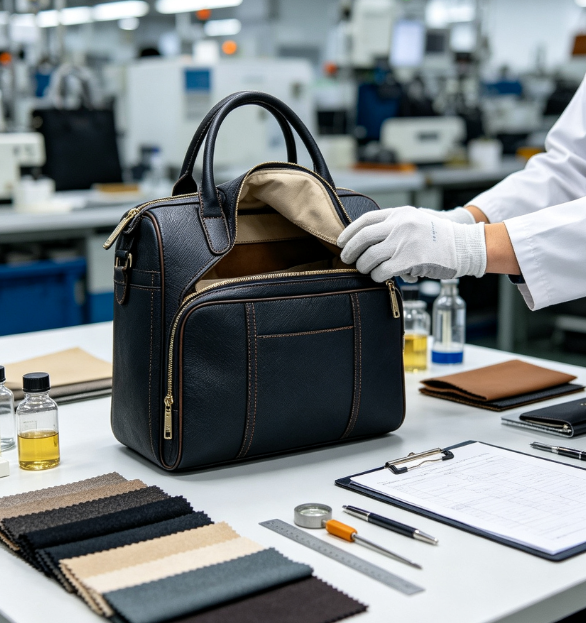
A recycled bag that breaks after ten trips defeats its own purpose. Sustainable material sourcing only counts when the fabric meets the same abrasion, waterproofing, and structural standards as any premium travel bag. Durability and eco-credentials aren’t separate checkboxes.
Abrasion Standards by Use Case
Fabric testing follows two main protocols: ISO 12947 / GB/T 21196.2-2007 (Martindale) for woven and knit shells, and ASTM D4060 (Taber) for industrial-grade wear checks.
|
Use Case |
Fabric Test |
Cycle Benchmark |
Wheel Wear |
|---|---|---|---|
|
Urban commuter bag |
ISO 12947 / ASTM D4966 |
≥10,000–20,000 cycles |
≥100,000 cycles |
|
Outdoor/expedition bag |
ASTM D4060 / high-grade Martindale |
≥25,000–50,000, up to 100,000 for heavy use |
≥100,000, dual-bearing soft wheels preferred |
QB/T 2917-2007 governs wheel abrasion testing specifically. A qualified suitcase wheel set should also stay under 45 dB running noise.
Waterproof Thresholds (ISO 811 Hydrostatic Testing)
-
Water-resistant: 1,000–5,000 mmH₂O
-
Waterproof: 5,000–10,000 mmH₂O
-
Highly waterproof: ≥10,000 mmH₂O
Commuter bags should target ≥1,500–5,000 mm; outdoor packs need ≥5,000 mm, with premium builds hitting ≥10,000 mm through taped seams and sealed zippers.
Structural Load and Zipper Specs
Load testing under ASTM D6797 requires straps and handles to hold 150% of rated capacity for 24+ hours without failure. High-durability bags pair this with YKK metal or high-tensile nylon zippers, or YKK AquaGuard for waterproof builds, plus box-and-X reinforcement stitching at every stress point.
How Recycled Fabrics Are Used Across Different Bag Categories
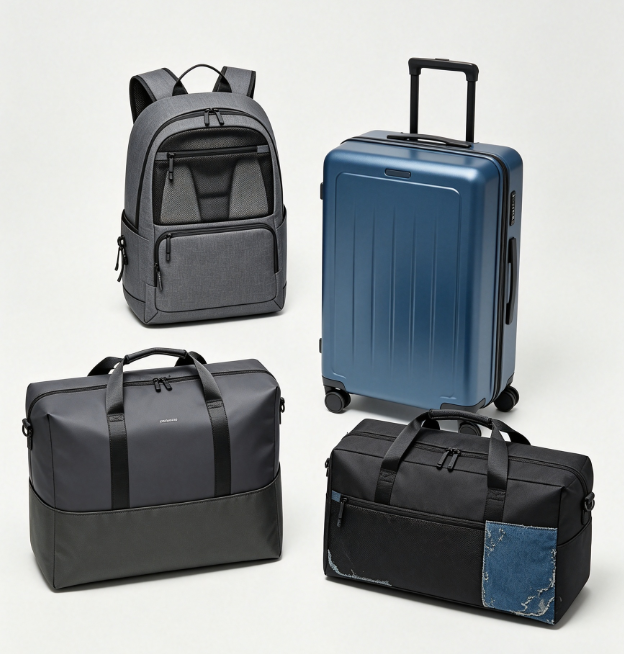
Not every bag category uses recycled fabric the same way. Structural demands dictate the material mix.
Backpacks: rPET Shells, Recycled Mesh Backing
Backpacks and daypacks use 300D–900D recycled oxford (150–280 g/m²) for the shell, often coated with PU or PVC. Back panels and shoulder straps get rPET mesh liners (120–200 g/m², 1–3mm pore) with EVA foam padding. Straps are 50–70mm wide for loads from 15 to 45L. That lets brands claim “≥50% recycled fiber” across shell, lining, and webbing.
Softbags: rPET Shell, Reinforced Nylon Base
For weekend bags and duffels, the shell is 300D–600D rPET oxford (160–220 g/m²), and the base is high-density 840D–1000D nylon (250–400 g/m²). Double-layer nylon bottoms boost tear strength 30–50% over single-layer rPET. Foldable travel bags go lighter with 190T–210T rPET taffeta (70–110 g/m²), keeping a 20–30L bag under 600g.
Hardshell Luggage: Recycled PC vs rPET Softcase
Hardshell cases use 30–70% recycled PC resin in 1.8–2.5mm panels, and impact strength shifts about ±10%. A 24-inch recycled PC case weighs 3.5–4.5kg; an rPET+PU softcase of the same size weighs 3.0–4.0kg. rPET softcases hit 70–85% recycled fiber content. Hardshells reach 60–70% when you include the lining.
Specialty Lines: Ocean Plastic and Fishing Net Nylon
Ocean-plastic backpacks claim 10–30 recycled bottles per bag. Recycled fishing net nylon (nylon 6/66) in 420D–1000D reinforces high-wear zones on hiking and commuter bags.
The Complete Guide to B2B Sourcing and OEM Customization
Sourcing recycled fabric is easy. Verifying it’s real requires paperwork most buyers skip.
Verify What “Recycled” Means
Request a TC/COC certificate per fabric that lists fiber type, recycled ratio, weight, and batch number. Cross-check it against the BOM. Main fabric, lining, webbing, zipper tape, and filler should each list gsm and recycled percentage separately. Industry threshold: if the main fabric makes up 60–70% of total weight, you can claim “100% recycled main material.” A 600D rPET backpack shell (280–320 g/m², 1.0–1.2m² usage) runs 300–380g fully recycled. If only the lining or webbing is recycled, actual recycled content often drops to 20–30% of total fiber weight. That’s a common greenwashing gap. You should sample at least 3 batches and 5 pieces for fiber-content and DSC/melt-point testing.
MOQ and Cost Benchmarks
-
rPET fabric: MOQ 500–1000m/color; USD 1.2–1.8/m uncoated, 10–20% premium over virgin PET
-
Recycled nylon: MOQ 800–1500m/color; USD 2.5–4.0/m, 20–30% premium
-
rPET blends: MOQ 500–1000m depending on recycled ratio
-
OEM backpack (CIF, ≥1000 pcs): USD 6–10/pcs with 100% rPET shell
-
Volume breaks: 3000 pcs vs 500 pcs cuts fabric cost by USD 0.2–0.4/m, total unit cost 5–10% lower
From Sample to Mass Production
-
Initial sample: 1–3 pcs, 7–15 days
-
PP sample: 3–5 pcs after BOM confirmation
-
Lab testing: Martindale abrasion, tear strength, REACH/RoHS. Takes 5–10 days, costs USD 150–500/style
-
Wear trial: 10–30 units, 2–4 weeks, checking zipper, strap, and coating durability
-
BOM freeze: locks recycled ratios, certifications, and suppliers per component
-
QC: IQC verifies TC/GRS batch match; FQC follows AQL 2.5–4.0, sampling 80–125 pcs per 1000; third-party inspection runs USD 250–350/day
How to Choose the Right Recycled Fabric for Your Product Line
Material selection starts with brand positioning. GRS confirms recycled origin, but it doesn’t confirm fit for your product. Strength, colorfastness, and gsm still need separate verification.
Match Fabric to Brand Position
-
Urban minimalist: lightweight rPET, prioritize hand-feel, drape, and color consistency. This fits commuter and light travel bags.
-
Outdoor/expedition: heavy-duty recycled nylon, prioritize tensile strength, abrasion resistance, and durable water repellency.
-
Premium luggage: recycled polycarbonate (rPC), prioritize impact resistance, surface hardness, and molding consistency.
Five-Step Sourcing Checklist
-
Define the application: shell, lining, strap, zipper tape, or hardshell panel.
-
List required metrics: tensile strength, tear strength, abrasion, gsm, shrinkage, colorfastness, pilling grade.
-
Request physical samples, not just spec sheets. Check gloss, color, and processing compatibility.
-
Compare three consecutive production batches for consistency. Shrinkage and pilling variance matter most.
-
Verify sustainability claims last: certificates, transaction certificates (TC), and traceable material origin.
Spotting Greenwashing
Demand a composition breakdown, physical test reports (shrinkage, pilling, light-fastness), and batch-matched GRS TCs. If a supplier can only offer a “green story” without a composition sheet, test reports, and TC, skip the sampling stage.
Industry Case Studies and Brand Evidence: How Recycled-Fabric Bags Perform in the Market
Luxury houses proved this market first. Prada’s Re-Nylon line runs on 100% ECONYL recycled nylon, targeting a full swap from virgin to recycled nylon across bags and accessories. Gucci followed with Off The Grid in 2020, built on the same fiber, now a recurring case study in sustainable fashion guides. Burberry went further with ReBurberry Edit, pairing recycled nylon trench coats and bags with castor-oil-based bio-nylon, backed by a 2040 climate-positive pledge. None of these brands compromised on durability claims. Recycled nylon travel bag lines carry the same repair and warranty support as their virgin-nylon predecessors.
Mid-Market and Industrial Waste Cases
Japanese brands upcycling discarded tents, seatbelts, and fire hoses into bags routinely sell out on launch. Scarcity plus an eco-story converts customers. Taiwan’s Guang Dian Xiong Forest Backpack series uses CYCLEPET, Bluesign, and REACH-certified rPET yarn since 2018, using certification as the trust signal buyers actually check.
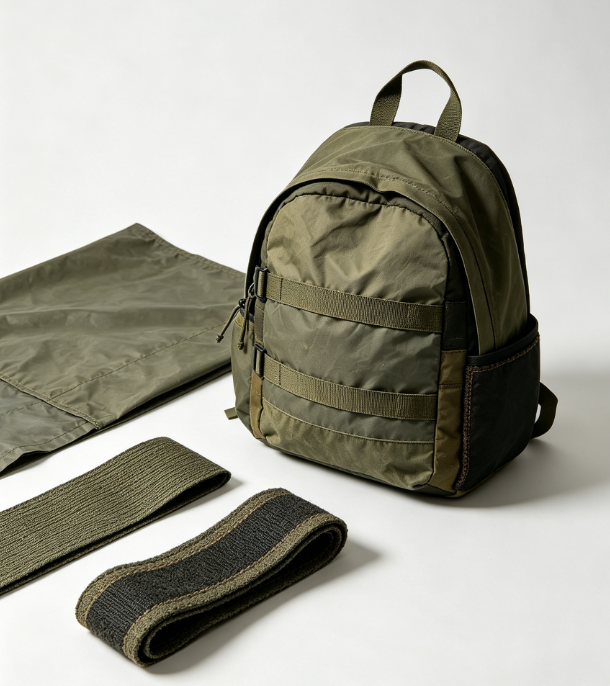
China’s Manufacturing Shift
Guangzhou Huadu’s bag industry shows the B2B upside directly. One manufacturer, founded in 1997, began integrating recycled PET-bottle fabric in 2017. Recycled-material bags now generate 60–70% of total revenue. Products sell well across European and American markets, and the company supplies automaker gift programs. That channel demands consistent durability testing and reliable delivery, not just green marketing.
What Buyers Actually Report
Across sustainable bag guides, recycled nylon earns consistent praise for abrasion resistance matching virgin nylon, stain resistance, and a premium hand-feel. rPET backpacks get flagged for one caution. Reinforce zipper seams and check tear strength, so “recycled” never reads as “fragile.”