
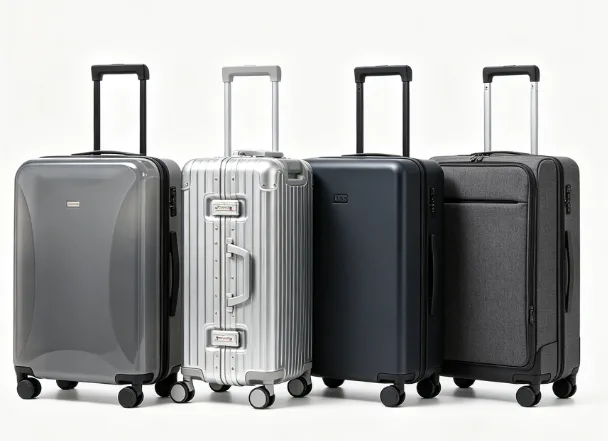
Standing in front of a wall of luggage options, most travelers face a silent dilemma. Grab the flexible nylon duffel that squeezes into any overhead bin, or trust a rigid polycarbonate suitcase to shield fragile items from baggage handlers who treat bags like footballs. This decision comes down almost entirely to what your bag is made of. Ballistic nylon flexes and forgives, but a hard case luggage shell resists crushing in ways soft fabric never will. Each material brings its own trade-offs in weight, waterproofing, and long-term wear. Whether you’re a frequent flyer choosing between nylon vs polyester luggage, or a retailer sourcing durable travel bag material for your next product line, understanding these construction differences will save you from costly regrets.
Soft-Sided Travel Bags: Materials & Structural Characteristics
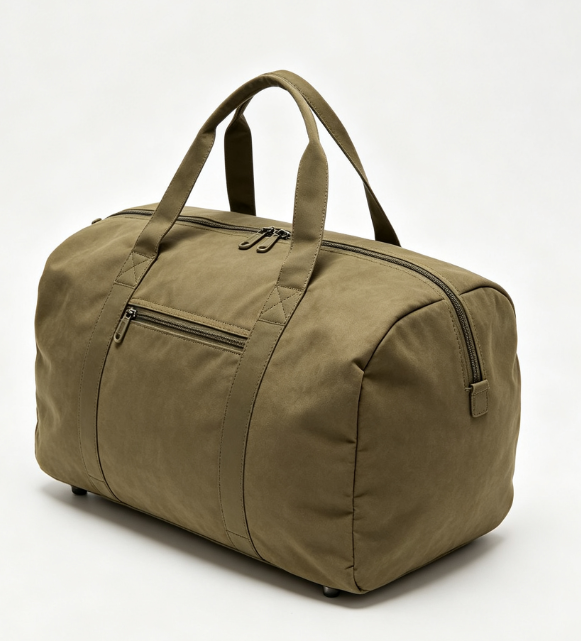
Denier ratings tell you almost everything you need to know about a soft-sided bag’s toughness. This number measures fiber thickness, and it separates a budget duffel from a bag built to survive baggage handlers.
Nylon vs Polyester: The Core Trade-Off
Nylon wins on abrasion resistance and tear strength, but it’s heavier. Polyester costs less and weighs less, but wears out faster at the same denier. Here’s how the common ranges break down:
-
600D: The industry baseline for mid-range carry-ons and everyday soft bags.
-
1200D–1680D polyester: Ballistic-grade polyester, tougher against punctures than standard 600D nylon.
-
1050D–1680D ballistic nylon: Woven in a tight 2×2 basket pattern, built for checked luggage and rough commutes. Expect roughly 1 lb (0.45 kg) of added weight compared to polyester versions of the same size.
Cordura vs Ballistic Nylon vs Ripstop
Cordura has a textured finish and slightly better long-term abrasion resistance, making it ideal for bags that see constant friction. Ballistic nylon is smoother and glossier; it surface-wears over time but retains structural strength. Ripstop nylon, sometimes called “parachute fabric,” is ultralight and used almost exclusively in frameless, compressible travel bags.
Canvas Duffels: A Middle Ground
Heavy waxed canvas (16–22 oz/yd², roughly equivalent to 500D–800D) delivers abrasion resistance close to mid-density nylon, though it handles sustained moisture worse. It costs more than basic polyester but less than ballistic nylon, positioning it in the casual, weekend-bag market.
Structural Support Without Rigid Panels
Most soft-sided bags use one of three internal systems:
-
Hardside back panel. A thin PC/PP board protects electronics while the front fabric flexes.
-
Wireframe/spring-steel frame. Adds 0.5–1.0 lb but allows lighter 400–600D fabric.
-
Frameless design. Relies entirely on reinforced stitching, bartacks, and thicker base fabric for shape retention.
Expansion zippers, common on 15–25% of soft-sided models, need reinforced ≥900D fabric around the seam since that’s where stress concentrates hardest.
Structured/Hard-Shell Travel Bags: Rigid Material Breakdown
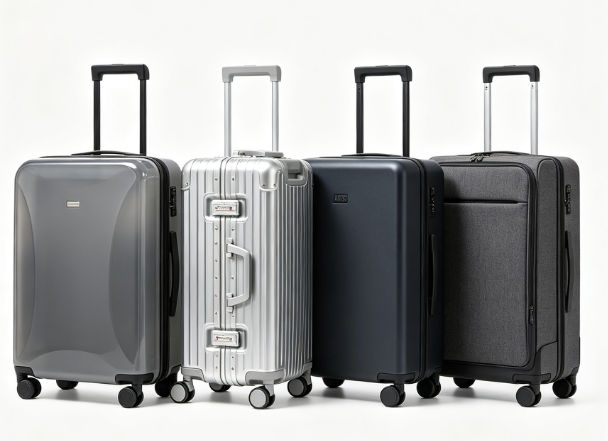
Four materials dominate the hard case luggage market, and each one trades weight against protection differently. Here’s what actually happens when a polycarbonate suitcase or aluminum-framed case hits the tarmac.
Polycarbonate (PC): The Industry Benchmark
PC sits at roughly 1.2 g/cm³ in density, with shell thickness typically running 0.8–1.5mm. PC stands out because it withstands 300–500 psi of pressure without structural failure, and its flexural modulus of 2.3–2.4 GPa lets the shell bend and spring back rather than crack. This matters most in cold cargo holds, where sudden drops and rough handling would shatter weaker plastics. That’s why supply chain guides consistently flag “100% PC” or PC-heavy composite shells as the defining feature of premium hard-shell luggage.
ABS: Budget-Friendly, But Brittle
ABS runs slightly lighter at 1.05–1.07 g/cm³, but manufacturers compensate for weaker impact resistance by thickening shells to 1.2–2.0mm. The trade-off shows up in cold weather and heavy impacts. ABS tends to crack rather than flex. Many brands blend ABS with PC to close this gap, which is why pure-ABS cases stay firmly in the economy tier.
Polypropylene (PP): Lightweight Champion
At just 0.90–0.91 g/cm³, PP is the lightest rigid option available. It resists brittle cracking better than ABS but relies on thicker walls and internal ribbing, not raw material stiffness, to handle pressure. This makes PP the go-to choice for oversized checked luggage where weight savings matter more than maximum impact protection.
Aluminum: Maximum Protection, Maximum Weight
Aluminum alloys weigh in at 2.7 g/cm³, over double PC’s density. Sheet thickness stays thin (0.8–1.2mm), and a 10–25μm anodized layer boosts corrosion resistance. Under stress, aluminum dents rather than splits, so it’s the top pick for protecting camera gear, precision electronics, and other high-value equipment. The weight and price premiums are significant, which pushes aluminum into small-to-mid gear cases rather than everyday travel bags.
Material-Based Performance Comparison: Durability, Weight & Protection
Numbers tell the real story here. Lab-tested impact strength (measured in Izod J/m) shows exactly why some hard case luggage survives a baggage handler’s worst day while others don’t.
Impact Protection: The Hard Numbers
-
ABS: 200–300 J/m, cracks under concentrated force
-
PP: 500–600 J/m, bends before it breaks
-
PC: 600–850 J/m, flexes under high-energy impact rather than splitting
-
Aluminum: exceeds 900 J/m before structural failure
For soft-sided bags protecting electronics, the equation shifts. Fabric relies on tear strength paired with internal cushioning for impact resistance. 1050D ballistic nylon offers ultimate tear resistance, outperforming 1000D Cordura under violent handling. Pair that fabric with UHMWPE reinforcement panels, and you get abrasion resistance 10–100 times higher than steel at a fraction of the weight. That’s a smart upgrade for anyone building expandable luggage meant to survive repeated cargo transfers.
Weight: Where Soft-Sided Bags Win
A 22-inch carry-on tells the clearest story:
|
Material |
Empty Weight (22″) |
|---|---|
|
PC hard case |
3.1–3.6 kg |
|
PP hard case |
2.5–2.9 kg |
|
Aluminum hard case |
5.0–5.5 kg |
|
Ballistic nylon soft bag |
<3.6 kg |
|
Polyester soft bag |
2.5–3.0 kg |
Load 15 kg of gear into both a PC hard case and a polyester soft bag, and the soft bag still comes out roughly 0.6 kg lighter (18.3 kg versus 17.7 kg total). Multiply that across a fleet of checked bags, and airlines’ per-kilo fees add up fast. Aluminum cases push the gap even further, running 1.5–2.5 kg heavier than a comparable ballistic nylon bag.
Where Bags Actually Fail
Shells rarely cause total failure. Zippers and stitching do. Soft-sided bags depend on hardware like YKK #8–#10 zippers and bartacked seams, and those are exactly what gives out first under overloading or rough baggage handling. Hard-shell luggage shifts the weak point to hinges and latches. The shell itself (especially PC or PP) resists cracking, but a thin metal hinge under lateral impact can snap and leave the case unable to close, even when the body survives intact.
Water & Weather Resistance: Fabric Coating vs Shell Sealing
Rain doesn’t care whether your bag has a hard shell or a soft one—it exploits whatever gap it finds first. For waterproof travel luggage, that gap is almost never where you’d expect.
Hydrostatic Head is the number that actually matters.
Waterproofing gets measured in millimeters of Hydrostatic Head (HH), the water column a fabric can resist before leaking. The industry floor sits at 1,000mm HH. Below that, you’re looking at water-resistant, not waterproof.
Standard PU-coated 70D–210D nylon falls in the 3,000–10,000mm HH range and is common on rain covers and budget soft bags. Mid-tier coated shells at 10,000–15,000mm HH work well for urban commuting and light rain. For sustained downpours and pressure zones like shoulder straps, you need laminate membranes (ePTFE/PU) at 20,000mm HH or more. DWR-only fabric is typically under 1,000mm HH, and brands like Sierra explicitly refuse to call it “waterproof.”
Where Bags Actually Leak
Fabric rarely fails first. Seams do. Military textile studies confirm that DWR treatment alone can’t seal stitch holes. It takes at least two passes of seam sealant to stop leakage at needle punctures. That’s why taped seams matter more than raw fabric HH ratings.
Zippers fail even faster. Untreated nylon zippers offer close to 0mm HH at the teeth. Waterproof zippers with PU-coated tape and a storm flap close that gap, but only if manufacturers spec them.
Climate-Based Material Selection
|
Environment |
Recommended Fabric |
Structure |
|---|---|---|
|
Tropical/heavy rain, 70–90% humidity |
≥20,000mm HH laminate |
Taped seams + waterproof zippers |
|
Urban/light rain |
10,000–15,000mm HH PU coating |
Sealed bottom seams, reinforced zipper top |
High-end soft bags now borrow hard-shell logic by using welded seams, waterproof zippers, and coated panels rated ≥10,000mm HH. That turns fabric into a functional shell.
Match the Material to How You Travel
Material specs only matter when you match them to your trips. Most buyers commute for business, check bags with fragile gear frequently, or travel with family on multi-modal trips.
Business Travel: Image Meets Practicality
If you fly every month with a laptop and documents, a 1680D ballistic nylon soft bag works well. This density delivers tensile strength above 3,000 N/5cm and survives over 20,000 Martindale abrasion cycles without visible wear. You need that polished look between meetings. Front pockets hold 10–15% of total volume, handy for grabbing a laptop or file at security checks. A PC hard case with a 50/50 clamshell split is less convenient for quick access. Front-opening business models solve that with 5–8cm compartments that fit 13–15″ laptops. On weight, ballistic nylon soft bags (2.4–3.0 kg for a 20″ size) beat PC hard cases (2.8–3.5 kg). Over a 5km commute, that 0.5kg difference cuts muscle exertion by roughly 7–10%. Occasional flyers who check bags more than they carry them should choose a matte PC shell. Glossy finishes show scratches faster. Matte or brushed textures reduce scratch visibility by 20–30%.
Frequent Checked Baggage & Fragile Items
Anyone checking bags 10+ times a year with cameras, glassware, or lenses needs rigid protection. PC shells at 2.5–3mm thickness increase out-of-plane stiffness 3–5x over soft fabric, cutting deformation by 50–70% under stacked loads. For professional photography or instrument cases, aluminum alloy (5052/6061) handles stacking loads above 50kg with under 10mm deformation. Pick it when protection matters more than weight.
Family & Multi-Modal Trips
Families who drive and take occasional flights get the most from soft-sided compressibility. An 80L soft bag shrinks to 60–65L unpacked, fitting trunks and overhead bins. Expandable zippers add 15–25% capacity when needed, then compress back before flights to stay within size limits.
B2B/OEM Sourcing Guide: Material Customization for Bag Manufacturers
Three price tiers dictate almost every material decision a factory makes. Sourcing teams working with manufacturers like Sunteambag choose between entry, mid-range, and premium material stacks. Each stack has its own FOB pricing and performance ceiling.
Entry Tier: PP shells (2.4–2.6mm) paired with 400–600D polyester survive a 1.0m drop test three times without cracking. FOB pricing on a 20–24″ case runs $12–$18, with materials eating 45–55% of total cost.
Mid Tier: PC+ABS blends (20–30% PC, 70–80% ABS) pass 1.2–1.5m drop tests with under 5% corner failure. Pair them with 600–1000D nylon or polyester and Martindale abrasion jumps to 25,000–40,000 cycles. FOB runs $28–$40, and the warranty extends from 1 year to 2–3 years.
Premium Tier: Full PC shells come with 1680D ballistic nylon and 6061/6063 aluminum framing (1.0–1.2mm wall). They survive 1.8m drops and 80–120kg stacking loads. FOB pricing hits $80–$150, with materials consuming 60–70% of cost.
Coating and Composite Customization
PU coatings deliver 5,000–10,000mm HH waterproofing for an added $0.20–$0.40/meter. X-Pac laminates cost 3–5x standard 600D polyester. They raise tear strength 30–50% and waterproofing to 20,000mm. Brushed, honeycomb, and matte shell textures reduce scratch visibility 20–40% for a one-time mold cost of $800–$1,500.
MOQ and Testing Requirements
Standard soft-bag MOQs run 100–500 units per style/color. Fabric MOQs sit at 500–1,000m per color; composite fabrics like X-Pac require 500–1,500m. New hard-shell molds need a $2,000–$5,000 tooling fee plus a 1,000–2,000 unit first batch. Always request third-party SGS or Intertek reports covering REACH, RoHS, CPSIA, and Martindale abrasion, dated within 12–24 months.
Quick Decision Framework: Soft-Sided vs Structured Material Selection Checklist
Four variables settle this decision faster than any spec sheet: protection level, budget, travel frequency, and check-in versus carry-on habits.
By Protection Need
-
Low protection (hand-carry, <10 kg): ≤600D polyester/nylon, no frame needed.
-
Medium protection (10-23 kg, mixed handling): 900-1200D nylon with foam padding, or ABS/PC blend ≥2.5mm.
-
High protection (23-32 kg, frequent transfers): 100% PC or aluminum shell ≥3.0mm with metal hinges, or 1680D nylon with structured framing.
By Budget Tier
-
Under $50: ABS shells or 300-600D polyester, no reinforced padding.
-
$50-120: ≥900D fabric or PC/ABS blends with reinforced corners.
-
Over $120: “100% Polycarbonate” or aluminum alloy, paired with 1200-1680D nylon.
By Frequency
-
≤2 trips/year: 600-900D or ABS/PC blend suffices.
-
3-6 trips/year: 900-1200D or 100% PC minimum.
-
6+ trips/year: 1680D nylon or PC/aluminum, check zipper and wheel warranty specs.
By Check-in vs Carry-on
-
70%+ checked: prioritize PC/aluminum shells, or ≥1200D fabric with #10 zippers.
-
70%+ carry-on: lighter PC shells or 600-900D soft bags win on weight and flexibility.