
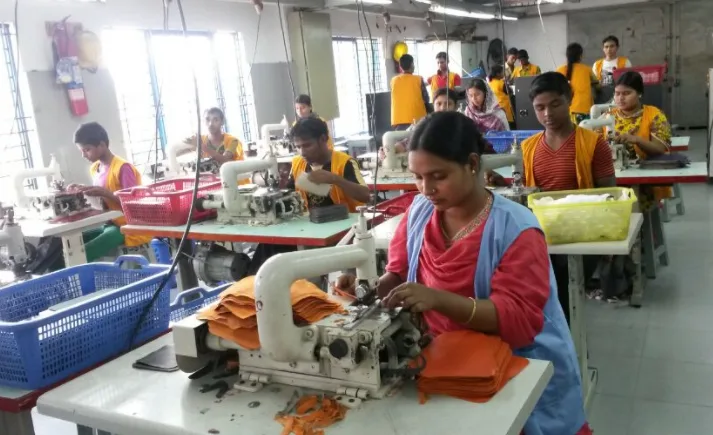
The wrong material for a custom briefcase order is a costly mistake.Selecting unsuitable fabric for your custom briefcase order may lead to customer dissatisfaction, returns, and harm your brand image in the long run. Whether you’re choosing a genuine leather briefcase for a premium look or a PU leather briefcase to protect tighter margins, the material decides perceived value, production lead time, and unit cost. This guide breaks down leather, nylon, canvas, and vegan alternatives from a real B2B sourcing perspective, so you can match material specs to your target market, budget, and timeline before sending that first PO.
Custom Briefcase Material Types: A Complete Category Breakdown
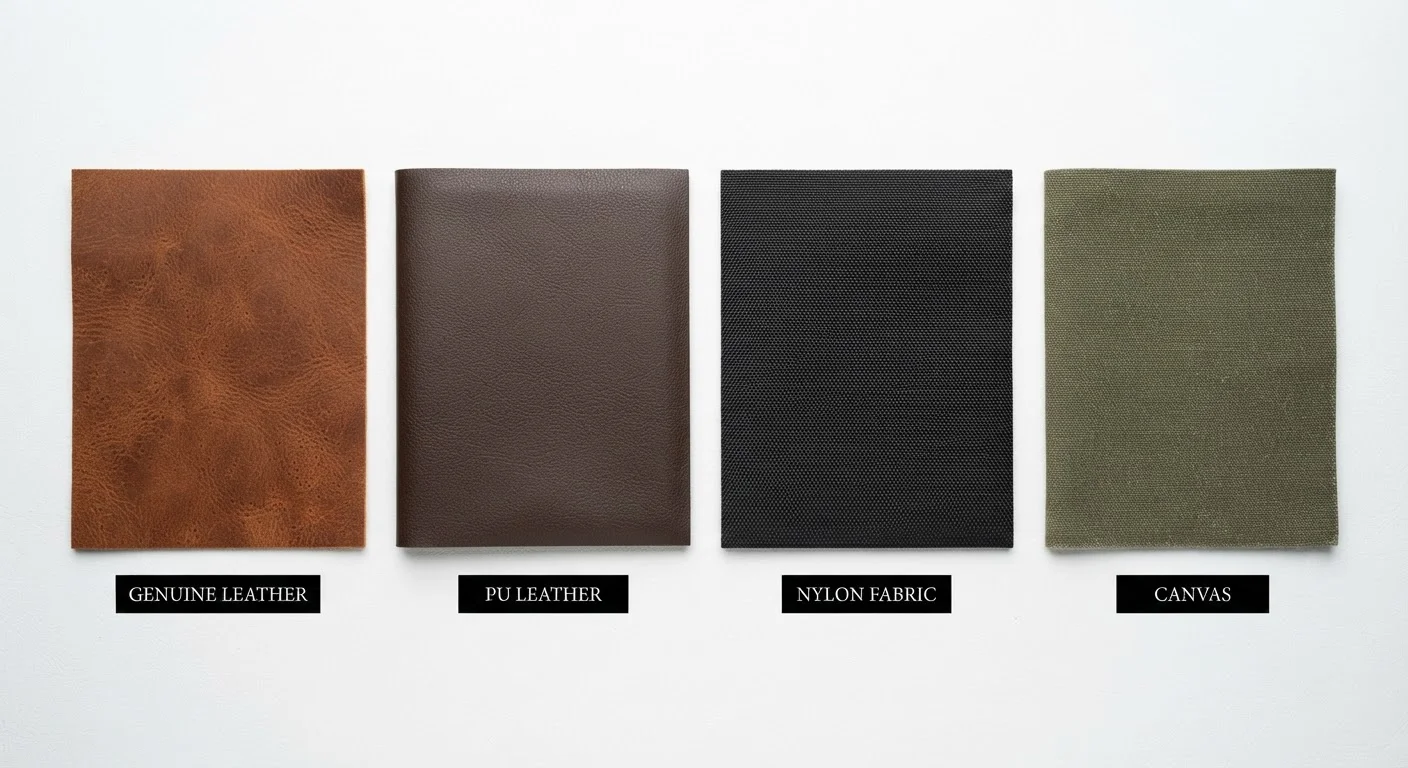
Four material families dominate briefcase manufacturing today, each with distinct technical benchmarks that directly affect your landed cost and product positioning.
Genuine Leather Briefcase Grades
Not all leather is equal. Full-grain leather runs 1.6–2.2mm thick, delivers 30,000+ Martindale abrasion rubs, and commands 4-6x the price of split leather. It is your flagship, executive-tier material. Top-grain leather offers 60-75% of full-grain pricing with slightly less durability (20,000+ rubs). It works well for polished business briefcases without the premium markup. Split/”genuine” leather sits at the budget end, typically 30-40% of full-grain cost but only 10,000-15,000 rubs before finish wear. It is fine for mass-market office bags but risky for premium positioning.
PU Leather Briefcase & Synthetic Options
A PU leather briefcase costs roughly 20-30% of genuine full-grain leather, with mid-range abrasion resistance (5,000-10,000 rubs) and near-waterproof surfaces, though zippers and seams remain failure points. Microfiber synthetic leather closes the gap with natural hide, reaching 20,000+ rubs while staying lighter (300-450 g/m²), and is popular among vegan leather briefcase buyers who still want durability.
Nylon Briefcase Durability & Canvas Options
Ballistic nylon (1680D/1050D) is the durability king, with 50,000+ rubs and water column ratings up to 3,000mm with proper coating. 600D Oxford nylon trades some toughness for cost efficiency (15,000-30,000 rubs). Canvas briefcase material ranges 10-18 oz/yd². It gives a heritage look and moderate 15,000-25,000 rub resistance when waxed for water resistance.
Eco & Alternative Materials
RPET fabrics, cork, and bio-based vegan leather now serve sustainability-focused brands. They match conventional performance at a mid-tier cost and support eco-conscious branding.
Leather vs Nylon Briefcase: Head-to-Head Durability & Performance Comparison
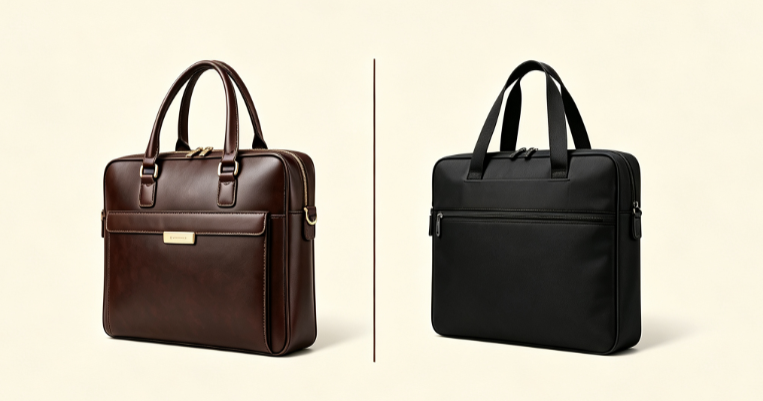
Numbers settle this debate faster than opinions do. When B2B buyers ask which material lasts longer, the answer depends on load conditions, climate, and how you define “durable.” Here’s the hard data on leather briefcase versus nylon briefcase durability across the metrics that matter for repeat customers.
Lifespan & Mechanical Strength
A full-grain leather bag with proper care runs 15-25 years. High-denier nylon (600D-1680D) delivers 7-12 years under typical office use, dropping to 3-7 years in heavy daily commuting. Full-grain leather’s tensile strength sits at 30-45 MPa with 3,000-5,000 Martindale cycles before wear shows. Ballistic nylon 1050D counters with 500-1,200 N tear resistance. Engineers call it nearly indestructible against abrasion and impact, closing much of the durability gap that standard nylon can’t.
Water Resistance & Maintenance
This is where nylon wins outright. Nylon is hydrophobic by nature. User ratings put water resistance at 4.6/5 versus leather’s lower score. A waterproof briefcase fabric like coated 1680D nylon shrugs off rain and spills for 5-10 years with zero maintenance. Leather is hydrophilic. It stiffens, spots, and risks mold without conditioning. Leather still leads on perceived durability (4.3/5) and professional appearance (4.7/5), but that authority comes with upkeep obligations your customers may not want.
Weight & Cost Positioning
Full-grain–weigh 1.2-1.8 kg empty. Nylon equivalents hit 0.5-0.8 kg. That 700-1,000g difference matters when laptops and files add another 2-4 kg. Cost tells a similar story. Nylon briefcases run US$80-200 in B2B catalogs. Leather sits at US$150-400+, often 2-3x nylon pricing for equivalent build quality.
Real-World Commuting Test
Under daily transit conditions (floor contact, rain, 3-5 kg internal load), full-grain leather retains structural integrity and working hardware for 10-15 years at notably higher rates than nylon. It develops patina rather than fraying. Ballistic nylon, meanwhile, survives concrete drag and airport floors with minor surface fuzz, no punctures, and wipes clean after spills instead of staining like unprotected leather does.
How to Choose Briefcase Material for High-End Executive & Luxury Positioning
Executive-grade briefcases play by different rules than mid-market bags. Material choice is the entire brand story.
Thickness and Longevity Benchmarks
For genuine leather briefcase programs targeting the C-suite, spec 1.4–2.0mm full-grain leather. This range keeps the bag’s shape through years of daily use. At this thickness, expect a 10–15 year lifespan with proper care, compared to 3–5 years for standard corrected-grain leather or PU leather alternatives before surface cracking sets in. That’s roughly triple the usable life, a number worth putting directly in your premium product messaging.
The Hand-Feel Test Before Bulk Ordering
Never approve a large PO on photos alone. Request physical samples and run two quick checks: fold the leather 180° and inspect for visible creasing or fiber breakage, then feel the edges for stiffness or excessive coating. Full-grain leather feels supple and full-bodied; corrected or synthetic leather often feels stiff or plasticky by comparison. This 30-second test prevents costly material mismatches before you commit to 500+ units.
Patina as a Brand Asset
Unlike PU, which cracks and peels without recovery, full-grain leather develops patina, deepening color, richer sheen, unique wear patterns per bag. Smart brands turn this into a selling point: “After 3-5 years, this briefcase looks more distinguished, not older.” That’s a story synthetic materials can’t tell.
Lining Choices That Match the Positioning
Pair premium exteriors with 210D–420D nylon or high-density polyester linings for daily durability, reserving satin linings for interior pockets where visual luxury matters more than abrasion resistance.
Best Fabric for Daily Business & Laptop Briefcase Use
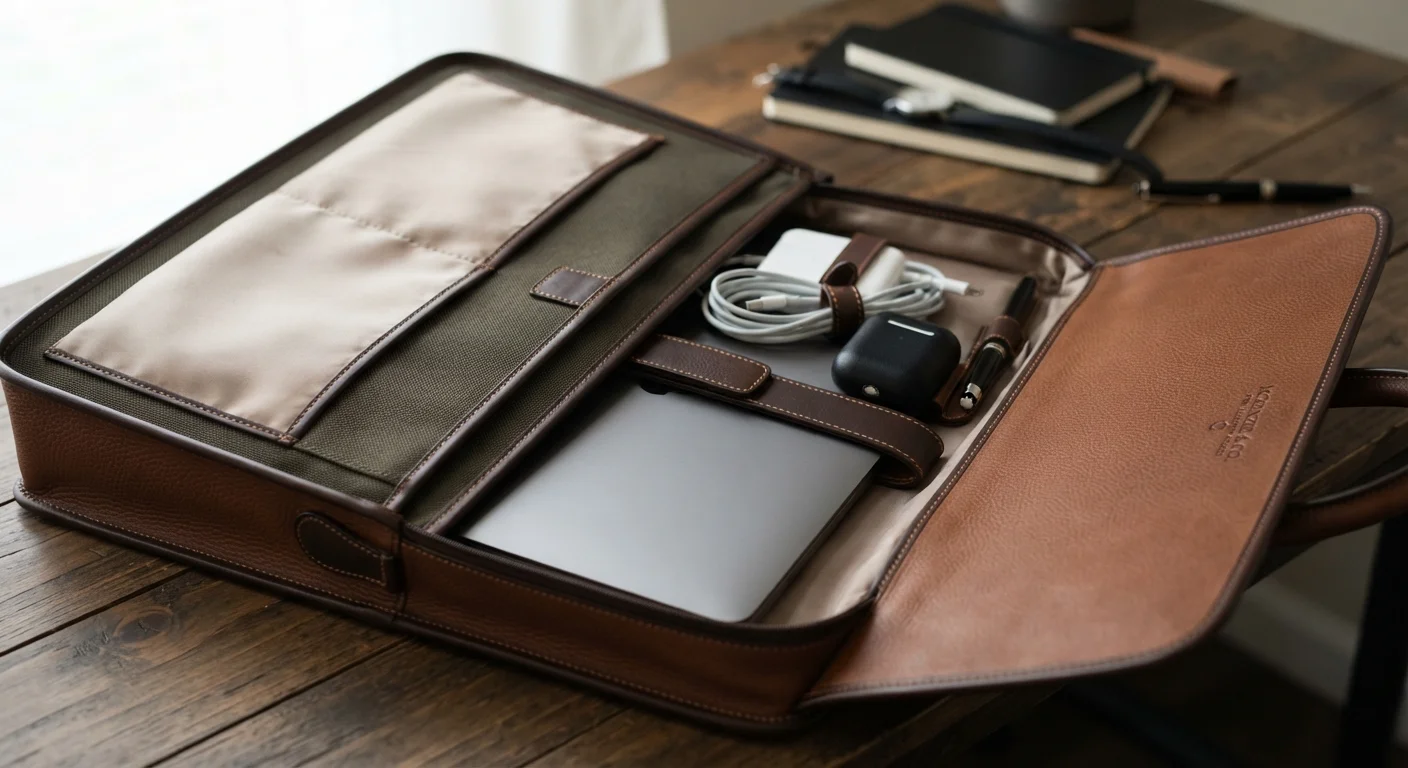
Daily carry loads average 3-6 kg once you factor in a laptop, charger, and files. That number should drive your fabric decision more than brand aesthetics do.
Weight-Durability-Cost Math That Matters
Empty shell weight depends on material. Full-grain leather runs 1.8-3.0 kg, ballistic/high-denier nylon sits at 0.9-1.8 kg, and PU or microfiber shells land at 1.2-2.0 kg. Service life data: full-grain leather lasts 10-20 years, ballistic nylon 5-10 years, 600D polyester 3-7 years, and PU leather just 2-4 years before peeling starts. For commuters using public transit daily, a simple scoring formula (durability × weight margin ÷ relative cost) ranks ballistic nylon and 600D polyester above full leather, despite leather’s premium image.
Laptop Compartment Specs by Device Size
Protection specs scale with screen size:
-
13″ laptop: 5-8mm EVA side padding, 8-10mm bottom pad, microsuede lining (120+ gsm)
-
15.6″ laptop: 8-10mm side padding, 10-12mm corner reinforcement, snug 15.5-16″ internal width
-
17″ laptop: 10-12mm side EVA, 12-15mm bottom cushioning, floating cradle design with 10-20mm suspension gap
EVA foam alone cuts drop damage by roughly 60% compared to unpadded compartments.
Practical Recommendation
Heavy commuters should specify ballistic nylon (840-1050D) with EVA-padded sleeves, targeting under 1.6 kg empty weight. Corporate buyers wanting the leather look without full leather cost should request microfiber-faced panels over a 600D nylon body. This hybrid construction cuts material cost 30-50% while still delivering 6-8 years of daily service.
Custom Briefcase Material Selection for Corporate Gifts & Bulk Orders
Bulk buyers care about three things: unit cost, logo clarity, and batch consistency. These factors decide whether your custom bag manufacturing order looks premium or falls flat across 1,000 units.
Pricing by Material (FOB China, Bulk Orders)
|
Material |
Price/pc (500+ units) |
Best For |
|---|---|---|
|
PU leather |
$6-10 |
Formal look, controlled budget |
|
Microfiber leather |
$9-14 |
High-perceived-value gifts |
|
600D/1680D nylon/poly canvas |
$5-9 |
Tech/business laptop bags |
|
Cotton canvas (12-16 oz) |
$7-12 |
Eco/casual branding |
Most annual conference gifts budget $10-25/pc including logo and packaging. For a “leather feel” under $15/pc, PU or microfiber replaces genuine leather without sacrificing perceived quality.
Logo Application by Material
-
PU/microfiber: Embossing or debossing at 0.3-0.6mm depth holds consistent batch imaging at over 95% reproducibility.
-
Nylon/poly canvas: Screen print at 70-100 lpi, or embroidery at 5,000-8,000 stitches—both hold color and edges well across 3,000+ units.
-
Cotton canvas: Water-based screen print or embroidery with a logo height of at least 20-25mm works for ESG-branded gifts. Expect ΔE 1.5-2.5 color variance because natural fiber absorbs ink unevenly.
Batch Consistency Benchmarks
PU and microfiber hold thickness to ±0.05-0.1mm tolerance with ΔE ≤1.0-1.5 for uniform color. Poly and nylon maintain weight variance at ±5-10 g/m², making them a good pick for repeat orders over 3,000 pieces. Cotton needs a 1-2% shrinkage allowance and extra rounds of color matching—factor that into your lead time when sourcing from a custom bag manufacturer.
Eco-Friendly & Sustainable Material Options for Custom Briefcase Manufacturer Projects
Sustainability has moved from a nice-to-have to a purchasing filter. Custom briefcase trends for 2025 show sustainability-minded buyers requesting vegan leather, recycled fabrics, and biodegradable textiles. Demand for eco-friendly manufacturing has seen a documented “significant rise” among corporate and retail brands sourcing bulk orders.
Recycled Synthetics: The Practical Eco Upgrade
rPET and recycled nylon are the top-recommended materials for durable, sustainable bags. 600D rPET delivers 1,000-1,500N tensile strength and 50N+ tear resistance (ASTM D2261), performing on par with virgin polyester. Cost premium runs 5-20% over virgin fabric, with minimal impact on final unit pricing since fabric is only part of total cost. Recycled nylon runs 10-20% above virgin nylon but offers better abrasion resistance at equal denier, ideal for slim tech briefcases.
Vegan Leather Briefcase Options
Standard PU-based vegan leather runs 0.8-1.4mm face thickness, hitting 20,000-40,000 Martindale rubs. Premium grades claim 50,000+. Bio-based versions—apple, cactus, pineapple leather—position as luxury alternatives but cost 1.5-3x standard PU, with 30-60% actual plant content blended with PU/PVC for strength. Use these selectively on flaps and front panels; reinforce stress points.
Cork, Organic Cotton & Other Natural Fibers
Cork veneer (0.2-0.4mm laminated onto textile backing) suits flaps, handles, and logo patches. Mid-to-high pricing but strong “natural luxury” branding value for EU markets. Organic cotton canvas (12-16 oz/yd², GOTS-certified) costs 15-30% more than conventional cotton. Best reserved for visible aesthetic panels rather than full-body construction.
Certifications That Matter to B2B Buyers
Request GRS for recycled content verification, OEKO-TEX Standard 100 for non-toxic claims, and GOTS for organic cotton sourcing. Suppliers should provide test reports on tensile/tear strength and chemical management (PFC-free DWR, solvent-free PU) alongside certificates. This documentation is non-negotiable for corporate sustainability audits.
Sunteambag’s Recommended Eco Spec
For mid-priced corporate briefcases, go with a 600D rPET shell (PFC-free DWR, GRS-certified), 210D rPET lining, and PU vegan leather trim. You get 3-5 years of daily service. For premium executive lines, try cactus or apple leather flap, recycled nylon body, and organic cotton lining. That balances eco credentials with the durability B2B buyers expect.
Key Factors B2B Buyers Must Evaluate Before Choosing Briefcase Material
Five checkpoints separate a smart material decision from a costly guessing game. Skip any one of them, and your next PO risks margin loss or a client complaint.
Match Material to Brand Positioning
Retail price bands tell the story. Ballistic nylon briefcases sell at $80-200, standard Oxford nylon at $30-80, PU leather at $30-100, and full-grain leather at $150-500+. Keep fabric and hardware costs to 20-30% of retail price to protect margin. Confirm color consistency at ΔE ≤1.0-1.5 before mass production. Match decoration to material: embossing for leather, screen or pad printing for PU, embroidery for nylon.
Define Usage Cycle Requirements
Long-term corporate briefcases that need to last 3-5 years require ≥1680D nylon or full-grain leather, YKK zippers rated for 5,000-10,000 open-close cycles, and handles tested at 15-20kg load for one hour. Short-term event giveaways can use 600D nylon or mid-grade PU, with colorfastness at ISO 105 grade 4+.
Set Budget-to-Material Benchmarks
FOB pricing maps directly to spec. At $6-10 you get basic 600D or PU. At $10-20 you unlock 900D nylon with padding. At $20-40 you get 1680D nylon or mid-tier leather. Fabric typically runs 40-60% of unit cost, hardware another 10-20%. Ask suppliers for a cost breakdown to catch corner-cutting.
Verify Functional Specs
Require drop-test data showing a 5kg load from a 1m drop with no seam failure. Check water column ratings: 500-1,000mm for casual use, 1,500-3,000mm for commuter-grade waterproofing.
Confirm Certifications
Request REACH, OEKO-TEX, or GRS certificates that include the lab name, report number, and matching material description. Cross-check certificate numbers on the issuing body’s website before signing off.
What to Prepare When Working with a Custom Briefcase Manufacturer
Suppliers move faster and quote more accurately when you walk in with specs, not vague ideas. Before your first call with a custom bag manufacturing partner, prepare this brief:
-
Use case & buyer profile: business travel, daily commute, or legal/finance carry; target age, profession, retail tier ($50-100 mass, $100-250 contemporary, $250-600 premium, $600+ luxury)
-
Order volume & FOB target: request 300/500/1,000 pc tiers; leather MOQs run 100-300 pcs, PU/canvas 300-500 pcs
-
Sample budget: $80-300/style, 10-25 day turnaround
-
Device dimensions: exact internal clearance for 13″/15″/17″ laptops plus A4 storage
-
Brand tone in numbers: leather ratio, hardware plating thickness, coating specs—not just adjectives like “premium”
Request material swatches with cost/MOQ, abrasion and waterproof test data, lining comparisons, and GRS/LWG/REACH certificates before approving bulk production.
FAQ: Common B2B Procurement Questions on Briefcase Material Selection
Procurement teams ask the same five questions before every bulk order. Here are direct answers based on real sourcing data.
Q1: Leather or nylon for high-frequency business use?
Full-grain leather lasts 5-10 years with regular oiling and moisture care. 1680D/1200D nylon runs 3-7 years under the same conditions—hardware and edges wear before the fabric does. Spec leather at ≥1.4mm thickness (15-25 MPa tensile strength) and nylon at ≥900D minimum, 1680D for premium durability.
Q2: Is PU leather suitable for mid-tier corporate gifts?
Yes, at RMB 150-400/unit versus RMB 400-800+ for genuine leather. Require ≥0.9mm PU thickness, 3-5 year hydrolysis resistance data, and Martindale ratings above 15,000 rubs. Avoid PU for CEO-level gifts or humid outdoor use—hydrolysis and peeling risk climbs after year two.
Q3: Which material shows logos best?
Leather embossing suits subtle branding (0.2-0.4mm depth, 15mm+ logo height). PU screen printing handles full-color logos affordably. Nylon embroidery (3,000-6,000 stitches) delivers premium feel with strong wash durability.
Q4: How much do eco-certified materials add to cost?
LWG leather adds 5-15%. Recycled nylon runs 10-25% higher. rPET premiums stay at 5-15%—manageable for most sustainability budgets.