
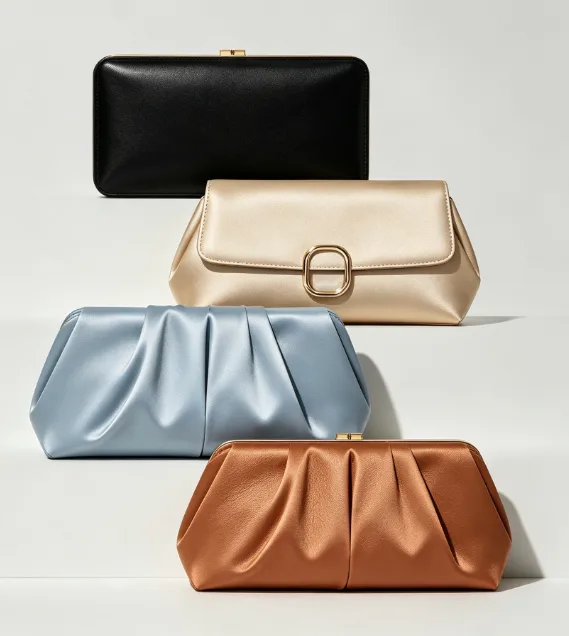
The clutch bag has quietly staged a coup on the runway. It’s now the piece brands lead with, no longer the demure sidekick to a statement gown. From Hermès’ architectural minimalism to Judith Leiber’s crystal-studded theatrics, luxury houses are rewriting what “small leather goods” can mean, reshaping everything from silhouette proportions to hardware specs. If you’re tracking custom clutch bag trends to inform your next collection, you’re seeing a shift toward personalization, material innovation, and quiet-luxury detailing that drives purchase intent. This breakdown covers where the design language is heading in 2025–2026, which finishes and fittings are winning buyer attention, and critically, what it actually takes to bring your own version into production, from MOQ realities to sourcing the right manufacturing partner.
Clutch Bags Are Becoming the Primary Statement Piece, Not Just Evening Accessories
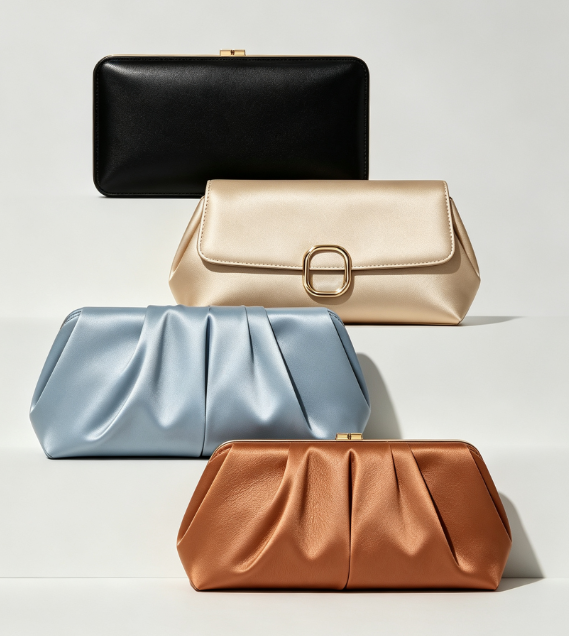
Numbers back up what the runways are showing. The global clutch bag market is growing at roughly 6% CAGR through 2028, reaching an estimated $368 million, fueled by luxury demand and e-commerce expansion. Offline retail still holds about 45% market share, but online sales are climbing fast, especially for designer pieces and sustainable-material styles.
The Oversized Shift Has Specific Numbers Behind It
Traditional evening clutches measured 18–25 cm wide and 3–5 cm thick—just enough for a phone, card, and lipstick. That’s changing fast. 2025–2026 oversized clutches now run 28–35 cm wide and 5–8 cm thick, pushing internal capacity from roughly 0.5–1 liter up to 1.5–3 liters. That’s enough room for a phone, long wallet, keys, makeup, and even a small tablet or notebook.
Headlines are already asking whether oversized clutches are replacing “demure mini handbags” on the street. Styling advice now pairs clutches with blazers and pantsuits for office wear—something unheard of a few seasons ago.
Day-to-Night Design Features Driving the Change
-
Softer materials: soft calfskin, suede, sustainable/vegetable-tanned leather replacing rigid metal-frame shells
-
Removable chains or short straps added while keeping the “no permanent strap” clutch identity
-
4–8 card slots, zip pockets, phone compartments for daily carry needs
-
Zip-plus-magnetic closures for street and commute security
Price Tiers Reflect Different Buyer Intent
|
Tier |
Price Range |
Materials |
Use Case |
|---|---|---|---|
|
Luxury custom |
$800–1000+ |
Exotic leather, hand-beading, custom hardware |
Statement piece for events + high-end daywear |
|
Accessible custom |
$100–300 |
Leather, recycled leather, textured PU |
Commute-to-party versatility |
For brands sourcing production, this data matters directly—it defines which spec sheet, MOQ, and material grade to target before approaching a manufacturing partner.
Silhouette & Proportion Trends: From Oversized Envelopes to East-West Elongated Forms
Four silhouettes are showing up most often in custom clutch bag production briefs right now. Each one works around a specific proportion.
Oversized Envelope clutches are 28–32 cm wide, 18–22 cm tall, with a flat, flap-forward structure covering half to two-thirds of the front panel. They prioritize silhouette over capacity — you get a 6.5″ phone and a slim wallet, and the bag stays rigid. Bridal parties, red carpets, and runway moments drive demand here. The buyers are 25–40 years old, paying premium prices for something that looks good in photos.
East-West Elongated forms, like Alaïa’s Teckel, measure 23–26 cm wide, 12–15 cm tall, with 5–8 cm depth. This is the sweet spot right now for a custom bag that feels practical and fashionable. The sizing fits a 6.7″ smartphone lengthwise, a slim wallet, small perfume, and cosmetics (roughly 1.5–2L total volume) without looking bulky. The height is underarm-friendly and keeps the bag from breaking your waistline. Alaïa’s design uses a dachshund-inspired elongated body with top-mounted zip closures — it appeals to 25–45 year-old professionals who want quiet luxury.
Structured Box silhouettes (Proenza Schouler’s Armory comes to mind) run 18–22 cm wide, 14–18 cm tall, 8–10 cm deep — near-cubic proportions that echo architectural blazers and structured coats. These suit commuting professionals aged 28–45 who want phone, wallet, and sunglasses storage without losing sharp lines.
Soft Pouch shapes range 22–32 cm wide, using gathers and drawstrings to create volume through drape rather than rigid framing. They work for both eveningwear and casual styling.
For manufacturers, these four proportion categories should anchor spec sheets before you quote MOQ or material options.
Material Innovation: Suede, Metallic Leather & Sustainable Vegan Options Leading Demand
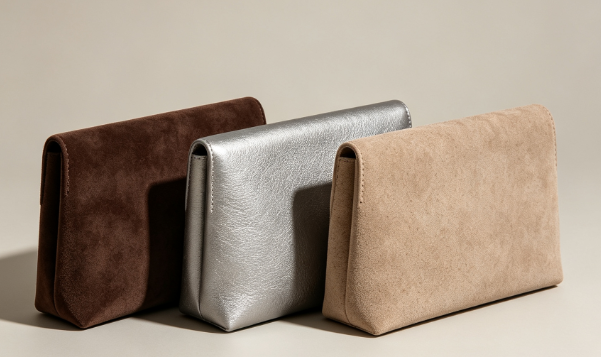
Material choice now carries as much design weight as silhouette. Three categories dominate current custom clutch bag production: classic suede, metallic/high-lustre leather, and plant-based vegan alternatives. Each has its own manufacturing specs and market positioning.
Suede & Metallic Leather: Timeless Textures, Technical Benchmarks
Suede is the go-to for boho-chic accessories and evening clutches. It’s usually specced at 0.8–1.2 mm thickness with controlled nap direction, color-fastness to rubbing, and a stain-protection coating. Metallic leather, running 0.7–1.0 mm, bonds metallic foils or pigments to corrected-grain leather or PU. Manufacturers test these for cracking resistance (5,000–10,000 flex cycles at 20°C) and corner abrasion, because clutches get handled and stacked. If you’re sourcing metallic vegan versions, expect PU-coated fabric with hot-stamped foil. Be upfront that the base is synthetic, since that affects sustainability claims.
Vegan Leather Is Booming, But the Fine Print Matters
The numbers explain why brands are chasing this category. The global vegan leather market hit $29.6 billion in 2019 and is projected to reach $85–89.6 billion by 2025, a 49.9% CAGR. Longer-term forecasts still show 10.8% CAGR through 2034, hitting $27.8 billion.
Roughly 90% of “vegan leather” today is just PU-coated fabric on polyester or cotton backing, essentially plastic with a marketing upgrade. These materials contribute to microplastic pollution (synthetic textiles account for ~35% of ocean microplastics) and can sit in landfill for 400+ years.
That’s why genuine plant-based innovators are gaining traction: Bolt Threads’ Mylo (mycelium, used by Stella McCartney), MycoWorks’ Reishi, Ananas Anam’s Piñatex (pineapple), Desserto’s cactus leather (adopted by Hugo Boss), and Vegea’s grape-based leather. For custom production, the sourcing rule is simple: if plant content is under 50% with heavy plastic coating, call it PU leather and don’t market it as sustainable. Target ≥80% plant content with minimal binders if you want an ESG-defensible claim.
Two color philosophies are splitting the custom clutch bag market right down the middle. One whispers. The other demands attention. Both are driving serious production volume in 2024–2026, just for very different buyers.
Quiet Luxury Neutrals: The Dominant Palette
Quiet luxury owns the mainstream right now. The palette includes oat, ecru, ivory, stone, putty, mushroom taupe, warm greige, and soft black-charcoal. Benjamin Moore’s Pale Oak (L* ≈ 83–85) is a common reference point for sampling, a warm, plaster-toned neutral that avoids anything stark or cold. Terracotta and sage green show up as accent tones, but the base stays muted.
Finish matters as much as color. This aesthetic runs on matte or eggshell sheens (5–15 GU), no mirror gloss anywhere. Hardware uses champagne gold, brushed brass, matte bronze, and warm pewter, all brushed or matte-plated rather than polished. Fabric-wise, linen, wool, and suede stay soft-lustre, never shiny.
Statement Metallic Sparkle: The Loud Counterpoint
The opposite camp goes all-in on shine. Soft gold, champagne, warm nickel, and brushed brass lead, with chrome used sparingly for punch. Mermaidcore adds iridescent aquas, pearlescent purples, and glittery silvers, while black-and-gold combinations dominate evening pieces.
High-gloss electroplating (80+ GU) paired with crystal or glass embellishment creates the reflective effect. The more refined 2026 direction softens this, moving toward 30–60 GU brushed metallics instead of mirror finishes, blending sparkle with restraint.
Regional Buying Patterns Matter for Sourcing
North American and Western European buyers lean hard into warm neutrals with subtle metal accents, 6–8 core neutral shades paired with champagne or brushed brass hardware. Middle Eastern demand goes the opposite direction, with saturated jewel tones, black-gold contrast, and dense crystal work, often thousands of stones per piece for bridal and event styles. If you’re sourcing globally, build separate color cards for each region rather than a single universal palette.
Hardware & Functional Customization: Detachable Straps and Italian-Grade Fittings
Metal specs separate a $150 clutch from an $800 one faster than leather does. In the premium tier, buyers expect solid brass or 316 stainless steel, not electroplated zinc alloy. 316-grade matters most for coastal or humid markets because it resists salt-spray corrosion far better than standard hardware. That’s why serious luxury bag suppliers in China spec it by default for export lines.
Detachable Strap Engineering That Holds Up
For clutch-to-shoulder-bag conversion, the webbing core should be nylon or polyester rated at roughly 2,200 lbs (1,000 kg) single-strand tensile strength. Skip polypropylene – it stretches and degrades under UV and moisture. Construction matters just as much. You need double-needle stitching plus bar-tacking at every stress point (connection ends, D-rings, adjusters), sewn with bonded nylon thread rather than cotton.
Riveted or welded metal loops beat sewn fabric loops every time under torque. The detachable mechanism itself typically pairs a slider, a swivel hook, and a folded-back termination. The hook needs to rotate freely without catching. For adjustable-and-detachable designs, separate the adjustment point from the detach point. Making one buckle handle both functions accelerates wear.
Two Hardware Personalities, Two Brand Positions
Logo-light minimalism suits quiet-luxury, everyday-carry brands. These are small, low-reflectivity, geometrically clean fittings where leather and silhouette carry the visual weight. Sculptural clasps suit fashion-forward, event-driven lines. The closure becomes the statement piece, jewelry-like and architecturally bold. Choosing between them early shapes your entire brand logo bag customization strategy and hardware sourcing brief.
Personalization Trends: Monogramming, Hand-Painted Initials & Hot-Stamping Techniques
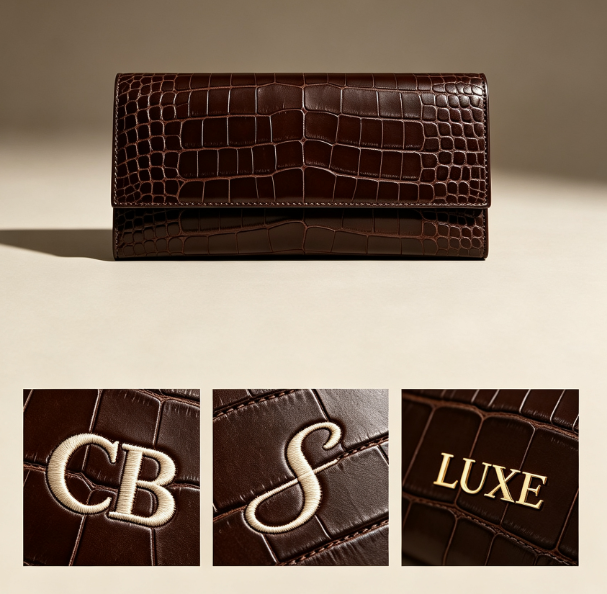
A $33.49 billion market by 2026 tells you personalization isn’t a niche add-on anymore. The personalized gifts category is growing at 8.7% CAGR from $30.79 billion in 2025, and now covers engraving, embroidery, printing, photo work, monogramming, and custom design. Custom clutch bags sit right in the middle of that growth, and luxury brands have split their approach into two distinct tiers.
Hot Stamping vs. Hand-Painted: Two Speeds, Two Price Points
Louis Vuitton runs both models side by side. Hot stamping is walk-in personalization, often complimentary with purchase, done while customers wait at select boutiques. Mon Monogram, their hand-painted service, works differently entirely: bags get shipped out to ateliers for actual hand-painting. Rebecca Minkoff’s Monogram Shop follows a similar split, offering up to two hand-painted initials on a small bag selection, colored to match the hardware finish.
The pricing gap is significant. Hot stamping usually costs nothing extra. Hand-painted customization runs several hundred dollars above the base bag price. Lead times diverge just as sharply. Pre-personalized hot stamping happens same-visit, while atelier-painted work needs 6 weeks minimum, sometimes stretching to 3 months for European-based houses.
Matching Technique to Material
Not every method suits every surface:
-
Hot stamping, debossing, foil stamping – best for leather goods
-
Hand-painted initials – premium leather, positioned as artisanal detail work
-
Embroidery – fabric items like linings, dust bags, textile accents
-
Laser engraving – metal or wood hardware components
Monogram Format and Placement Rules
Traditional Western monograms use three letters (first, middle, last), with the last-name initial larger and centered. Single-initial formats work for gender-neutral styling. Luxury monogramming is trending simpler and more legible: ornate scripts are losing ground because they become unreadable at small scale. Placement follows use case: discreet corners and interior tags for work bags, bolder center placement for occasion clutches designed to showcase the monogram.
For manufacturers, building a live-preview workflow before production launch matters. Customers need to see initial placement and scale before committing, and return policies should account for personalized items differently.
Luxury Brand Design References: What Judith Leiber, Saint Laurent & Hermès Reveal About Direction
Six brands dominate the reference boards for custom clutch bag production right now, and each one teaches a different lesson about translating luxury design into a workable manufacturing spec.
Judith Leiber Couture: Crystal Density as the Business Model
Judith Leiber’s crystal evening clutches run 17–20 cm wide, 10–12 cm tall, 4–5 cm thick — small enough to hold, structured enough to stand upright on a table. Retail sits at $995–$5,000, with sculptural novelty shapes (animals, fruit, perfume bottles) pushing past $6,000–$8,000. The formula: brass or alloy shells covered 90–100% in Austrian crystal, with standard pieces using 2,000–5,000 stones and intricate shapes exceeding 10,000. For OEM, this translates to a metal or MDF shell fully crystal-clad, priced $120–$300 FOB, with mold costs of $1,000–$3,000 per style amortized across runs.
Saint Laurent: One Logo, One Silhouette, Repeatable Structure
The Uptown Pouch (26×15×2 cm, retail $595–$750) is a flat envelope with a pointed flap and metal YSL logo — no hardware beyond that. Manhattan runs 22–24 cm wide, 16–18 cm tall, 6–7 cm deep, retailing $1,790–$2,800, built on a rigid box shape with a narrow metal bar closure. Strip the logo and keep the envelope-plus-bar-closure structure, and OEM pricing lands at $75–$150 FOB, matching entry-level luxury retail anchors of $750–$1,000.
Hermès: The Kelly Grammar, Simplified
Kelly Pochette (22×13×7 cm) retails $8,000–$12,000+, built on box calf, Swift, or Epsom leather with a top handle, flap, and center turn-lock closure. The “Kelly grammar” — single top handle, tapered box body, center-lock hardware, side straps — reproduces at $100–$200 FOB using simplified magnetic or rotating-lock hardware instead of the original mechanism.
How to Source Custom Clutch Bags: MOQ, Pricing Tiers & Manufacturer Selection Criteria
Sourcing decisions live or die on three numbers: MOQ, price-per-unit, and lead time. Get those wrong and the whole collection budget shifts. Here’s how the three main product tiers break down for B2B buyers approaching an OEM clutch bag production run.
MOQ & Pricing by Product Tier
|
Tier |
MOQ |
Price/pc |
Notes |
|---|---|---|---|
|
Quiet luxury PU/leather |
200–300 pcs full OEM; 50–200 pcs semi-custom |
PU: $5–20; Leather: $25–80 |
Volume drives margin |
|
Crystal/glass embellished |
300–500+ pcs (up to 1,000 for complex shapes) |
$15–35 (machine-set); $30–80+ (hand-set) |
Price drops 10–20% per volume tier |
|
Personalized (initials/custom hardware) |
20–50 pcs semi-custom; 100–200 pcs full new design |
$40–120 |
Sample fee alone runs $80–300/pc |
Rush orders (2–3 week delivery) add 10–30% surcharge. Standard OEM timelines run 3–6 months from development to delivery; fast-track using existing patterns plus air freight compresses that to 6–7 weeks.
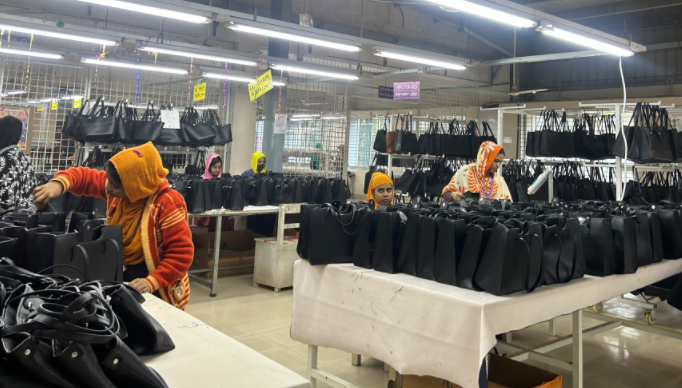
What Separates a Reliable Manufacturer
-
Material consistency: batch color variance under ΔE 1–2, full BOM documentation, traceable leather grading
-
Embellishment capability: hardshell mold experience, stone drop-off rate under 1% within 6 months
-
Hardware development: in-house plating/PVD, minimum 3 logo techniques (hot-stamp, foil, metal plate)
-
Track record: prior OEM work for international brands, delivery reliability at 6–8 weeks standard
These criteria determine whether a supplier can execute the material and hardware trends at scale.