
You’ve found a factory that checks all the boxes — the leather feels right, the craftsmanship looks solid, and the price works. Now one question stands between you and launch: How long is this going to take?
For brands planning a seasonal drop, retailers chasing a holiday window, or first-time buyers stepping into OEM production, the clutch bag timeline is not just a logistical detail. It’s the backbone of your go-to-market strategy. Miss it, and you miss the market.
This guide breaks down every phase of the custom clutch bag manufacturing process — from design confirmation to international delivery. You’ll know what to expect at each step, so you can order earlier, plan smarter, and launch on time.
“How Long Does It Take To Manufacture A Custom Clutch Bag?”
The honest answer? It depends — but the ranges are more predictable than most buyers expect.
Here’s the big picture for a bulk custom clutch bag order:
|
Scenario |
Total Timeline |
|---|---|
|
Fast-track (existing pattern + air freight) |
6–7 weeks |
|
Standard factory order (sea freight) |
9–11 weeks |
|
Mid-complexity new design (Asia → US/EU) |
~15 weeks |
|
Full custom multi-sample development |
Up to 6 months |
This guide covers each production phase — sampling, material sourcing, bulk manufacturing, QC, and shipping. You get real time benchmarks at every step. Placing your first private label clutch bag order? These numbers help you work backward from your launch date. Already running a supply chain? Use them to spot delays before they cost you a selling window.
Quick Answer: Custom Clutch Bag Manufacturing Timeline at a Glance
Most B2B clutch bag orders take between 4 and 12 weeks to produce. Where your order falls in that range comes down to three things: design complexity, order quantity, and whether you’ve worked with the factory before.
|
Order Type |
Typical Lead Time |
|---|---|
|
Simple style, small batch |
4–6 weeks |
|
Standard custom bulk order |
6–8 weeks |
|
New design, complex structure |
8–12+ weeks |
First-time orders take longer. Sample approval alone adds 18–25 days before bulk production can start. Repeat orders skip that stage — so returning buyers tend to see shorter timelines overall.
One practical rule: Have a fixed launch date? Count back at least 8 weeks for a reorder. For a new design or a new factory relationship, give yourself 10–12 weeks. That buffer isn’t extra time — it’s insurance.
Phase 1: Design Confirmation & Tech Pack Preparation
Before a single stitch is sewn, the factory needs one thing: a complete, frozen tech pack. This phase sets the pace for everything that follows — and it’s where most delays start.
Realistic time range: 3 days to 2 weeks.
Submit complete design files on Day 1, and you can reach tech pack freeze in as little as 3–6 days. Trickle in revisions — changing hardware finishes, swapping lining materials, or adjusting logo placement mid-review — and this phase stretches to 3–4 weeks. That pushes back sampling, material booking, and bulk production all at once.
What “Complete” Means
A ready-to-freeze tech pack for a custom clutch bag should include:
-
Flat technical sketches — front, back, and side views with numbered callouts for every seam, pocket, zipper, flap overlap, and hardware position
-
Key dimensions — length, height, depth, strap length, flap measurements, and hardware placement coordinates (in mm)
-
Material specs — shell material (e.g., PU 1.0–1.2 mm or top-grain leather 1.2–1.4 mm), lining, interfacing, thread type
-
Color references — Pantone codes or lab-dip references for each colorway (1–3 at prototype stage)
-
Hardware BOM — zipper gauge, clasp type, D-rings, chain weight, logo badge dimensions
-
Vector logo files — AI, EPS, or SVG format; JPEG will not work for embossing or metal badge production
-
Target MOQ and FOB price range — share this upfront (e.g., US$6–8 for PU clutch, US$18–25 for leather). This lets the factory align material specs to your budget before sampling starts
Why Changes After Freeze Are Expensive
One post-freeze change — say, swapping a zipper gauge or repositioning the logo — does not just affect that detail. It cascades:
-
Pattern revision: +3–5 days
-
Sample re-make: +7–10 days
-
Hardware re-sourcing (if new supplier or tooling needed): +5–14 days
That one “small” change can cost you two weeks off your launch calendar.
The rule is simple: lock the design before the factory starts, not during.
Phase 2: Sampling & Prototype Development
Sampling is where the timeline either holds — or starts bleeding out.
Once your tech pack is frozen, the factory moves into prototype development. The time it takes comes down to two things: are they adapting an existing pattern, or building a new structure from scratch?
Realistic time range: 5 days to 4 weeks.
Existing Pattern vs. New Structure: A Real Difference
|
Scenario |
Typical Sample Timeline |
|---|---|
|
Minor update to existing factory pattern |
5–7 days |
|
New design, moderate complexity (PU/fabric) |
7–14 days |
|
New design, genuine leather construction |
10–18 days |
|
Full custom structure with new hardware tooling |
3–4+ weeks |
The gap is significant — and the reason is structural. A factory with a validated pattern skips re-drafting, re-grading, and structural iteration. They adjust material specs and tweak details. Starting fresh means every layer of the bag needs verification before bulk can begin.
Material Makes a Measurable Difference
Genuine leather clutches take longer to sample — expect 7–14 days for a mid-complexity style. Edge paint alone needs 2–3 application passes. Each coat requires drying time before the next one goes on. Leather also demands careful hide selection. Factories reserve 3–5% extra material to cover scars and inconsistent thickness. Calibrating machine pressure and stitch depth for a new leather spec adds another 1–2 days on top of that.
PU and fabric clutches move faster — 3–7 days for the same structure. Materials are more uniform. Machine parameters are easier to set. Edge finishing uses binding tape instead of painted edges. PU sampling cuts sewing time by 30–40% compared to leather.
How to Compress This Phase
The factory controls speed once work begins. You control speed before it starts.
-
Ship a physical reference sample. A real bag cuts design communication time by at least 2–3 days. Factories measure it directly instead of guessing from sketches.
-
Lock hardware specs before kickoff. Confirm zipper gauge (#5 or #8), pull type, metal finish (light gold, gunmetal), and clasp dimensions in the tech pack. Using the factory’s in-stock hardware cuts out a 3–5 day sourcing delay.
-
Give consolidated feedback within 48 hours. Fragmented comments spread across multiple emails force factories to re-read, re-confirm, and re-queue. Send one complete feedback round fast. This keeps the second sample inside the same production week and saves 3–4 days of idle time.
-
Specify the sample type upfront. A Proto Sample validates structure. A PP Sample (Pre-Production Sample) locks every production parameter — stitch density, thread type, hardware torque. Know which one you need. This stops factories from over-building an early prototype or under-specifying a final approval sample.
One number to keep in mind: a complete, unambiguous tech pack cuts 1–2 full revision rounds — that’s 5–10 days saved in total sampling time.
Phase 3: Sample Review, Revisions & Final Approval
The sample is in your hands. What happens next determines whether your bulk order starts on schedule — or loses weeks before production ever begins.
This phase is the most unpredictable part of the entire custom clutch bag production timeline. Each revision round adds 1–3 weeks: 3–7 days for your feedback, 3–5 days for pattern adjustment, 5–10 days for the factory to remake the sample, and 3–5 days for international courier. Most first-time custom clutch bag orders go through 2–3 revision rounds, adding 4–9 weeks in total. On complex projects, this stage alone takes up 30–50% of the entire lead time.
Realistic time range: 2 weeks to 9+ weeks, depending on revision rounds and how fast you respond.
Why Samples Come Back for Revision
The four most common issues — and their frequency:
-
Dimensional deviation — First-round samples have a 20–30% re-pattern rate due to sizing misalignment. Most buyers accept ±0.3–0.5 cm on key dimensions.
-
Color mismatch — Without a specific Pantone reference, color rework rates exceed 50%. Even with one, 25–40% of small-brand orders still need a second color round.
-
Hardware feel and quality — No hardware standards set before sampling (e.g., 48-hour salt spray test, 2,000 open/close cycles)? Expect 30–50% of first samples to come back with hardware change requests.
-
Structural fit — Functional problems like insufficient phone clearance or strap length trigger full re-patterning. That single round alone can stretch to 3–4 weeks.
Use a Structured Feedback Checklist
Vague feedback is the #1 cause of extra revision rounds. Comments like “feels too big” or “not premium enough” force the factory to guess — and guessing costs weeks.
A structured checklist turns subjective impressions into clear, actionable parameters:
|
Feedback Area |
What to Specify |
|---|---|
|
Dimensions |
Measure to 0.1 cm; confirm interior phone clearance (e.g., 16.0 × 7.5 cm) |
|
Color |
Pantone code + “10–15% lighter in value” — not “more vintage” |
|
Hardware |
Test clasp 50–100 times; rate as smooth / slight resistance / stiff |
|
Function |
Check core scenario (wedding, everyday carry) against a must-fit items list |
Buyers who use structured feedback templates average 1–2 fewer revision rounds. That saves 2–4 weeks on the clutch bag sample production timeline.
Classify every comment as Must Fix or Nice to Have. This stops factories from burning revision time on low-priority details.
Buyer Response Speed Shifts Your Delivery Date
Every 7-day delay in returning feedback adds 7 days to your final delivery — and that compounds across rounds.
Here’s a practical example: a project planned at 12 weeks with 2 sample rounds, each delayed by 7 days, stretches to ~14 weeks. Three rounds with 10-day delays each push the same project to 16+ weeks — a 30–35% overrun.
To protect your custom bag order turnaround time:
– Schedule your internal review meeting before the sample ships — review it the day it arrives
– Set a firm internal SLA: feedback within 5 business days of receipt
– Loop in your key decision-maker (e.g., creative director) from Day 1 — “waiting for sign-off” stalls projects for 1+ weeks on a regular basis
– On complex decisions, confirm the locked specs (structure, dimensions) first. The factory can move forward on those while you finalize aesthetics
Final Approval Checklist Before Releasing to Bulk
Don’t release bulk production until you confirm every item below in writing:
-
All key dimensions within ±0.3–0.5 cm of spec
-
Color approved against a physical Pantone swatch or approved lab dip — not a screen reference
-
Hardware passed functional test (clasp cycles, zipper pull, plating quality)
-
Interior fits target phone size and essential items
-
A signed or email-confirmed PP Sample approval on file
That last point carries real weight. Once you sign off on the PP sample, bulk production can’t be disputed. Treat the approval document as a contract checkpoint.
Phase 4: Bulk Production — Cutting, Sewing & Assembly
PP sample approved, signed off, on file. Bulk production starts now — and the clock works at a different pace from here.
Most buyers underestimate this phase. Sampling feels slow because of back-and-forth. Bulk production feels slow because of volume. A factory doesn’t just make your bag. It slots your bag into a live production line with other orders. It runs machines across multiple styles. It treats every workstation as a timed, measurable unit.
Realistic time range: 15–40 working days, depending on order quantity, style complexity, and whether special craft processes are involved.
How Factories Measure and Manage Production Time
Before a single piece is cut, factories break the full production chain into measurable work units:
Material prep → Cutting → Sewing → Hardware assembly → Lining treatment → Final finishing / inspection
Each step gets its own timed measurement. The industry standard formula:
Standard Time = Observed Time × Rating Factor × (1 + Allowance Rate)
Factories run timing on a smooth line. They need at least 20 consecutive cycles per operation — or 30 observations for higher-reliability measurement. Cutting, sewing, and assembly each carry their own allowance rate. You can’t add the three together. Each segment gets its own calculation first. Only then does the factory confirm total production time.
This number is your actual bag factory lead time — not a rough guess, but a production-engineered figure.
What Pushes Your Order to the Back of the Line
Factories schedule bulk runs based on continuity and profit. Large orders, repeat styles, and high-volume reorders go first. They spread setup costs, line changeover, and machine calibration across more units — so the numbers work better.
Small orders with multiple styles, frequent spec changes, or first-time runs tend to get scheduled later. Factories often batch them together with similar styles to cut line switching time. Your order falls into this category? Build in extra buffer.
Special Processes That Extend This Phase
Two process types add real time to bulk production beyond standard estimates:
-
Embroidery, beading, or hand decoration — adds 4–16 weeks. Each needs a dedicated workstation, manual labor hours, and extra QC checkpoints for rework. Line output drops hard.
-
Multi-color printing — adds 1–3 days per colorway. This covers plate setup, color matching, first-piece confirmation, and drying time.
Both show up in your custom bag order turnaround time. Cutting, sewing, hardware assembly, and lining treatment run in sequence — each step depends on the one before it. One delayed station stalls everything that follows.
Key Metrics Your Factory Should Be Tracking
A factory running bulk clutch bag production well will track these indicators in real time:
-
Line takt consistency — workstations running at matched cycle times
-
Changeover time — how long it takes to switch from one style to the next
-
First-piece confirmation time — the first finished unit checked against the approved PP sample
-
Rework rate — percentage of units returned for correction
-
SMV (Standard Minute Value) — the per-unit time cost used to calculate delivery dates
Your factory can’t give you an SMV for your clutch style? That’s a signal worth taking seriously. Factories with solid time study processes deliver more predictable windows — and that protects your launch calendar.
Phase 5: Quality Control & Packaging
Bulk production wraps — but the bags aren’t ready to ship yet. QC and packaging run 2–3 days for a standard clutch bag order. That window stretches fast if issues surface late.
What happens across those three days:
-
Day 1 — Inspectors confirm the AQL standard (2.5 for minor defects, 1.0 for majors). They set the sample size and prep tools: calipers, color reference cards, and functional test fixtures.
-
Day 2 — Inspectors run visual checks, test hardware function (clasp cycles, zipper pulls), and verify dimensions against your approved PP sample.
-
Day 3 — The team isolates defective units, verifies rework, checks packaging integrity, and generates the final inspection report for shipment release.
Packaging inspection adds time most buyers don’t budget for. Inspectors check labels, hang tags, dust bags, and outer carton specs against your approved artwork — each one individually. Your packaging specs need confirmation before this phase starts. Gift boxes are the biggest risk here. Miss that step and you’re looking at 7 extra days minimum for reprinting or resampling.
Your QC involvement options:
|
Option |
Added Lead Time |
|---|---|
|
Factory self-inspection |
≤0.5 days |
|
Third-party inspection (SGS/ITS/BV) |
+2–4 days |
|
Video inspection (remote witness) |
≤1 day |
First orders with a new factory? Go third-party. Same for shipments heading into EU or North American markets. The 2–4 day buffer is a small price for the risk reduction it gives you on a full bulk order.
Phase 6: Shipping & International Delivery
Bags packed, inspection report signed — the timeline is now out of the factory’s hands.
Shipping is the phase most buyers get wrong on their custom bag order turnaround time. The production number looks clean. The freight number looks simple. But door-to-door delivery involves port handling, customs clearance, inland transit, and documentation. None of these steps move as fast as the tracking number suggests.
Sea freight benchmarks by destination (door-to-door):
|
Destination |
Typical Transit Time |
|---|---|
|
Japan / South Korea |
3–7 days |
|
Southeast Asia |
7–15 days |
|
Australia |
15–25 days |
|
US West Coast |
12–22 days |
|
US East Coast |
25–38 days |
|
Europe |
25–40 days |
|
Africa / South America |
30–60 days |
Add 3–5 days for customs clearance on top of those figures. Also add a 7–10 day safety buffer for vessel delays, port congestion, and document corrections.
Air freight vs. sea freight — how to choose:
-
Need delivery within 7 days? Air freight is your option.
-
Can accept ~30 days? Sea freight gives you far better cost per kg.
Peak season adds 30–50% to standard transit times. September through December covers Black Friday, Christmas, and Chinese New Year preparation. Port congestion and freight capacity both tighten hard during this stretch. Book your shipment ahead of time or expect to pay more.
The full equation for a bulk clutch bag order:
Production lead time + Sea freight (30–50 days) + Customs clearance (3–5 days) + Safety buffer (7–10 days)
Miss any one of those numbers and your launch date slips. Not because the factory was late — because the math was wrong from the start.
Key Factors That Affect Your Custom Clutch Bag Lead Time
Six variables determine whether your order ships on time or runs weeks late. Know each one, and you can spot where delays are likely to hit your project — then act before they do.
1. Design Complexity
Structure drives production time more than most buyers expect. A simple two-piece envelope clutch takes 0.5–1 working day per 100 units for cutting and sewing combined. Add multiple interior compartments, hidden pockets, or a detachable strap, and that jumps to 1.5–2 working days per 100 units. That’s 2–3 extra working days per batch — before queue time even enters the picture.
Incomplete design files make this worse. A complete tech pack — covering dimensions, hardware BOM, color references, and logo artwork — allows one clean sample pass. Missing specs force back-and-forth revisions. That adds 5–10 working days to the sampling stage alone.
2. Material & Hardware Sourcing
Standard synthetic leather and off-the-shelf zippers ship in 3–7 working days. Imported specialty materials or custom-colored metal hardware take 10–30 days. Custom lock clasps that need CNC tooling and electroplating add 20–30 days under normal conditions. During peak season, that can stretch by another 14 days if the factory outsources hardware production.
Relying on a single supplier makes this riskier. One key material goes on backorder, and the entire bulk run stops. That alone can push your clutch bag lead time out by 2–4 weeks.
3. Order Quantity
Volume affects scheduling in a clear staircase pattern:
|
Order Size |
Typical Bulk Production Window |
|---|---|
|
≤500 units |
15–20 working days |
|
500–3,000 units |
18–25 working days |
|
3,000–10,000 units |
21–30 working days |
|
10,000+ units |
30+ working days (phased runs) |
Small orders with high-complexity craft — multi-leather patchwork, multicolor foil printing — get no benefit from economies of scale. Factories can’t group them with standard runs. Frequent machine recalibration adds up fast. Lead times can run 20–30% longer than a simpler large order.
4. Customization Process Type
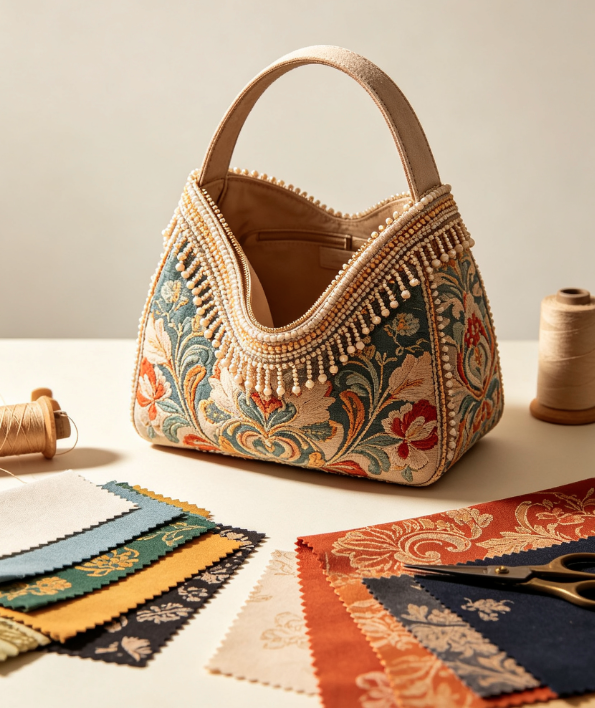
Handwork is the biggest time multiplier in this category. Each extra hand-craft process — beading, embroidery, hand-weaving — cuts unit output capacity by 20–40%. That adds 3–7 working days per batch. Layered techniques like embossing, foil stamping, and high-frequency molding need cross-department routing in sequence. Transfer wait times alone add another 5–8 working days on top of actual production hours.
5. Buyer Approval Speed
This is the one variable you control — and industry data points to it as the single largest cause of project overruns.
-
Fast buyer (feedback within 1–2 working days): total project from order to completion runs 30–45 days
-
Average buyer (5–7 days per review round): adds 1–1.5 weeks per round
-
Slow buyer (2–3 weeks total approval time with multiple revisions): a 4-week project stretches to 6–8 weeks
Delays at the quotation and deposit stage pile on top. Slow internal approvals can push that phase from the standard 3–8 working days to 10–15 working days. You lose a full 1–2 weeks before production even starts.
6. Factory Capacity & Peak Season Scheduling
September through December is peak season. Bulk production windows at bag factories stretch from 15–20 working days to 20–30 working days during this period. Small or first-time orders get pushed behind large accounts. Scheduling wait times grow from 3–5 days to 7–10 days.
Rush orders exist — but they cost more. Factories can compress sampling from 5–10 days to 3–5 days, and bulk production from 15–20 days to 7–10 days. The price premium runs 10–30% above base price. Rush service also requires complete design files and materials pulled from factory stock.
The bottom line: for cross-border sea freight orders, budget a 90–100 day minimum from first inquiry to delivery. During peak season, without a locked production slot, plan for 110–120 days.
First-Time Order vs. Repeat Order: How Timelines Differ
Order from the same factory a second time, and you skip 27 days of work. That’s not a bonus — it’s a structural difference in how production runs.
First-time orders (new design, new factory relationship) run 60–135 days end to end. Sampling alone takes 20–35 of those days. Add another 7–15 days for revisions and approval. You’re building the foundation from scratch: tech pack, pattern archive, hardware specs, quality benchmarks.
Repeat orders on the same style drop to 42–110 days — a 20–30% reduction — because that foundation already exists. No resampling. No re-patternmaking. Workers know the construction. QC inspectors already hold a defect reference list. The factory can slot your order into priority scheduling ahead of new accounts.
That 27-day gap hits your bottom line directly. Inside any 90-day window, repeat buyers complete 1.3–1.4x more order-to-sale cycles than first-time buyers. In Q4 peak season, that gap can mean one extra replenishment run on your core style — worth $8,000–$12,000 in gross margin on a 1,000-unit order at $8–12/unit profit.
Four stored assets drive those savings:
-
Tech Pack on file — skips 3–7 days of spec re-confirmation
-
Pattern archive — skips 3–5 days of re-patternmaking
-
Process card (工艺卡) — cuts workshop training from 2–3 days to half a day
-
Defect reference list — drops rework rate from 5–8% to 2–4%, saving another 3–5 days in production
On your first order, ask the factory to assign a unique style code (e.g., CLUTCH-PL-2024-001) and archive all four documents on file. Also, get a target repeat-order lead time in writing. A solid benchmark: ≤70 days for a same-style reorder with no structural changes.
How to Plan Your Launch Timeline Backward
Most missed launch windows aren’t caused by slow factories. Buyers miss them by counting forward from the order date — not backward from the shelf date.
Here’s the right approach: lock your target go-live date first. Then work backward and set every milestone from there.
Use this template for a November 1 launch target — the sweet spot for Black Friday and 11.11 preparation:
|
Milestone |
Target Date |
|---|---|
|
Products live & ads running |
Nov 1 |
|
Inventory received at warehouse |
Oct 1–15 |
|
Cargo departed factory (sea freight) |
Sep 1–15 |
|
Bulk production complete + QC passed |
Aug 1–31 |
|
PP Sample approved, PO issued |
Jul 15–31 |
|
Sampling & revision rounds |
Jun 15 – Jul 15 |
|
Start supplier inquiry |
May 15 – Jun 15 |
That’s a 5–6 month runway for a first-time order. Repeat orders with an existing factory compress to 3–4 months.
Three costs of not planning backward:
-
Missing the sales window — seasonal categories start climbing 1–2 months before peak. A 2–3 week delay at the warehouse can erase 30–50% of your seasonal revenue opportunity.
-
Paying rush premiums — factory expedite fees run 5–15% above base price. Air freight costs 3–5× more than sea. With proper lead time, you avoid both.
-
Compressed QC — time runs short, sampling rounds get cut. Defect rates climb. Return rates follow.
The practical rule: take your total lead time — production plus freight plus customs — and add a 20–30% buffer on top. A 12-week standard timeline gets planned as 14–16 weeks. A 16-week timeline becomes 19–20 weeks on your calendar.
FAQ: Custom Clutch Bag Manufacturing Time
These are the questions buyers ask most before placing their first custom clutch bag order — answered with real numbers, not estimates.
Q1: What’s the total lead time from start to finish?
For a standard OEM clutch bag order, budget 8–12 weeks from project start to delivery via sea freight. Here’s how it breaks down:
-
Sampling: 7–15 days
-
Bulk production: 15–40 days
-
QC and packing: 1–7 days
-
Sea freight: 20–35 days
Air freight cuts transit to 4–7 days. That’s worth considering if production wraps on time but your launch date is close.
Q2: Does design complexity really change the timeline that much?
Yes — and the difference is bigger than most buyers expect. A simple logo on an existing clutch style takes 3–7 business days to produce. A fully custom structure with new hardware and a new pattern is a different story. Sample approval alone takes 6–8 weeks. Bulk production adds another 3–6 weeks on top. That’s 2–3× longer overall. Developing a new design? Build that into your calendar from Day 1.
Q3: How does order quantity affect production time?
|
Quantity |
Typical Bulk Production Time |
|---|---|
|
1–50 units |
1–2 weeks |
|
50–500 units |
15–30 days |
|
500–2,000 units |
~12 business days |
|
2,000+ units |
8–12 weeks total (custom quoted) |
Small orders move faster through production. But factories often batch them with similar styles. At busy periods, that batching can push your schedule back a few days.
Q4: Can I rush a custom clutch bag order?
It depends on how much customization is involved. For semi-custom clutches — existing shape, custom logo or print — a realistic rush window is 2–3 weeks from approval to delivery. That’s based on small-to-medium quantities, air freight, and fast approvals. Rush service adds 10–30% above base price.
Full custom development is harder to speed up. A new pattern with custom hardware needs 6–8 weeks for sampling alone. At that stage, the most practical way to save time is switching from sea freight to air — not pushing the factory floor harder.
Q5: What’s the MOQ, and does it affect lead time?
Most factories accept 1 pc as a sample MOQ. For fully custom styles, bulk production MOQs start at 200 units. Under 50 units, production wraps within 1–2 weeks. Over 500 units, bulk production stretches to 12+ business days. Complex custom orders at that volume run 25–40 days.
Q6: What’s the fastest possible turnaround for a simple clutch order?
For a semi-custom clutch on an existing pattern — logo customization, standard materials, air freight — you’re looking at a minimum of 2–4 weeks from design approval to delivery. Three things need to go right for that: fast buyer sign-off, hardware already in stock, and zero revision rounds. It’s doable. Every stage just needs to run clean.
Need a timeline mapped to your exact design and quantity? Contact us for a free lead time estimate — we’ll break it down stage by stage.