There’s a moment every woman knows — standing in front of a mirror before a formal event, clutch in hand, asking: does this look expensive, or just expensive-looking? The answer has nothing to do with price tags. It comes down to design details. Most people overlook them at first. Then someone points them out, and you can’t stop noticing them.
From the weight of the hardware to the way fabric catches light, luxury bag craftsmanship shows up in small, deliberate choices. Shopping for a wedding, a gala, or a black-tie dinner? Knowing what to look for makes all the difference. You stop guessing and start choosing with confidence. These five evening bag embellishments and design details will change how you evaluate every clutch you pick up.
What Makes an Evening Clutch Bag Look Luxurious
Luxury isn’t announced — it’s felt. Pick up a well-made evening clutch and something registers right away. The weight sits right. The surface feels deliberate. The edges are smooth without trying to prove anything. That’s luxury bag craftsmanship doing its job.
Here’s what’s interesting: consumers rank material, craftsmanship, detail, and finish above visible branding when identifying a high-end clutch. The bags that read as most expensive often carry the smallest logos — or none at all. What they have instead is a sharp combination of quality materials, clean proportions, and details that hold up under close inspection.
This matters more for evening clutches than almost any other accessory. At a wedding, your bag sits at chest height in every photo. At a gala or awards ceremony, high-definition lighting exposes every surface texture, every seam, every piece of hardware. There’s nowhere to hide. That’s why formal handbag design at the luxury level is built around details most shoppers never think to check.
The five dimensions that separate a truly elevated evening clutch bag from one that only looks the part:
-
Material & tactility — silk, satin, velvet, metal frames, exotic skins
-
Craftsmanship & detail density — beading, crystal embellishment, stitching precision
-
Proportion & silhouette — how size and shape interact with your overall look
-
Color & light interaction — how different finishes behave under event lighting
-
Scene fit & styling integration — how the clutch completes a formal outfit rather than just accompanying it
Each one is specific, observable, and — once you know what you’re looking for — impossible to unsee.
Design Detail #1: Fabric & Material Quality — The First Signal of Luxury
Fabric is the first thing your fingers — and the camera — judge. Before anyone reads a price tag or notices a clasp, the surface of your satin clutch bag is already sending a signal. And it either says quality or it doesn’t.
The gap between luxury-grade fabric and budget options isn’t small. It’s measurable.
Silk Satin vs. Polyester Satin: More Than Just a Price Difference
Real silk satin — 22–30 momme weight in high-end evening bag construction — produces what most people call a “moonlight glow.” The sheen is soft and diffused. It shifts across the surface as you move. Under warm indoor lighting, it spreads light across the fabric rather than creating harsh bright spots.
Polyester satin works differently. Its surface reflects light in sharp, concentrated peaks — bright but stiff. Under flash photography (think: wedding receptions, awards ceremonies), that gap becomes obvious. Industry testing shows synthetic satin can reflect up to 15–25% more light intensity at peak points than real silk. But it lacks the smooth, spread-out diffusion that reads as refined.
The drape tells the same story. Silk folds into soft, flowing waves. Polyester folds into rigid creases — more origami than couture.
Velvet, Leather, and Brocade: What Each Signals
-
High-quality velvet absorbs light rather than bouncing it back. At a formal dinner, a deep-toned matte velvet clutch draws attention through texture and outline — not glare. Pair it with simple metal hardware, and the contrast between matte fabric and soft gold becomes the whole design.
-
Full-grain leather carries irregular natural pores and slight surface variation. That imperfection is the luxury signal. PU leather repeats its printed texture in identical patterns — any trained eye can spot it.
-
Brocade built for formal handbag design has real weight and raised texture. Run your finger across it and you feel the pattern lift off the surface. Printed fabric copies are flat — the design is there to see, but the surface gives nothing back to the touch.
How to Identify Fabric Quality in 30 Seconds
Online shoppers: look at how fabric behaves near folds and edges. Luxury bag craftsmanship shows smooth tonal gradients in shadow areas, clean fold lines, and no “blown-out” white streaks. Budget materials show sharp crease lines and concentrated highlight bands.
In person, pinch the fabric between two fingers with light pressure. Quality material has density, resistance, and a slow rebound. Then fold a small section for a moment — premium fabric releases the crease fast and clean. Cheap alternatives hold the fold longer, and it shows.
One final check: the label. “100% Silk,” “Full Grain Leather,” or certifications like OEKO-TEX Standard 100 aren’t just marketing. They’re the starting point of every detail that follows.
Design Detail #2: Hardware & Metal Finish — Where Cheap Bags Always Fail
Run your thumb across a clasp. That single gesture tells you almost everything.
Hardware is where budget evening bags fall apart — not bit by bit, but right away. The finish flakes. The edges catch your skin. The clasp wobbles after three months. Under the bright, harsh lighting of a wedding reception or awards ceremony, every flaw shows up in full detail.
The Material Underneath the Finish
Most luxury clutch bag hardware starts with solid brass. Its hardness (around 80–90 HB) resists scratches and holds precise shapes — razor-clean logo engravings, tight hinge tolerances, crisp edge details. Zinc alloy, the standard in budget hardware, runs softer. With repeated use, it wears down, loosens, and develops that faint rattle. That rattle signals the structure is giving out.
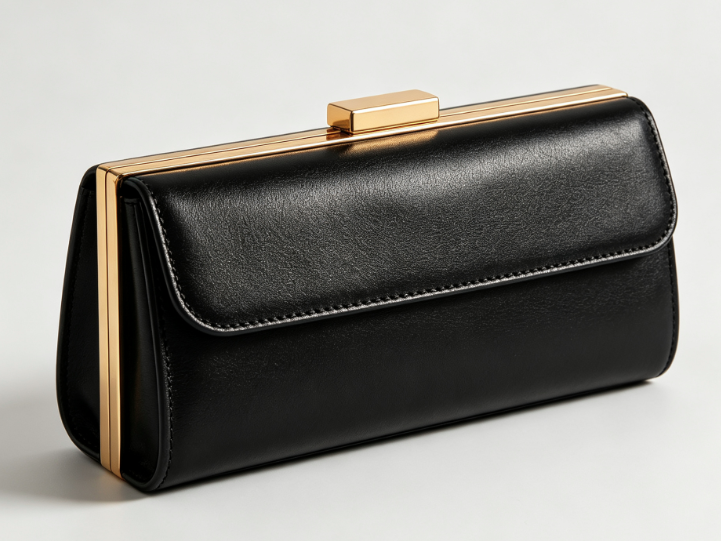
Moisture makes the gap permanent. Zinc alloy hardware in a humid setting — or exposed to perfume and sweat — can develop visible pitting within 100–200 hours of contact. Quality brass hardware with a proper plating layer (20+ μm) holds its surface past 500 hours. That’s the difference between a clutch that still looks new after a year and one that looks worn after a single season.
Plating Thickness: The Number No One Talks About
Cheap clutch bag hardware details fail at the plating stage. A thin coating under 5 μm starts showing base metal within weeks of regular use. Quality evening bag embellishments use plating layers of 15–25 μm. That thickness handles daily use without chipping, bubbling, or fading at the edges.
Visual red flags are easy to spot once you know them:
– Uneven color across the same piece — bright gold center, darkened edges
– Visible orange-peel texture on polished silver hardware at close distance
– Blurred logo engraving — clean lettering needs high-hardness brass. Zinc alloy dies wear fast and produce soft, inconsistent strokes
Four Finish Types and What They Signal
-
Brushed Gold — a linear texture (Ra ≈ 0.2–0.6 μm) that spreads reflection into a matte warmth. It hides light scratches well. You’ll find it as the standard finish on mid-to-high-end formal handbag design.
-
Polished Silver — mirror reflectivity above 80%. It looks striking when flawless. Any flaw, and it shows everything. Quality pieces show zero wave distortion at 10 cm. Budget pieces reveal rippling and pit marks right away.
-
Antique Brass — chemical oxidation layered over mechanical polishing. High-end versions show a clean, gradual color shift at the edges. Cheap imitations produce flat, muddy dark patches with no depth.
-
Gunmetal — the most color-sensitive finish of the four. Premium hardware keeps color variation under ΔE 2 across every component. On a low-quality metallic clutch purse, the zipper pull, D-ring, and clasp often read as three different shades of “almost black.”
The hardware on a high-end clutch doesn’t just function — it feels intentional at every point of contact.
Design Detail #3: Construction & Stitching — The Craftsmanship Signature
Stitching rarely gets the attention that fabric or hardware does. But it’s often the first thing that fails — and the whole bag looks cheap the moment it does.
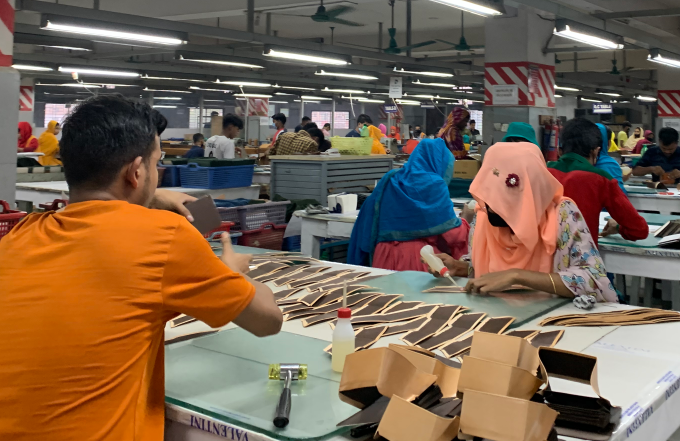
There’s a clear standard that separates a well-made evening clutch bag from a disposable one: 8–10 stitches per inch (SPI) across the main body, rising to 10–12 SPI at stress points like clasp attachments and frame joints. Drop below 6 SPI, and each stitch carries too much tension. The seam won’t just look rough — the structure breaks down too.
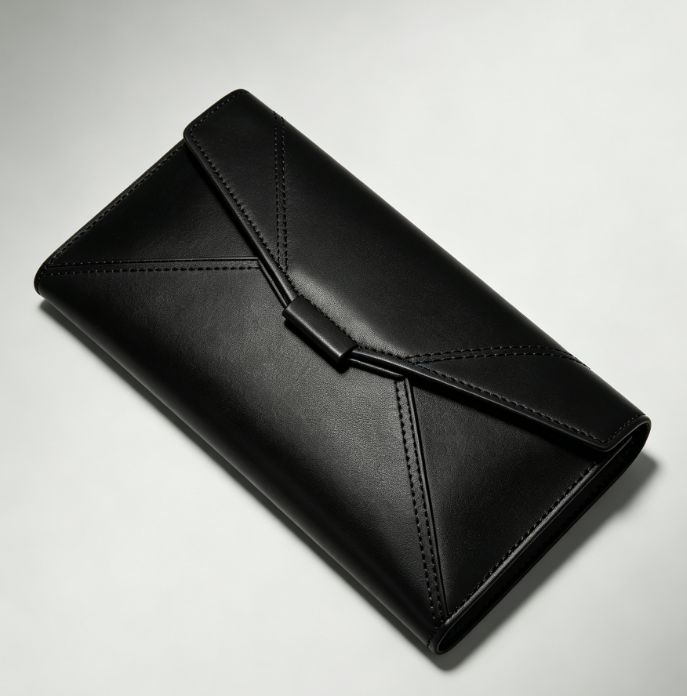
Here’s a quick field test: run your fingernail along 25mm of seam and count the stitches.
– 8–10 stitches — the maker took luxury bag craftsmanship to heart
– Fewer than 6 — cost-cutting happened right at this seam
Thread, Tension, and Edge Finishing
Thread choice matters more than most shoppers expect. Quality high-end clutch bag construction uses waxed cotton or polyester thread. Both resist abrasion, moisture, and fading well. The thread diameter should also match the leather weight. Too fine on thick material signals poor engineering. Too heavy on delicate satin looks clumsy.
Color follows the same logic. You have two solid options:
– A near-exact tone match — clean, unified, no visual noise
– A subtle contrast, like deep navy leather paired with a slightly lighter blue thread
A subtle shift adds quiet depth. A strong contrast just looks unfinished on a formal handbag.
Edge finishing is the final test. Quality edges go through a layered process:
1. Trimming
2. Three coats of base sealant, with drying time between each coat
3. Edge paint applied in multiple passes
Clean edges show no fraying, no paint bleeding onto the stitch line, and no exposed fiber.
Hand vs. Machine Stitching: What You’re Seeing
Machine stitching uses a lock stitch. The upper and lower threads interlock inside the material, so one broken stitch won’t unravel the whole seam. The result is precise, consistent, and even throughout.
Hand stitching uses a saddle stitch — two needles, one thread, pulled through pre-punched diamond-shaped holes. The thread crosses at a slight diagonal. The front and back look a little different from each other. That’s not poor workmanship. It’s by design. That visible rhythm, that small imperfection, is what makes it read as handcrafted rather than mass-produced.
On high-end clutch bag designs, that subtle diagonal line isn’t a flaw. It’s the signature.
Design Detail #4: Shape, Structure & Silhouette — The Architecture of Elegance
Proportion is a precision game. The wrong size clutch doesn’t just look off — it undermines your entire outfit before you’ve said a word.
Formal handbag design works within a tight set of measurements. The sweet spot for an evening clutch sits between 14–20 cm wide — about 2.0–2.5 times the average female palm width (7–8 cm). In that range, the bag extends just beyond your hand without taking over your silhouette. Go wider than 9–10 inches (22–25 cm) and the visual weight shifts away from you. The bag takes over. Go narrower than 12 cm and it reads as a wallet, not a clutch — the ceremony disappears.
Height follows the same logic. The ideal range is 3–4.5 inches (7.6–11.4 cm). That keeps the lower edge of the bag clear of your wrist line, giving you a clean silhouette in standing poses. Below 7 cm, your hand swallows the bag. Above 12 cm, it starts competing with your dress for space.
Four Silhouettes — Four Design Languages
Each classic shape sends a different signal:
-
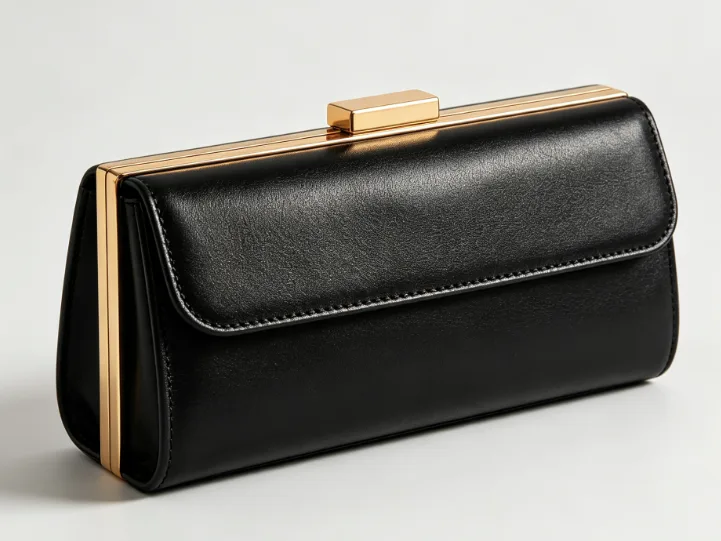
Minaudière (hard shell) — geometric, sculptural, high surface density. Metal alloy frames hold a rigid outline under any lighting. These clutches read as jewelry, not bags. Pair them with simple, single-color gowns so the bag becomes the focal point.
-
Envelope clutch — flat profile, sharp folded flap, clean horizontal line. The shape is built on restraint. It moves from cocktail events to formal dinners without demanding attention.
-
Fold-over clutch — soft, unstructured silhouette shaped by the fabric itself. Luxury here lives in material — silk, velvet, supple leather — rather than rigid form.
-
Cylindrical / tube clutch — axial outline, circular cross-section. It pairs best with minimal gowns. Think of it as a sculptural accent, not a classic accessory.
Structure Is What Keeps It From Collapsing
A clutch that sags loses everything. High-end clutch bag construction relies on three structural methods to prevent this:
-
Hard shell frames — cast metal alloy forms a closed box. The outline stays sharp whether you’re holding it still or moving through a room.
-
Internal stiffener boards — 1–2 mm boards sit inside soft-shell walls. They keep the edges sharp without adding bulk.
-
Metal base grooves — the shell edges lock into recessed channels in the frame. The metal border does more than hold shape. It creates a visible high-contrast edge that catches light and sharpens the entire profile.
That last detail counts under event lighting. A well-framed metal edge stays visible even in low or directional light — and that’s the condition most formal venues run in.
Design Detail #5: Surface Embellishments & Finishing Touches — The Detail That Elevates Everything
Surface embellishments are where an evening clutch stops being an accessory and starts being a statement. Every other detail we’ve covered — fabric, hardware, stitching, structure — builds the foundation. Embellishment is what people see from across the room. It’s the first thing that registers.
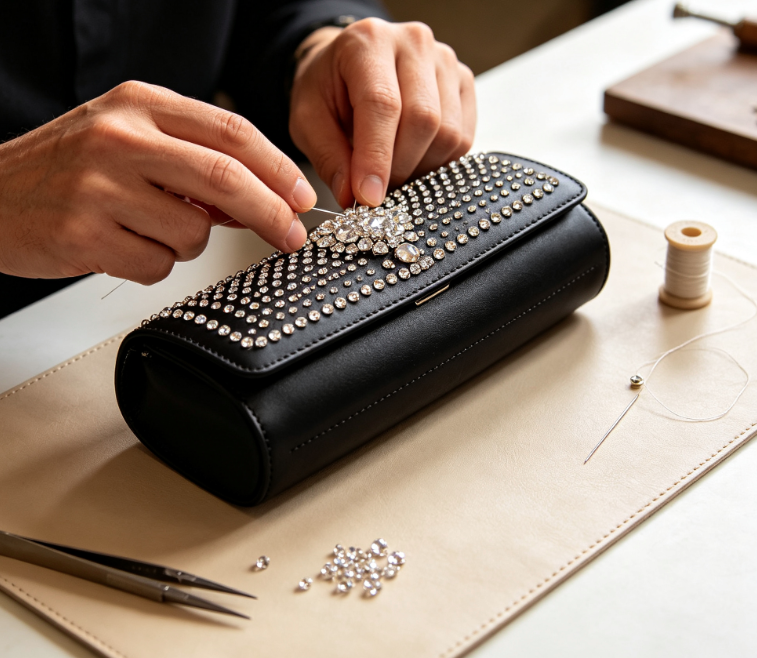
The range is enormous. A high-end beaded evening clutch might carry 2,000 to 8,000 individual beads across its face. Full-coverage designs push past 10,000 pieces. At that density, the work isn’t decoration — it’s architecture.
Hand-Beading vs. Glue: The Difference You Can Feel
How each bead is attached tells you everything about the bag’s quality tier.
High-end construction uses a thread-and-knot technique. Each bead is strung, knotted, and locked with a back stitch. Turn the bag inside out and you’ll see clean, deliberate stitch lines — minimal glue, maximum structure. Glue accounts for more than 70% of the attachment in lower-quality bags. Bead loss risk jumps sharply at that point. That’s not an opinion — it’s an industry quality control benchmark.
Try this quick field test. Press one section of beading lightly with your fingertip. Quality work holds firm. Feel an entire row shift together? The foundation is glued, not sewn.
Embellishment Density & the Luxury of Restraint
More coverage doesn’t mean more luxury. The distribution of embellishment matters just as much as the total count.
High-end brands follow a 60–80% embellished surface with 20–40% intentional negative space. That open area isn’t emptiness. It’s where the metal frame, the leather edge, and the structural seam lines get to breathe and speak. Cover every centimeter and you flatten the visual hierarchy. The bag ends up looking busy, not rich.
There’s also a distance logic worth understanding:
-
At 1 meter: the overall pattern shape and brightest highlight points should read clearly at a glance
-
At 30 cm: the layered density, stitch direction, and bead variation reveal themselves
That two-stage reveal — strong silhouette from far, fine detail up close — is the mark of truly considered evening bag embellishments. You see something bold first. Then you get closer and find the craft.
How to Spot Low-Quality Surface Work
Three checks, thirty seconds:
Check the glue line. Hold the bag at a 45-degree angle under a light source. A well-made beaded evening clutch shows no visible adhesive ring around individual beads. Hardened glue residue wider than 0.2mm is a red flag. Budget construction often leaves rings of 0.5mm or more — visible without magnification, no tools needed.
Check the thread ends. On the front face, no thread tail should exceed 3mm. On the interior lining, look for knotted or back-stitched ends. A clean cut with no knot means the thread can travel. Beads will follow.
Check the edges. Near the flap fold and side seams, beadwork on quality bags tapers on purpose — density reduces as it reaches structural stress points. Beads that run straight to the edge with no transition are almost always glued. That edge is where failure starts first.
The surface of a high-end clutch bag rewards a close look. It’s where luxury bag craftsmanship either proves itself — or quietly comes apart.
Quick Buying Checklist: How to Spot a Luxury Evening Clutch at a Glance
Five details. Thirty seconds. That’s all it takes to read a clutch’s quality tier — you just need to know where to look.
Run through these five checks before you buy:
1. Test the hardware first. Lift the bag by its chain or strap. Luxury hardware feels cool, solid, and a touch heavy. A hollow, tinny rattle means the chain is lightweight plated metal — and it will show. Open and close the clasp three times. It should click shut with firm, consistent resistance and zero wobble.
2. Read the material. Real leather shows natural grain variation — no two sections look identical. Quality satin spreads light across its surface in one even glow. Sharp, plasticky shine or bright concentrated spots? That’s synthetic fabric.
3. Check the stitching in three places: side seam, flap edge, bottom corner. Good luxury construction runs at 8–10 stitches per inch. The thread sits recessed into the material, and the spacing stays even around curves. Crooked stitches at corners are the first sign of cost-cutting.
4. Set it down and look straight at it. Edges should be sharp and even. The flap line should run parallel to the base. Any tilt or soft bulging points to lower structural precision.
5. Count the design elements. One or two strong details — a sculptural clasp, rich fabric, precise crystal work — reads as intentional and refined. Too many competing elements at once (heavy studs plus sequins plus oversized logo) kills the luxury feel fast.
Price Tier vs. What to Expect
|
Price Range |
Materials |
Hardware |
Overall Impression |
|---|---|---|---|
|
$50–$150 |
Faux leather, polyester satin |
Light, basic clasp |
Stylish from a distance; reveals price up close |
|
$150–$500 |
Real leather, better satin, suede |
Solid feel, smoother mechanism |
Refined enough for most events |
|
$500+ |
Nappa, silk, exotic skins, plexi |
Custom signature clasp, weighted chain |
Reads as luxury — in person and in photos |
Match your expectations to the price tier. A $200 clutch with good leather and clean stitching will outperform a $400 bag with glued embellishments and hollow hardware every time. The details above don’t lie — regardless of what the price tag says.
Common Mistakes That Make an Evening Clutch Look Cheap
Knowing what makes a clutch look luxurious is half the equation. The other half is spotting what destroys the illusion — even on a bag with an impressive price tag.
These are the details that read as cheap, fast.
Hardware That’s Too Shiny and Too Light
Mirror-finish gold plating sounds elegant in theory. In practice, it reflects light like plastic wrap. That sharp, almost yellow-gold brightness registers as budget the moment you see it. A hollow-feeling chain makes it worse.
Do a quick weight check. Quality small-format evening clutch hardware (chain plus clasps combined) falls in the 40–80g range. Below that, it feels like a costume accessory, not a formal one. Run your finger along the back and sides of any clasp. Rough edges, visible seams, or unpolished surfaces mean the detail work stopped where no one was supposed to look.
Fix it: Choose brushed or matte metal finishes. Skip large areas of mirror gold.
Logo Overload
A clutch covered in repeated brand letters or monogram-style prints doesn’t read as luxury. It reads as trying too hard. Real luxury brands keep external logos to less than 3–5% of the front face. Some skip them on the outside and use an interior stamp you only see with the bag open.
A design that mimics a recognizable luxury brand at a fraction of the price — that shortcut shows. Every time.
Lining That Doesn’t Match the Outside
Open the bag. A sleek black exterior leading to a bright red or neon-pink interior with thin, see-through fabric — that breaks the illusion on the spot. Clutch bag lining quality matters more than most people expect. Anyone standing next to you at an event will see inside it at some point.
Good lining uses a tonal match or low-contrast transition:
– Black exterior → charcoal or dark grey interior
– Champagne exterior → soft beige interior
The fabric should be dense. Press a fingertip against it — no light should come through the other side.
Zipper and Closure Problems
Test any zipper at least five times, back and forth. One snag, skip, or audible catch is a red flag. Clutch bag closure types that feel off — magnetic clasps that pop open with a light shake, frame closures that need force to shut, frame edges that don’t meet flush — all point to the same problem. The engineering stopped at the surface you can see.
Embellishment That Doesn’t Stay Put
Shake the bag gently. Run two fingers across the beaded or crystal surface. Anything that shifts, flakes, or transfers onto your fingers means the stones are glued, not sewn. Glue won’t hold through a full evening. Look for uneven crystal spacing, visible glue rings around individual stones, and missing pieces near fold points. These details look fine in a product photo. They fall apart in real use.