Why Spain Is a Global Hub for Custom Leather Handbag Manufacturing
Hermès, Chanel, Gucci — and a small Andalusian town of fewer than 17,000 people. That’s the story of Ubrique. It’s the beating heart of Spain’s leather goods industry and one of the most powerful luxury manufacturing clusters on earth.
Leather craftsmanship took root in Ubrique back in the 18th century. Family workshops have passed their skills down through three or four generations of artisans. They’ve spent centuries perfecting the kind of detail work luxury labels demand: hand-applied edge paint, internal structural reinforcement, and 20–40 separate production steps per bag.
The results are hard to argue with. Between 2009 and 2015, leather exports from Cádiz province more than tripled. This happened even as Spanish manufacturers faced intense cost pressure from Asian competitors. Their survival strategy? Stop competing on price. Focus on premium and luxury — where buyers care about craftsmanship, not just cost.
That positioning makes Spain a strong choice for brand founders and OEM buyers today:
-
Ex-factory costs of €80–€200 per unit for full-grain leather structured handbags — well below comparable Italian production, with no compromise on EU-regulated materials or craft standards
-
8–12 week production lead times for custom small-batch orders, with prototype development in 4–8 weeks
-
REACH-compliant leather sourcing from EU-regulated tanneries — essential for brands selling into European and North American retail
-
A tight cluster of specialized factories that handle pattern development, custom hardware coordination, and full collection production under strict NDA
Polène Paris built its entire brand around this ecosystem. Its founders visited an Hermès workshop in Ubrique in 2016, and the brand grew from there. Strathberry positions its Ubrique-made bags as a direct premium alternative to mass-market production. Spain isn’t just a manufacturing option. For the right brand, it’s a real competitive edge.
Qfactory — Best for Startups & Small-Batch Custom Leather Handbags (Ubrique)
Most Ubrique factories will turn you away if your order is under 150 units. Qfactory won’t.
Qfactory is based in Ubrique and runs a no minimum quantity policy. That’s rare. Standard MOQs in this market run 50–200 units for basic styles. Complex custom work pushes that to 500–1,000+ units. Qfactory sits outside that norm entirely. For startups and independent designers, this matters a lot. You can test multiple designs, leathers, and colorways before scaling. No need to lock up your whole inventory budget upfront.
Who this works best for:
-
DTC brands validating demand before a full production run
-
Independent designers who need artisan-quality fabrication at small volumes
-
Limited-edition launches that can’t justify factory-standard MOQs
The Ubrique origin adds real brand value too. A Made in Spain / Made in Ubrique label supports premium positioning. It also gives you solid ground to justify higher retail prices.
Before committing, confirm these details with Qfactory:
-
Whether the no-MOQ policy covers all styles and materials
-
Lead times for 1–10 pc samples, 20–50 pc test drops, and 50–200 pc first runs
-
The full OEM/ODM workflow from pattern making through bulk production
-
Leather sourcing details and REACH compliance documentation
Montecapri — Best for Premium Brands Needing Cross-European Development Support
Montecapri runs production facilities in two of Europe’s most respected leather goods clusters — Ubrique, Spain and Scandicci, Italy. That dual-site setup isn’t a marketing angle. It’s a practical tool for brands that need both cost efficiency and a credible luxury image within the same collection.
Here’s how it works. Ubrique handles volume SKUs and cost-sensitive styles (ex-factory ~€40–80 for a mid-size full-grain bag). Scandicci takes the flagship pieces that need complex construction or a Made in Italy label — at 15–30% higher cost. Use both lines together, and you cut overall collection COGS by 10–20%. Your brand’s European positioning stays intact.
What makes Montecapri worth considering:
-
Integrated development team — Pattern designers, model makers, and production engineers work under one roof. This compresses new-style development to 6–10 weeks. Compare that to the 12–16 weeks you’d face with those roles split across separate vendors.
-
Pilot-friendly MOQ — Development runs start at 20–50 pcs per style. Standard collections run at 100–500 pcs.
-
Eco-premium capability — Upcycled marine plastic substrates are available for sustainability-focused lines. This adds ~5–15% to material cost, but retail margin potential goes up by a clear margin.
Best fit: premium brands moving away from Asia-based OEM toward European origin, or established labels building capsule collections that need Italy’s prestige and Spain’s production economics — all through one partnership.
Piñaval — Best OEM Partner for Luxury & High-End Fashion Brands in Spain
Piñaval built its reputation on one thing: making leather handbags and small leather goods for high-end fashion and luxury brands. Not as one-off projects — as a long-term OEM partner, run after run.
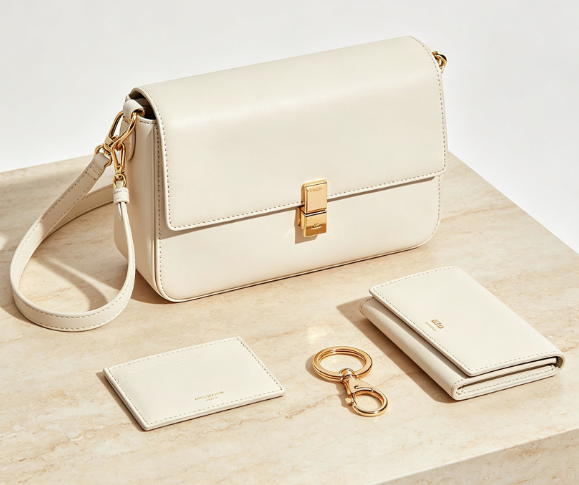
That track record sets Piñaval apart from factories that only dabble in the luxury segment. Their full workflow — from design intake to mass production — stays inside Spain. You get a real “Made in Spain” label, backed by actual substance.
Where Piñaval fits in your sourcing decision:
-
MOQ: 50–150 pcs per color for new models; ongoing styles scale to 1,000–3,000 pcs per year
-
Best-fit clients: Established luxury houses and DTC brands that need strict QC and close design collaboration — from first sketch to pre-production sample
-
Quality benchmarks: AQL 1.0–1.5, edge paint at 3 coats minimum, handle pull resistance over 200N
-
Lead time: 6–10 weeks from first prototype to production-ready sample
Montecapri focuses on cost optimization. Piñaval goes after higher per-unit-value bags with tighter craftsmanship standards. So if brand positioning drives your sourcing decision — not price — Piñaval is the stronger match.
Ubrique Leather Cluster — Spain’s Artisan Manufacturing Hub for Global Luxury Brands
Fewer than 17,000 people live in Ubrique. Yet this small Andalusian town supplies Louis Vuitton, Gucci, Hermès, Chanel, Chloé, Loewe, and Carolina Herrera. BBC reporting confirms that more than half of Ubrique’s residents work in the leather trade. No other town in European manufacturing packs this level of skill into one location.
This isn’t mass production. Ubrique’s edge is precision craftsmanship at premium specification. Global luxury houses cannot replicate this work elsewhere — not at any price.
For OEM buyers, the cluster gives you a clear entry point:
-
Direct factory outreach — connect with Ubrique-based manufacturers for sampling and full production runs
-
No-minimum prototyping — select workshops take on small runs, perfect for capsule launches or market validation
-
“Made in Ubrique” provenance — a real brand-building asset, not just a label on a tag
Polène credits its Ubrique production base as core to its brand identity. That’s the kind of sourcing signal worth paying attention to.
Sema Leather Goods — Proven Manufacturer Behind Contemporary Designer Handbag Brands
By Far’s Mini, Maya, and Martin bags are three of the most recognizable silhouettes in contemporary fashion. Sema Leather Goods makes all of them. That one fact tells you exactly where this Spain-based manufacturer sits in the market.
Sema focuses on small leather goods and handbags. Their sweet spot is structured, design-forward pieces for contemporary brands in the $300–$900 retail price range. You get clean lines, precise edge finishing, and consistent production quality across seasonal runs. Not ultra-luxury work. Not volume fast fashion. Right in between.
Practical specs for new brand inquiries:
-
MOQ: ~80–150 pcs per colorway for handbags; 150–300 pcs for small leather goods
-
Sample lead time: 1–1.5 weeks from complete tech pack submission
-
Production lead time: 6–8 weeks from sample approval to delivery
-
Best fit: Contemporary designer labels, private label buyers, mid-to-premium DTC brands needing European origin credentials
Come with a full tech pack. Sema charges per-style development fees, as most comparable Spanish OEM factories do. A portion of those fees offsets against your production order.
Iscatrade — Best for Scalable Production Volume in Spain’s Industrial Manufacturing Belt
Ubrique gets the luxury headlines. But your brand may need something different — consistent, high-volume output with solid industrial reliability. That’s where Spain’s Valencian manufacturing belt comes in. Iscatrade sits right at its center.
Iscatrade brings 20+ years of experience making fashionable, casual, and luxury bags. They run as both a manufacturer and wholesaler. That dual role gives you real flexibility. You can place custom OEM orders for core styles. Or you can pick up wholesale stock for seasonal or trend-driven SKUs. No full MOQ commitment is needed on every line.
Key specs for OEM buyers:
-
MOQ: 150–300 units/color for standard styles; 250–500 units for GRS-certified recycled material bags
-
Pricing: €12–18/unit (PU/mixed materials, small run); €25–40/unit (leather); 10–25% discount at 3,000+ unit programs
-
Lead time: 6–8 weeks after sample approval; 8–12 weeks for multi-model programs
-
Certifications: BSCI (social compliance) + GRS (Global Recycled Standard)
The industrial setting here is worth noting. Catalonia alone hosts 35,000+ industrial companies. Valencia and Catalonia both offer regional grants and strong cluster infrastructure. So manufacturers like Iscatrade can grow production capacity without the cost increases you’d see in smaller, artisan-focused regions.
Best fit: mid-market fashion brands, retail chains, and e-commerce labels. You need repeatable seasonal programs — 5–20 models, several thousand units per season. Everything stays under EU compliance standards.
PARIS/64 — Spain’s Ethical & Artisanal Handbag Factory for Value-Aligned Brands
PARIS/64 launched in 2019 with its own production facility in Illueca, Aragón. That setup gives the brand something most OEM factories simply can’t match: full, verifiable control over every step of production. For brands that need ESG credentials built into their supply chain — not just added as an afterthought — that’s a real advantage.
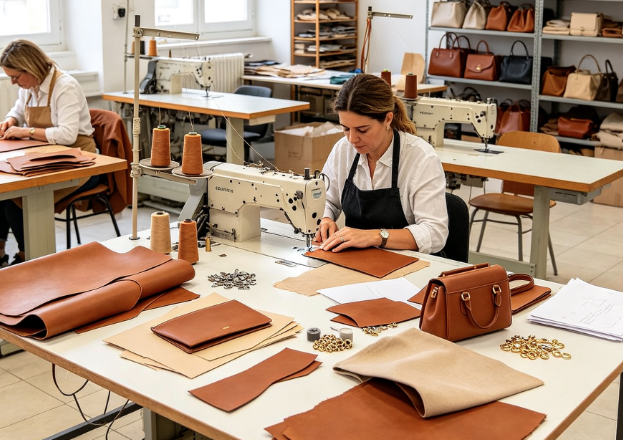
What sets PARIS/64 apart from standard Spanish OEM factories:
-
Owned production, no subcontracting — ethical labor standards apply at every level, with no third-party gaps
-
EU traceability certification covering threads, zippers, and structural reinforcements
-
Spanish Napa leather paired with stainless steel hardware and PVD/gold coating
-
Multi-material base construction built for shape retention and long-term durability — a deliberate step away from fast-fashion production logic
Ready to explore B2B collaboration? Confirm these details first:
– MOQ per model and material
– Private-label options and custom hardware engraving availability
– Leather origin documentation and EU traceability certificates
– Sample timelines and production lead times
Best fit: quiet-luxury DTC brands, slow-fashion labels, and premium private label buyers. These are brands whose retail positioning depends on proving responsible sourcing — not just saying it.
Strathberry’s Ubrique Partner Workshops — Handcrafted Luxury Bag Manufacturing with Heritage Storytelling
A Scottish label, family-run. Five workshops in a small Andalusian town. Every bag made by hand.
That’s Strathberry’s production model. It’s one of the clearest examples of how Ubrique-based manufacturing builds real brand equity.
All Strathberry bags come from five partner workshops in Ubrique. The brand calls these relationships a “partnership built on trust.” Workshop teams work as “an extension of the Strathberry family.” Each workshop runs the full production cycle — leather prototype sampling (salpas), full bag assembly, multi-stage QC, and post-sale repair services.
Craft standards B2B buyers can benchmark against:
-
Edge finishing: hand-painted in multiple coats, matching Ubrique’s standard for luxury-tier OEM production
-
Stitching: machine-locked main seams, with hand-reinforced stress points at handles, strap attachments, and drawstring openings
-
Hardware: brass or zinc alloy components with PVD or gold-plate coating, tested to 48–72 hour salt-spray standards
-
QC: multi-stage checks covering leather grading, hardware function, seam consistency, and final shape integrity — one team tracks each bag from start to finish
The heritage storytelling here is planned and repeatable. Strathberry’s content strategy links “Scottish, family-owned label” with “handcrafted in Ubrique, Spain” across every channel. That includes Schön! Magazine behind-the-scenes features and YouTube workshop documentaries. The outcome: origin turns into a conversion asset, not just a side note.
Independent brands looking at Ubrique OEM partnerships can learn a lot from this model. Entry MOQ runs 100–150 pcs/colorway. Select workshops accept 50–80 pc trial runs for brands that show long-term potential. Factory pricing for structured totes falls in the €70–150/unit range.
Smaller Studio-Factories & Boutique Workshops — Custom Micro-Batch & Capsule Collection Manufacturing
Spain’s boutique workshop scene fills a gap that large Ubrique factories don’t cover. These studios handle runs of 10–150 units, built around your exact design specs.
Studio-factories are spread across four cities. Each one has a clear focus:
-
Barcelona (Eixample, Born, Poblenou districts) — capsule collections and buyer-store exclusives for European fashion networks
-
Madrid — sample development, corporate gifting, and enterprise custom orders
-
Seville — traditional craft meets small-batch production; atelier-retail hybrid studios
-
Galicia (A Coruña) — pattern development, sampling, and capsule trial runs backed by strong textile infrastructure
Standard services cover custom colorways (3–10 variants), logo hardware (MOQ 200–500 pcs, split across styles to spread tooling costs), leather embossing, and laser-engraved metal plates.
Address these risks before you commit:
-
Get monthly production capacity confirmed in writing — most studios serve 5–15 brands at the same time
-
Add 20–30% time buffers to every milestone. A 6-week project? Plan for 8 weeks
-
Lock in a detailed Tech Pack at sample sign-off. This stops batch-to-batch quality drift
-
Ask for itemized quotes that break out tooling, labor, materials, and QC separately — micro-batch unit costs run 20–100% above standard factory pricing
For concept validation (10–50 pcs) or capsule launches (3–12 styles, 30–150 pcs each), these workshops handle work that large OEMs won’t take on.
How to Choose the Right Custom Handbag Manufacturer in Spain: A Buyer’s Decision Framework
Six criteria separate a reliable Spanish handbag manufacturer from one that costs you time, money, and market credibility. Work through each one before you commit.
MOQ Flexibility
Test whether a factory can match your actual order size — not their preferred minimum. For early-stage brands, look for factories that accept ≤30 pcs per style on trial orders. They should also leave room to scale MOQ on repeat runs. A factory that won’t discuss tiered MOQ structures is not a good long-term partner. That’s a clear red flag.
Service Scope
Look for factories that cover at least four of these six modules:
– Pattern development
– Sampling
– Material sourcing
– Internal testing
– Bulk production
– Export logistics
Fewer than four means you fill the gaps yourself. That adds weeks and real risk to your timeline.
Leather Grade & Certification
Confirm the factory sources full-grain or top-grain leather. Ask for LWG-certified tannery documentation to back it up. Get itemized leather pricing with the tannery name included. A reasonable benchmark sits at €12–€30 per sq ft.
Verified “Made in Spain” Status
Ask for the factory’s CIF/NIF registration. Check that the production address matches the registered address. Some EU-registered trading companies outsource production outside Spain while still marketing “Spanish design.” That label won’t survive retail scrutiny — so verify it early.
Lead Time Commitments
Sampling should run 2–4 weeks. First production runs of 50–150 units take 6–10 weeks. Get specific week counts in writing — not rough estimates. Also build penalty clauses into contracts for delays beyond two weeks.
Price Bracket Alignment
Match the factory tier to your retail positioning. For €150–€250 retail, target EXW pricing of €30–€60. For €400+ luxury positioning, budget €80–€150 EXW. Spain carries a 20–40% cost premium over comparable Asian production. That premium buys origin credibility and EU compliance — not just craftsmanship.
Spain vs. Italy vs. China: Which Country Should You Source Custom Handbags From?
Three countries dominate global custom handbag sourcing. Each serves a different brand goal — pick the wrong one, and you lose margin, credibility, or both.
|
Spain |
Italy |
China |
|
|---|---|---|---|
|
Best for |
Mid-premium, European origin |
Luxury prestige, heritage |
Cost, speed, scale |
|
Target retail |
US$150–500+ |
US$500–2,000+ |
US$30–300+ |
|
Key advantage |
European-made at lower cost than Italy |
“Made in Italy” as a marketing asset |
Lowest COGS, fastest sampling |
|
Main risk |
Less prestige signaling than Italy |
Highest labor cost |
QC and IP exposure |
Here’s how to decide:
-
Choose Spain — your retail target is mid-premium. You want European manufacturing credibility. Italian-level labor costs would crush your margin. Spain solves all three.
-
Choose Italy — craftsmanship is your brand story. Your customer pays a real premium for heritage. The “Made in Italy” label does the selling for you.
-
Choose China — low COGS and fast scale are the priority. Put serious resources into QC controls and airtight NDA agreements. That investment protects you.
Spain prices below Italy at the consumer level — 21% VAT vs. Italy’s 22%, plus a higher refund rate. That gap comes from a real structural difference in factory economics. It’s not a perception thing. For DTC brands and contemporary labels, Spain gives you the European origin story without hitting Italy’s price ceiling.
Bottom line: Spain = best-value European source. Italy = strongest prestige. China = best cost-speed-scale equation.
FAQ: Custom Handbag Manufacturing in Spain — What Buyers Ask Most
These are the questions sourcing managers and brand founders ask most — answered here, straight to the point.
What’s the minimum order quantity for Spanish handbag manufacturers?
It depends on factory type. Ubrique artisan workshops (like Qfactory) often have no formal MOQ. Standard industrial factories require 200–500 pcs for simple customization. Complex work involving custom hardware or special leathers pushes that to 500–1,000+ pcs. Also, ask whether MOQ is defined per style–per color or combined across shared components. That distinction changes your budget planning.
How long does a full custom order take — from NDA to delivery?
Simple designs with small runs: 8–10 weeks to EU delivery. Full custom orders with design iterations and specialty sourcing: 12–16 weeks. Get a written milestone schedule. It should cover the first sample, revision windows, production start, and estimated ship date. A rough verbal estimate is not enough — push for something on paper.
Which value-added services should I expect?
Most Spanish OEM factories include:
– Pattern making
– Sampling
– Basic private-label branding
Packaging (dust bags, branded cartons), compliance documentation (REACH certificates, LWG tannery records), and logistics coordination are usually add-ons. Confirm what’s bundled before you compare quotes. Two factories with similar prices can look very different once you break down what each one actually includes.
How do I verify a factory manufactures in Spain?
Ask for the factory’s CIF/VAT registration with a Spanish address. Check that the origin appears on both the commercial invoice and the customs export declaration. For high-value orders, go further. Third-party audits from SGS, Bureau Veritas, or Intertek give you solid proof. An on-site visit to Ubrique is even better — you see the operation firsthand and remove any doubt.