Why Source Custom Handbags from Portugal: Craft Heritage and Real Cost Advantages
Banana Republic already knows. So does Ideal & Co. Family-run workshops in Guimarães have been producing leather goods for international brands since 1945. The infrastructure built around that heritage is what makes Portugal a strong choice for custom handbag sourcing today.
The Craft Foundation Is Real
Portugal’s leather industry isn’t concentrated in one city. It runs across a network of specialized hubs:
-
Guimarães & Porto — the core of handbag and accessories manufacturing
-
Alcanena — Portugal’s primary tanning center, known for both vegetable and chromium tanning, with a growing number of LWG Silver/Gold certified tanneries
-
São João da Madeira — a skilled artisan base that combines traditional craft with modern design capability
Bags are the most manufactured leather product in Portugal’s entire leather sector — ahead of small leather goods and belts. This isn’t a secondary category. Portuguese factories have put their deepest expertise here. That focus matters when you’re sourcing at scale.
The Cost Math Works
Farfetch founder José Neves said it straight: Portugal offers quasi-Italian quality — often using the same Italian and French materials — but at a much lower cost. Here’s what the numbers look like:
-
Portuguese manufacturing labor runs 30–50% lower than Italy for comparable leather goods work
-
Spain’s Ubrique cluster runs 10–20% higher than equivalent Portuguese workshops, pushed up by luxury brand concentration
-
Italian and French hides, hardware, and trims reach Portuguese factories in about 3 days — so material quality stays high while labor cost stays competitive
The result is a position that holds up under scrutiny — Italian-material quality, Portuguese labor cost.
Low MOQs Change the Risk Profile
Portugal’s leather industry runs on small-scale factories. That structure gives emerging brands a real edge:
|
Sourcing Location |
Typical MOQ (handbags) |
|---|---|
|
Portugal small factories |
30–100 units/style |
|
Italian premium factories |
100–300+ units/style |
Smaller first runs mean less capital tied up in untested inventory. You can launch more SKUs at once. Once a style proves itself, you scale to 200–500 units with the same factory relationship already in place.
Sample turnaround is faster too — 4–6 weeks at most Portuguese facilities, compared to 8–12 weeks at Italian counterparts.
“Made in Portugal” Carries Real Brand Value
The label does more than tell you where the bag was made. Portuguese-made leather bags sit in a clear pricing window:
-
“Made in Europe” origin supports price premiums of ~10–30% versus non-EU equivalents
-
Portuguese-made bags retail in the €180–€450 range — versus comparable Italian-made bags priced at €350–€800
-
The cost-to-image ratio stands apart: production costs closer to Eastern Europe, image capital closer to Italy and Spain
For brands building a mid-premium narrative, that gap is the commercial opportunity.
Sustainability Credentials Are Built Into the Supply Chain
Portugal’s sourcing ecosystem lines up with the ESG requirements that B2B buyers now treat as non-negotiable:
-
Alcanena’s vegetable tanning expertise supports REACH compliance and chrome-free or chrome-reduced leather sourcing
-
You get access to LWG-certified tanneries — both local and Italian — with no added logistics complexity
-
EU labor standards, wastewater treatment compliance, and hide traceability documentation come standard across established factories
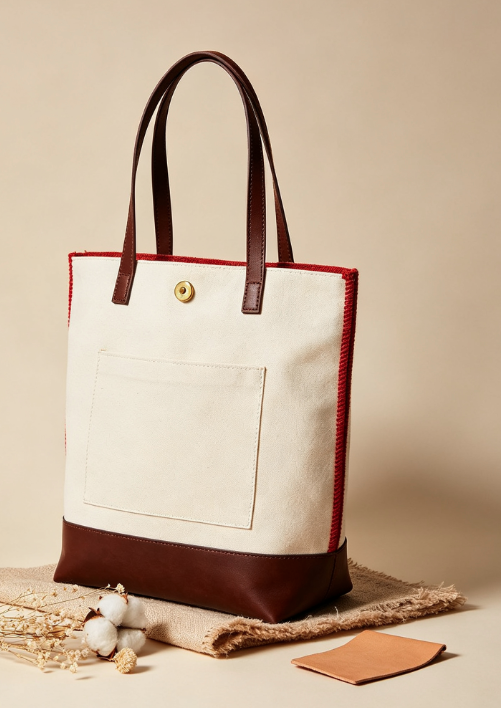
Brands like Ideal & Co use this to their advantage. They position their Portuguese-made bags around handcrafted vegetable-tanned leather and selvedge canvas as a concrete, verifiable sustainability story. That’s not marketing language. It’s a supply chain you can document and report on.
How to Evaluate a Portuguese Handbag Factory Before Reaching Out (Selection Criteria)
Most sourcing mistakes happen before the first email is sent. A few quick checks upfront save you months of wasted development cycles.
MOQ Alignment: Your First Filter
Match the factory tier to your actual order size first:
-
Boutique/atelier: 20–50 pcs/style — right for prototypes and limited drops
-
Small–medium factory: 50–100 pcs/style — the sweet spot for emerging brands
-
Industrial scale: 300–500+ pcs/style — for brands at replenishment stage
Don’t just ask for the headline MOQ. Ask by material. Leather handbags and canvas totes often have different minimums at the same factory.
Sampling Speed and Cost
Expect 10–15 days per round for simple styles. Structured leather bags take up to 21 days. Budget €80–€300 per style per round, based on complexity. New partnerships need 2–3 approval rounds before bulk orders begin.
Send these three questions in your first outreach:
– What’s your standard sampling lead time for a basic bag versus a complex leather style?
– How many rounds does a new client need to reach final approval?
– Is the sample charge refundable against bulk — and at what percentage?
Certifications to Pre-Screen
Check the factory’s website or profile for these before making contact:
-
ISO 9001 / ISO 14001 — quality and environmental management baseline
-
LWG certification — for leather traceability and environmental performance
-
OEKO-TEX STANDARD 100 — for linings and skin-contact components
-
REACH compliance statements — standard across Portugal’s established sector
No certificates listed? Ask for third-party audit reports (SGS, Bureau Veritas, or Intertek) and check the current certificate expiry dates.
Real Factory vs. Trading Company
A factory can walk you through its own process flow. A trading company cannot.
Ask for:
– Business license with manufacturer activity listed
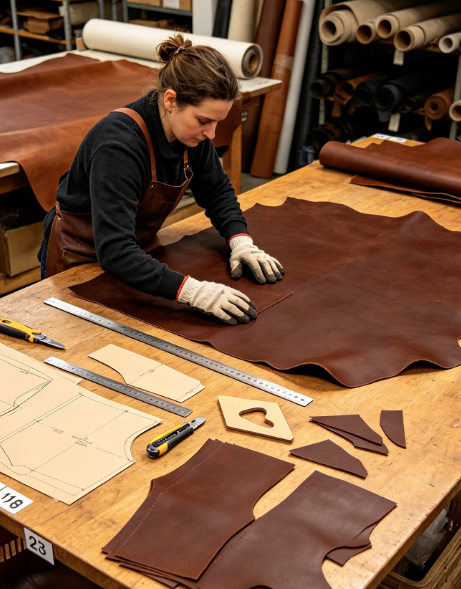
– Line photos — cutting tables, stitching machines, packing area — not showroom shots
– Capacity figures by product category, per month
– A clear list of in-house steps versus outsourced processes
Vague answers on technical details or capacity numbers? You’re talking to a middleman.
Total Cost, Not Just Unit Price
Compare factories across five cost elements: unit ex-factory price, sampling cost per style, packaging cost, payment terms impact on cash flow, and lead time in weeks. Look at all five together — not one by one. A factory priced 15% higher per unit but shipping three weeks earlier can lift sell-through and cut markdown risk. Build that into your evaluation scorecard before you shortlist.
1. Belcinto — Established Volume Producer for Classic Leather Handbags
Founded: 1961 | Location: São João da Madeira | Employees: ~82 | Type: Small-to-mid industrial manufacturer
Six decades of leather goods production. That’s the track record Belcinto brings.
São João da Madeira has deep roots in Portugal’s leather craftsmanship tradition. Belcinto started with leather belts and grew from there. Today, the product range covers travel bags, school bags, handbags, wallets, hats, and leather accessories. That range is useful for brands. You can build a full leather goods lineup with one supplier instead of splitting development across several factories.
With 82 employees, Belcinto sits in the small-to-mid industrial band. It handles consistent seasonal programs well. It’s not set up for large commodity bulk orders.
Best for: Heritage-positioned brands sourcing classic leather handbags alongside wallets and accessories.
For new partnerships, start with wallets or small leather goods first. This lets you check quality and finishing before moving into handbags and travel bags.
2. Olhamar Factory, LDA — Structured Women’s Handbags with Decades of Precision
Founded: 1972 | Location: Benedita, Leiria | Employees: 20–49 | Type: OEM / Private Label
Olhamar has over 50 years of non-stop leather goods production. That’s not a marketing claim — it’s just the record. José Jacinto Ramalho started the factory in 1972. It’s now in its third generation of family ownership. In 2023, the team rebranded as Olhamar Factory and moved into newer facilities to grow its international client base.
Their main product range covers structured women’s handbags, lady bags, briefcases, belts, and small leather goods. The real strength here is clean, geometric construction — panel-based builds with tight edge finishing and consistent stitching. You’ll find boxy totes, business briefcases with reinforced handles, and formal lady bags built to hold their shape. This is OEM production to client tech packs. Not off-the-shelf, not ready-made.
MOQ benchmark: 50–150 pcs/color for handbags and briefcases. Pattern development takes 2–4 weeks. Sampling runs 4–6 weeks. European delivery averages 4–8 weeks after confirmed purchase order.
Best for: Design-driven brands building structured women’s collections or business bag lines at medium batch volumes. EU-origin manufacturing is a clear advantage here.
Kick off your outreach by asking for portfolio samples of their lady bags and briefcases made for current clients. That gives you a direct look at finish quality and how they handle structural details.
3. Marta Ponti — Premium Mass-Market Handbag Manufacturer for Retail Chains
Founded: 1965 | Location: Amadora, Lisboa | Employees: 25+ | Type: Own Brand + OEM / Private Label
Marta Ponti has been producing leather goods in Amadora for sixty years. That track record is what they bring to retail chain partnerships.
The brand started with Italian vegetable-tanned leather, made in Portugal. That same material still defines the line today — mass-premium positioning, not high-end fashion. Consumer retail prices run €80–€220 per bag. That’s the right range for department stores and regional chains that need steady quality without luxury-level pricing.
Here’s what the OEM profile looks like for buyers:
-
MOQ benchmark: 100–150 units/SKU/color — works well for chain programs, less practical for micro-brands
-
Private label capacity: design adaptation from existing MP patterns; around 5–15 new SKUs per season
-
Replenishment lead time: 6–10 weeks for reorders; 10–14 weeks for initial orders, including material procurement
-
Defect rate: under 2–3% at final QC — a process-consistency advantage over smaller workshops
-
Customization scope: color, hardware finish, logo application, and minor pattern tweaks — not full custom construction
Retail chain compliance is already built into how they operate. Packaging meets standard EU retail norms: polybag plus tissue, foam-protected handles, 5–10 units per carton with SKU/EAN/PO labeling. Swing tags include material composition and “Made in Portugal” origin marking. They also hold a formal warranty policy, so defect-handling documentation is ready to go — exactly what retail buyers need.
Best for: Regional retail chains, department stores, and distributors sourcing classic leather handbags and business bags at mid-to-upper-mid price points with dependable seasonal replenishment.
Contact: Rua Carlos Duarte Caneças 18-A, 2700-163 Amadora, Lisboa | +351 21 498 9740. Start by asking about OEM capacity share, available standard models, and REACH compliance documents for their Italian leather sourcing.
4. Maria Maleta — Small-Batch Artisan Leather Handbags for Emerging Brands
Founded: ≈2014 | Location: São João da Madeira | Type: Artisan brand / white-label capsule | MOQ: 20–50 pcs/style
Two friends. One hot summer afternoon. A shared frustration with bags that didn’t last. That’s the origin story behind Maria Maleta — a women-led leather goods workshop. Ana Neto and Daniela Marques founded it in São João da Madeira, the heart of Portugal’s footwear and leather trade.
The production stays small by design. Core team of 2–3 people. Every bag is cut, stitched, and edge-finished by hand. No synthetics — 100% genuine leather, sourced from the same suppliers that serve Portugal’s footwear industry. That detail matters for durability. Footwear-grade cowhide holds up to 30,000+ flex cycles. A handbag made from the same material can last 5–10 years with normal use.
For emerging brands, the numbers work:
-
Retail range: €60–€190 per bag
-
B2B ex-factory price: €24–€80/unit, based on complexity
-
MOQ for a new custom style: 20–50 units total — or ~10–20 units per colorway across 2–3 options
-
Sampling lead time: 2–4 weeks for an initial prototype, plus 1–2 revision rounds before production starts
Their past collaboration with artist ELLEONOR shows how this plays out. The capsule used custom colorways and built a female friendship narrative around it. They shaped existing bag designs to fit the artist’s creative direction. The storytelling got as much attention as the product itself.
That’s the real value for sourcing-minded brands. You get more than a manufacturer — you get a content-rich production partner. Behind-the-scenes footage of leather selection, pattern cutting, and hand-stitching in a 2–10 person workshop gives your brand a premium narrative. A large OEM factory can’t offer that.
Best for: Emerging brands building a “Made in Portugal, small-batch artisan” story — those targeting the €130–€180 accessible-premium retail window in particular.
5. Naditum — Boutique-Scale Contemporary Bag Production in Porto
Founded: 2015 (first products launched 2018) | Design: Munich, Germany | Manufacturing: Single family workshop near Porto (est. 1984) | Type: Boutique brand / micro-collab partner | MOQ: 10–50 pcs/variant
German designer Malin Bernreuther took three years to build her Porto production setup before one bag hit the market. That gap — 2015 to 2018 — wasn’t a setback. It was a choice. She ran prototype after prototype, tracked down the right materials, and built a real working relationship with one small family workshop near Porto that has been running since 1984.
Every bag Naditum produces comes from that one workshop. Vegetable-tanned leather. Clean, minimal silhouettes. Product names pulled from Babylonian goddesses. The brand holds a sharp, consistent identity — and for sourcing-focused brands, that consistency is what makes a low-volume collab actually work.
Working numbers:
– Pilot collab: 10–30 units/variant, total 30–80 units
– Full small collection: 80–200 units across 2–4 SKUs
– Ex-factory price: €60–€180/unit (≈30–40% of retail)
– Design + sampling: 6–10 weeks | Production: 4–8 weeks after approval
Best for: Brands that want minimalist, story-led positioning at small batch scale. This fits well if you can use the German-design-meets-Portuguese-craft origin story as part of your brand narrative.
6. Ideal & Co — Heritage Artisanal Production for Storytelling-Driven Luxury Brands
Founded: 2012 (tannery heritage since 1959) | Location: Vila Nova de Gaia, Porto | Type: Heritage artisan brand / white-label capsule partner | MOQ: 20–50 pcs/style
The grandfather opened Fábrica de Curtumes Ideal in 1959. Sixty-three years on, Rute Vieira and José Lima took that tannery legacy and built Ideal & Co from it. The result is a 100% Portuguese vegetable-tanned leather accessories brand. It stands on one idea: genuine craft deserves to be preserved, reinterpreted, and shared.
That multigenerational story is the real sourcing asset here. Not just the leather. Not just the location. The story density per product is exceptionally high. For luxury brands that sell narratives as much as objects, that’s a concrete commercial edge.
What makes their production distinctive:
-
Vegetable tanning only — a 30–60 day process, compared to 1–2 days for chrome tanning. It’s slower, more costly, and traceable back to local Portuguese tanneries
-
Hand-burnished edges, manual pattern cutting, hand-stitched reinforcements — standard practice across their backpack and travel goods range
-
Leather thickness: 1.6–2.4 mm for structural pieces. It develops a personal patina over 5–10 years of use
-
Single-country supply chain: Portuguese hides, local tanning, local assembly. Every step is documentable for brand marketing and ESG reporting
The capsule math works for storytelling-driven brands:
|
Product |
Ex-Factory |
Retail |
|---|---|---|
|
Heritage travel backpack (18–22 L) |
€120–€180 |
€490–€750 |
|
Daily messenger bag (8–12 L) |
€80–€130 |
€350–€550 |
|
Small leather goods (wallet, passport holder) |
€20–€40 |
€90–€190 |
A first run of 50–80 units per SKU — total 200–320 units — is a realistic starting point. Numbered limited editions of 50–150 units suit this workshop’s scale and working ethos well.
The risk profile is real, and manageable. Output runs 80–250 bags per month, depending on complexity. One artisan handles critical steps — so illness or departure cuts capacity by 30–50% fast. Vegetable-tanned leather lead times add another 3–6 weeks to your planning buffer.
Handle this with a clear structure. Split deliveries into 50+50 unit batches. Lock a golden sample per style before bulk production starts. Also, provide a QC checklist that specifies 6–8 SPI stitch density, ±1–2 mm dimensional tolerance, and edge finishing criteria. This approach closes most of the quality variance gap. It does so without asking the workshop to change how it works.
Best for: Luxury micro-brands and storytelling-led labels building “heirloom” positioning around “vegetable-tanned in a family tannery founded in 1959, crafted by fewer than 10 artisans in Vila Nova de Gaia.” That single sentence can anchor a campaign, a packaging booklet, and a retail conversation.
7. Gentil Elenco — Flexible Mid-Size Custom Handbag Programs for Growing Brands
Type: OEM / Custom Development | Location: North Portugal | Focus: Cork & leather fashion accessories | Positioning: Sustainable materials, flexible mid-size programs
Cork and leather. That material pairing tells you a lot about where Gentil Elenco sits in Portugal’s accessories manufacturing scene.
Based in northern Portugal, Gentil Elenco builds fashion accessories around sustainable natural materials. Their focus is clear: rational resource use and pollution prevention. Your brand gets a verifiable supply chain to back up real sustainability claims — not just marketing language.
Where they fit in your sourcing strategy:
This program works well for brands in the growth stage. You’re past the prototype phase but not yet running industrial-scale replenishment. Here’s how the workflow runs:
-
Submit tech packs, style references, quantities per style/color, price targets, and delivery deadline
-
The factory checks feasibility and maps out the development scope
-
Small-batch sampling and pilot order
-
Approved sample lock
-
Mid-size production run — benchmark 6–10 weeks from approved sample to finished goods
-
Repeat orders with expanded colorways or material variants
Before you commit, verify these:
-
MOQ by style and by material type
-
Sample fee and sample turnaround time
-
Production capacity figures per month
-
QC process and defect handling steps
-
On-time delivery track record on comparable orders
Best for: Growing brands that want co-development flexibility, sustainable material options, and a factory ready to scale alongside them. Not a fit for brands that need large fixed-volume programs from day one.
8. Cintize — Leather Craftsmanship Specialist for Coordinated Bag and Belt Collections
Founded: 1988 | Location: Gondifelos, North Portugal | Type: OEM / Private Label | Specialty: Coordinated bag and belt collections
Cintize started as a belt factory. That origin matters more than it sounds.
Factories that build belts first develop skills most handbag producers simply don’t start with. You get obsessive edge finishing, tight skiving control, and hardware pull-testing that holds at 15–20 kgf without failure. All of those skills carry over to handbag shoulder straps, handles, and flap closures.
Why “bag + belt” sourcing from one factory makes commercial sense:
-
Same leather batch = color variance below ΔE 1.0–1.5. Split across two suppliers, and you’re looking at a 3–5% complaint rate
-
Unified hardware development cuts tooling costs by 20–30%. Two factories means two sets of tooling fees
-
Shipment gap between bags and belts stays within 0–3 days — that’s critical for coordinated window displays and launch events
The right brand fit: mid-size designer or accessory-driven labels buying 5,000–50,000 leather goods per year. You need 2–4 capsule sets per season where belts, bags, and small leather goods match in color, edge finish, and hardware style.
MOQ benchmark: ~50–100 pcs/style for bags; 100–150 pcs for belts. Combined set orders of 300–500 total units work well for first-season testing.
Best for: Accessory-led fashion brands that sell coordinated sets and need one production partner — not three — to lock in visual consistency across an entire collection.
9. Portugal Textile Bags Factory — Full-Service Custom Collection Development with Sustainable Innovation
Type: Full-service OEM/ODM | MOQ: ~100–300 pcs/style (textile); 250–500+ pcs (leather/technical) | Contact: [email protected]
One contact. One project manager. You get the full chain covered — design refinement, material sourcing, pattern development, sampling, production, and logistics — all under one roof. That’s the core offer here. It’s a real advantage for brands that don’t yet have a dedicated sourcing team.
The sustainable materials range stands out. You’ll find organic cotton canvas (GOTS-certified, 180–360 gsm), recycled rPET fabrics, LWG-certified leather, and cork. Portugal leads the world in cork production. This gives the factory direct access to cork sheets laminated locally (0.2–0.6 mm on textile backing). Competitors in other regions can’t source these as fast or as easily. Bio-based options like pineapple fibre composites are on the table too — though these work better for capsule runs than large-scale production.
Timeline benchmark: 2–4 weeks for prototyping, 6–12 weeks from approved sample to finished goods.
Go in knowing the trade-offs. FOB pricing runs 1.5–3× Asian benchmarks on basic canvas styles. Scaling fast beyond a few thousand units per style will need a bigger production partner. Also, in a full-service setup, the factory handles material selection — you get a curated list of vetted options, not open mill access.
Best for: New brands with no in-house sourcing team. Ideal if you need end-to-end support, solid sustainable material credentials, and a clear “Made in EU” supply chain story from day one.
Portugal vs Italy vs Spain: Where Should You Manufacture Custom Handbags?
Three countries. Three very different value propositions. The right answer depends on where your brand stands right now.
Here’s a decision framework built on real cost and production data.
The Numbers Behind the Choice
Labour cost is the clearest dividing line:
-
Portugal: €8–€14/hour for skilled leather workers
-
Spain: €10–€16/hour
-
Italy: €14–€20/hour
That gap hits your unit economics hard. A structured leather handbag with a Portuguese CMT cost of €20 would run €28–€34 at an Italian factory. Same materials, same complexity — 40–70% more expensive, purely from the labour difference.
MOQs follow the same pattern:
|
Country |
Typical MOQ (custom handbags) |
|---|---|
|
Portugal |
50–500 units/style |
|
Spain |
150–500 units/style |
|
Italy |
300–1,000+ units/style |
Match the Factory Location to Your Brand Stage
Early-stage brands testing the market should start with Portugal. MOQs around 50 units per style make small launches workable. Factor in EU import duties (6.5–9.6%) plus freight from Asia, and the landed cost gap versus Asian production shrinks to just 25–40%. At volumes under 300 units, that difference is often too small to matter.
Growth-stage brands scaling a proven collection have the most choices. Portugal still leads on cost and speed. Spain becomes a solid option if your brand story calls for a Spanish leather heritage angle. Italy makes sense at this stage only if you’re moving upmarket and your retail price can support it.
Mature luxury brands selling above €1,000 retail belong in Italy. The “Made in Italy” label supports price elasticity at that tier. For diffusion lines or sustainable capsule drops under the same brand group, Portugal handles those well — lower cost, no damage to your flagship positioning.
Where Portugal Pulls Ahead on Speed
Italy’s supply chain spreads across multiple regions. Tanning, cutting, hardware sourcing, and assembly often take place in different areas. That creates extra transport, coordination time, and delays. Portugal’s leather industry sits tightly clustered around Guimarães, Porto, and Alcanena. Production steps stay close together. That cuts lead times in ways Italian factories can’t match by structure.
Total cycle from first contact to delivery: 15–32 weeks in Portugal. Italian luxury handbag programs regularly run 6–9 months for the same process.
The One-Line Decision Filter
-
MOQ ≤100 units, retail €150–€400, EU origin required → Portugal
-
MOQ 150–500 units, retail €250–€700, European leather story → Spain
-
Luxury positioning, retail €1,000+, heritage narrative is central → Italy
How to Start Working with a Portuguese Handbag Factory: Step-by-Step Sourcing Roadmap
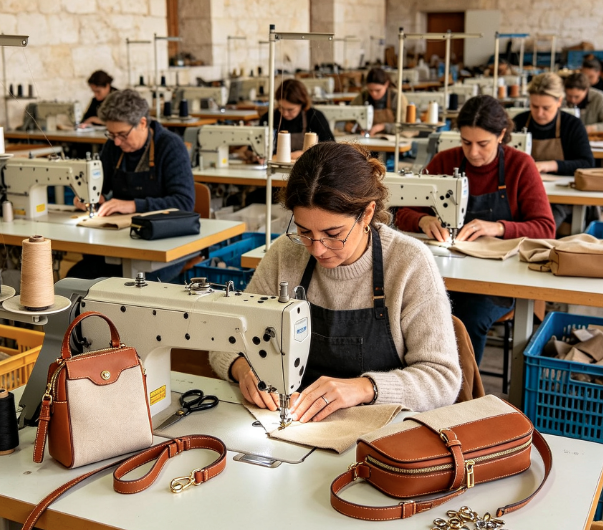
Six steps stand between a brand idea and finished bags on a Portuguese production line. Here’s how that process runs.
Step 1 – Build a Factory-Ready Tech Pack
Send vague references, get vague quotes. Portuguese factories move fast with complete specs in hand. Your tech pack needs:
-
2D drawings (front/back/side views)
-
Finished dimensions with ±2–3 mm tolerances
-
Material specs (e.g. full-grain calf at 1.4–1.6 mm)
-
Hardware list (zipper type, D-rings, studs)
-
Pantone color codes and logo placement details
-
Packaging specs
A leather handbag BOM usually covers 20–60 line items. Add your target FOB price with ±5–10% variance. This lets the factory check feasibility right away.
Step 2 – Send a Structured RFQ
Email your tech pack to the factory. Include:
-
Brand intro (2–3 lines)
-
Quantities per style and color
-
Material preferences
-
Target price range (e.g. €45–55/pc ex-factory)
-
Payment terms (30% deposit, 70% before shipment)
Expect a feasibility response within 2–5 business days.
Step 3 – Manage Sampling Rounds
Budget €80–200 per style for sampling fees. Plan for 2–3 revision rounds before final approval. Your key pass/fail criteria:
-
Dimensions within ±2 mm
-
Stitch density at 4–5 stitches/cm
-
Handles holding at least 8–10 kg load
-
Edge paint with no cracking at 180° bend
Push for 50–100% of sampling fees deducted from your bulk invoice. Get this agreed upfront before sampling starts.
Step 4 – Lock Down Your Contract
Attach three documents as binding contract annexes: the approved pre-production sample, the tech pack, and the materials list. Set clear terms on three points:
-
Acceptable defect rate: under 2–3%
-
Delivery window: 60–90 days after sample approval
-
IP clauses: block the factory from selling your design to other clients
Step 5 – Control First-Order Risk
Start your pilot batch at 100–300 units per style. Run QC across five checkpoints:
-
Material intake
-
Cutting
-
In-line assembly (at 20–30% completion)
-
Final inspection
-
Pre-shipment AQL 2.5–4.0
Scale to 2–3× volume after you confirm both sell-through rates and defect rates. Not before.
Step 6 – Track Factory Performance Over Time
Set clear benchmarks for each order cycle:
-
On-time delivery: ≥95%
-
Major defects on arrival: under 2–3%
-
Price variance across 12 months: ≤5%
-
Email reply time: within 24–48 hours
These numbers show you two things. First, whether the relationship is worth growing. Second, whether it’s time to look at other options.
FAQ: Custom Handbag Manufacturing in Portugal
Straight answers to the questions sourcing teams ask most.
What’s the minimum order quantity for custom handbags in Portugal?
It depends on the factory tier. Here’s a quick breakdown:
-
Small workshops and artisan studios: 50–150 pcs/style
-
Mid-size OEM factories: 150–300 pcs/style as standard
-
Industrial-scale producers (e.g., Vicbag): 300–1,000+ pcs
Custom hardware or non-standard leather colors push MOQs higher. You could be looking at 500+ units. This is due to material-level minimums set by suppliers.
Do Portuguese factories work with startups?
Many do. Small workshops are the most open to it. Show clear growth potential and a mid-premium price point that covers EU labor costs — that’s what gets them interested.
How long does sampling take?
Plan 3–6 weeks per round for most styles. Complex structured leather bags can run up to 6 weeks. Budget for 2–3 revision rounds before bulk approval.
How does Portugal pricing compare to Asia?
FOB prices run 30–50% higher than Chinese or Indian production at similar volumes. So what do you get for that? EU origin, lower defect rates, and a traceable supply chain. At retail, those advantages carry real commercial weight.